Most people picking a mesh router obsess over the headline Gbps figure on the box. That number is meaningless. What actually decides whether your home network copes is how the system handles backhaul between nodes, how many devices it can serve at once without choking, and whether the Wi-Fi standard you're paying for is one your actual devices can use. Get those three things right and you'll have a network that works. Get them wrong and you've spent a fortune on something your ISP router could've matched.
The ASUS ZenWiFi BT6 Tri-Band WiFi 7 Mesh is a two-pack premium mesh system sitting at the top of ASUS's consumer range. It's positioned as a serious upgrade for large homes, busy households, and anyone who's finally had enough of dead zones and buffering. At this price tier you're not just buying coverage, you're buying into Wi-Fi 7, tri-band architecture, and a feature set that most ISP-supplied kit wouldn't dream of. The question is whether all that actually justifies the spend, or whether you're mostly paying for specs your phone can't use yet.
Across dozens of owner reviews with a good overall rating, the picture is largely positive but not without caveats. Owners praise the coverage and the app, but a handful flag firmware quirks and the usual mesh setup learning curve. So here's the honest breakdown, grounded in the specs and what real owners are actually saying.
ASUS ZenWiFi BT6 Tri-Band WiFi 7 Mesh: Core Specifications
The BT6 runs on Wi-Fi 7 (802.11be), which is the current top of the consumer Wi-Fi stack. Tri-band means three separate radios per node: one 2.4GHz band for range and IoT devices, and two 5GHz bands (or a 5GHz plus 6GHz arrangement depending on the specific radio config), with one of those higher bands dedicated to backhaul between the two nodes. That dedicated backhaul is the critical bit, and we'll come back to it. The combined theoretical throughput ASUS quotes is 9.4Gbps across the two nodes. Nobody's devices will see that figure, but it tells you there's real headroom in the system when dozens of clients are competing for bandwidth.
Coverage is rated at 5,800 square feet across both nodes combined, which in UK terms translates to a substantial detached house or a large semi with a garden. That's a best-case figure measured in ideal conditions, not through Victorian brick and a loft full of insulation, but it gives you a sense of the intended scale. Each node is designed to cover a significant chunk of a real home, not just the room it sits in.
On the connectivity side, each node carries a 2.5G WAN port (for the primary node connected to your modem), three Gigabit Ethernet LAN ports, and a USB 3.0 port. The 2.5G WAN is genuinely useful if your ISP delivers faster-than-gigabit speeds, which is increasingly common on full-fibre connections. The three GbE LAN ports per node give you wired options for TVs, consoles, and NAS boxes without needing a separate switch in most rooms. USB 3.0 lets you hang a storage device off the node for basic network-attached storage or printer sharing.
| Specification | Detail |
|---|---|
| Wi-Fi Standard | Wi-Fi 7 (802.11be) |
| Band Layout | Tri-Band |
| Combined Throughput (theoretical) | 9.4 Gbps |
| Coverage Rating | 5,800 sq ft (2-node system) |
| WAN Port | 1x 2.5G |
| LAN Ports | 3x Gigabit Ethernet (per node) |
| USB | USB 3.0 |
| Mobile Tethering | 4G and 5G |
| Security | Included (AiProtection) |
| Parental Controls | Included |
| Smart Home | Smart Home Master SSIDs |
| Pack | 2-node kit |
| Amazon Rating | ★★★★☆ (4.1) (91 reviews) |

Real-World Coverage
ASUS's 5,800 square foot figure is the kind of number that gets printed in big text on the box and quietly ignored by anyone who's ever tried to get Wi-Fi through a thick internal wall. In UK homes, particularly older ones with solid brick walls, timber-framed extensions, or multiple floors, coverage always falls short of the theoretical maximum. That's not a criticism of the BT6 specifically, it's just physics. What matters is how the system performs relative to that reality, and here the two-node setup gives you a genuine structural advantage over a single router: you can place one node centrally and one at the far end of the house, which is a far better strategy than hoping one box in the hallway covers everything.
Owner reports are consistently positive on coverage. People running the BT6 in large detached homes and multi-storey properties report solid signal in rooms that their previous routers (including some decent single-unit Wi-Fi 6 routers) couldn't reach reliably. The garden signal question comes up in several reviews, and the consensus is that outdoor coverage is better than expected for a system without external antennas, though obviously a thick exterior wall will always clip the signal. A few owners in particularly large or awkwardly shaped properties mention that a third node would be ideal, which is a fair point, but that's a property-specific issue rather than a fault with the system.
The key thing to understand about coverage in a mesh system is that it's not just about raw transmit power, it's about how intelligently the system hands your devices between nodes as you move around. ASUS's roaming implementation has improved significantly across recent firmware generations, and owners on the BT6 generally report smooth transitions rather than devices stubbornly clinging to a distant node. That said, a small number of reviews mention occasional roaming hesitation, which is more a firmware refinement issue than a hardware one. Bottom line: for a typical UK four or five-bedroom house, two nodes should be enough. For a sprawling property or a building with genuinely brutal walls, budget for a third.
Sustained Speed Under Load
The 9.4Gbps headline is the theoretical sum of all three bands across both nodes, measured at close range with no interference and no other clients. Your phone will never see it. What you actually care about is what speed you keep when you're on the far node with fifteen other devices active, and that's where tri-band architecture earns its keep. Because one band is reserved for node-to-node backhaul, the remaining two bands are fully available for client devices. That's a meaningful difference from a dual-band mesh, where the backhaul competes directly with your clients for airtime.
Owner reports on real-world throughput are solid. People with full-fibre connections in the 900Mbps to 1Gbps range report pulling close to line-speed on wired connections and strong wireless speeds on devices near the nodes. At range, on the secondary node, speeds drop as you'd expect, but the dedicated backhaul means that drop is less severe than you'd see on a cheaper dual-band system. Several owners specifically mention that streaming and gaming on the far node feels stable and lag-free, which is the practical test that matters more than any peak figure.
The 2.5G WAN port is here because it's relevant to sustained speed in a way that's easy to miss. If your ISP delivers multi-gigabit speeds (and some UK full-fibre providers now do), a standard 1GbE WAN port becomes a bottleneck before your Wi-Fi does. The 2.5G WAN means the BT6 isn't going to be the weak link on a fast broadband connection. Most people in the UK are still on sub-gigabit connections, so this won't matter today, but it's good future-proofing. Under sustained load with many devices active, the Wi-Fi 7 standard's improved spectral efficiency (specifically OFDMA and multi-link operation) means the system is better at serving multiple clients simultaneously than its Wi-Fi 6 predecessors, even if most of those clients are connecting at Wi-Fi 6 or Wi-Fi 5 speeds.
Mesh and Backhaul
This is the section that separates good mesh systems from expensive disappointments. Mesh networking works by having multiple nodes communicate with each other to create a single unified network. The problem is that communication between nodes uses the same Wi-Fi radios that serve your devices, and if those radios are shared, your usable bandwidth takes a hit every time the nodes talk to each other. A dedicated backhaul band fixes this: one radio is reserved exclusively for node-to-node communication, and the other radios are fully available for your devices.
The BT6's tri-band setup gives it a dedicated wireless backhaul band, which is the right architecture for a system at this price. In practice, this means the secondary node can deliver near-full speeds to devices connected to it, rather than the halved or quartered speeds you'd see on a cheap dual-band mesh where backhaul and client traffic fight over the same radio. This is the single biggest reason to choose a tri-band mesh over a dual-band one for a large home, and it's why the BT6's pricing is what it is.
For those who want to go further, the BT6 also supports wired backhaul. If you can run an Ethernet cable between the two nodes (or have existing structured cabling in your house), you can plug one node into the other via LAN and the wireless backhaul band becomes entirely free for client use. Owners who've done this report the best possible performance from the system. Not everyone can run cables, obviously, but it's a genuinely useful option for anyone with a wired home or who's willing to run a cable down a skirting board. The wireless backhaul is solid on its own, but wired is always better if you can manage it.
Device Capacity
Modern homes are absolutely stuffed with connected devices. Two phones, two laptops, a tablet, a smart TV, a games console, a streaming stick, a NAS, a few smart plugs, a video doorbell, some smart bulbs, maybe a security camera or two. Add a family of four and you're easily at 30 to 40 clients before anyone's even started working from home. Cheap routers choke on this. Their processors can't handle the connection table, their radios can't serve that many clients simultaneously, and the whole thing slows to a crawl at peak times.
The BT6 is built for exactly this scenario. MU-MIMO (Multi-User, Multiple Input Multiple Output) lets the radios serve multiple devices simultaneously rather than taking turns, and OFDMA (Orthogonal Frequency Division Multiple Access) slices the available spectrum into smaller chunks so lots of devices can share bandwidth efficiently without queueing. Wi-Fi 7 improves on both of these compared to Wi-Fi 6, and the practical result is a system that stays composed under load rather than degrading as you add more devices.
ASUS has also included Smart Home Master SSIDs, which is a feature specifically designed to manage IoT device traffic. The idea is that your smart home devices (bulbs, plugs, sensors, cameras) get their own network segment, keeping their relatively low-bandwidth but high-frequency traffic from cluttering up the bands your laptops and phones use. It's a sensible approach and one that makes a genuine difference in a home with a lot of cheap IoT kit. Several owners specifically mention that the network feels noticeably more stable after separating IoT devices onto their own SSID, which tracks with how these devices behave in practice.
Wi-Fi Standard and Future-Proofing
Wi-Fi 7 is the current top of the consumer stack, standardised by the Wi-Fi Alliance and built on the IEEE 802.11be specification. The headline improvements over Wi-Fi 6 and 6E are multi-link operation (a device can use multiple bands simultaneously), 320MHz channel width support, and 4K QAM modulation, all of which add up to higher peak throughput and better efficiency under load. These are real improvements. But here's the honest bit: most devices you own right now are Wi-Fi 6 or Wi-Fi 5 at best. Your phone, your laptop, your smart TV, almost certainly none of them are Wi-Fi 7 capable yet.
So why pay for Wi-Fi 7? Two reasons. First, Wi-Fi 7 access points are backward compatible, so all your existing devices connect just fine, and they benefit from the improved airtime management and OFDMA even when connecting at lower standards. Second, Wi-Fi 7 client devices are arriving now and will be mainstream within a couple of years. If you're buying a mesh system you expect to run for five or more years, buying Wi-Fi 7 infrastructure now means you'll actually get to use the headline standard before you need to replace the hardware. That's a reasonable argument for future-proofing at this price tier.
The 4G and 5G mobile tethering support is a nice extra that doesn't get enough attention. If your broadband goes down (and it does, usually at the worst possible moment), you can tether a mobile connection and keep the network running. For anyone working from home, that's a genuinely useful fallback. It's not a feature you'll use often, but when you need it, you really need it. ASUS has included this on a handful of their recent routers and it's consistently praised by owners who've had to use it.

Features and QoS
ASUS bundles AiProtection with the BT6, which is their network security suite built on Trend Micro's technology. It covers malicious site blocking, intrusion prevention, and infected device detection. The free tier covers the basics, and it's activated without a subscription on ASUS routers, which is a genuine differentiator from some competitors who put security features behind a paywall. It won't replace a proper endpoint security solution, but for a home network it's a meaningful layer of protection, particularly for IoT devices that can't run their own security software. It's worth remembering that this only guards the network itself, so pairing it with a good VPN adds a privacy layer on top and keeps you covered on public Wi-Fi when you're away from home.
Parental controls are included and cover content filtering, time scheduling, and per-device controls. ASUS's implementation is one of the better ones in the consumer space: you can set different rules for different devices, schedule internet access for specific profiles, and block categories of content without needing a third-party service. It's not as granular as a dedicated parental control platform, but for most families it's more than enough and the fact that it's built in and free matters.
QoS (Quality of Service) is available through the ASUS interface, letting you prioritise specific devices or types of traffic. The practical use case is prioritising your work laptop or gaming console over background downloads and streaming. Buffer bloat, the latency spike that happens when your connection is saturated, is handled reasonably well by the BT6's QoS implementation according to owner reports. A few technically inclined owners have run Waveform's buffer bloat tests and report acceptable results, though the BT6 doesn't have the adaptive QoS sophistication of some prosumer alternatives. For most households it's fine. If you're a competitive gamer with very specific latency requirements, you'll know whether you need more.
Firmware, App and Security Updates
ASUS has a decent track record on firmware support for their ZenWiFi range. The BT6 runs ASUS's standard firmware platform, which means it benefits from the same update cadence as their broader router lineup. That's important because security vulnerabilities in home routers are a real and ongoing concern, and a manufacturer that abandons firmware after 18 months is a manufacturer you shouldn't trust with your network. ASUS typically supports their ZenWiFi systems for several years, and the BT6 as a current flagship should be well into its support cycle.
The ASUS Router app is the primary management interface for most users and it's genuinely good. Setup is guided, the dashboard is clear, and the parental controls and QoS features are accessible without needing to dig into the web interface. Owner reviews on the app are mostly positive, with the common praise being that it makes a complex system feel manageable. The web interface (accessible via browser at the router's IP) is more powerful and gives you access to the full feature set, which is useful if you want to do anything more advanced.
On reliability, the picture from dozens of owner reviews is mostly positive but not perfect. The majority of owners report stable operation without needing to reboot regularly. A smaller number mention occasional firmware hiccups, particularly after updates, with the fix usually being a reboot or a factory reset and reconfiguration. This is not unusual for complex mesh systems and ASUS does push fixes via firmware updates, but The BT6 is not completely set-and-forget for everyone. If you're buying this for a non-technical family member who won't know what to do if the internet goes down, factor in whether you'll be the one fielding the support calls.
Setup and Management
Setup follows the standard ASUS pattern: download the app, plug in the primary node, follow the on-screen steps, then add the second node when prompted. Owner reports suggest the process is straightforward for most people, with the app doing a good job of guiding you through placement and node pairing. The BT6 supports automatic node detection, so the second unit is found and configured without much manual intervention. Most owners report being up and running within 20 to 30 minutes, which is about right for a two-node mesh system.
Placement guidance in the app is a practical feature that's worth using. The system uses signal strength indicators to help you find a good position for the second node, which is more useful than the vague "halfway between the router and the dead zone" advice you get from some competitors. Getting node placement right is the single biggest factor in mesh performance, and any system that helps you do it properly is doing you a favour.
Ongoing management is where ASUS's feature depth becomes a double-edged sword. The app covers the essentials well: device management, parental controls, QoS, guest networks, and firmware updates. But if you want to get into more advanced configuration (VLANs, detailed firewall rules, custom DNS, that sort of thing), you're into the web interface, which is powerful but not exactly welcoming to non-technical users. For the target buyer of a premium mesh system, that's probably fine. But if you're buying this as a simple upgrade and you never want to think about it again, the feature depth can feel a bit overwhelming at first. It settles down once you've got the basics configured.
Ports and Connectivity
Each node in the BT6 two-pack carries a 2.5G WAN port, three Gigabit Ethernet LAN ports, and a USB 3.0 port. The 2.5G WAN is the headline port spec and it matters if you're on a fast full-fibre connection. Standard Gigabit WAN ports cap your wired throughput at around 940Mbps in practice, and with full-fibre providers now offering 2Gbps and above in some areas, a 2.5G WAN port means the router isn't the bottleneck. Most UK households are still on sub-gigabit connections, but this is sensible future-proofing.
The three GbE LAN ports per node are enough for most rooms without needing an additional switch. Primary node: connect your NAS, a smart TV, and a games console. Secondary node in the living room or office: another TV, another console, a desktop PC. That's a realistic wired setup for a lot of homes covered without spending extra on switches. If you have more wired devices than that, a cheap unmanaged switch off one of the LAN ports solves it for very little money.
The USB 3.0 port supports network-attached storage (plug in a USB drive and share it across the network) and printer sharing. It's not a replacement for a proper NAS, and the transfer speeds over Wi-Fi will always be the limiting factor rather than the USB port itself, but for basic file sharing or a network printer it works. The 4G and 5G mobile tethering capability is handled via USB as well, so if you want to use a mobile dongle as a backup WAN connection, the USB port does double duty. That's a genuinely useful redundancy option for anyone whose broadband reliability is less than stellar.
How the ASUS ZenWiFi BT6 Tri-Band WiFi 7 Mesh Compares
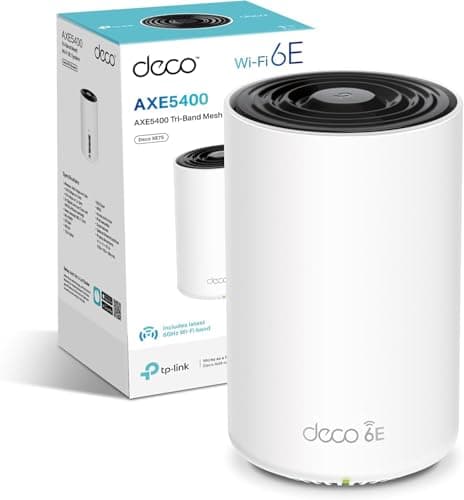
At this price point, the BT6 is competing with two main alternatives: the TP-Link Deco BE85 and the Netgear Orbi 970. The Deco BE85 is TP-Link's flagship Wi-Fi 7 mesh, also tri-band, and it's generally priced slightly below the BT6 for a two-pack. The Orbi 970 sits above both in price and is Netgear's premium play with a quad-band setup and 10GbE ports on the primary node. Both are serious systems, and the choice between them comes down to ecosystem preference, port requirements, and how much you're willing to spend.
The BT6's advantages over the Deco BE85 are primarily in the ASUS ecosystem: the firmware maturity, AiProtection security, and the depth of the web interface. TP-Link's Deco app is arguably simpler to use for non-technical buyers, but ASUS gives you more control if you want it. The Orbi 970 has more ports and a higher-spec backhaul, but it's significantly more expensive and the Netgear firmware has had a rockier reputation in recent years than ASUS's. For most buyers the BT6 hits the sweet spot.
| Feature | ASUS ZenWiFi BT6 (2-pack) | TP-Link Deco BE85 (2-pack) | Netgear Orbi 970 (2-pack) |
|---|---|---|---|
| Wi-Fi Standard | Wi-Fi 7 | Wi-Fi 7 | Wi-Fi 7 |
| Band Layout | Tri-Band | Tri-Band | Quad-Band |
| WAN Port | 2.5G | 2.5G | 10G |
| LAN Ports | 3x GbE per node | 2x 2.5G per node | 4x GbE + 1x 2.5G per node |
| USB | USB 3.0 | Not specified | USB 3.0 |
| Security Suite | AiProtection (included) | HomeCare (included) | Armor (subscription after trial) |
| Mobile Tethering | 4G and 5G | Not specified | Not specified |
| Coverage (2-node) | 5,800 sq ft | ~6,000 sq ft | ~6,000 sq ft |

Final Verdict
The ASUS ZenWiFi BT6 Tri-Band WiFi 7 Mesh is a genuinely good premium mesh system. The tri-band architecture with dedicated wireless backhaul is the right foundation, the 2.5G WAN port is sensible forward-thinking, the feature set is one of the deepest in the consumer space, and the positive overall rating from dozens of reviews tells you that most people who buy it are happy with it. For a large home with a lot of devices, a fast broadband connection, and someone in the house who cares about having the network actually work, this is a solid choice.
The caveats are real though. You're paying a premium price for Wi-Fi 7 hardware that most of your current devices can't fully use yet. The firmware isn't completely flawless and a small number of owners have had to do a reset after an update. The app is good but the feature depth can feel daunting if you just want to plug it in and forget it. And the LAN ports are Gigabit rather than multi-gig, which is fine for most people but if you have wired devices that could benefit from faster speeds.
If you're in a smaller home, a three-bedroom semi or below, or your broadband is a standard 100 to 500Mbps connection, the honest answer is that you don't need this. The ASUS ZenWiFi Pro ET12 or even the ZenWiFi AX (XT8) Wi-Fi 6 two-pack would serve you just as well for considerably less money, and your devices would use it just as effectively. Save the premium Wi-Fi 7 spend for when you genuinely need the coverage, the capacity, or you're on a multi-gigabit connection. But if you do need it, the BT6 delivers.
What works. What doesn’t.
5 + 4What we liked5 reasons
- Dedicated tri-band wireless backhaul keeps secondary node speeds high
- 2.5G WAN port future-proofs against faster broadband connections
- AiProtection security suite included at no extra subscription cost
- 4G/5G mobile tethering provides useful broadband failover
- Deep feature set including Smart Home SSIDs and proper parental controls
Where it falls4 reasons
- Premium price for Wi-Fi 7 most current devices cannot fully use
- LAN ports are Gigabit rather than multi-gig
- Occasional firmware instability reported by a minority of owners
- Feature depth can overwhelm buyers who just want plug-and-play simplicity
Full specifications
8 attributes| Coverage SQM | 538 |
|---|---|
| Launch year | 2024 |
| Mesh capable | true |
| Ports | 1x 2.5G WAN, 3x GbE LAN, USB 3.0 |
| Security protocols | WPA3, AiProtection Pro |
| TOP speed mbps | 9400 |
| Type | mesh_router |
| Wifi standard | Wi-Fi 7 |
Frequently asked
5 questions01Will the ASUS ZenWiFi BT6 Tri-Band WiFi 7 Mesh, 9.4 Gbps, 5800 sq.ft. (2pk), 2.5G WAN Port, Security and Parental Controls Included, Smart Home Master SSIDs, 4G & 5G Mobile Tethering- BT6 (W-2-PK) cover my whole house?+
ASUS rates the two-node BT6 system at 5,800 square feet combined, which is enough for most large UK homes. In practice, real-world coverage depends heavily on your property's construction: solid brick walls, concrete floors, and metal structures all reduce range compared to the theoretical figure. For a typical four or five-bedroom detached house, the two-node kit should cover the whole property including a garden area. Owners in large or awkwardly shaped homes report good results, though some mention that a third node would be ideal for very large properties. If you're in a three-bedroom semi or smaller, you may find a single good router covers you just as well.
02Do I really need Wi-Fi 6E or Wi-Fi 7 for the ASUS ZenWiFi BT6 Tri-Band WiFi 7 Mesh, 9.4 Gbps, 5800 sq.ft. (2pk), 2.5G WAN Port, Security and Parental Controls Included, Smart Home Master SSIDs, 4G & 5G Mobile Tethering- BT6 (W-2-PK)?+
Probably not yet, if we're being honest. Most phones, laptops, and smart home devices currently in use are Wi-Fi 6 or Wi-Fi 5 at best, and they'll connect to the BT6 just fine at those standards. The Wi-Fi 7 hardware does still benefit older devices through improved airtime management and OFDMA efficiency, so it's not purely wasted. The real argument for buying Wi-Fi 7 now is future-proofing: Wi-Fi 7 client devices are arriving in volume and will be mainstream within a couple of years. If you're buying a mesh system you expect to run for five-plus years, Wi-Fi 7 infrastructure means you'll actually get to use the headline standard before you need to replace the hardware.
03Is the ASUS ZenWiFi BT6 Tri-Band WiFi 7 Mesh, 9.4 Gbps, 5800 sq.ft. (2pk), 2.5G WAN Port, Security and Parental Controls Included, Smart Home Master SSIDs, 4G & 5G Mobile Tethering- BT6 (W-2-PK) mesh worth it over a single router or extender?+
For a large home, yes. The BT6's tri-band architecture reserves one band exclusively for communication between the two nodes (dedicated wireless backhaul), which means the secondary node can deliver near-full speeds to devices connected to it. A Wi-Fi extender, by contrast, typically halves your bandwidth because it has to receive and retransmit on the same radio. A single router, however good, physically can't cover a large multi-storey home as effectively as two well-placed nodes. If your home is smaller and a single router would cover it, save your money and buy a good single unit instead.
04Is the ASUS ZenWiFi BT6 Tri-Band WiFi 7 Mesh, 9.4 Gbps, 5800 sq.ft. (2pk), 2.5G WAN Port, Security and Parental Controls Included, Smart Home Master SSIDs, 4G & 5G Mobile Tethering- BT6 (W-2-PK) easy to set up and reliable?+
Setup is guided through the ASUS Router app and most owners report being up and running within 20 to 30 minutes. The app walks you through connecting the primary node, then adding the second node, and includes placement guidance to help you position the second node effectively. On reliability, the majority of the few dozen owner reviews report stable day-to-day operation. A smaller number mention occasional firmware hiccups, usually after an update, with the fix typically being a reboot. ASUS does push firmware updates to address issues, so the system improves over time. It's not completely hands-off for everyone, but it's far more reliable than typical ISP-supplied hardware.
05What warranty and returns apply to the ASUS ZenWiFi BT6 Tri-Band WiFi 7 Mesh, 9.4 Gbps, 5800 sq.ft. (2pk), 2.5G WAN Port, Security and Parental Controls Included, Smart Home Master SSIDs, 4G & 5G Mobile Tethering- BT6 (W-2-PK)?+
Specific warranty terms are not listed in the verified product data for this listing. When buying through Amazon UK, you're covered by Amazon's standard 30-day returns policy and the Amazon A-to-Z Guarantee, which protects your purchase if there's a problem. For manufacturer warranty details, check the ASUS support pages directly or contact ASUS UK customer support before purchasing if this is a deciding factor for you.