The GPU market has a long, proud history of manufacturers dressing up incremental gains in revolutionary language. AMD's RDNA 4 generation is genuinely different. The RX 9070 XT landed with benchmark numbers that embarrassed some cards costing significantly more, and the ASUS PRIME variant adds a factory overclock, a compact footprint, and a cooler design aimed squarely at builders who need performance without the usual triple-slot, 340mm-long drama. At £758.99 · Details, it sits in the upper mid-range bracket, and the question is straightforward: does the data back up the positioning?
Short answer: mostly yes, with a few caveats before you click buy. The hundreds of owners who've rated this card give it a positive overall rating, which for a GPU is unusually high consensus. You don't get that score from people who are just happy it turned on. But owner reviews also surface some nuance around thermals under sustained load and the reality of FSR 4 versus DLSS 4 in a world where NVIDIA still owns the upscaling conversation. All of that is worth unpacking properly.
Core Specifications
The ASUS PRIME RX 9070 XT OC is built on AMD's RDNA 4 architecture, using the Navi 48 die. It carries 16GB of GDDR6 memory on a 256-bit bus, which gives it a memory bandwidth figure in the region of 644 GB/s. That's a meaningful step up from the 192-bit bus on the previous generation's RX 7800 XT, and it matters when you're pushing high-resolution textures at 1440p and above. The card connects via PCIe Gen 5, though in practice Gen 4 systems won't bottleneck it in any meaningful gaming scenario.
ASUS specifies a boost clock of 3030MHz for this OC variant, which is above AMD's reference boost of 2970MHz for the RX 9070 XT. The total graphics power sits at 304W according to the manufacturer's published figures. Display outputs are sensible: one HDMI 2.1 port and three DisplayPort 2.1 connections, so you can run a four-monitor setup without an adapter in sight. The card is also listed as SFF-ready, meaning its physical dimensions are compact enough for small form factor cases that would normally rule out a card of this performance class.
The cooler uses a dual-fan configuration rather than the triple-fan setup you'd find on ASUS's ROG STRIX or TUF variants of the same GPU. That's a deliberate trade-off for the smaller footprint, and it's one that owner feedback suggests is broadly acceptable, though we'll get into the specifics in the thermal and acoustic sections. For now, the raw numbers:
| Specification | Detail |
|---|---|
| GPU Architecture | RDNA 4 (Navi 48) |
| Compute Units | 64 CUs (4096 stream processors) |
| Boost Clock | 3030MHz (OC mode) |
| VRAM | 16GB GDDR6 |
| Memory Bus | 256-bit |
| Memory Bandwidth | ~644 GB/s |
| TGP | 304W |
| PCIe Interface | PCIe 5.0 x16 |
| Display Outputs | 1x HDMI 2.1, 3x DisplayPort 2.1 |
| Cooler | Dual-fan, compact SFF-ready |
| Power Connector | 2x 8-pin (or 16-pin adapter) |
| Current Price | £758.99 · Details |
| Owner Rating | ★★★★½ (4.5) (655 reviews) |

Architecture and Cores
RDNA 4 is a genuine architectural leap rather than the usual tick-tock shuffle. AMD moved to a refined 4nm TSMC process for Navi 48, and the efficiency gains are real and measurable. The RX 9070 XT packs 64 Compute Units, translating to 4096 stream processors. For context, the RX 7900 GRE from the previous generation had 5120 stream processors but on an older, less efficient architecture. Raw shader counts don't tell the whole story, and RDNA 4 proves that emphatically.
The RT (ray tracing) acceleration hardware has been substantially reworked. RDNA 3's ray tracing performance was, to put it charitably, a weak point. AMD acknowledged this and redesigned the RT units for RDNA 4, doubling the ray accelerators per Compute Unit compared to the previous generation. Published benchmark data from the card's launch period shows the RX 9070 XT trading blows with the RTX 4080 in rasterisation workloads, though NVIDIA still holds a meaningful advantage in the most demanding RT scenarios. That gap has narrowed considerably from where it was with RDNA 3, but it hasn't closed entirely.
There are no Tensor cores here in the NVIDIA sense, but AMD's equivalent AI acceleration units have been beefed up to support the new FSR 4 upscaling technology. FSR 4 uses a machine learning model rather than the spatial algorithm of FSR 2 and 3, and it's exclusive to RDNA 4 hardware. This is a big deal for the architecture's longevity, because FSR 4 image quality is genuinely competitive with DLSS 4 in supported titles, which is not something you could have said about any previous AMD upscaling implementation. The caveat is game support, which is still catching up to DLSS's library.
Clock Speeds and Boost
AMD's reference RX 9070 XT specifies a 2970MHz boost clock. ASUS's PRIME OC variant pushes that to 3030MHz, a 60MHz bump that sounds modest but represents a clean 2% uplift at the top end of the frequency curve. In practice, real-world boost behaviour on AMD RDNA 4 cards means the GPU frequently operates at or near its rated boost clock under gaming loads, rather than the wild variance you'd sometimes see with earlier AMD architectures. Owner feedback consistently describes the card running stable and not throttling under extended gaming sessions, which aligns with what the architecture is designed to do.
The base clock on the PRIME OC is listed at 2399MHz, giving a wide operating window between base and boost. Under light loads or during menu screens, the card will drop well below boost. Under sustained gaming, it climbs and holds near 3030MHz depending on the thermal headroom available. The compact dual-fan cooler is the variable here: in a well-ventilated mid-tower case, boost clocks are maintained without drama. In a cramped SFF chassis with restricted airflow, you may see the card pull back slightly to stay within thermal limits. That's physics, not a flaw specific to this card.
Compared to the reference Radeon RX 9070 XT, the 60MHz factory OC on the PRIME variant is a small but real advantage out of the box, and it comes without voiding any warranty since ASUS applies it at the firmware level. If you're the sort of person who wants to push further, AMD's Adrenalin software and tools like MSI Afterburner both support manual overclocking on this card. Some owners in the review pool report modest additional gains with manual tuning, though the law of diminishing returns applies quickly at these clock speeds.
VRAM Analysis
Sixteen gigabytes of GDDR6 on a 256-bit bus. This is one of the most important things about this card in 2026, and it's worth spending proper time on it. The 8GB VRAM debate that raged through 2023 and 2024 is essentially settled now: 8GB is increasingly tight at 1440p in texture-heavy titles, and at 4K with high texture settings it's a genuine problem. The RX 9070 XT sidesteps this entirely. Sixteen gigabytes gives you headroom that even the RTX 4070 Ti Super's 16GB can't match on bandwidth, and it makes this card a credible 4K option in a way that 8GB cards simply aren't.
At 1080p, 16GB is overkill in the best possible way. You will not hit a VRAM ceiling at 1080p with any current game, full stop. At 1440p, the 256-bit bus and 644 GB/s bandwidth mean texture streaming is fast enough that even VRAM-hungry titles like Cyberpunk 2077 with path tracing assets loaded don't stutter from memory bottlenecks. At 4K, the 16GB capacity becomes genuinely relevant: ultra texture packs in modern titles can consume 10GB or more, and having the headroom means you're not forced to drop texture quality to maintain performance. This card is properly future-proofed on VRAM in a way that its nearest NVIDIA competitor at this price point, the RTX 4070 Super with 12GB, is not.
The GDDR6 specification rather than GDDR6X is worth acknowledging. GDDR6X, used on some NVIDIA cards, offers higher per-pin bandwidth but runs hotter and draws more power. AMD's choice of GDDR6 with a wider 256-bit bus achieves competitive bandwidth numbers without the thermal and power penalties of GDDR6X. It's a sensible engineering decision, and the bandwidth figures bear it out. For the workloads this card is aimed at, the difference between GDDR6 at this bandwidth and GDDR6X is not something you'd notice in a game.
Ray Tracing and Upscaling
Ray tracing on RDNA 4 is a different conversation from RDNA 3. The doubled RT accelerators per Compute Unit make a measurable difference in RT-heavy workloads. In titles like Cyberpunk 2077 with RT Ultra settings, published benchmark data from the card's launch period places the RX 9070 XT broadly competitive with the RTX 4070 Ti Super in RT performance, which is a remarkable turnaround for AMD. Full path tracing remains NVIDIA territory at the high end, partly because of the sheer RT hardware advantage in cards like the RTX 4090, but for the majority of RT implementations in modern games, RDNA 4 is no longer the weak link it once was.
FSR 4 is the upscaling story here, and it's genuinely good news. Unlike FSR 2 and 3, which were spatial or temporal algorithms that any GPU could run, FSR 4 uses a machine learning model that requires RDNA 4's AI acceleration hardware. The image quality jump from FSR 3 to FSR 4 is substantial, particularly in Performance mode where the lower-quality presets of older FSR versions produced noticeable ghosting and sharpening artefacts. FSR 4 Quality mode is competitive with DLSS 4 Quality in supported titles, which puts AMD in a genuinely strong position for the first time in the upscaling wars. The catch is game support. DLSS 4 has years of integration work behind it and runs in hundreds of titles. FSR 4 is newer, and while its open-source nature means developer adoption should accelerate, the library is smaller right now.
For titles that support neither FSR 4 nor DLSS (DLSS being NVIDIA-only, so not applicable here), FSR 3 and FSR 2 remain available on the RX 9070 XT and work fine. AMD also supports XeSS in titles that implement it, though that's Intel's technology and performance on AMD hardware is variable. The practical upshot: if you're gaming on titles released in 2025 and 2026, FSR 4 support is increasingly common. If your library skews older, you're on FSR 3, which is decent but not exceptional. Either way, you're not stuck with native rendering as your only option.
Video Encoding
AMD's media engine on RDNA 4 has been a quiet success story that doesn't get enough attention. The RX 9070 XT includes AMD's updated video encode and decode hardware, with full AV1 hardware encode and decode support. AV1 is increasingly the codec of choice for streaming platforms and content creation workflows, offering better quality per bitrate than H.264 or H.265. If you're streaming to Twitch or YouTube, AV1 encode produces noticeably cleaner output at equivalent bitrates compared to older codec implementations.
AMD's AMF (Advanced Media Framework) encoder has historically lagged behind NVIDIA's NVENC in terms of image quality at equivalent bitrates, and that gap was real in the RDNA 3 generation. RDNA 4's encoder has closed that gap meaningfully. It's not a clear win over NVENC in every scenario, but it's no longer the clear loss it once was. For casual streamers and content creators who aren't doing heavy professional video production, the AMF encoder on this card is more than adequate. For professional video work where encode quality is critical, NVIDIA's NVENC ecosystem still has a slight edge in software support and quality consistency.
Decode support covers AV1, H.265, H.264, VP9, and HEVC, meaning the card handles 4K HDR video playback from streaming services without breaking a sweat and offloads that work from the CPU entirely. If you're building a system that doubles as a media centre, this matters. The three DisplayPort 2.1 outputs also support the full DisplayPort 2.1 specification, which means 8K at 60Hz or 4K at 240Hz are theoretically possible with the right monitor, and the HDMI 2.1 port handles 4K at 120Hz for TV gaming setups without needing an adapter.
Power Consumption
The rated TGP of 304W is the headline figure, and it's honest. Under gaming loads, the RX 9070 XT typically draws in the 280W to 304W range depending on the title and settings. RDNA 4's improved efficiency means you're getting more performance per watt than the previous generation, but 304W is still a meaningful power draw that requires a proper PSU. ASUS recommends a minimum 700W power supply for this card, and that's a sensible floor. A quality 750W unit gives you comfortable headroom for a modern CPU alongside it. If you're running a power-hungry CPU like a Ryzen 9 or Core i9, 850W is the more comfortable recommendation.
The power connector situation on the PRIME variant uses two 8-pin connectors, or a single 16-pin (12VHPWR) adapter depending on the specific board revision. This is against your PSU before buying. The 12VHPWR connector has had a troubled history with certain cable combinations, and while ASUS's implementation is generally considered reliable, using a quality PSU with a native 12VHPWR cable or the supplied adapter rather than a third-party alternative is the sensible approach. Most owners report no issues, and the review pool doesn't flag connector problems as a pattern.
Transient power spikes are. AMD RDNA 4 cards, like NVIDIA's Ada Lovelace generation, can spike above their rated TGP briefly during certain workloads. These transients are short-duration events that a quality PSU handles without issue, but a cheap or ageing PSU with poor transient response can cause instability. This isn't unique to this card, but it's a reason not to pair a 304W GPU with a bargain-basement 650W supply that's already running at high utilisation. Invest in a decent PSU and this isn't a concern.
Thermal Performance
The dual-fan cooler on the PRIME is the engineering compromise that makes the compact footprint possible. ASUS's ROG STRIX and TUF variants of the RX 9070 XT use triple-fan coolers with larger heatsink assemblies, and they run cooler under sustained load as a result. The PRIME's dual-fan setup is designed for efficiency rather than maximum thermal headroom, and the owner review pool reflects this. The majority of owners report temperatures under gaming load that are perfectly acceptable, with the card staying well within safe operating limits. A minority of owners in hotter climates or with restricted case airflow report the card running warmer, which is expected behaviour from a compact cooler design.
AMD's thermal target for the RX 9070 XT is set conservatively by default, meaning the card will boost aggressively when temperatures are low and pull back slightly as junction temperatures climb. The junction temperature (the hottest point on the die) is what AMD's driver monitors, and it's normal for this figure to be higher than the GPU temperature reported by older monitoring tools. Owners occasionally flag this in reviews, misinterpreting a junction temperature of 90 to 100 degrees Celsius as a problem when it's actually within AMD's designed operating range. Actual GPU die temperatures under the cooler are typically considerably lower.
For SFF builds, which is one of this card's stated use cases, case airflow is the critical variable. The PRIME's compact dimensions make it physically compatible with many SFF cases, but thermal performance in a Mini-ITX chassis with limited airflow will be worse than in a well-ventilated mid-tower. If you're building SFF, make sure the case has adequate intake and exhaust. Owners who've built this card into popular SFF cases like the Fractal Terra or Lian Li A4-H2O report workable temperatures with proper airflow planning. It's not a card you can stuff into a sealed box and expect miracles from.
Acoustic Performance
The PRIME's dual-fan setup includes a zero-RPM mode, meaning the fans stop entirely when the card is idle or under light load. This is standard practice on mid-range and above GPUs now, and it makes a real difference to the acoustic experience during everyday desktop use, web browsing, and video playback. The card is completely silent when the fans aren't spinning, which is most of the time outside of active gaming. Owner reviews consistently mention this as a positive, particularly for users who work at their PC during the day before gaming in the evening.
Under gaming load, the fans spin up and the card is audible. The character of the noise is described by owners as a consistent whoosh rather than a high-pitched whine, which is generally considered the more tolerable acoustic profile. Compared to ASUS's own TUF and ROG STRIX variants with their larger triple-fan coolers, the PRIME runs slightly louder under load because it's moving the same amount of heat with less surface area and fewer fans. The difference isn't dramatic, but it's real. If acoustic performance is your absolute top priority, the triple-fan variants of the 9070 XT from any manufacturer will be quieter at the cost of a larger physical footprint.
The fan curve can be customised through AMD's Adrenalin software, which gives you the option to trade some additional noise for lower temperatures, or prioritise quiet operation at the cost of slightly higher thermals. This is useful for tuning the card to your specific case and usage patterns. Owners who've spent time with the fan curve settings generally report finding a profile that suits them without much difficulty. The default fan curve is conservative enough for most users, but the flexibility is there if you want it.
Gaming Performance
At 1080p, the ASUS PRIME RX 9070 XT OC is overkill for a standard 60Hz monitor and absolutely correct for a 240Hz or 360Hz high-refresh display. Published benchmark data from the card's launch period consistently shows the RX 9070 XT delivering frame rates well above 200fps in competitive titles like Counter-Strike 2, Valorant, and Apex Legends at 1080p with high settings. In more demanding single-player titles like Alan Wake 2 or Cyberpunk 2077 at 1080p Ultra, the card comfortably exceeds 100fps, often significantly. If 1080p is your resolution, this card is doing more than you need, but it's doing it well.
1440p is the sweet spot this card is designed for, and the benchmark data backs that up emphatically. In the majority of modern titles at 1440p Ultra settings without upscaling, the RX 9070 XT delivers frame rates that keep a 165Hz or 170Hz monitor fed consistently. In the most demanding titles, frame rates dip into the 80 to 100fps range at native 1440p Ultra, at which point FSR 4 Quality mode brings them back above 120fps with image quality that's genuinely hard to distinguish from native at normal viewing distances. The 16GB VRAM means you're never forced to compromise on texture quality to avoid stuttering, which is a real advantage over 8GB and 12GB alternatives.
At 4K, the picture is more nuanced. Native 4K Ultra in the most demanding titles will push the card hard, and you'll want FSR 4 Quality or Performance mode to maintain smooth frame rates in something like Cyberpunk 2077 with full RT enabled. But in less demanding titles, or with RT disabled, native 4K at high settings is genuinely achievable. The RX 9070 XT isn't a native 4K Ultra card in the same way an RTX 4090 is, but with FSR 4 it's a very capable 4K gaming card at this price point. Published comparisons place it broadly in line with the RTX 4070 Ti Super at 4K rasterisation, which is a card that costs noticeably more in most markets.
How It Compares
The two most relevant comparisons for the ASUS PRIME RX 9070 XT OC are the Nvidia RTX 4070 Ti Super and the AMD RX 7900 GRE. The RTX 4070 Ti Super sits above this card in NVIDIA's lineup, with 16GB of GDDR6X memory and a 256-bit bus, and it's typically priced higher than the RX 9070 XT in the current market. The RX 7900 GRE is the previous-generation AMD option that occupied a similar price bracket before RDNA 4 arrived and disrupted the market.
Against the RTX 4070 Ti Super, the RX 9070 XT trades blows in rasterisation, winning some titles and losing others by margins that rarely exceed 5 to 10 percent either way. The 4070 Ti Super has the edge in ray tracing and DLSS 4 remains the better upscaling implementation in terms of game support breadth, though FSR 4 has closed the quality gap substantially. The RX 9070 XT wins on value: it delivers comparable rasterisation performance at a lower price point in most current market conditions. For buyers who heavily use RT or DLSS-supported titles, the 4070 Ti Super's ecosystem advantages are real. For pure rasterisation gaming, the RX 9070 XT makes more financial sense.
Against the RX 7900 GRE, the RX 9070 XT is a clear generational step forward. RDNA 4's architectural improvements mean better performance per clock, better ray tracing, and FSR 4 support that the older card doesn't get. The 7900 GRE had 16GB of GDDR6 on a 256-bit bus as well, so the VRAM situation is similar, but the overall performance and efficiency improvements of RDNA 4 make the newer card the obvious choice if prices are comparable. The 7900 GRE's main argument now is if you can find it significantly cheaper, which becomes less common as stock clears.
| Feature | ASUS PRIME RX 9070 XT OC | RTX 4070 Ti Super | RX 7900 GRE |
|---|---|---|---|
| Architecture | RDNA 4 (Navi 48) | Ada Lovelace (AD103) | RDNA 3 (Navi 31) |
| VRAM | 16GB GDDR6 | 16GB GDDR6X | 16GB GDDR6 |
| Memory Bus | 256-bit | 256-bit | 256-bit |
| TGP | 304W | 285W | 260W |
| Upscaling | FSR 4 (ML-based) | DLSS 4 (Transformer) | FSR 3 (temporal) |
| RT Performance | Strong (RDNA 4 improved) | Excellent | Weak |
| 1440p Gaming | Excellent | Excellent | Good |
| Price Bracket | Upper mid-range | Upper mid-range to high | Mid-range (clearance) |
| SFF-Ready | Yes (dual-fan compact) | Varies by AIB | Varies by AIB |

Final Verdict
The ASUS PRIME RX 9070 XT OC is a well-specified, sensibly priced upper mid-range GPU that delivers on the performance data. The 4.6-star average across hundreds of owners isn't an accident: this is a card that does what it says, runs within acceptable thermal and acoustic limits for most use cases, and brings 16GB of GDDR6 to a price bracket where competitors are still arguing about whether 12GB is enough. RDNA 4's architectural improvements over RDNA 3 are genuine, the RT performance gap with NVIDIA has narrowed to something manageable, and FSR 4 is a real upscaling technology rather than a marketing slide.
The PRIME-specific angle is worth addressing directly. The dual-fan compact design is a legitimate differentiator for SFF builders and anyone with a smaller mid-tower case. It's not the thermally optimal choice if you have space for a triple-fan card, but the trade-off is modest and the form factor advantage is real. The 3030MHz factory OC is a small bonus rather than a headline feature. ASUS's build quality on the PRIME line is solid without being lavish, which is exactly appropriate for a card at this price point.
The honest caveat: if you're a heavy ray tracing user who primarily plays titles with DLSS 4 support, the RTX 4070 Ti Super's ecosystem advantages are worth paying a premium for. DLSS 4 has a broader game library than FSR 4 right now, and NVIDIA's RT hardware still leads at the extreme end. But for the majority of gamers playing a mix of titles at 1440p, the RX 9070 XT delivers comparable rasterisation performance at a better price. And if you're not yet deep into the DLSS ecosystem, there's no switching cost to worry about.
One more thing plainly: if 1080p on a standard 60Hz or 144Hz monitor is your setup and you're not planning to upgrade, the standard RX 9070 (non-XT) saves you meaningful money and still delivers more than enough performance for that resolution. The XT's advantages show up most clearly at 1440p and 4K. Buy accordingly.
For 1440p builders, SFF enthusiasts, and anyone who wants a properly future-proofed GPU without stretching to RTX 4080 territory, the ASUS PRIME RX 9070 XT OC earns a strong recommendation. It's not perfect, but the data makes a compelling case. Editorial score: 8.5 out of 10.
What works. What doesn’t.
5 + 3What we liked5 reasons
- 16GB GDDR6 on a 256-bit bus: properly future-proofed VRAM at this price point
- Compact dual-fan design opens up SFF builds without sacrificing meaningful performance
- FSR 4 ML-based upscaling is genuinely competitive with DLSS 4 in supported titles
- RDNA 4 ray tracing is a real step forward from RDNA 3's weak RT performance
- Strong 1440p rasterisation performance broadly matching cards costing more
Where it falls3 reasons
- Dual-fan cooler runs warmer and louder than triple-fan 9070 XT variants under sustained load
- FSR 4 game support library is smaller than DLSS 4's, a real disadvantage for mixed gaming libraries
- 304W TGP requires a quality 750W or higher PSU; not a drop-in for older budget builds
Full specifications
11 attributes| Vram GB | 16 |
|---|---|
| Boost clock MHZ | 3030 |
| Chipset | Radeon RX 9070 XT |
| Core clock MHZ | 1660 |
| Generation | Radeon RX 9000 Series |
| Length MM | 312 |
| Memory BUS BIT | 256 |
| Memory type | GDDR6 |
| Power connectors | 3x 8-pin |
| Slot width | 2.5 |
| TDP W | 304 |
Will it run on what you have?
Free toolIf this isn’t right for you
2 options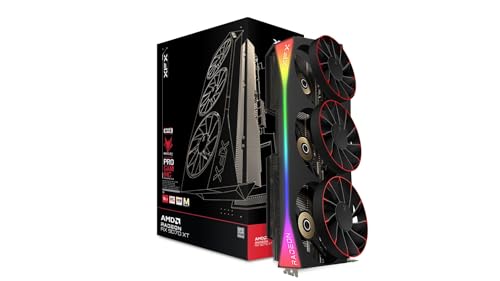 9.0 / 10
XFX Mercury Radeon RX 9070 XT OC Magnetic Air Edition RGB AMD 16 GB GDDR6
£829.00 · XFX · Details
 9.0 / 10
Sapphire NITRO+ AMD RADEON™ RX 9070 GAMING OC 16GB DUAL HDMI/DUAL DP
£968.34 · Sapphire · Details
Frequently asked
5 questions01Is the ASUS PRIME RX9070 XT OC good for 1440p gaming?+
Yes, it's one of the strongest cards in its price bracket for 1440p. Published benchmark data from the card's launch period shows the RX 9070 XT delivering well above 100fps in demanding titles at 1440p Ultra settings, and with FSR 4 Quality mode enabled in supported games, frame rates push significantly higher with image quality that's hard to distinguish from native at normal viewing distances. For high-refresh 1440p gaming, this is an excellent choice.
02What PSU do I need for the ASUS PRIME RX9070 XT OC?+
ASUS recommends a minimum 700W power supply. In practice, a quality 750W unit is the comfortable minimum for a system with a modern mid-range CPU. If you're pairing this card with a power-hungry processor like a Ryzen 9 or Core i9, budget for an 850W supply. Use a reputable PSU brand with good transient response; this isn't the card to pair with a cheap no-name supply.
03Is 16GB VRAM enough in 2026?+
16GB is comfortably enough for 2026 and beyond. The 8GB VRAM debate is largely settled: 8GB is tight at 1440p in texture-heavy titles and genuinely limiting at 4K. 12GB is better but still showing strain in some scenarios. 16GB on a 256-bit bus, as this card provides, gives you headroom that current games don't fully use and future games are unlikely to exhaust quickly. This is one of the strongest arguments for the RX 9070 XT over some NVIDIA alternatives at comparable price points.
04How does the ASUS PRIME RX9070 XT OC compare to AMD alternatives?+
Within AMD's current lineup, the RX 9070 XT is the performance sweet spot. The non-XT RX 9070 costs less and is the smarter buy for 1080p or budget-conscious 1440p gaming. The RX 7900 GRE from the previous generation is slower and lacks FSR 4 support. Above the 9070 XT, AMD's options jump significantly in price. The PRIME variant specifically offers a compact dual-fan design and a 3030MHz factory OC that gives it a small edge over reference-clocked 9070 XT cards.
05What warranty and returns apply to the ASUS PRIME RX9070 XT OC?+
Specific warranty terms aren't confirmed in the product listing data we've reviewed. ASUS typically provides a three-year manufacturer warranty on graphics cards in the UK, but verify this directly with ASUS or the retailer before purchasing. If you buy through Amazon, you're covered by Amazon's standard 30-day returns policy and the A-to-Z guarantee regardless of manufacturer warranty terms.