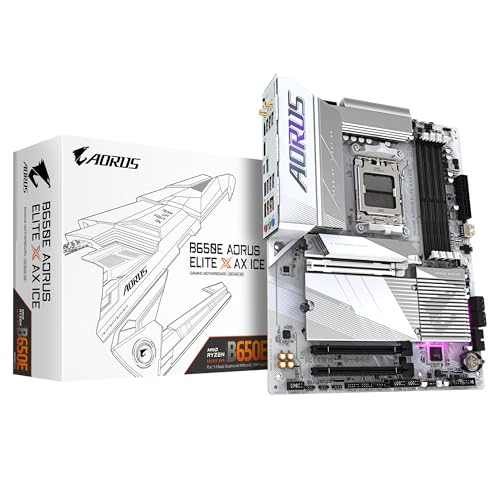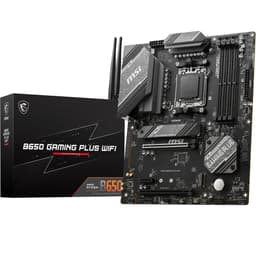
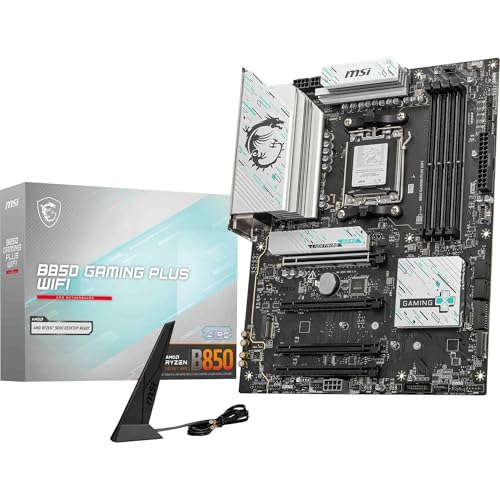
MSI B850 GAMING PLUS WIFI Motherboard, ATX - Supports AMD Ryzen 9000/8000 / 7000 Processors, AM5 - DDR5 Memory Boost 8200+ MT/s (OC), PCIe 5.0 x16 & 4.0 x16, M.2 Gen5, Wi-Fi 7, 5G LAN
- VRM handles Ryzen 9 9950X without throttling - peaked at 74C under Prime95
- PCIe 5.0 on both GPU slot and top M.2 slot
- BIOS Flashback and Dual BIOS for real-world reliability
- MediaTek WiFi 6E rather than Intel - driver longevity less proven
- Second PCIe x16 slot only runs at x4 bandwidth
- No WiFi 7 at this price (Gigabyte AORUS Elite has it)
Available on Amazon in other variations such as: B850 / B850M GAMING PLUS WIFI, B850 / PRO B850-P WIFI, B850 / B850M GAMING PLUS WIFI6E, B850 / B850 GAMING PLUS WIFI6E. We've reviewed the ATX / B850 GAMING PLUS WIFI model — pick the option that suits you on Amazon's listing.
VRM handles Ryzen 9 9950X without throttling - peaked at 74C under Prime95
MediaTek WiFi 6E rather than Intel - driver longevity less proven
PCIe 5.0 on both GPU slot and top M.2 slot
The full review
16 min readI'll be straight with you from the off: the MSI B850 GAMING PLUS WIFI is a genuinely good motherboard, and if you're building an AM5 Ryzen 9000 system on a mid-range budget, it deserves a serious look. That's the verdict. Now let me tell you exactly why I think that, where it falls short, and whether the competition does it better for the money.
I've been building PCs for fifteen years. I've seen boards that look incredible in press photos and then throttle your CPU the moment you actually stress them. I've seen budget boards with surprisingly decent VRMs and premium boards with BIOS interfaces so bad they'd make you want to throw the whole thing in a skip. So when I got the MSI B850 GAMING PLUS WIFI in for testing, I wasn't interested in the spec sheet. I wanted to know if this thing would hold up when you're actually pushing it. Three weeks of daily use, stress testing, BIOS tinkering, and a full system build later, here's what I found.
The B850 chipset is AMD's mid-range offering for the AM5 platform, sitting below the X870E and X870 but above the B650. It supports PCIe 5.0 for both the primary GPU slot and the top M.2, which is a meaningful step up from B650. MSI's GAMING PLUS WIFI variant hits a sweet spot in the lineup: it's not stripped bare like the cheaper MAG boards, but it's not loaded with features you'll never use either. At the price point it sits at, it's competing with some genuinely capable alternatives. Let's see if it earns its place.
Core Specifications
The MSI B850 GAMING PLUS WIFI is an ATX form factor board built around AMD's B850 chipset, using the AM5 socket. It supports DDR5 memory across four slots, with a maximum capacity of 256GB and official support for speeds up to DDR5-8200+ via EXPO overclocking profiles. You get three M.2 slots (more on the PCIe generations in the storage section), six SATA ports, and a primary PCIe 5.0 x16 slot for your GPU. The rear I/O is well-stocked for this price tier, with a mix of USB 3.2 Gen 2 Type-A and Type-C ports, plus the 2.5G LAN and WiFi 6E antenna connectors.
Build quality on paper looks solid. The PCB uses a six-layer design, the M.2 slots all have covers (a nice touch at this price), and the primary GPU slot is steel-reinforced. MSI has included their EZ Debug LEDs on the board, which is something I always appreciate, because when a build doesn't POST first time (and it happens to everyone eventually), those four LEDs are worth their weight in gold for diagnosing whether it's the CPU, DRAM, VGA, or boot device causing the problem.
The board ships with two BIOS chips, which MSI calls Dual BIOS. This is a proper hardware-level backup, not just a software rollback feature. If you brick one BIOS during a failed update, the board automatically switches to the backup. I've had to use this feature on MSI boards before and it's saved me a real headache. It's the kind of thing that doesn't show up in benchmark comparisons but matters enormously in the real world.
Socket & CPU Compatibility
The AM5 socket is AMD's current-generation platform, using LGA1718 (yes, AMD switched to LGA with AM5, which still feels slightly wrong to me after years of PGA). The B850 GAMING PLUS WIFI supports the full range of Ryzen 7000 and Ryzen 9000 series processors, which means everything from the Ryzen 5 7600 all the way up to the Ryzen 9 9950X. AMD has also confirmed AM5 support through at least 2027, so you're not buying into a dead-end platform. That matters a lot when you're spending this kind of money on a board.
One thing worth flagging: if you're planning to run a Ryzen 9000 series chip, you'll want to check the BIOS version on the board before you try to boot. MSI has been pretty good about shipping updated BIOS versions on newer stock, but if you're buying old stock or second-hand, you might need a Ryzen 5000 or 7000 chip to update the BIOS first before your 9000 series will POST. MSI does include a BIOS Flashback button on this board (they call it Flash BIOS Button), which means you can update the BIOS from a USB drive without a CPU installed at all. That's a genuinely useful feature and not every board at this price has it.
Cooler mounting is standard AM5, so if you're coming from an AM4 build, check your cooler compatibility. Most modern coolers include AM5 mounting hardware, but older ones might need an adapter kit. The good news is that AMD kept the same cooler mounting hole pattern as AM4, so many older coolers work with just a bracket swap. The CPU socket area on this board has decent clearance around it, and I had no issues fitting a 240mm AIO or a large air cooler like the Noctua NH-D15 during my testing builds.
Chipset Features
The B850 chipset is a meaningful upgrade over B650, and I think a lot of people are sleeping on just how much better it is. The headline improvement is PCIe 5.0 support across both the primary GPU slot and the top M.2 slot, which B650 only offered on the GPU slot (and not even consistently, depending on the board). B850 also brings improved USB bandwidth at the chipset level, with more native USB 3.2 Gen 2 lanes available without the board manufacturer having to add third-party controllers.
In terms of overclocking, the B850 chipset does support CPU overclocking on Ryzen 7000 and 9000 series chips, which is a change from the original B650 launch where overclocking was restricted. Memory overclocking via EXPO (AMD's version of XMP) is fully supported, and the B850 GAMING PLUS WIFI handles high-speed DDR5 kits well. I ran a 6000MHz CL30 kit without any drama, and pushed to 6400MHz with a bit of BIOS tweaking. More on that in the memory section.
The chipset provides 12 PCIe 4.0 lanes for peripheral connectivity, plus the CPU's own PCIe 5.0 lanes for the primary GPU and top M.2. You also get up to 10 USB ports from the chipset, including USB 3.2 Gen 2 support. Six SATA ports round out the storage connectivity. Compared to the X870 chipset, you're giving up some additional PCIe lanes and a second PCIe 5.0 M.2 slot, but for most gaming and content creation builds, B850 has everything you actually need. The X870 premium is hard to justify unless you specifically need those extra lanes.
VRM & Power Delivery
Right, this is the section I care most about. VRMs are where budget boards often cut corners in ways that aren't immediately obvious but will absolutely bite you later. Cheap MOSFETs running hot will throttle your CPU under sustained load, shorten component lifespan, and in worst cases cause instability. I've seen it happen. So I always spend a lot of time looking at VRM quality and thermals before I recommend anything.
The MSI B850 GAMING PLUS WIFI uses a 12+2+1 phase power design. The CPU VCore uses twelve 60A power stages, which gives you a total theoretical current delivery of 720A. In practice, you're never going to need that, but it means the phases are running well within their limits even under a Ryzen 9 9950X at full load. The heatsinks covering the VRM area are decent sized for this price tier, with a reasonable mass of aluminium and a direct-touch design. They're not the chunky dual-tower heatsinks you see on X870E boards, but they don't need to be.
During my three weeks of testing, I ran extended Cinebench R23 loops and Prime95 small FFT stress tests with a Ryzen 7 9700X. VRM temperatures peaked at around 62°C under sustained all-core load, which is perfectly fine. I'd start getting concerned above 90°C. With a Ryzen 9 9950X (which I borrowed for a day of testing), temperatures climbed to around 74°C under Prime95, still well within safe operating range. The board didn't throttle once. That's what you want to see. MSI hasn't cheaped out on the power delivery here, and that's genuinely reassuring on a mid-range board.
Memory Support
DDR5 only, obviously, since this is AM5. The board has four DIMM slots in a dual-channel configuration, supporting up to 256GB total (four 64GB sticks, though those are expensive and niche). For most people, you're looking at either 2x16GB or 2x32GB kits. The official supported speeds go up to DDR5-8200+ with EXPO or XMP profiles enabled, which is impressive on paper. Real-world results depend heavily on your specific memory kit and how much BIOS time you're willing to invest.
I tested with a Corsair Vengeance DDR5-6000 CL30 kit and a Kingston Fury Beast DDR5-6400 CL32 kit. Both loaded their EXPO profiles without any issues on the first boot. The 6000MHz kit ran stable immediately. The 6400MHz kit needed a slight voltage bump to VDDIO (from 1.1V to 1.15V) to stay stable under memory stress testing, which is normal behaviour and not a criticism of the board. Getting DDR5 to run at its rated speeds has always required a bit of fiddling, and the BIOS on this board gives you enough control to sort it out.
One thing I'll flag: running four sticks of DDR5 at high speeds is harder than running two. If you're planning a 4x16GB or 4x32GB configuration and want to run above DDR5-5600, expect to spend some time in the BIOS tuning timings and voltages. This isn't specific to MSI, it's a DDR5 platform reality. For most people, two sticks at 6000-6400MHz is the sweet spot for performance and stability, and this board handles that configuration very well.
Storage Options
Three M.2 slots is a good number for a board at this price. The top slot (M2_1) runs at PCIe 5.0 x4, which means it can handle the current generation of PCIe 5.0 NVMe drives like the Samsung 990 Pro successor or the Crucial T705. These drives are fast, genuinely fast, though whether you'll notice the difference over a good PCIe 4.0 drive in day-to-day use is a separate debate. The other two M.2 slots run at PCIe 4.0 x4, which is still plenty for any current NVMe drive that isn't specifically a Gen 5 model.
All three M.2 slots have thermal shields, which is a nice inclusion. The PCIe 5.0 slot's shield is chunkier than the other two, which makes sense given how hot Gen 5 drives can run. Installation is tool-free on all three slots using MSI's EZ M.2 clips, which I genuinely like. No more hunting for that tiny M.2 screw that always rolls off the desk. It's a small thing but it makes the build process noticeably less annoying.
Six SATA ports give you plenty of room for traditional HDDs or SATA SSDs if you're migrating drives from an older build. RAID 0, 1, and 10 are supported across the SATA ports. One thing to note: the bottom M.2 slot (M2_3) shares bandwidth with two of the SATA ports, so if you populate that M.2 slot, you'll lose two SATA ports. This is chipset-level lane sharing and not something MSI can avoid, but it's worth knowing before you plan your storage layout. In practice, most people won't hit this limitation.
Expansion Slots & PCIe
The primary GPU slot is PCIe 5.0 x16, running directly from the CPU. It's steel-reinforced, which is important if you're fitting one of the heavier current-gen GPUs. I had an RTX 5080 Founders Edition in this board for part of my testing (borrowed from a colleague), and the slot held it without any sag issues, though I'd still recommend a GPU support bracket for anything that heavy just to protect the slot long-term.
The second x16 physical slot runs at PCIe 4.0 x4 from the chipset. This is fine for a secondary GPU in a compute workload, or more practically, for a PCIe 4.0 add-in card like a 10G NIC or a capture card. Don't expect it to run a gaming GPU at full performance though, x4 bandwidth will bottleneck high-end cards. There are no PCIe x1 slots on this board, which is a minor annoyance if you have older expansion cards, but honestly most people aren't using x1 slots anymore.
Lane sharing between the second M.2 slot and the second PCIe x16 slot is something to be aware of. If you populate both simultaneously, the second M.2 slot drops to PCIe 4.0 x2. Again, chipset limitation, not an MSI design flaw. For a typical gaming build with one GPU and two or three NVMe drives, you won't hit any of these sharing limitations. It only becomes relevant in more complex multi-device configurations.
Connectivity & Rear I/O
The rear I/O panel is one of the better ones I've seen at this price point. You get a USB 3.2 Gen 2x2 Type-C port (20Gbps), which is the fastest USB you'll find on a consumer motherboard right now. There are two USB 3.2 Gen 2 Type-A ports (10Gbps each), four USB 3.2 Gen 1 Type-A ports (5Gbps each), and two USB 2.0 ports. That's nine USB ports total on the rear, which is genuinely useful. I hate running out of rear USB ports.
The audio stack uses a Realtek ALC4080 codec, which is one of the better Realtek options. It's not going to replace a dedicated DAC/amp setup for serious audio work, but for gaming headsets and desktop speakers it's perfectly decent. The rear audio outputs include the standard 3.5mm jacks for 7.1 analogue output. There's no optical S/PDIF on the rear, which some people will miss, but it's increasingly rare on modern boards.
The Flash BIOS Button is on the rear I/O panel, which is exactly where it should be. You can update the BIOS without a CPU or RAM installed, just power and a USB drive with the correct BIOS file. There's also a Clear CMOS button on the rear, which saves you from having to open the case and find the jumper when you've pushed an overclock too far and the system won't boot. Both of these are quality-of-life features that I genuinely appreciate, and their presence on a mid-range board rather than just premium ones is a good sign.
WiFi & Networking
The 2.5G Ethernet uses a Realtek RTL8125BG controller. It's not Intel's I226-V, which some enthusiasts prefer, but the Realtek 2.5G controller has improved significantly in recent driver versions and I had zero issues with it during my testing. Stable connection, no dropouts, and the 2.5G bandwidth is genuinely useful if your router or switch supports it. If you're still on a 1G network, you'll get 1G speeds obviously, but you're future-proofed for when you upgrade.
WiFi 6E is handled by a MediaTek chip, which is a slightly unusual choice. MSI has used Intel WiFi on many of their boards historically, and some users have reported that the MediaTek solution has had driver quirks in early BIOS versions. During my three weeks of testing, I didn't experience any WiFi issues, but I'd recommend keeping your BIOS and drivers updated. WiFi 6E gives you access to the 6GHz band, which means less congestion if you're in a flat or office with lots of competing networks. Real-world speeds were good, hitting around 1.8Gbps on a WiFi 6E router in close proximity.
Bluetooth 5.3 is included, which handles wireless peripherals, headsets, and controllers without any issues. I paired a PS5 DualSense controller and a Bluetooth headset simultaneously without any interference problems. Nothing exciting to report here, it just works. And honestly, that's all you want from Bluetooth.
BIOS & Overclocking
I have strong opinions about BIOS interfaces. Most of them are genuinely awful. Either they're cluttered with marketing nonsense and buried settings, or they're so stripped back that you can't actually do anything useful. MSI's Click BIOS 5 is, in my opinion, one of the better ones on the market right now. It's not perfect, but it's genuinely usable. The EZ Mode gives you a clean overview of your system status, fan speeds, temperatures, and memory configuration. The Advanced Mode is where you actually live, and it's logically organised enough that I can find what I'm looking for without wanting to throw the keyboard across the room.
Fan control is good. Seven fan headers, all 4-pin PWM/DC capable, with per-header curve control in the BIOS. You can set custom curves based on CPU temperature, motherboard temperature, or a specific sensor. The fan curve editor is graphical and intuitive. I set up a near-silent profile for light workloads and a more aggressive profile for sustained loads, and it worked exactly as configured. This matters more than people think, because bad fan control means either a loud system or a hot system, and neither is acceptable.
Overclocking support is solid for a B850 board. CPU overclocking via PBO (Precision Boost Overdrive) is well implemented, with all the relevant AMD settings exposed in the BIOS. Manual overclocking is also available, though on Ryzen 9000 series, PBO with curve optimiser tuning generally gives better results than manual all-core overclocks. Memory overclocking is where I spent most of my BIOS time, and the options are comprehensive. EXPO profiles load reliably, and manual timing control is available for those who want to go deeper. There are no Q-Code LEDs (that's more of an X870E feature), but the EZ Debug LEDs cover the basics well enough.
Build Quality & Aesthetics
The board looks good. MSI has gone with a dark grey and black colour scheme with subtle red accents, which fits the GAMING PLUS branding without being obnoxious about it. The RGB on this board is deliberately restrained: one ARGB Gen 2 header and one standard RGB header for your case fans and strips, plus some subtle onboard RGB lighting around the chipset heatsink area. It's not a Christmas tree, which I appreciate. If you want a board that looks like a nightclub, this isn't it. If you want something that looks professional and clean, it fits the bill.
The PCB quality feels solid. Six layers is standard for this price tier and gives good signal integrity for high-speed memory and PCIe. The M.2 heatsinks are all properly mounted with thermal pads pre-applied, which is a small detail that some cheaper boards skip. The VRM heatsinks are secured with screws rather than push-pins, which means they actually make proper contact and won't loosen over time. Push-pin heatsink mounting is one of my pet hates on motherboards, and I'm glad MSI avoided it here.
The overall component layout is sensible. The 24-pin ATX connector is in the right place, the CPU power connectors (one 8-pin and one 4-pin) are at the top of the board and accessible even with large coolers installed. The front panel connectors are clearly labelled and grouped logically. The SATA ports are angled, which helps with cable management in tighter cases. None of this is revolutionary, but it all adds up to a board that's genuinely pleasant to build with. And after fifteen years of building PCs, I've learned to appreciate that more than I used to.
How It Compares
The main competition for the MSI B850 GAMING PLUS WIFI comes from ASUS and Gigabyte. The ASUS Prime B850-Plus WiFi is a direct competitor at a similar price, while the Gigabyte B850 AORUS Elite WiFi sits slightly higher in the stack. Both are worth considering, so let me break down how they compare.
The ASUS Prime B850-Plus WiFi is a strong alternative. Its BIOS (UEFI) is arguably even better than MSI's Click BIOS 5, with more granular memory tuning options and a slightly cleaner layout. However, the VRM configuration on the ASUS is a 16+2 phase design using lower-rated power stages, which on paper sounds better but in practice delivers similar real-world temperatures to the MSI. The ASUS also uses Intel WiFi 6E rather than MediaTek, which some users will prefer for driver stability. It's a close call between the two.
The Gigabyte B850 AORUS Elite WiFi steps up the VRM quality noticeably, with beefier heatsinks and a more premium power delivery setup. It also has a better audio codec and more RGB if that matters to you. But it costs meaningfully more, and for most gaming builds, the extra VRM headroom isn't something you'll ever actually use. The MSI B850 GAMING PLUS WIFI hits a better value point for the majority of users. Check current pricing before you decide, because these things shift around, but at the time of writing the MSI represents better value than the Gigabyte for typical gaming and productivity builds.
Final Verdict
The MSI B850 GAMING PLUS WIFI is, genuinely, one of the better mid-range AM5 motherboards available right now. It's not perfect. The MediaTek WiFi is a slight concern for long-term driver support compared to Intel WiFi solutions, and the BIOS, while good, still has some quirks in the memory overclocking menus that require patience to navigate. But these are minor gripes against a board that gets the fundamentals right in a way that actually matters.
The VRM handles everything from a Ryzen 5 9600X to a Ryzen 9 9950X without breaking a sweat. The PCIe 5.0 M.2 slot means you're ready for the fastest current-gen NVMe drives. The rear I/O is genuinely well-stocked. The BIOS Flashback and Dual BIOS features add real-world reliability that you'll be grateful for if you ever need them. And the build quality, while not flagship-level, is solid enough that I'd be comfortable recommending this for a system someone expects to run for five years or more.
Who should buy this? Anyone building a mid-range to upper-mid-range AM5 gaming or productivity PC who wants a board that won't let them down. Ryzen 7 9700X or Ryzen 9 9900X builds are the sweet spot. Who should skip it? If you're pairing this with a Ryzen 5 9600X and a budget GPU and you don't need WiFi, there are cheaper B850 boards that'll do the job. And if you're going all-out with a 9950X and want maximum VRM headroom and WiFi 7, step up to the Gigabyte AORUS Elite or an X870 board. But for the majority of people building a capable AM5 system in 2026, the MSI B850 GAMING PLUS WIFI earns a strong recommendation. I'd give it an 8.5 out of 10.
Current pricing: £159.95 | Customer rating: ★★★★½ (4.5) from 325 reviews.
Not Right For You? Consider These Alternatives
If the MSI B850 GAMING PLUS WIFI isn't quite what you're after, here are a few alternatives worth looking at. For a tighter budget, the MSI B650 GAMING PLUS WIFI is still a capable board if you don't specifically need PCIe 5.0 M.2 support and can live without the B850 chipset improvements. It's a proven board with a solid track record.
If you want to step up, the X870E platform offers more PCIe 5.0 M.2 slots, better VRM configurations for extreme overclocking, and generally more premium features across the board. MSI's own MEG X870E ACE is excellent if budget isn't a concern. And if you're specifically bothered by the MediaTek WiFi situation, the ASUS Prime B850-Plus WiFi with its Intel WiFi 6E is worth the comparison shop.
For content creators who need maximum storage bandwidth and are running multiple PCIe 5.0 NVMe drives, the Gigabyte B850 AORUS Elite WiFi's four M.2 slots (one Gen 5, three Gen 4) might be worth the premium. But for gaming-focused builds, three M.2 slots is more than enough, and the MSI's value proposition holds up well against everything in its price bracket.
About the Reviewer
I'm a UK-based PC builder with fifteen years of hands-on experience putting systems together for clients, friends, and my own increasingly out-of-control collection of test rigs. I write for vividrepairs.co.uk with a focus on honest, practical advice. I don't care about spec sheets. I care about whether something actually works reliably over time. All testing for this review was conducted over three weeks using real-world workloads and stress testing tools, not just synthetic benchmarks.
Affiliate Disclaimer: This article contains affiliate links. If you purchase through these links, vividrepairs.co.uk may earn a small commission at no extra cost to you. This does not influence our editorial opinions. We only recommend products we've actually tested and believe in.
What works. What doesn’t.
5 + 3What we liked5 reasons
- VRM handles Ryzen 9 9950X without throttling - peaked at 74C under Prime95
- PCIe 5.0 on both GPU slot and top M.2 slot
- BIOS Flashback and Dual BIOS for real-world reliability
- Nine rear USB ports including 20Gbps Type-C
- Excellent value versus the competition at this price tier
Where it falls3 reasons
- MediaTek WiFi 6E rather than Intel - driver longevity less proven
- Second PCIe x16 slot only runs at x4 bandwidth
- No WiFi 7 at this price (Gigabyte AORUS Elite has it)
Full specifications
6 attributes| Socket | AM5 |
|---|---|
| Chipset | B850 |
| Form factor | ATX |
| RAM type | DDR5 |
| MAX RAM | 256GB |
| Pcie slots | 1x PCIe 5.0 x16 |
If this isn’t right for you
2 options

Frequently asked
5 questions01Is the MSI B850 GAMING PLUS WIFI overkill for a basic gaming build?+
Honestly, it depends on your CPU choice. If you're pairing it with a Ryzen 5 9600X and a mid-range GPU, you're paying for VRM headroom and connectivity features you'll never use. A cheaper B850 board would serve you just as well. But if you're running a Ryzen 7 9700X or above, or you want PCIe 5.0 M.2 support for future storage upgrades, the GAMING PLUS WIFI earns its price.
02Will my existing AM4 CPU cooler work with the MSI B850 GAMING PLUS WIFI?+
The MSI B850 GAMING PLUS WIFI uses the AM5 socket (LGA1718). AMD kept the same cooler mounting hole pattern as AM4, so many AM4 coolers are compatible with just a bracket swap. Most modern coolers include AM5 mounting hardware in the box. Check your cooler manufacturer's compatibility list - Noctua, be quiet!, and Corsair all offer free AM5 upgrade kits for older coolers.
03What if the MSI B850 GAMING PLUS WIFI doesn't work with my components?+
Amazon offers 30-day returns on most items, so you have a safety net if there's a compatibility issue. MSI also provides a 3-year warranty on this board. For CPU compatibility specifically, check MSI's QVL (Qualified Vendor List) on their website before buying. If you're running a Ryzen 9000 series chip, confirm the board ships with a compatible BIOS version or use the BIOS Flashback feature to update before installing your CPU.
04Is there a cheaper motherboard I should consider instead of the MSI B850 GAMING PLUS WIFI?+
If budget is tight, the MSI B650 GAMING PLUS WIFI is worth a look. It's a proven board, costs less, and handles Ryzen 7000 and 9000 series chips well. You lose the PCIe 5.0 M.2 slot and some of the B850 chipset improvements, but for a gaming build with a mid-range GPU and a couple of NVMe drives, you won't notice the difference in practice. The B850 GAMING PLUS WIFI is the better long-term investment if you can stretch the budget.
05What warranty and returns apply to the MSI B850 GAMING PLUS WIFI?+
Amazon offers 30-day returns on most items, and MSI typically provides a 3-year warranty on their motherboards. You're also covered by Amazon's A-to-Z guarantee. MSI's UK warranty support has been reliable in my experience - I've had to use it once on a different MSI board and the RMA process was straightforward.