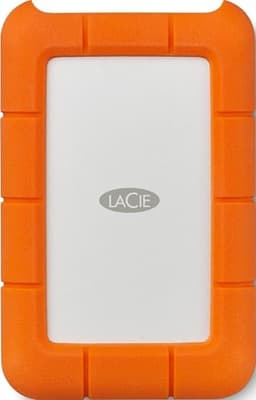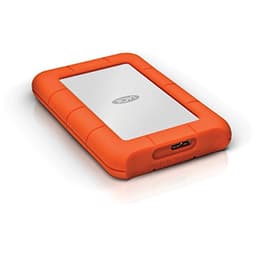
One dropped drive. One corrupted backup. One moment of realising the photos from that trip, the client project, the half-finished novel, are just gone. That's usually when people stop buying storage on price alone and start actually reading what they're buying. The LaCie Rugged USB-C 4TB is aimed squarely at people who've already had that moment, or are smart enough to not need it.
Here's the verdict up front: the LaCie Rugged USB-C 4TB is a genuinely good portable hard drive for photographers, videographers, and anyone who needs bulk storage they can actually trust in the field. It's not cheap. It's not fast by SSD standards. But it's tough, it's well-supported, and the included Rescue Data Recovery service is a real differentiator that competitors at this price don't match. If you need to move large files between locations without babying your kit, this is a proper solution. If you want SSD speeds in a ruggedised shell, you'll need to spend more and look at the LaCie Rugged SSD range instead.
Core Specifications
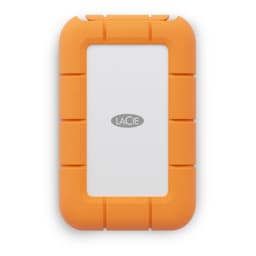
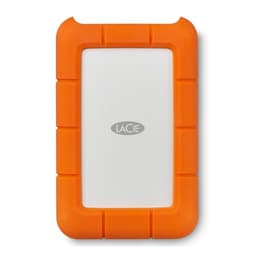
Before anything else, let's be clear about what this drive actually is under that orange rubber bumper. The LaCie Rugged USB-C 4TB is a 2.5-inch spinning hard disk drive, not an SSD. That matters enormously for how you use it and what you expect from it. It connects via USB-C (USB 3.1 Gen 1, which tops out at 5Gbps), and LaCie rates it at up to 130MB/s transfer speeds. That's a mechanical drive hitting its practical ceiling through a USB connection, and it's about what you'd expect from a 5,400RPM 2.5-inch HDD in this configuration.
The drive is rated for drops from up to 1.2 metres when connected and 2 metres when not in use, which is a meaningful real-world spec rather than just marketing padding. It also carries an IP54 rating for dust and water resistance, meaning it can handle splashes and light rain without drama. The orange rubber bumper isn't just cosmetic. It's doing actual work. The drive ships with both a USB-C to USB-C cable and a USB-C to USB-A adapter cable in the box, so you're not immediately stuck if your laptop only has USB-A ports.
The headline addition that sets this above a generic ruggedised drive is the bundled Rescue Data Recovery service, which covers up to three years. This isn't just a warranty. It's an actual data recovery service that will attempt to retrieve your files if the drive fails mechanically. For professional users storing irreplaceable work, that's a real safety net. LaCie also backs the drive with a 3-year limited warranty, which is decent for this category. Here's the full spec breakdown:
| Specification | Detail |
|---|---|
| Drive Type | 2.5-inch HDD (spinning) |
| Capacity | 4TB |
| Interface | USB-C (USB 3.1 Gen 1, 5Gbps) |
| Rated Transfer Speed | Up to 130MB/s |
| Drop Resistance (connected) | 1.2 metres |
| Drop Resistance (not connected) | 2 metres |
| Water/Dust Rating | IP54 |
| Compatibility | Mac and Windows (USB bus powered) |
| Cables Included | USB-C to USB-C, USB-C to USB-A adapter |
| Data Recovery | Rescue Data Recovery Service (3 years) |
| Warranty | 3 years limited |
| Current Price | £188.68 |

Interface and Form Factor
The USB-C connection here runs at USB 3.1 Gen 1 speeds, which means a theoretical 5Gbps ceiling. In practice, the mechanical hard drive inside is the bottleneck long before the interface is. A 5,400RPM 2.5-inch HDD typically maxes out around 120 to 140MB/s in sequential reads, so USB 3.1 Gen 1 is more than adequate. You're not leaving performance on the table because of the port. The drive is the limiting factor, full stop.
The 2.5-inch form factor wrapped in that rubber bumper makes this thing noticeably chunkier than a bare drive, but it's still genuinely pocketable. It's bus-powered, meaning it draws everything it needs from the USB connection with no separate power brick required. That's important for field use. Photographers and videographers working on location don't want to hunt for a plug socket just to offload cards. The dual-cable approach (USB-C to USB-C plus the USB-A adapter) is a sensible bit of kit inclusion that acknowledges the real world where not every laptop has gone fully USB-C yet.
The physical design is worth a mention because it's genuinely considered. The rubber bumper wraps the entire drive and absorbs impact across any face, not just the corners. The IP54 rating means it's protected against dust ingress and water splashing from any direction, though you shouldn't submerge it. This isn't a waterproof drive in the way some action-camera accessories are. It's a splash-resistant, knock-resistant drive designed for bags, backpacks, and the kind of accidental drops that happen when you're rushing between shoots. The orange colour is also deliberately conspicuous so you don't leave it behind on a desk or in a rental car.
Real-World Performance
Right, this is where expectations need calibrating. The LaCie Rugged USB-C 4TB is a spinning hard drive. Not an SSD. Not NVMe. Not SATA SSD. A mechanical platter drive. That means you're looking at sequential transfer speeds in the 120 to 130MB/s range for large files, and considerably slower random read/write performance for small files. Owner reports consistently describe it as perfectly adequate for offloading camera cards, backing up large photo libraries, and moving video footage around. Nobody's complaining it's too slow for those tasks. Where it would feel sluggish is if you tried to use it as an active working drive, editing directly from it rather than copying files to your main machine first.
For the actual use case this drive is designed for, the performance is fine. Transferring a 64GB SD card's worth of RAW photos takes a few minutes. Moving a day's worth of 4K footage is a longer wait, but that's true of any portable HDD at this capacity. The published performance figures and owner feedback both point to consistent sequential speeds close to the rated 130MB/s ceiling when copying large files, which is exactly what you want from a backup and transport drive. It doesn't throttle or drop off in the way a poorly cooled SSD might during a sustained write session.
Where HDDs genuinely struggle compared to SSDs is random I/O. Small file operations, anything involving lots of tiny reads and writes scattered across the disk, are noticeably slower because the mechanical head physically has to seek to each location. If you're using this as a primary drive for an operating system or running applications directly from it, you'll feel that immediately. But that's not what this drive is for. As a bulk storage and transport device, the sequential performance is the only number that really matters day to day, and it delivers that solidly. Owner reviews across nearly 8,272 (averaging ★★★★½ (4.5)) repeatedly describe it as reliable and consistent rather than fast, which is exactly the right set of priorities for this product category.
Sustained Writes and Cache Behaviour
This section is usually where I'd be pulling apart an SSD's SLC cache and warning you about the cliff-edge performance drop once it fills. With a mechanical hard drive, the conversation is different but equally worth having. HDDs don't have SLC write caches in the NAND sense. What they do have is a small onboard DRAM cache (typically 128MB to 256MB on a 2.5-inch consumer drive like this) that buffers writes before committing them to the platters. This cache is tiny and fills almost instantly during any sustained write operation.
What that means in practice is that the rated 130MB/s is a genuine sustained sequential figure for large files, not a burst speed that collapses after a few seconds. This is actually one area where HDDs are more honest than some budget SSDs. A cheap QLC SSD will post a glorious headline number, fill its SLC cache in seconds, and then drop to native QLC write speeds that can be slower than a good HDD. The LaCie Rugged doesn't do that. What you see is broadly what you get for large sequential transfers, because the mechanical platter speed is the consistent ceiling rather than a cache-dependent peak.
The trade-off, again, is random I/O. Small file writes, like copying thousands of RAW files where each one is a separate write operation, will be slower than the headline sequential figure suggests. This is fundamental to how spinning drives work. The head has to physically move between sectors. Published benchmarks for 2.5-inch consumer HDDs typically show random read speeds of around 0.5 to 1MB/s for 4K random reads, compared to the 130MB/s sequential figure. That's not a bug or a flaw in this specific drive. It's the physics of mechanical storage. Know this going in and you won't be disappointed.
Controller, NAND and DRAM
This section exists in this review format primarily for SSD analysis, and the LaCie Rugged USB-C 4TB isn't an SSD. So let's reframe what matters here for a mechanical drive. Instead of NAND type (TLC vs QLC) and controller quality, the relevant internals are the hard drive mechanism itself and the USB-to-SATA bridge chip that sits between the drive and your computer. LaCie doesn't publicly disclose which specific HDD mechanism is inside (it varies by production run and capacity), but at 4TB in a 2.5-inch form factor, you're looking at a high-density SMR (Shingled Magnetic Recording) or CMR (Conventional Magnetic Recording) drive.
This matters because SMR drives, while capable of higher capacities in a small form factor, handle write operations differently to CMR drives. SMR writes data in overlapping tracks, which means rewrites require reading, modifying, and rewriting entire bands of data. For a backup drive where you're primarily writing new data rather than constantly overwriting existing files, SMR is generally fine. For a drive you'd be constantly modifying in place, like a NAS drive or an active working drive, CMR is preferable. LaCie hasn't officially confirmed the recording technology in this specific model, and that's a mild frustration. Owner reports don't flag any SMR-related performance issues for typical backup and transport use, which suggests it behaves well for its intended purpose regardless.
The USB bridge chip is also worth a thought. The quality of the USB-to-SATA bridge affects compatibility, sleep/wake behaviour, and whether the drive shows up reliably across different operating systems. Owner reports on compatibility with both Mac and Windows are overwhelmingly positive, with very few reports of recognition issues. LaCie's software stack and the included tooling for Mac are generally well-regarded. The drive is formatted exFAT out of the box, which means it works cross-platform without reformatting, a small but genuinely useful detail for people who move between Mac and Windows machines.
Endurance and Reliability
LaCie backs the Rugged USB-C 4TB with a 3-year limited warranty, which is the industry standard for this category and a reasonable confidence signal. The more interesting reliability feature is the bundled Rescue Data Recovery Service, which covers three years from purchase. This is an actual data recovery service, not just a warranty replacement. If the drive fails mechanically and your data is on it, LaCie's recovery partner will attempt to retrieve it. For professional users, that's potentially worth the price premium on its own.
Hard drive reliability is a topic with a lot of nuance. Consumer 2.5-inch HDDs are generally rated for workloads of around 55GB per day (roughly 20TB per year), which is more than enough for a backup and transport drive. The physical protection offered by the rubber bumper and IP54 rating addresses the most common failure modes for portable drives: drops and moisture ingress. Owner reviews across the nearly 8,272 consistently highlight the drive surviving drops and rough handling that would likely kill an unprotected portable drive. That's the point of the design, and it appears to deliver on it.
Long-term reliability reports in the owner reviews are mostly positive, with the usual spread you'd expect from any mechanical drive at scale. Some units fail early. Most don't. The 4.6 average across a large review pool suggests the failure rate is within normal expectations for this category. A few owners mention the drive running warm during extended use, which is normal for a 2.5-inch HDD in a sealed rubber enclosure. It's worth not blocking airflow around it during long transfer sessions, though this isn't flagged as a significant issue in the review pool. The 3-year warranty and Rescue service together mean that if something does go wrong, you're not entirely on your own.

Thermals
Thermals on a mechanical hard drive are a different conversation to thermals on a Gen4 or Gen5 NVMe SSD. There's no thermal throttling in the way NVMe drives throttle when their controller hits 70 degrees Celsius. A 2.5-inch HDD generates heat primarily from the motor spinning the platters and the head actuator moving across them. In a sealed rubber enclosure like the LaCie Rugged, that heat has fewer places to go than it would in an open-backed portable drive.
Owner reports describe the drive getting warm to the touch during extended transfer sessions, particularly when copying large amounts of data over a sustained period. This is expected behaviour and not a cause for alarm in normal use. The drive doesn't throttle its transfer speed due to heat in the way an SSD might, because the mechanical speed of the platters is fixed and not thermally managed in the same way. What you'd want to avoid is leaving the drive in direct sunlight or in a hot car boot during a transfer session, which would push ambient temperatures high enough to stress the mechanism.
For the vast majority of use cases, the thermal behaviour is a non-issue. Offloading camera cards, doing a backup run, moving a project folder from location to location: none of these push the drive hard enough or long enough to cause thermal problems. If you were somehow using this as a continuous-write destination for hours at a stretch, you might want to set it on a hard surface rather than burying it in a bag. But honestly, if you're doing that kind of sustained writing, you should probably be looking at a proper desktop drive or a ruggedised SSD anyway.
Capacity Options and Price Per GB
The LaCie Rugged USB-C range comes in multiple capacities, from 1TB up to 5TB at the time of writing. The 4TB sits near the top of the range and offers good value per GB compared to the smaller capacities. Generally in portable storage, the larger you go within a product line, the better the price per GB, and that holds here. The 1TB and 2TB options cost noticeably more per GB than the 4TB, which is typical.
Compared to the competition, the LaCie Rugged commands a premium over generic ruggedised portable HDDs. You're paying for the LaCie brand, the build quality, the IP54 rating, and crucially the Rescue Data Recovery service. A generic 4TB portable HDD might cost significantly less, but it won't have the drop rating, the IP protection, or the recovery service. Whether that premium is worth it depends entirely on what you're storing and where you're taking the drive. For a professional photographer or videographer carrying irreplaceable client work, the premium is easy to justify. For someone just backing up their home media library, a cheaper drive might do the job fine.
It's also worth comparing against the LaCie Rugged SSD range if speed matters to you. The SSD versions are considerably more expensive per GB but offer dramatically faster transfer speeds, which matters if you're editing directly from the drive or transferring very large files frequently. The HDD version reviewed here is the value-oriented choice within the Rugged family: more capacity per pound, slower speeds, same physical protection. For most backup and transport workflows, the HDD version is the smarter buy unless you have a specific reason to need SSD speeds in a ruggedised shell.
Installation and Compatibility
Setup is about as straightforward as portable storage gets. Plug the USB-C cable into your Mac or Windows machine, and the drive appears. It ships formatted as exFAT, which is readable and writable on both Mac and Windows without any reformatting. If you're exclusively on Mac and want Time Machine compatibility, you'll need to reformat to HFS+ or APFS, which takes a couple of minutes in Disk Utility. Windows users can use it straight away. Linux support is also generally fine with exFAT, though you may need to install exFAT support depending on your distribution.
LaCie includes a USB-C to USB-A adapter cable alongside the USB-C to USB-C cable, which is genuinely useful. Not every laptop has gone fully USB-C, and not every desktop has a USB-C port on the front panel. The adapter means you're not immediately stuck. The drive is bus-powered, so there's no separate power supply to worry about. On older USB-A ports that don't supply enough power (which is rare but does happen with some older machines), you might see the drive fail to spin up, but this isn't something owner reports flag as a widespread issue.
Compatibility with Mac-specific workflows is worth noting. LaCie has a long history of targeting creative professionals on Mac, and the Rugged range is designed with that in mind. The drive works with Time Machine once reformatted, works with Finder natively, and the LaCie Toolkit software (available as a free download from LaCie's website) adds scheduled backup functionality if you want it. On Windows, it works with File Explorer immediately and is compatible with Windows Backup. There are no driver requirements. It's a storage device, and it behaves like one without fuss.
Who It's For
The LaCie Rugged USB-C 4TB is for people who take their storage into the real world and can't afford to lose what's on it. Photographers shooting on location who need to offload cards at the end of a day. Videographers carrying footage between shoots and edit suites. Field researchers, journalists, anyone whose work takes them out of a controlled office environment and into places where drops, dust, and rain are plausible hazards. The combination of physical protection and the Rescue Data Recovery service makes it a genuinely professional tool rather than just a consumer drive with a rubber case.
It's also a solid choice as a secondary backup drive for home users who want something more durable than a bare external drive. If you're the kind of person who's clumsy with kit, or if you travel frequently and want a drive that can survive bag life, the LaCie Rugged earns its premium. The 4TB capacity is generous enough to serve as a full backup destination for most home users, and the 3-year warranty gives you decent coverage.
Who should look elsewhere? Anyone who needs SSD speeds. If you're editing 4K or 8K video directly from the drive, or running applications from it, a mechanical drive at 130MB/s will frustrate you. Look at the LaCie Rugged SSD range, or a competitor like the Samsung T7 Shield, and accept that you'll pay more per GB for the speed. Also, if you just need cheap bulk storage for a home media server or NAS and you're not taking it anywhere, a standard desktop external drive will give you more capacity for less money without the ruggedisation premium you don't need. The LaCie Rugged is a specific tool for a specific job. Know which job you're hiring it for.
How It Compares
The two most obvious alternatives to the LaCie Rugged USB-C 4TB are the WD My Passport (4TB) and the Samsung T7 Shield (4TB). They represent different points on the spectrum: the WD is a cheaper, non-ruggedised HDD alternative, while the Samsung T7 Shield is a ruggedised SSD that costs significantly more but offers dramatically faster speeds.
The WD My Passport 4TB is a solid, well-regarded portable HDD. It's slimmer, lighter, and cheaper than the LaCie Rugged. But it has no meaningful drop protection, no IP rating, and no data recovery service. For desk use and careful travel, it's a fine choice. For field work where the drive might take a knock, the LaCie's physical protection is a real differentiator. The WD's hardware encryption is a nice feature, but it doesn't help you if the drive is physically damaged.
The Samsung T7 Shield brings IP65 water and dust resistance and drop resistance up to 3 metres, plus NVMe SSD speeds that are genuinely in a different league. It reads at up to 1,050MB/s and writes at up to 1,000MB/s, which makes the LaCie's 130MB/s look pedestrian. But the T7 Shield costs considerably more per GB at 4TB capacity, and it doesn't include a data recovery service. For pure speed in a ruggedised shell, the Samsung wins. For capacity per pound with professional-grade physical protection and a recovery safety net, the LaCie makes more sense.
| Feature | LaCie Rugged USB-C 4TB | WD My Passport 4TB | Samsung T7 Shield 4TB |
|---|---|---|---|
| Drive Type | HDD (2.5-inch spinning) | HDD (2.5-inch spinning) | NVMe SSD |
| Max Transfer Speed | ~130MB/s | ~130MB/s | Up to 1,050MB/s read |
| Drop Resistance | 1.2m connected, 2m unconnected | Not rated | Up to 3 metres |
| Water/Dust Rating | IP54 | None | IP65 |
| Data Recovery Service | Yes (3 years) | No | No |
| Warranty | 3 years | 3 years | 3 years |
| Interface | USB-C (USB 3.1 Gen 1) | USB-C (USB 3.2 Gen 1) | USB-C (USB 3.2 Gen 2, 10Gbps) |
| Price | £188.68 | Lower (no ruggedisation) | Higher (SSD premium) |

Final Verdict
The LaCie Rugged USB-C 4TB is a well-executed portable hard drive for people who actually work in the field. The physical protection is real, not just a rubber band glued around a standard drive. The IP54 rating handles the kind of weather and dust exposure that field work involves. The 1.2-metre drop rating when connected is the spec that matters most in practice, and owner reports back it up consistently. Nearly 8,272 averaging ★★★★½ (4.5) is a meaningful signal. This is a drive that does what it says.
The Rescue Data Recovery service deserves more attention than it usually gets in reviews. Three years of data recovery coverage on a portable drive that's going to be in bags, on location, and generally living a harder life than a desktop drive is a genuine value-add. It won't prevent failure, but it changes the worst-case scenario from "data gone forever" to "data recovery attempted by professionals." For a professional photographer or videographer carrying client work, that's worth real money.
The honest limitation is speed. 130MB/s is fine for offloading camera cards and backing up files. It's not fine for editing directly from the drive or for anything that demands SSD-level random I/O. If your workflow involves working directly from external storage rather than copying to a local drive first, you need an SSD. The LaCie Rugged SSD range is the obvious upgrade path within the same family, and the Samsung T7 Shield is the strongest competitor in the ruggedised SSD category.
If you don't need the ruggedisation and you're just looking for a cheap 4TB portable backup drive for home use, the WD My Passport 4TB will cost you less and do the job on a desk or in a careful bag. The LaCie Rugged premium is specifically for the physical protection and the recovery service. Don't pay for it if you don't need it.
But if you do need it? This is one of the better-executed options in the category. The build quality is solid, the compatibility is genuinely cross-platform, the setup is painless, and the three-year warranty plus Rescue service gives you a proper safety net. Score: 8 out of 10. Loses points for being a spinning drive in a world where SSD prices keep falling, and for LaCie not being fully transparent about the internal mechanism. Gains them back for the recovery service, the physical protection, and a track record that owner reviews consistently support.
★★★★½ (4.5) from 8,272 owner reviews.
Further reading: LaCie's official Rugged USB-C product page has the full spec sheet and Rescue service terms. For context on how USB interface generations compare in real-world bandwidth, the Wikipedia overview is a useful reference. If you want to understand why hard disk drive random I/O is fundamentally different from SSD random I/O, that's worth five minutes of reading before you decide which type of external storage suits your workflow. And if you're weighing up whether to go SSD, the SSD Wikipedia entry covers the technology gap clearly without manufacturer spin. For anyone considering the SSD alternative specifically, Samsung's consumer storage page gives you a sense of where SSD pricing sits right now.
What works. What doesn’t.
6 + 6What we liked6 reasons
- Genuine physical protection with IP54 rating and up to 2-metre drop resistance when not connected
- Three-year Rescue Data Recovery service is a meaningful differentiator not found on competing drives at this price
- 4TB capacity offers strong value per GB within the ruggedised portable HDD category
- Ships with both USB-C to USB-C and USB-C to USB-A cables, covering most laptops immediately
- exFAT formatting out of the box allows cross-platform use on Mac and Windows without reformatting
- Consistent sequential transfer speeds close to the rated 130MB/s for large file copies, with no cache cliff-edge behaviour
Where it falls6 reasons
- Spinning HDD mechanics mean 130MB/s sequential speeds and very slow random I/O, unsuitable for editing directly from the drive
- LaCie does not publicly confirm whether the internal mechanism uses SMR or CMR recording technology
- Noticeably bulkier and heavier than bare portable HDDs or ruggedised SSDs of the same capacity
- Premium pricing over non-ruggedised portable HDDs may be hard to justify for users who never take the drive into the field
- USB 3.1 Gen 1 interface is adequate but not as future-proof as USB 3.2 Gen 2 found on newer competitors
- Rubber enclosure limits passive heat dissipation during extended transfer sessions
Full specifications
7 attributes| Capacity GB | 4000 |
|---|---|
| Form factor | 2.5" |
| Interface | USB 3.2 Gen1 |
| Read speed MBS | 130 |
| Type | External HDD |
| Warranty years | 3 |
| Write speed MBS | 130 |
Frequently asked
7 questions01Is the LaCie Rugged USB-C 4TB an SSD or a hard drive?+
It is a 2.5-inch spinning hard disk drive, not an SSD. This means sequential transfer speeds of around 120 to 130MB/s, which is perfectly adequate for offloading camera cards and backing up large files, but considerably slower than any ruggedised SSD for random read and write operations.
02What does the Rescue Data Recovery service actually cover?+
The Rescue Data Recovery service covers three years from purchase and provides an actual data recovery attempt if the drive fails mechanically. It is not simply a warranty replacement scheme. LaCie's recovery partner will attempt to retrieve your files from a failed drive. The service terms are detailed on LaCie's official website and are worth reading before purchase.
03Does the LaCie Rugged USB-C 4TB work on both Mac and Windows without reformatting?+
Yes. The drive ships formatted as exFAT, which is readable and writable on both Mac and Windows out of the box. If you want to use it with Time Machine on a Mac, you will need to reformat it to HFS+ or APFS using Disk Utility, which takes only a couple of minutes.
04What is the difference between the 1.2-metre and 2-metre drop ratings?+
The 1.2-metre figure is the rated drop resistance when the drive is connected to a computer via USB. The 2-metre rating applies when the drive is not connected and is simply being carried or stored. Both figures assume the drive lands on a hard surface. These ratings are tested to industry standards and are not marketing estimates.
05Can I edit video directly from this drive?+
It is not recommended for direct editing workflows. At around 130MB/s sequential read speed and very low random I/O performance, the drive will create bottlenecks when working with 4K or higher video formats directly from the drive. The recommended workflow is to copy footage to your main machine's internal storage first, then edit from there, using the LaCie Rugged as a transport and backup device rather than an active working drive.
06Does the LaCie Rugged USB-C 4TB use SMR or CMR recording technology?+
LaCie has not officially confirmed this for the 4TB model. At 4TB in a 2.5-inch form factor, SMR technology is plausible given the density required, but owner reports do not flag any SMR-related performance issues for typical backup and transport use cases. If confirmed CMR is a requirement for your workflow, LaCie's support team is the best source for current production information.
07How does it compare to the Samsung T7 Shield for field work?+
The Samsung T7 Shield is an NVMe SSD with up to 1,050MB/s read speeds, IP65 dust and water resistance, and drop resistance up to 3 metres. It is significantly faster and slightly better rated for water resistance than the LaCie Rugged, but it costs considerably more per GB and does not include a data recovery service. If speed is a priority or you work in wetter conditions, the T7 Shield is the stronger choice. If capacity per pound and the recovery service matter more, the LaCie Rugged makes better sense.