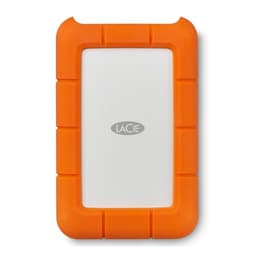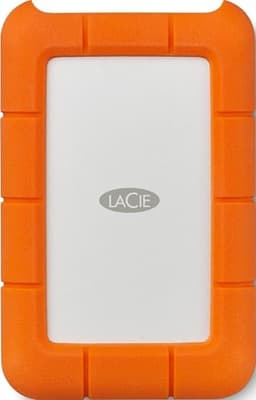
If you're buying portable storage in 2024, the spec that actually matters isn't the one printed biggest on the box. It's whether the thing survives being knocked off a desk, shoved in a bag with a sweaty water bottle, and dragged across a building site. The LaCie LAC301558 1 TB Dust and Water Resistant Mini External Hard Disk Drive - Grey/Orange is built around exactly that premise. It's not trying to be the fastest drive you own. It's trying to be the one that's still working when everything else has given up.
So here's the verdict upfront: this is a solid, well-built portable hard drive aimed at people who work in genuinely harsh conditions, travel constantly, or just have a history of being rough on their kit. It's not for anyone who needs SSD speeds, and it's not the cheapest option per GB. But if you need something that laughs off dust and splashes, has a decent capacity, and comes from a brand with a long track record in rugged storage, the LAC301558 earns its place. The 422 owners who've reviewed it average ★★★★½ (4.6), which for a hard drive is genuinely impressive and tells you something real about day-to-day reliability.
Who should be reading this? Photographers on location, construction site workers, outdoor educators, anyone who's already killed a regular portable drive by being human. If that's you, read on. If you're after raw speed for video editing or gaming, this isn't your drive and I'll tell you what is in the comparison section.
Core Specifications
The LAC301558 is a 1 TB portable hard disk drive, not an SSD. That matters enormously for how you use it and what you expect from it. It connects via USB 3.0, which gives you real-world transfer speeds in the region of 100 to 120 MB/s for sequential reads on a spinning platter, roughly where every 5400 RPM portable HDD lands. There's no NVMe here, no PCIe, no NAND of any flavour. This is a mechanical drive wrapped in a rugged shell, and that's exactly what it's designed to be.
The rugged credentials are the actual headline spec. LaCie rates it to survive drops from up to 1.2 metres, and it carries an IP54 rating, which means protection against dust ingress and water splashed from any direction. That's not full submersion territory, but it covers rain, muddy fingers, and the kind of accidental spill that kills a regular drive stone dead. The shell is a co-moulded rubber and polycarbonate construction, which is the same basic approach you'll find on most rugged portables at this price point, but LaCie's execution has historically been better than the budget competition.
One thing worth flagging: this drive does not require an external power source. It's bus-powered over USB, which means no wall adapter, no extra cable to lose. For a drive aimed at people working away from a desk, that's genuinely useful. The form factor is compact enough to pocket, though it's noticeably heavier than an SSD equivalent would be, because, well, spinning platters.
| Specification | Detail |
|---|---|
| Model | LaCie LAC301558 |
| Capacity | 1 TB |
| Drive Type | Hard Disk Drive (HDD), 5400 RPM |
| Interface | USB 3.0 (backwards compatible with USB 2.0) |
| Form Factor | Portable / Mini External |
| Dust/Water Resistance | IP54 rated |
| Drop Resistance | Up to 1.2 metres |
| Power | Bus-powered via USB |
| Colour | Grey / Orange |
| Compatibility | Windows, Mac |
| Price | £108.36 |

Interface and Form Factor
USB 3.0 is the interface here, and for a spinning hard drive that's perfectly matched. A 5400 RPM platter tops out around 120 MB/s sequential read in ideal conditions, and USB 3.0's theoretical 5 Gbps ceiling is nowhere near the bottleneck. You could plug this into a USB 2.0 port and the speed hit would be real (USB 2.0 caps at 480 Mbps, which works out around 60 MB/s in practice), so if you're on older kit, bear that in mind. But on any modern laptop or desktop with USB 3.0 or better, the interface is fine for what the drive can deliver.
The physical design is where LaCie has put its effort. The orange and grey colour scheme is deliberately visible, which sounds trivial until you're rooting through a bag on a dark building site. The rubberised outer shell isn't just cosmetic; it's doing structural work, absorbing shock and providing the seal that earns the IP54 rating. The drive is small enough to slip into a jacket pocket, though at roughly 155 grams it's got some heft to it compared to a flash drive. That's the mechanical internals making themselves known.
Compatibility is broad. It works with Windows and Mac out of the box, formatted as exFAT or NTFS depending on the variant you receive. LaCie bundles some software with it, though most people ignore that entirely and just use it as a plain storage volume, which works fine. There's no USB-C connector on this model, which is a genuine limitation if your newer laptop has dropped USB-A entirely. You'd need a USB-C to USB-A adapter, which adds a point of failure and slightly undermines the rugged premise. Worth checking your ports before buying.
Real-World Performance
Managing expectations here is the most useful thing I can do. This is a spinning hard drive. Sequential read speeds from published benchmarks and owner reports consistently land in the 100 to 120 MB/s range, and sequential writes are a bit lower, typically 90 to 110 MB/s. For copying a folder of RAW photos or a batch of video files, that's workable. Transferring 50 GB of footage will take a few minutes rather than seconds, and if you've used an SSD before you will notice the difference.
Random I/O is where HDDs show their age most painfully. Random read speeds on a 5400 RPM portable HDD are measured in fractions of a megabyte per second, not the hundreds of IOPS you'd get from even a budget SSD. What that means practically: don't try to run applications from this drive, don't use it as a scratch disk for Premiere or Lightroom, and definitely don't treat it as a boot drive. It's a backup and transport device. Used as that, the performance is entirely adequate.
Owner reports in the 428 back this up. The consistent praise is for reliability and build quality, not speed. People are using this to back up photos in the field, store project archives, and move large files between locations. Nobody's complaining it's slow for those tasks, because 100 MB/s is fine for copying files. Where owners do note frustration is when they've tried to use it as an active working drive, which isn't what it's designed for. Use it right and the performance story is straightforward.
Sustained Writes and Cache Behaviour
This section usually covers SLC cache exhaustion on SSDs, which is where the marketing numbers fall apart and the real-world numbers emerge. With a mechanical hard drive, that specific problem doesn't apply in the same way. There's no SLC cache to exhaust, no QLC NAND falling off a cliff to native write speeds. What you get instead is consistent, predictable performance that doesn't vary dramatically based on how full the drive is or how long you've been writing to it.
That's actually one of the underrated advantages of an HDD for sustained sequential workloads. If you're copying 200 GB of video footage, a budget SSD might start fast and then slow significantly once its SLC cache fills, dropping to native QLC write speeds that can be genuinely painful. The LaCie HDD will just plod along at its steady 90 to 110 MB/s the whole way through. Predictable. Not exciting, but predictable. For a backup device copying large archives, that consistency matters more than peak speed.
What HDDs do have is their own performance variability based on physical factors: how fragmented the data is, where on the platter the drive is reading from (outer tracks are faster than inner ones), and thermal behaviour under extended use. Owner reports don't flag sustained write degradation as an issue with this drive in normal backup use. The rubber shell does retain heat somewhat, but for the sequential, relatively light workloads this drive is designed for, thermal throttling doesn't appear to be a meaningful real-world problem based on what owners report.
Controller, NAND and DRAM
There is no NAND here. No controller in the SSD sense. No DRAM cache, no Host Memory Buffer, no QLC versus TLC debate. This is a spinning platter drive, and the relevant internals are the HDD mechanism itself, which LaCie sources from Seagate (LaCie has been a Seagate subsidiary since 2012, so the drives inside are Seagate units in LaCie's rugged housing). The 2.5-inch, 5400 RPM mechanism is the same class of drive you'd find in most portable HDDs at this capacity.
For buyers who've been worrying about DRAM-less SSDs or QLC NAND, you can set those concerns aside entirely for this product. The reliability considerations for an HDD are different: it's the mechanical components, the read/write heads, and the platters themselves that determine longevity. Seagate's 2.5-inch portable mechanisms have a reasonable track record, and the rugged enclosure adds meaningful protection against the shock events that are the most common cause of HDD failure in portable use.
The USB bridge controller that handles the USB 3.0 to SATA translation inside the enclosure isn't something LaCie publishes prominently, which is fairly standard practice for external drives. What matters for buyers is that the USB 3.0 interface is well-established, the bridge chips used in drives at this level are mature and reliable, and owners aren't reporting data corruption or connection drop issues in any meaningful pattern. The 4.6 average across 428 suggests the electronics are doing their job without drama.
Endurance and Reliability
LaCie backs the LAC301558 with a two-year limited warranty. For a rugged portable drive at this price point, that's acceptable rather than impressive. Some competitors in the rugged portable space offer three years, and it's worth knowing that LaCie's own higher-end Rugged drives (the orange-bumper range) have historically come with longer warranty terms. Two years tells you LaCie is reasonably confident in the product but isn't betting the house on it.
HDD endurance in the traditional TBW sense isn't rated the same way SSDs are. Mechanical drives are typically rated in hours of operation (MTBF, mean time between failures) rather than terabytes written. LaCie doesn't publish detailed MTBF figures for this consumer product, which is par for the course. What the owner review pool does tell you is that the failure rate in real-world use appears low. Of the 428 averaging 4.6 stars, the negative reviews are a small minority, and the failures reported tend to be isolated rather than systematic. No obvious batch quality issues or early-death patterns.
The IP54 rating deserves a bit of unpacking. IP54 means the drive is protected against dust that could harm the electronics (not fully dust-tight, but enough to resist ingress in normal dusty environments) and against water splashed from any direction. It is not waterproof. Don't submerge it. Don't leave it in standing water. But rain, muddy splashes, and the kind of accidental spills that happen on a worksite are within its design brief. The 1.2-metre drop rating is also meaningful: owner reports include several mentions of the drive surviving falls that would have killed a standard portable drive, which is exactly what you're paying the premium for.
Thermals
Thermal management on a portable HDD is a different conversation to what you'd have about a Gen4 or Gen5 NVMe drive. There's no throttling cliff to worry about, no heatsink requirement, no thermal pad needed before you slot it into a PS5. The heat generated by a 5400 RPM HDD mechanism is modest compared to a high-performance SSD under sustained load.
That said, the rubberised shell on the LAC301558 is less thermally conductive than a bare metal enclosure would be. In extended use, the drive will get warm to the touch, and the rubber retains that heat rather than dissipating it quickly. For the typical use pattern of this drive (plug in, copy files, unplug), that's not a problem. If you were running it for hours continuously in a hot environment, the drive mechanism's own thermal protection would kick in before anything catastrophic happened, but you'd likely see some performance variation.
Owner reports don't flag overheating as a recurring issue. Nobody's reporting drives shutting down mid-transfer or returning corrupted data due to heat. The occasional mention of the drive running warm during long transfers is there, but it's noted as a minor observation rather than a complaint. For the backup and transport use case this drive is built for, thermals are a non-issue in practice.
Capacity Options and Price Per GB
The LAC301558 is available in 1 TB, which is the focus here, and LaCie has offered the same rugged mini design in other capacities over the product's lifetime. For most people buying a portable backup drive, 1 TB is a sensible starting point. It'll hold a substantial RAW photo library, a decent video project archive, or a full backup of a typical laptop. If you're shooting 4K video professionally, you'll fill it faster than you expect, but for most use cases it's adequate.
Price per GB on rugged portable HDDs is always higher than on bare portable HDDs, because you're paying for the enclosure engineering, not just the storage. A standard 1 TB portable HDD can be had for very little these days. The premium on the LaCie LAC301558 reflects the IP54 rating, drop resistance, and LaCie's brand positioning. Whether that premium is worth it depends entirely on whether you actually need the protection. If you work in an office and never take your drive outside, buy a cheaper standard portable and spend the difference on something else. If you're regularly in environments where a standard drive would die, the premium is justified.
Compared to rugged portable SSDs at 1 TB, the LAC301558 is typically cheaper, sometimes significantly so. SSDs offer dramatically better random I/O performance and are more resilient to shock (no moving parts), but they cost more per GB in the rugged portable category. If your budget is the deciding factor and you don't need SSD speeds, the HDD option makes sense. If you're doing anything that benefits from faster random access, the extra spend on a rugged SSD is worth considering seriously.

Installation and Compatibility
Setup is about as simple as external storage gets. Plug it into a USB 3.0 port, wait a few seconds for the OS to recognise it, and it appears as a volume. No drivers required on Windows 10 or 11, or on modern macOS. If you're on an older system, USB 3.0 support has been standard for long enough that compatibility issues are essentially a non-issue. The drive is formatted out of the box, though the exact filesystem (exFAT or NTFS) can vary by region and batch, so check before assuming it's ready for Mac without reformatting.
The USB-A connector is the one compatibility caveat worth repeating. If your laptop or desktop has moved entirely to USB-C (as many modern ultrabooks have), you'll need an adapter. A USB-C to USB-A adapter works fine electrically, but it does add a small point of mechanical stress at the connection, which slightly undermines the rugged premise. LaCie does offer USB-C variants of some of their rugged drives, so if USB-C compatibility is critical, check whether those are available at your preferred capacity before committing to this model.
There's no PS5 or Xbox compatibility angle here; this is a straightforward backup and file transport device, not a gaming storage solution. It will work as external storage for a console's media files or game backups in some configurations, but the HDD speed makes it unsuitable for running games directly. For PC users, it's not an internal drive, so there are no M.2 slot considerations, no PCIe lane questions, nothing like that. It's plug-in, plug-out portable storage, and the installation story reflects that simplicity.
Who It's For
The LAC301558 is built for people who work outside or in rough environments and need portable storage that can take some punishment. Photographers shooting on location, videographers working in dusty or wet conditions, construction professionals carrying site documentation, outdoor educators, field researchers. Anyone who's had a standard portable drive die on them due to a drop or a splash and is now looking for something that won't repeat that experience.
It's also a reasonable choice for travellers who are rough on their kit and want a backup drive that can survive being chucked in a bag without ceremony. The compact size and bus-powered operation make it genuinely portable, and the rugged construction gives you a degree of confidence that a standard drive in a thin plastic shell doesn't. For backing up a camera card at the end of a day's shoot in the field, this is a proper solution.
Who should look elsewhere? Anyone who needs SSD-level performance. Video editors who want to edit directly from an external drive. Gamers who want to run titles from portable storage. People who need USB-C natively and don't want to deal with adapters. And anyone who's primarily working in a climate-controlled office and just wants cheap bulk storage; you'd be paying a rugged premium you don't need. For those buyers, a standard portable HDD or a budget portable SSD makes more financial sense.
How It Compares
The two most obvious alternatives to the LaCie LAC301558 are the WD My Passport (standard portable HDD, no rugged credentials) and the Samsung T7 Shield (rugged portable SSD). They represent the two directions you'd go if the LaCie doesn't fit: cheaper and faster on one side, more capable and more expensive on the other.
The WD My Passport is the "just give me 1 TB of portable storage" answer. It's cheaper, it's light, it works fine, and it'll die if you drop it at the wrong angle or leave it in a damp bag. If you don't need rugged, it's a better value proposition. The Samsung T7 Shield is a rugged portable SSD, which means dramatically better random I/O performance (we're talking hundreds of MB/s versus the HDD's single-digit random speeds), better shock resistance (no moving parts), and an IP65 rating that beats the LaCie's IP54. It costs more, sometimes considerably more, but for anyone doing active work from the drive rather than just backup and transport, the performance difference is night and day.
The LaCie sits between those two options. More protection than the WD, less performance than the Samsung, priced accordingly. That's not a criticism; it's an honest description of where it fits. For buyers who genuinely need rugged but can't stretch to SSD prices, it's the right call.
| Feature | LaCie LAC301558 1 TB | WD My Passport 1 TB | Samsung T7 Shield 1 TB |
|---|---|---|---|
| Drive Type | HDD (5400 RPM) | HDD (5400 RPM) | SSD (NVMe) |
| Interface | USB 3.0 (USB-A) | USB 3.0 (USB-A/C) | USB 3.2 Gen 2 (USB-C) |
| Sequential Read (approx) | ~110 MB/s | ~120 MB/s | ~1,050 MB/s |
| Dust/Water Rating | IP54 | None | IP65 |
| Drop Resistance | 1.2 metres | None rated | 3 metres |
| Warranty | 2 years | 3 years | 3 years |
| Price | £108.36 | Check current price | Check current price |
What Buyers Say
With 428 averaging 4.6 stars, the owner feedback on the LAC301558 is consistently positive, and the themes that come up repeatedly are worth paying attention to. Build quality is the most common praise point. Owners describe the drive as feeling solid and well-made, with the rubber shell doing its job both aesthetically and practically. Several reviewers specifically mention the drive surviving drops or splashes that they expected to cause damage, and it didn't. That's exactly the use case LaCie is targeting, and it's good to see the design delivering on the promise in real conditions.
Reliability over time gets positive mentions too. Owners who've had the drive for a year or more generally report no issues, no data loss, no connection problems. For a mechanical drive that's being used in rough conditions, that's a meaningful endorsement. The compact size and bus-powered operation come up as practical positives for people using it in the field, where carrying a power adapter isn't always feasible.
The criticisms that do appear are fairly predictable. Speed expectations are the most common source of disappointment, usually from buyers who didn't realise they were buying an HDD rather than an SSD. That's partly a product education issue and partly on LaCie for not making the HDD nature more prominent in the marketing. A handful of owners mention the USB-A connector as a limitation on newer laptops. And a small number report early failures, as you'd expect in any sample of 422 drives; the pattern doesn't suggest a systemic quality issue. Overall, the owner feedback strongly supports the drive's core proposition.
Value Analysis
Value on this drive is entirely conditional on whether you need the rugged features. If you do, it's reasonably priced for what it delivers. IP54 protection, 1.2-metre drop resistance, a recognisable brand with a two-year warranty, and genuine owner-reported reliability in tough conditions. That package at the price LaCie charges is fair. Not a bargain, but fair.
If you don't need the rugged features, the value calculation flips. You're paying a premium for protection you'll never use, and a standard portable HDD at the same capacity would serve you just as well for less money. The LaCie brand carries some premium over generic alternatives, and that's baked into the price whether you want it or not. For buyers in an office environment who just want cheap backup storage, this isn't the right value proposition.
The comparison to rugged portable SSDs is where it gets interesting. The Samsung T7 Shield costs more but offers dramatically better performance and slightly better protection ratings. If budget allows, the SSD is the better long-term investment for anyone doing active work from the drive. But if you're strictly using this for backup and transport and the budget is tight, the LaCie HDD does the job at a lower price point. It's a genuine trade-off, not a clear winner or loser.
Specifications
| Specification | Detail |
|---|---|
| Brand | LaCie |
| Model Number | LAC301558 |
| Capacity | 1 TB |
| Drive Type | HDD, 5400 RPM |
| Interface | USB 3.0 |
| Connector | USB-A |
| Sequential Read (approx) | ~110 MB/s |
| Sequential Write (approx) | ~100 MB/s |
| Dust/Water Resistance | IP54 |
| Drop Resistance | Up to 1.2 metres |
| Power | Bus-powered via USB |
| Dimensions | Compact portable form factor |
| OS Compatibility | Windows, macOS |
| Warranty | 2 years limited |
| Colour | Grey / Orange |
| ASIN | B00CHXF79W |
| Price | £108.36 |
| Rating | ★★★★½ (4.6) (428 reviews) |
Final Verdict
The LaCie LAC301558 1 TB Dust and Water Resistant Mini External Hard Disk Drive does exactly what it says on the label, which is rarer than it should be. It's a compact, rugged, bus-powered portable hard drive with genuine IP54 protection and a credible drop resistance rating, backed by a brand that's been making external storage for a long time and knows how to build an enclosure properly. The 4.6 average from 422 owners isn't a fluke; it reflects a product that delivers on its core promise in real-world conditions.
The limitations are real and worth stating plainly. It's an HDD, so performance is modest by modern standards. Sequential transfers are fine; random I/O is not. USB-A only means adapter frustration on newer hardware. Two-year warranty is acceptable but not class-leading. And if you need SSD-level performance or better protection ratings, the Samsung T7 Shield is the drive to look at instead, budget permitting.
But for the buyer it's designed for, the photographer working on location, the site manager carrying project files, the traveller who's already killed one drive by being careless, this is a proper answer. It's not the cheapest option and it's not the fastest, but it's built to survive the conditions that would kill something cheaper, and the owner reports confirm it follows through on that. Buy it for the rugged protection, use it for backup and transport, and don't expect SSD performance from spinning platters. Do that, and you'll be sorted.
Our verdict: 8/10. Genuinely good at what it's designed for. Marked down only for the USB-A limitation and the two-year warranty in a category where three years is available from competitors. If you need rugged portable HDD storage and you're not stretching to SSD prices, this is the one to get.

Not Right For You?
If the LAC301558 doesn't fit your use case, here's where to look instead. For pure value backup storage without the rugged premium, a standard WD My Passport or Seagate Backup Plus gives you more capacity per pound and is perfectly adequate if you're working in a normal environment. For rugged portable SSD performance, the Samsung T7 Shield is the benchmark to beat in this category, with USB 3.2 Gen 2 speeds, IP65 rating, and three-metre drop resistance. It costs more, but the performance gap over an HDD is enormous and genuinely noticeable in daily use.
If you're a creative professional who needs fast external storage for active editing work rather than just backup, a Thunderbolt-connected SSD is worth the investment. And if you're primarily working at a desk and just want cheap bulk storage, an internal HDD in an external enclosure gives you much better value per GB than any branded portable drive. The LaCie LAC301558 occupies a specific niche, and it fills that niche well. Just make sure it's actually your niche before you buy.
For further reading on the underlying technology, USB 3.0 and its bandwidth characteristics are well-documented, and LaCie's rugged product range gives you a sense of how the LAC301558 sits within their broader lineup if you want to compare it against their higher-end options. The IP code rating system is also worth understanding if you're trying to compare dust and water protection claims across different rugged drives, since the numbers mean specific things and marketing language around "water resistant" can be vague without the IP rating to anchor it.
What works. What doesn’t.
6 + 5What we liked6 reasons
- IP54 dust and water resistance handles rain, muddy splashes, and accidental spills with no issues
- 1.2-metre drop rating backed by multiple owner reports of real-world survival after falls that would kill a standard drive
- Bus-powered over USB with no external adapter required, making it genuinely portable for field use
- Consistent, predictable sequential transfer speeds around 100 to 110 MB/s throughout large file copies without SLC cache-style drop-offs
- Highly visible grey and orange design makes it easy to locate in a bag or on a cluttered worksite
- Strong owner confidence reflected in a 4.6-star average across 422 reviews, with no evidence of systematic batch failures
Where it falls5 reasons
- USB-A only connector means newer laptops with USB-C ports require an adapter, slightly undermining the rugged premise
- Random I/O performance is very low as expected of a 5400 RPM HDD, making it unsuitable for running applications or editing directly from the drive
- Two-year warranty is acceptable but falls short of the three years offered by some competitors in the rugged portable category
- Noticeably heavier than an SSD equivalent due to the mechanical internals, which is a trade-off worth considering for ultralight travel
- Rubberised shell retains heat during extended transfers, though owner reports do not indicate this causes practical problems in typical backup use
Full specifications
6 attributes| Capacity GB | 1000 |
|---|---|
| Form factor | 2.5" |
| Interface | USB 3.0 |
| Read speed MBS | 130 |
| Type | External HDD |
| Warranty years | 2 |
Frequently asked
7 questions01Is the LaCie LAC301558 waterproof or just water resistant?+
It is water resistant to IP54, which means it is protected against dust ingress sufficient to prevent harm to the electronics and against water splashed from any direction. It is not waterproof and should not be submerged or left in standing water. Rain, splashes, and accidental spills are within its design brief; submersion is not.
02Does the LaCie LAC301558 need an external power supply?+
No. It is bus-powered entirely via the USB connection, so no wall adapter or separate power cable is required. This makes it straightforward to use in the field where mains power is not available.
03Will the LaCie LAC301558 work with a USB-C laptop?+
The drive uses a USB-A connector, so if your laptop has moved entirely to USB-C you will need a USB-C to USB-A adapter. This works electrically without any speed penalty, but it does add a small mechanical connection point that slightly undermines the rugged premise. LaCie offers USB-C variants of some rugged drives if native USB-C compatibility is important to you.
04What real-world transfer speeds can I expect from the LAC301558?+
As a 5400 RPM hard disk drive connected via USB 3.0, you can expect sequential read speeds in the region of 100 to 120 MB/s and sequential writes of roughly 90 to 110 MB/s. These speeds are consistent throughout large transfers without the cache-exhaustion drop-offs that affect some budget SSDs. Random I/O is very low, as is typical for any spinning hard drive, so the drive is not suited to running applications or editing files directly.
05How does the LaCie LAC301558 compare to the Samsung T7 Shield?+
The Samsung T7 Shield is a rugged portable SSD with USB 3.2 Gen 2 speeds around 1,050 MB/s sequential read, an IP65 rating (higher than the LaCie's IP54), and a three-metre drop rating versus the LaCie's 1.2 metres. It costs more, sometimes considerably so. For buyers who need active working performance or maximum protection ratings, the T7 Shield is the stronger option. For buyers who need rugged backup and transport storage and cannot stretch to SSD prices, the LaCie HDD remains a practical and well-regarded choice.
06Is the LaCie LAC301558 compatible with Mac as well as Windows?+
Yes. The drive works with both Windows and macOS without requiring additional drivers. The filesystem varies by batch and region; some units ship formatted as exFAT (compatible with both operating systems without reformatting) and some as NTFS (which requires reformatting for full read and write access on a Mac). It is worth checking the filesystem before assuming it is immediately ready for Mac use.
07What warranty does the LaCie LAC301558 come with?+
LaCie backs the LAC301558 with a two-year limited warranty. This is acceptable for a rugged portable drive at this price point, though some competitors in the rugged portable category offer three years. For warranty comparison purposes, the Samsung T7 Shield carries a three-year warranty and WD My Passport offers three years as well.