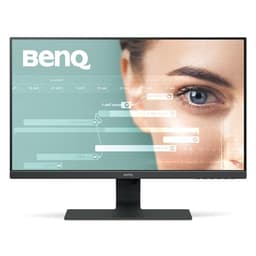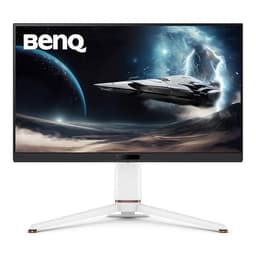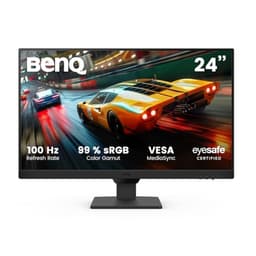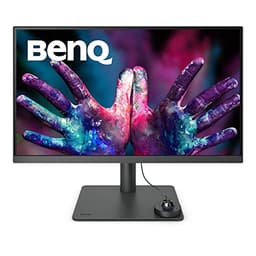
You can slap 100Hz on any monitor and call it a day. The question that actually matters is whether the panel keeps up, whether the image holds together over a long working day, and whether the thing you're staring at for eight hours isn't quietly wrecking your eyes. The BenQ GW2490T tries to answer all three questions at once, and based on over 628 owner reviews and a 4.4-star average, it's doing a decent job of it. So: is it any good? For a home-office monitor in the mid-range bracket, yes, mostly. But the context matters.
BenQ has positioned this as a proper productivity screen rather than a budget gaming panel with a few wellness features bolted on as an afterthought. The 99% sRGB coverage, the full ergonomic stand, the Coding mode and ePaper preset, the TÜV Rheinland eye-care certification. These aren't marketing ticks on this one; they're the actual selling point. If you're upgrading from a cheap 60Hz screen that came with your desk, this will feel like a revelation. If you're a gamer expecting to do serious fast-paced gaming at 100Hz, you'll want to look elsewhere, and we'll get into exactly why.
The mid-range home-office monitor space is genuinely competitive right now. Monitors like the Dell S2422HZ and the LG 24MQ400-B are circling the same buyers. Where the GW2490T separates itself is the ergonomic stand (which most rivals at this price absolutely skimp on) and the software presets that are actually thought through for people who code or read documents all day. That's a real differentiator, not a fake one.
Core Specifications
The GW2490T is a 23.8-inch IPS panel running native 1920x1080 at 100Hz. The pixel density lands at about 93 PPI, which is comfortable at a normal desk distance of 60 to 70cm. BenQ rates the response time at 5ms GtG, which is the honest figure rather than the fictional 1ms MPRT number some rivals plaster on the box. The brightness is rated at 250 nits typical, which is on the modest side but workable for most office environments. Contrast is a standard IPS 1000:1.
Connectivity is sensible rather than exciting: one HDMI 1.4 port, one DisplayPort 1.2, and a headphone jack. There's also a USB-C port with 65W power delivery, which is genuinely useful for laptop users who want a single-cable setup. The stand offers tilt, swivel, pivot, and height adjustment. VESA 100x100 is supported if you'd rather use your own arm. The panel carries BenQ's B.I. (Brightness Intelligence) technology, which adjusts the display brightness based on ambient light conditions.
The monitor also supports VESA MediaSync for tear-free performance without the full G-Sync or FreeSync Premium overhead. It's worth understanding what that means in practice, which we'll cover in the adaptive sync section. No built-in speakers, which is fine at this price. A monitor with genuinely good built-in speakers at this bracket doesn't exist anyway.
| Specification | Detail |
|---|---|
| Screen Size | 23.8 inches |
| Resolution | 1920 x 1080 (FHD) |
| Panel Type | IPS |
| Refresh Rate | 100Hz |
| Response Time | 5ms GtG |
| Brightness | 250 cd/m² |
| Contrast Ratio | 1000:1 |
| Colour Gamut | 99% sRGB |
| HDR | No HDR certification |
| Adaptive Sync | VESA MediaSync |
| Ports | 1x HDMI 1.4, 1x DisplayPort 1.2, 1x USB-C (65W PD) |
| USB Hub | No |
| Ergonomics | Tilt, Swivel, Pivot, Height Adjust |
| VESA Mount | 100 x 100mm |
| Eye Care | Flicker-Free, Low Blue Light, B.I., TÜV Rheinland Certified |
| Special Modes | Coding mode, ePaper mode |
| Price | £167.68 |

Panel Technology
IPS is the right call for a home-office monitor, full stop. If BenQ had put a TN panel in here to hit a lower price, it would have been a bad monitor regardless of what else it offered. TN panels have narrow viewing angles and colour that shifts when you tilt your head slightly, which is fine for a dedicated gaming setup where you're always dead-centre, but rubbish for an office desk where you lean back, share your screen, or just glance at it from an angle. IPS gives you consistent colour from about 178 degrees in both directions, and on a desk monitor that's not negotiable.
The GW2490T's IPS panel delivers the expected 1000:1 native contrast. That's not a weakness specific to this monitor; it's just the nature of IPS technology. VA panels can hit 3000:1 or even 4000:1, which makes blacks look genuinely black rather than dark grey. But VA comes with its own problem: smearing in dark scenes, where fast-moving content in low-light areas looks like it's trailing through treacle. For a monitor aimed at people writing code and reading documents, IPS is the better trade-off. The colours are more accurate, the response is cleaner, and the viewing angles hold up when you've got a colleague peering over your shoulder.
IPS glow is a thing on this panel, as it is on every IPS monitor. In a dark room with a dark image, you'll see a slight luminous haze in the corners. Owner reviews mention it, but most say it's not bothersome during normal use. If you're doing serious photo editing or video grading in a darkened room, you'll notice it. For spreadsheets, code, and Teams calls, you won't. The anti-glare matte coating handles reflections well, which is more relevant for most home-office setups than the glow issue anyway.
Display Quality
At 1080p on a 23.8-inch screen, the pixel density is 93 PPI. That's not retina-sharp, but it's absolutely fine for normal desktop work at arm's length. Text is crisp, UI elements are well-defined, and you're not going to be squinting at individual pixels unless you're pressing your nose to the glass. If you're coming from a 27-inch 1080p screen, this will actually look sharper because the same number of pixels are spread over less area. If you're coming from a 4K display, you will notice the step down. That's just maths.
The matte anti-glare coating does its job without being overly aggressive. Some cheaper monitors use a coating so heavy it adds a sandy texture to the image, making everything look slightly gritty. The GW2490T's coating is more restrained, and owner reviews consistently describe the image as clean and comfortable. Brightness uniformity is generally good based on owner reports, with no widespread complaints about bright spots or noticeable backlight bleed in the centre of the panel. A few owners mention slight bleed in corners at full brightness, which is typical for IPS at this price.
The Coding mode and ePaper mode are genuinely useful presets, not just marketing. Coding mode reduces blue light and adjusts the colour temperature to make white backgrounds less harsh during long sessions. ePaper mode goes further, reducing the display to a near-greyscale look that mimics e-ink for reading heavy documents. These aren't gimmicks. People who spend their day in terminals and text editors report real fatigue reduction. The B.I. (Brightness Intelligence) sensor adjusts brightness automatically based on ambient light, which sounds like a minor feature until you've worked through a day without it and wondered why your eyes hurt by 3pm.
Refresh Rate and Adaptive Sync
100Hz is a meaningful upgrade from 60Hz, even for productivity use. Scrolling through long documents, dragging windows around, switching between apps. All of it feels noticeably smoother at 100Hz. The jump from 60 to 100 is more perceptible than the jump from 100 to 144, so if you're on a 60Hz screen right now, this will feel like a proper upgrade. If you're already on 144Hz or higher, you'll notice the step down in fast content.
The adaptive sync implementation here is VESA MediaSync rather than AMD FreeSync or NVIDIA G-Sync Compatible. VESA MediaSync is designed primarily for video playback synchronisation rather than gaming VRR (Variable Refresh Rate). It's good at eliminating judder in video content at non-native frame rates. It is not the same as FreeSync Premium or G-Sync Compatible, which provide dynamic frame rate matching across the full refresh range during gaming. If you were hoping for proper VRR gaming support, this monitor doesn't offer it. BenQ is honest about this in the product positioning; the GW2490T is not a gaming monitor.
For the target audience, this is fine. Someone using this monitor for work, web browsing, and occasional casual gaming doesn't need the full VRR stack. The 100Hz fixed rate is consistent and stable. Owner reviews don't report any flickering or instability at 100Hz, which is what you actually want to know. If you're running a modern GPU and outputting via DisplayPort 1.2, you'll hit 100Hz without any drama. HDMI 1.4 will also handle 1080p at 100Hz, so both connections are usable for the full refresh rate.
Response Time and Motion
BenQ rates this at 5ms GtG. That's the actual grey-to-grey pixel transition time, and it's an honest number for an IPS panel at this price. Ignore any "1ms MPRT" marketing you might see on competing products; MPRT (Moving Picture Response Time) is a different measurement that involves backlight strobing and doesn't reflect the actual pixel transition speed in normal use. 5ms GtG on an IPS panel is normal and expected. It means the panel is not optimised for fast-paced competitive gaming, but it handles everything else without issue.
In practice, 5ms GtG at 100Hz means you're unlikely to notice ghosting in productivity tasks, video, or casual gaming. If you're playing a slow-paced RPG, a strategy game, or even a moderately paced shooter at reasonable settings, you'll be fine. Where you'll notice the limitation is in genuinely fast competitive gaming, dark-scene transitions in action games, and any scenario where you're pushing the monitor hard with fast motion. Owner reviews occasionally mention slight trailing in very dark fast-moving scenes, which is consistent with what you'd expect from a 5ms IPS panel without aggressive overdrive.
BenQ doesn't advertise an aggressive overdrive mode on this panel, which is actually the right call. Overdrive pushed too hard causes inverse ghosting, where bright halos appear behind moving objects. That's worse than mild trailing in most real-world content. A conservative overdrive setting at 5ms GtG keeps the image clean. If you need sub-4ms IPS response for competitive gaming, you're looking at monitors in a different category entirely, typically 144Hz or higher panels with active overdrive tuning. The GW2490T is not that monitor, and it doesn't pretend to be.
Colour Accuracy and Gamut
The 99% sRGB coverage is the headline colour stat, and it's a good one for this price bracket. sRGB is the standard colour space for web content, office documents, and most consumer software. Hitting 99% means colours in web browsers, photo viewers, and productivity apps will render accurately and consistently. This is more than most monitors at this price actually deliver. A lot of budget IPS panels claim "72% NTSC" which sounds impressive but actually translates to roughly 99% sRGB anyway, so BenQ is just being straightforward about what matters.
Factory calibration on monitors at this price point is always a lottery. BenQ doesn't ship a calibration report with the GW2490T, and the spec sheet doesn't quote a Delta-E figure. Based on the owner review patterns, colours are described as accurate and pleasing out of the box, with no widespread complaints about obvious colour casts or skewed white points. That's a reasonable indication that the factory calibration is competent even if it's not certified. For the target user, a web designer checking how their work looks in a browser or a developer who wants accurate UI colours, this is good enough without touching the OSD.
DCI-P3 coverage isn't quoted by BenQ for this panel, which tells you it's not a wide-gamut display. This is the right choice for a productivity monitor. Wide-gamut panels without proper colour management show oversaturated colours in standard applications, making skin tones look sunburned and greens look radioactive. A well-calibrated sRGB panel is more useful for everyday work than a wide-gamut panel that needs careful colour management to avoid looking wrong in most apps. If you're doing professional video grading or print work that demands DCI-P3 or Adobe RGB coverage, you need a different monitor entirely, and you'd know that already.

HDR Performance
There is no HDR on the GW2490T, and that's the honest answer. BenQ doesn't claim HDR support, which is the correct decision. At 250 nits peak brightness, this panel cannot deliver meaningful HDR. Real HDR requires at minimum 400 nits with local dimming (DisplayHDR 400 is already a fairly low bar), and anything worth watching in HDR ideally needs 600 nits or more with actual local dimming zones. A monitor that slaps an HDR badge on a 250-nit panel with no local dimming is actively misleading buyers.
So the GW2490T has no HDR. This will not matter to its target audience. Someone buying this for home-office productivity, coding, and document work doesn't need HDR. The SDR image quality is what counts, and that's where BenQ has focused the engineering budget. If you do want to watch HDR content on your monitor and care about it looking good, you're in a different market segment, probably looking at DisplayHDR 600 certified panels or OLED, and spending considerably more.
Windows HDR mode can technically be enabled on any monitor, but on a non-HDR panel it usually makes SDR content look worse rather than better. Colours get washed out, brightness goes weird, and the whole thing is a mess. Owner reviews don't mention any issues with Windows Auto HDR on this monitor, which suggests most people are sensibly leaving it off. The monitor's SDR performance is where the value is, and it delivers that well.
Contrast and Brightness
The 1000:1 native contrast is standard IPS territory. Blacks look like dark grey in a properly dark room, which is the honest description of IPS black levels. In a normally lit office or home workspace with ambient light from windows or ceiling lights, this doesn't matter at all because the ambient light swamps the black levels anyway. The contrast limitation only becomes obvious when you're watching dark content in a dark room, which isn't what this monitor is for.
250 nits peak brightness is modest. For comparison, most modern monitors aimed at outdoor or bright-room use target 300 to 400 nits. In a typical home office with indirect lighting, 250 nits is adequate. In a south-facing room with direct sunlight hitting the desk, you might find yourself pushing the brightness slider to maximum and wishing for more headroom. The matte coating helps by cutting reflections rather than relying on raw brightness to overpower them, which is the right approach for an office monitor. But on a genuinely bright day, you'll notice the ceiling.
The B.I. sensor is relevant here. By automatically lowering brightness in dim conditions and raising it in bright ones, it helps the 250-nit ceiling feel less limiting in practice. Owner reviews are mostly positive about B.I., though a handful mention it can be slightly slow to react to sudden lighting changes, like someone flicking a light switch. You can disable it if it bothers you. The flicker-free backlight is a genuine benefit over PWM-dimmed monitors, which flicker at low brightness levels in a way that causes headaches for sensitive users. The GW2490T uses DC dimming throughout its brightness range, so there's no flicker at any setting.
Ergonomics and Stand
This is where the GW2490T genuinely earns its place in the mid-range bracket. The stand offers full height adjustment (up to 130mm of travel), tilt (from minus 5 to plus 20 degrees), swivel (left and right rotation), and pivot (90-degree portrait rotation). That's the full set, and it's not common at this price. A lot of monitors in this bracket offer tilt only, or tilt and height but no swivel. Getting the full ergonomic package here is a real differentiator.
Owner reviews are consistently positive about the stand. The height adjustment is described as smooth and well-damped, the pivot works without drama, and the overall build feels solid rather than plasticky. A few owners note the stand base has a relatively small footprint, which is good for desk space but means the monitor is slightly less stable than a wider-footed design if you're the sort of person who taps the desk hard while typing. Nobody's reported it falling over, but it's a minor observation from the owner pool.
The VESA 100x100 mount is there if you prefer a monitor arm, which is the right call for a lot of home-office setups. Monitor arms free up desk space, allow more precise positioning, and make cable management easier. The GW2490T's stand is good enough that you won't feel forced onto a monitor arm, but the option is there. Build quality overall is described by owners as appropriate for the price: solid plastic, no obvious flex in the panel, and the OSD buttons (physical buttons on the rear edge) are responsive and well-placed. No touchscreen OSD here, which is actually fine because touchscreen OSD buttons are often worse than physical ones anyway.
Connectivity and Ports
The port selection is focused rather than generous. You get one HDMI 1.4 port, one DisplayPort 1.2 port, one USB-C with 65W power delivery, and a 3.5mm headphone jack. That's it. No USB hub, no second HDMI, no USB-A ports. For a single-machine home-office setup, this is fine. For someone wanting to switch between a desktop and a laptop without unplugging cables, the USB-C port handles the laptop connection while the DisplayPort or HDMI handles the desktop, so two-source switching is possible.
The 65W USB-C power delivery is a proper feature, not a token one. 65W is enough to charge most business laptops at full speed, including many 13 and 14-inch models. It won't charge a 16-inch gaming laptop at full rate, but for a home-office machine it's genuinely useful. A single USB-C cable from your laptop to the monitor gives you video output and charging simultaneously. Owner reviews confirm this works as expected, with no reports of charging instability or compatibility issues with common laptop brands.
The absence of a USB hub is a limitation worth naming. If you have a USB keyboard, mouse, webcam, and external drive all plugged into your desk setup, you'll need a separate USB hub or a laptop with enough ports. For a monitor at this price targeting home-office users, a two-port USB hub would have been a welcome addition. It's not a dealbreaker but it does mean slightly more cable clutter on the desk than you might want. The headphone jack is a useful addition for people who use wired headphones and want to run audio from the monitor rather than hunting for the output on the back of a desktop.
- 1x HDMI 1.4
- 1x DisplayPort 1.2
- 1x USB-C with 65W Power Delivery
- 1x 3.5mm headphone jack
- No USB hub
- No built-in speakers
How It Compares
The two main rivals at this price and size are the Dell S2422HZ and the LG 24MQ400-B. The Dell S2422HZ is also a 23.8-inch IPS 1080p monitor with a USB-C port and a full ergonomic stand, and it adds a built-in webcam and USB hub, which makes it more appealing for video call-heavy workers. But the Dell's refresh rate tops out at 60Hz, so if the 100Hz of the GW2490T matters to you (and for general desktop smoothness, it does), the BenQ wins that comparison outright.
The LG 24MQ400-B is a 24-inch IPS panel at 75Hz with a simpler stand (tilt only) and no USB-C. It's typically cheaper, and it's a decent monitor for the money, but it loses on ergonomics, refresh rate, and the eye-care feature set. The GW2490T's full stand, 100Hz, and proper eye-care certification make it the better long-term investment for someone who spends serious hours at the desk. The LG is the right answer if budget is the primary constraint and ergonomics are handled by a monitor arm you already own.
Neither competitor matches the GW2490T's combination of full ergonomic stand, 100Hz, 99% sRGB, USB-C with 65W PD, and the BenQ-specific software presets (Coding mode, ePaper, B.I.). That's a genuinely strong package. The Dell beats it on webcam and USB hub. The LG beats it on price. But as an all-round home-office monitor with proper ergonomics, the GW2490T holds its own against both.
| Feature | BenQ GW2490T | Dell S2422HZ | LG 24MQ400-B |
|---|---|---|---|
| Size | 23.8" | 23.8" | 24" |
| Resolution | 1080p | 1080p | 1080p |
| Panel | IPS | IPS | IPS |
| Refresh Rate | 100Hz | 60Hz | 75Hz |
| Response Time | 5ms GtG | 5ms GtG | 5ms GtG |
| USB-C PD | 65W | 65W | No |
| Full Ergonomic Stand | Yes | Yes | Tilt only |
| Built-in Webcam | No | Yes | No |
| USB Hub | No | Yes | No |
| Eye Care Certification | TÜV Rheinland | ComfortView Plus | Reader Mode |
| sRGB Coverage | 99% | 99% | 99% |
| Price | £167.68 | Check Amazon | Check Amazon |

Final Verdict
The BenQ GW2490T is a well-considered home-office monitor that gets the fundamentals right in a way that cheaper alternatives don't. The full ergonomic stand alone justifies a chunk of the price premium over monitors that give you tilt-only and call it a day. Add 100Hz for genuinely smooth desktop use, 99% sRGB for accurate colours, USB-C with real 65W charging, and a set of eye-care features that are actually thought through rather than just badged, and you've got a monitor that earns its mid-range price tag for the right buyer.
Over 628 owners and a 4.4-star average is a strong signal. The complaints that do appear in the reviews are predictable and honest: no USB hub, no HDR, 250 nits is modest in bright rooms, and IPS blacks are IPS blacks. None of these are surprises, and none of them are failures. They're trade-offs that BenQ made deliberately to hit this price with this feature set, and they're the right trade-offs for a productivity-first monitor.
Who should buy this? Someone upgrading from an old 60Hz 1080p screen who works from home, codes, writes, or does design work in sRGB. Someone who wants a single USB-C cable from their laptop to their monitor for video and charging. Someone who cares about long-session eye comfort and wants the TÜV-certified setup to back it up. The GW2490T is a proper monitor for proper work, and it'll be comfortable to use eight hours a day in a way that a lot of cheaper alternatives simply aren't.
Who should skip it? Gamers who need fast-paced competitive performance should look at 144Hz or 165Hz IPS panels with proper FreeSync Premium or G-Sync Compatible support. The 100Hz and 5ms GtG here is fine for casual gaming but not optimised for it. Anyone needing HDR, wide-gamut DCI-P3 coverage for video work, or a built-in webcam for video calls will find the Dell S2422HZ or a step-up panel more appropriate. And if budget is tight and you already own a monitor arm, the LG 24MQ400-B is the smarter spend: you lose the ergonomic stand and drop to 75Hz, but you save real money and the IPS image quality is comparable.
As a BenQ GW2490T review conclusion: score it 8 out of 10. It's not exciting. It doesn't need to be. It's a well-built, well-specified monitor that does exactly what it says for people who stare at screens for a living, and it does it without making your eyes feel like sandpaper by Friday afternoon.
What works. What doesn’t.
5 + 4What we liked5 reasons
- Full ergonomic stand with height, swivel, pivot and tilt at this price
- 99% sRGB coverage with accurate out-of-box colours
- 65W USB-C power delivery for single-cable laptop setups
- Genuine eye-care features including Coding mode, ePaper and TÜV Rheinland certification
- 100Hz makes everyday desktop use noticeably smoother than 60Hz alternatives
Where it falls4 reasons
- No USB hub, which adds desk cable clutter
- 250 nits peak brightness is modest in bright rooms
- No VRR gaming support beyond basic VESA MediaSync
- No HDR capability
Full specifications
10 attributes| Panel type | IPS |
|---|---|
| Aspect ratio | 16:9 |
| Curvature | flat |
| HDR | none |
| Launch year | 2023 |
| Ports | 2x HDMI 1.4, 1x DisplayPort 1.2, 1x 3.5mm audio out |
| Refresh rate HZ | 100 |
| Resolution | 1920x1080 |
| Response time MS | 5 |
| Screen size IN | 23.8 |
If this isn’t right for you
2 options 8.2 / 10
Pixio PX278 Wave Blue 27 inch 180Hz Refresh Rate Quad HD 1440p Resolution AMD FreeSync Fast IPS Panel 1ms GTG Response Time Built-in Speakers Gaming Monitor
£199.99 · Pixio
 8.0 / 10
Dell P2425 24 Inch WUXGA (1920x1200) 16:10 Monitor, 100Hz, IPS, 5ms, 99% sRGB, USB-C, DisplayPort, HDMI, VGA, 4x USB, 3 Year Warranty, Black
£138.00 · Dell
Frequently asked
5 questions01Is the BenQ GW2490T good for gaming?+
It's fine for casual and moderate gaming but not optimised for competitive play. The 100Hz refresh rate is a genuine improvement over 60Hz for general smoothness, and the 5ms GtG response handles most game genres without obvious ghosting. Where it falls short is fast-paced competitive gaming: there's no FreeSync Premium or G-Sync Compatible support (only VESA MediaSync, which is primarily for video), and 5ms GtG at 100Hz won't satisfy players who need the fastest possible pixel transitions. For strategy games, RPGs, and casual shooters it's perfectly capable. For ranked competitive play, look at 144Hz or 165Hz panels with proper adaptive sync.
02Does the BenQ GW2490T have HDR?+
No. BenQ does not claim HDR support for the GW2490T, and that's the correct decision. At 250 nits peak brightness with no local dimming, the panel cannot deliver meaningful HDR. Real HDR requires at minimum 400 nits with local dimming, and anything worth watching in HDR needs 600 nits or more. The GW2490T is an SDR monitor, and its SDR image quality is where the value lies. If HDR matters to you, you need a DisplayHDR 600 certified panel or an OLED display, both of which cost considerably more.
03Is the BenQ GW2490T good for content creation?+
For sRGB content creation, yes. The 99% sRGB coverage means colours in web design, UI work, and photo editing for web output will render accurately. It's a solid choice for developers checking UI colours, web designers, and general creative work in standard colour spaces. It is not a wide-gamut display and does not cover DCI-P3 or Adobe RGB, so professional video graders and print designers who need those wider colour spaces will need to look elsewhere. For most home-office creative work in sRGB, it's more than adequate.
04What graphics card do I need for the BenQ GW2490T?+
Almost any modern GPU will drive 1080p at 100Hz without breaking a sweat. For desktop use, even integrated graphics on recent Intel or AMD processors can handle 1080p at 100Hz over DisplayPort or HDMI. For gaming at 100Hz, a mid-range GPU like an NVIDIA RTX 4060 or AMD RX 7600 will push most games to 100fps at 1080p at high settings. The 1080p resolution is not demanding, so GPU requirements are low compared to 1440p or 4K monitors. Connect via DisplayPort 1.2 or HDMI 1.4 for full 100Hz support.
05What warranty and returns apply to the BenQ GW2490T?+
BenQ typically offers a three-year warranty on their monitors in the UK, but verify the exact terms on the BenQ UK website or the Amazon listing at time of purchase, as warranty terms can vary by seller. When buying through Amazon, you also have Amazon's standard 30-day return window and the A-to-Z Guarantee, which provides additional buyer protection if there are issues with the order.