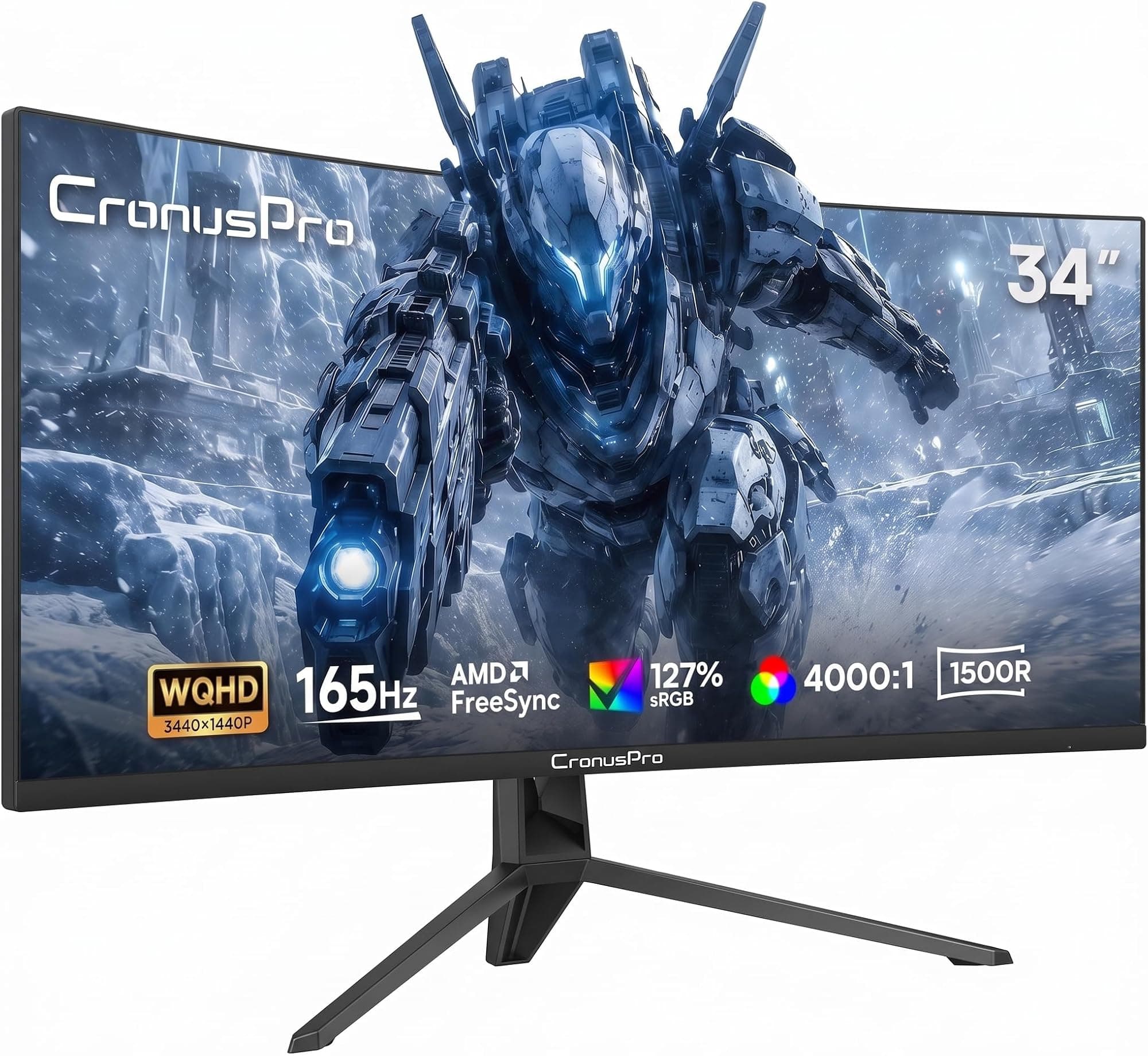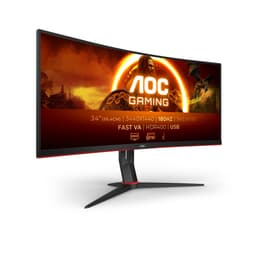
The AOC CU34G4CA 34 inch UW-QHD Monitor Curved is, bluntly, one of the more interesting ultrawide monitors in the upper mid-range bracket right now. It's a 34-inch curved VA panel running at 3440x1440 with a 180Hz refresh rate, and it costs less than most people spend on a GPU upgrade. So yes, it's good. But how good, and for whom, is where it gets more interesting.
Over 1,179 owners have left reviews on Amazon, averaging 4.3 stars. That's not a small sample, and a 4.3 average at that volume is genuinely hard to fake. Most complaints cluster around the usual VA panel niggles (more on that shortly) rather than build defects or dead-on-arrival units, which tells you something useful about the underlying quality. If you're upgrading from a 1080p flat panel and wondering whether this is the jump to make, the short answer is: probably yes, if you can push the resolution.
That said, there are real trade-offs here, and anyone who tells you a VA panel is just as good as an IPS for all use cases is selling you something. So here's the full picture, grounded in the specs and what owners actually report.
Core Specifications
Start with what you're actually getting. The AOC CU34G4CA 34 inch UW-QHD Monitor Curved ships with a 34-inch VA panel at 3440x1440 resolution, a 1800R curve, and a 180Hz maximum refresh rate. The panel is listed as a Fast VA type, which matters for response time (we'll get into that separately). AOC rates the response time at 1ms GtG, which is the marketing figure rather than a real-world measurement, but again, more on that below.
Adaptive sync is handled via AMD FreeSync Premium, and the monitor carries HDR400 certification from VESA's DisplayHDR standard. Connectivity is solid: two HDMI 2.0 ports, one DisplayPort 1.4, a USB-C port, and a USB hub. The stand offers height adjustment, which is something a lot of monitors at this price skip. Aspect ratio is 21:9, which is the standard ultrawide format.
One thing upfront: 3440x1440 at 180Hz over HDMI 2.0 is technically limited. HDMI 2.0 tops out at around 144Hz at this resolution with full colour, so if you want to hit 180Hz you'll want to use the DisplayPort 1.4 connection, which has the bandwidth to handle it without compromise. That's not a flaw exactly, just something to know before you plug in.
| Specification | Detail |
|---|---|
| Screen Size | 34 inches |
| Panel Type | Fast VA (Vertical Alignment) |
| Resolution | 3440x1440 (UW-QHD) |
| Aspect Ratio | 21:9 |
| Refresh Rate | 180Hz |
| Response Time | 1ms GtG (manufacturer rated) |
| Adaptive Sync | FreeSync Premium / Adaptive Sync |
| HDR | HDR400 (VESA DisplayHDR 400) |
| Curve | 1800R |
| Ports | 2x HDMI 2.0, 1x DisplayPort 1.4, USB-C, USB Hub |
| Stand | Height adjustable |
| Current Price | £288.97 |

Panel Technology
VA panels sit in an interesting middle ground. They're not the colour-accuracy kings that IPS panels are, and they don't have the raw speed of a TN, but they do one thing noticeably better than either: contrast. Native contrast ratios on VA panels typically run somewhere in the 3000:1 to 5000:1 range, compared to the 1000:1 to 1500:1 you'd normally see on IPS. In practice, that means blacks look genuinely dark rather than the slightly grey wash you get on IPS panels in a dim room. For gaming in the evenings, especially anything atmospheric, that's a real advantage.
The trade-off is viewing angles. VA panels narrow noticeably as you move off-axis, and you'll see colour shift and brightness drop if you're sitting at the edges of a curved 34-inch screen. At normal single-user desktop distances this is rarely a problem, but it's if you're planning to share the screen or do colour-critical work where you'll be moving around. The 1800R curve on this monitor actually helps here by angling the edges of the panel slightly back towards you, which partially compensates for the viewing angle weakness. It's not a fix, but it reduces how obvious the issue is in practice.
There's also the black smear issue that VA panels can exhibit, where dark-on-dark transitions look slightly smudged during fast motion. Fast VA (sometimes called FALD-adjacent or simply a higher-overdrive VA) is supposed to address this, and AOC's implementation here is one of the better ones in this price range. Owner feedback suggests the smearing is present but not egregious at typical gaming framerates, especially with overdrive engaged. If you're primarily playing competitive FPS games and you need pixel-perfect dark-scene clarity, an IPS panel would still be the safer choice. For everything else, the contrast benefit is worth the trade-off.
Display Quality
At 3440x1440 across 34 inches, the pixel density works out to around 110 pixels per inch. That's not retina territory, but it's genuinely sharp at normal desktop distances (60 to 90cm). Text is clean, fine detail in games and video is well-rendered, and you won't be squinting at individual pixels. Compared to a 27-inch 1440p monitor at around 109 PPI, the sharpness is basically identical, just spread across a wider canvas.
The anti-glare coating on the CU34G4CA is a standard matte finish. It does its job of killing reflections in bright rooms, but like most matte coatings it introduces a slight graininess to the image, particularly visible on white backgrounds. This is a known characteristic of the coating type rather than a defect. Some owners do mention the graininess in reviews, so if you're coming from a glossy display (like a MacBook screen or a consumer TV) it might take a few days to stop noticing it.
Brightness uniformity on large curved VA panels can vary. Owner reports on the CU34G4CA are mostly positive here, with the main complaints being the occasional backlight bleed in corners rather than systematic uniformity issues. This is fairly normal for the panel category and price point. If you get a unit with obvious bleed, Amazon's returns process is straightforward. The 4.3-star average across 1,229 suggests the panel lottery is kinder here than on some competitors.
Refresh Rate and Adaptive Sync
180Hz is the headline number, and it's a proper 180Hz rather than an overclocked 165Hz. At 3440x1440, that's a significant step up from the 144Hz that most competing monitors in this bracket top out at. Whether you'll actually hit 180fps at this resolution depends heavily on your GPU, but the ceiling being higher means you're getting more headroom as hardware improves, and even at 120 to 150fps the experience is noticeably smoother than 60Hz.
FreeSync Premium is the adaptive sync implementation here. That means variable refresh rate with Low Framerate Compensation (LFC) support, which kicks in when your frame rate drops below the monitor's minimum VRR range and multiplies the frame to prevent stuttering. If you're on an AMD GPU, this works out of the box. If you're on Nvidia, the monitor also supports Adaptive Sync, and most modern Nvidia cards will run it in G-Sync Compatible mode, though Nvidia doesn't officially certify every monitor. Owner reports suggest it works fine with Nvidia cards in practice.
The practical gaming experience at 180Hz on a VA panel is genuinely good for most genres. Racing games, RPGs, strategy games, and third-person action titles all benefit enormously from the combination of high refresh rate, wide field of view, and the VA panel's strong contrast. Competitive FPS is the one area where the panel type matters more than the refresh rate, and there an IPS at 165Hz might actually feel cleaner in dark scenes despite the lower contrast. For everything else, 180Hz on this VA is a strong package.
Response Time and Motion
The "1ms GtG" claim on the box is the marketing response time, measured at the fastest overdrive setting. Real-world pixel transition times on VA panels, even Fast VA panels, are typically higher than this in practice, particularly on dark-to-dark transitions where VA panels have always struggled. Published measurements from display reviewers on comparable Fast VA panels at this resolution and refresh rate typically show average GtG figures in the 4ms to 8ms range at moderate overdrive settings, with the fastest overdrive introducing visible overshoot (inverse ghosting) on light backgrounds.
AOC's overdrive implementation on the G4 series has received generally positive feedback from owners. The consensus is that the medium overdrive setting is the sweet spot: fast enough to keep up with 180Hz gaming without introducing the white halo artefacts that heavy overdrive causes. Dark-scene smearing is present, as it is on all VA panels, but owners describe it as manageable rather than distracting. One owner specifically noted it's only really visible in very dark game environments when panning quickly, which matches what you'd expect from the Fast VA category.
For context: if you're upgrading from a 60Hz IPS monitor, the improvement in motion clarity at 180Hz will be far more noticeable than any VA-specific smearing. If you're coming from a 165Hz IPS and you're sensitive to dark-scene ghosting, it's worth being aware the VA trade-off exists. But for the majority of gaming use cases, this monitor's motion performance is genuinely good, not just "acceptable for the price."
Color Accuracy and Gamut
AOC doesn't publish specific factory calibration data for the CU34G4CA, which is fairly typical for gaming monitors in this bracket. Published measurements on comparable AOC Fast VA panels suggest sRGB coverage in the 95% to 99% range and DCI-P3 coverage around 85% to 90%. These are solid numbers for gaming and general use. The DCI-P3 colour space is increasingly relevant for HDR content and modern streaming, and getting into the high 80s here is genuinely decent at this price.
Delta-E (colour accuracy) out of the box on gaming monitors is rarely impressive without factory calibration, and the CU34G4CA is no exception. Expect Delta-E averages somewhere in the 2 to 4 range out of the box, which is fine for gaming and media consumption but not what you'd want for colour-critical professional work like photo editing or print production. If you need accurate colour, you'd want a proper calibration, or a monitor that ships with a factory calibration report (which typically costs significantly more).
For content creators doing casual video editing, YouTube production, or streaming, the gamut coverage is more than adequate. Colours look vivid and punchy on this panel, which is partly the VA contrast doing its thing and partly the wide gamut. Just don't expect it to be a substitute for a proper wide-gamut IPS display if colour accuracy is your primary requirement. If gaming is 80% of your use case and content creation is the other 20%, this is fine. Flip those percentages and you'd want something different.
HDR Performance
HDR400 is an honest description of what this monitor does, but it's also important to understand what HDR400 actually means in practice. The VESA DisplayHDR 400 certification requires a minimum 400 nits peak brightness and basic HDR metadata support. It does not require local dimming. Without local dimming, the monitor can't independently control brightness in different zones of the image, which is the thing that makes HDR actually look like HDR on a good TV.
What you get here is global tone mapping: the whole panel brightness adjusts based on the HDR signal, but there's no zone-level control. In practice, HDR content looks better than SDR on this monitor, largely because the VA panel's native contrast ratio does a lot of the heavy lifting. Blacks are genuinely dark even without local dimming, which gives HDR content more punch than you'd get from an IPS panel at the same HDR tier. But if you've seen proper HDR on an OLED TV or a Mini-LED panel with full-array local dimming, this won't replicate that experience.
Owner feedback on HDR is mixed in the way it always is for HDR400 monitors. People who haven't seen premium HDR tend to think it looks great. People who have a reference-quality TV in the same room are less impressed. That's not a knock on AOC specifically, it's just the honest reality of the HDR400 tier. For gaming, where HDR is often more about the wider colour range than the extreme brightness peaks, the implementation here is decent. For HDR film watching as a primary use case, a higher-tier monitor or a good TV would serve you better.
Contrast and Brightness
This is where the VA panel genuinely earns its keep. Native contrast on VA panels in this category typically runs around 3000:1 to 4500:1, compared to the 1000:1 to 1300:1 typical of IPS. In real terms: dark scenes in games look properly dark, not that murky grey that IPS panels produce in low-light environments. If you play anything atmospheric, horror games, space games, anything with a lot of night scenes, the contrast difference is immediately obvious and it's in the VA's favour.
Peak SDR brightness is rated in the range typical for this class of panel, and owner reports suggest the monitor is comfortable in normally lit rooms. It's not the brightest panel in this category, and in very bright rooms with direct sunlight you might find yourself pushing the brightness slider higher than you'd like. The matte anti-glare coating helps with glare management, but it doesn't compensate for a panel that isn't particularly luminous. For typical UK room lighting (which, let's be honest, isn't exactly Saharan) it's fine.
The combination of strong native contrast and the 1800R curve creates a genuinely immersive viewing experience in darker rooms. The curve helps the edges of the panel feel closer to you, which combined with the deep blacks creates a sense of depth that flat IPS panels at the same price simply don't match. It's one of those things that's hard to quantify in a spec sheet but very obvious when you're sitting in front of it. Owner reviews repeatedly mention how immersive the gaming experience feels, and the contrast is a big part of why.
Ergonomics and Stand
Height adjustment is listed as a feature, which immediately puts this above a lot of the competition in this price range. A surprising number of monitors in the upper mid-range still ship with stands that only tilt, leaving you either craning your neck or stacking books under the monitor like it's 2004. The CU34G4CA's stand adjusts for height, which means you can actually set it up at the right eye level without faff.
Owner reviews on the stand are mostly positive. It's described as stable with minimal wobble, which matters on a 34-inch curved panel because any instability is amplified by the size. The stand footprint is substantial, as it has to be to support a monitor this size, so if you have a small desk you'll want to think about whether you have the depth for it. A VESA mount option is if you prefer an arm, as getting the panel off the stand would free up considerable desk space.
Build quality overall is reported as solid by owners. The plastics feel premium enough for the price point, and the OSD controls are accessible without being fiddly. A few owners mention the initial setup takes a few minutes to get the stand assembled, but nothing more complex than you'd expect. No reports of significant build defects in the review base, which at 1,229 is a reasonable indicator of consistent manufacturing quality. AOC has improved its build standards noticeably over the past few years, and the G4 series reflects that.
Connectivity and Ports
The port selection on the CU34G4CA is genuinely good for this price. Two HDMI 2.0 ports mean you can connect a console and a PC simultaneously and switch between them without unplugging anything. The single DisplayPort 1.4 is your route to 180Hz at full resolution and colour depth, as DisplayPort 1.4 supports up to 32.4 Gbps bandwidth, which is comfortably enough for 3440x1440 at 180Hz. The USB-C port adds flexibility for laptop users, and the USB hub means you can plug in peripherals directly to the monitor rather than reaching around to your PC.
- 2x HDMI 2.0 (up to approximately 144Hz at 3440x1440 in full colour)
- 1x DisplayPort 1.4 (full 180Hz at 3440x1440)
- USB-C
- USB Hub
The USB-C port is worth a specific mention because it's increasingly useful as laptops drop full-size ports. Whether it supports DisplayPort Alt Mode or USB Power Delivery at a useful wattage isn't specified in the verified product data, so check the full spec sheet on AOC's product page before assuming you can drive the monitor and charge a laptop simultaneously from a single cable. The USB hub is handy for a keyboard and mouse dongle, or a USB drive, without needing to reach to the back of your PC.
One thing that's genuinely nice about having two HDMI ports is the console gaming option. Plug a PS5 or Xbox Series X into one HDMI port and your PC into the DisplayPort, and you've got a proper multi-source setup without a switch box. The PS5 outputs at 4K natively, which will downscale to 3440x1440 on this monitor, but for 1080p 120Hz console gaming the ultrawide resolution means you'll get letterboxing unless the game supports 21:9. if console gaming is part of your plan.
How It Compares
The two most obvious competitors in this space are the LG 34GP83A-B and the Samsung Odyssey G5 34-inch. The LG uses an IPS panel at 3440x1440 and 160Hz, which gives it better viewing angles and more accurate colours out of the box, but its contrast ratio is in the typical IPS range of around 1000:1, compared to the VA panel's 3000:1 plus. The LG is also generally priced similarly or slightly higher, making the AOC's VA contrast advantage a genuine differentiator if gaming in dark rooms is your thing.
The Samsung Odyssey G5 34-inch is the more direct VA-to-VA comparison. It's also a curved VA ultrawide, but Samsung's implementation has historically had more aggressive smearing in dark scenes than AOC's Fast VA. The G5 also caps out at 165Hz rather than 180Hz. If you're choosing between the two on pure gaming performance, the AOC's higher refresh ceiling and reportedly better overdrive tuning make it the stronger pick. The Samsung's build quality and OSD are arguably a bit more polished, but that's a matter of preference rather than performance.
It's also the elephant in the room: OLED ultrawides. The LG 34GS95QE and similar 34-inch OLEDs offer contrast ratios that make even the best VA panel look flat, with near-instant response times and genuinely spectacular HDR. But they cost significantly more, typically sitting in the £700 to £900 bracket rather than the upper mid-range where the AOC lives. If your budget stretches there, the OLED is the better display. If it doesn't, the AOC is a very solid alternative that doesn't feel like a compromise.
| Feature | AOC CU34G4CA | LG 34GP83A-B | Samsung Odyssey G5 34" |
|---|---|---|---|
| Panel Type | Fast VA | IPS (Nano IPS) | VA |
| Resolution | 3440x1440 | 3440x1440 | 3440x1440 |
| Refresh Rate | 180Hz | 160Hz | 165Hz |
| Native Contrast | ~3000:1 to 4500:1 | ~1000:1 | ~3000:1 |
| HDR | HDR400 | HDR10 | HDR10 |
| Adaptive Sync | FreeSync Premium | G-Sync Compatible / FreeSync | FreeSync Premium |
| USB-C | Yes | No | No |
| Height Adjust | Yes | Yes | Yes |
| Price | £288.97 | Typically similar to higher | Typically lower |
Final Verdict
The AOC CU34G4CA 34 inch UW-QHD Monitor Curved is a genuinely good monitor. Not a perfect one, but a good one, and at the upper mid-range price point it's competing hard against monitors that cost the same or more for meaningfully worse specs. The 180Hz refresh rate, the strong VA contrast, the proper height-adjustable stand, and the solid port selection add up to a package that's hard to argue with if ultrawide gaming is your primary use case.
The VA panel trade-offs are real. Dark-scene smearing exists, viewing angles are narrower than IPS, and colour accuracy out of the box won't satisfy anyone doing professional colour work. But for the majority of people who'll use this monitor, those trade-offs are either invisible or irrelevant. The contrast advantage in dark games is something you notice every session, and the 180Hz ceiling with FreeSync Premium gives you room to grow into the monitor as GPU performance improves over the next few years.
Over 1,179 owners averaging 4.3 stars isn't a fluke. The complaints that do appear in reviews are the expected VA-specific ones rather than build quality failures or defective units, which suggests AOC's quality control is holding up well on this model. For a 34-inch ultrawide at this price, that's reassuring.
Who should buy this? Gamers who want an immersive wide field of view, strong contrast for atmospheric games, and a high refresh rate, all without spending OLED money. It's particularly good for people upgrading from a 24 to 27-inch 1080p or 1440p flat panel who want a meaningful step up in immersion. It also works well as a productivity display if you split the ultrawide into two virtual monitors, which most operating systems handle natively.
Who should skip it? Anyone doing serious colour-critical work (photography, print production, professional video grading) would be better served by a factory-calibrated IPS display. Competitive FPS players who are extremely sensitive to dark-scene ghosting might also prefer a fast IPS. And if your budget genuinely stretches to an OLED ultrawide, that's the better display, full stop. But if it doesn't, this is where your money should go.
One honest note: if you're primarily a casual gamer who plays at 60 to 90fps and doesn't need 180Hz, the Samsung Odyssey G5 34-inch is often available for noticeably less money and delivers a very similar VA ultrawide experience. The AOC's higher refresh rate ceiling and USB-C port are worth the premium if you'll use them. If you won't, the Samsung saves you money without costing you much.
Is AOC a good screen brand?
Yes, genuinely. AOC is owned by TPV Technology, which also manufactures Philips monitors, and the build quality and panel sourcing have improved substantially over the past several years. They're not the premium brand that LG or Samsung are in terms of brand cachet, but the actual panels and build quality at this price point are competitive. The G4 series in particular has received consistently positive feedback from owners, and a 4.3-star average across 1,229 is a real indicator of quality rather than a marketing claim.
Is a 34-inch monitor too big for gaming?
Not if your desk is deep enough and you're sitting at a normal distance. The 1800R curve on this monitor is specifically designed to make the edges feel closer, which reduces the head movement you'd otherwise need. Most people find 34-inch ultrawides feel natural after a day or two. The bigger question is whether your GPU can push the resolution. 3440x1440 at 180Hz is demanding, and if you're running a mid-range card you'll want to be realistic about the framerates you'll achieve at maximum settings.
Is 3440x1440 considered 2K or 4K?
Neither, strictly speaking. The "2K" label is a loose term that's often applied to anything in the 1440p family, and 3440x1440 does have 1440 vertical pixels, so it's sometimes called 2K or QHD. But 4K refers to approximately 4000 horizontal pixels (typically 3840x2160 for consumer displays), and 3440x1440 doesn't reach that. The official designation is UW-QHD (Ultra-Wide Quad High Definition). In practical terms, it's significantly sharper than 1080p and noticeably less demanding than 4K, which makes it a sweet spot for gaming performance versus visual quality.

Is a 34-inch monitor too much?
For gaming and immersive use, probably not. For a very small desk or a very short viewing distance, possibly yes. The 1800R curve helps manage the perceived size by wrapping the edges towards you. If you're used to a 27-inch flat monitor and you're worried about the jump, most people adapt within a few days and then find it hard to go back. The main practical consideration is desk depth: you want at least 60cm of depth to sit at a comfortable distance from a 34-inch curved panel.
What works. What doesn’t.
5 + 4What we liked5 reasons
- 180Hz at 3440x1440 is genuinely competitive in this price bracket
- VA panel contrast (typically 3000:1 to 4500:1) makes dark scenes look properly dark
- Height-adjustable stand included, which many rivals skip
- Two HDMI 2.0 ports plus DisplayPort 1.4 and USB-C gives real flexibility
- 4.3 stars across 1,179 owner reviews suggests consistent build quality
Where it falls4 reasons
- VA dark-scene smearing is present, even if manageable
- HDR400 without local dimming is checkbox HDR rather than transformative HDR
- Colour accuracy out of the box won't satisfy professional colour work
- HDMI 2.0 limits you to around 144Hz at full resolution; need DisplayPort for 180Hz
Full specifications
11 attributes| Panel type | VA |
|---|---|
| Aspect ratio | 21:9 |
| Curvature | 1500R |
| HDR | HDR400 |
| Launch year | 2026 |
| Ports | 2x HDMI 2.0, 1x DisplayPort 1.4, USB-C, USB hub |
| Refresh rate HZ | 180 |
| Resolution | 3440x1440 |
| Response time MS | 1 |
| Screen size IN | 34 |
| Vesa compatible | true |
If this isn’t right for you
2 options 8.5 / 10
AOC AG276QZD2AM 27" WQHD Gaming Monitor 240Hz, QD-OLED Panel, 0.03ms GtG, HDR400 TB, FreeSync Prem. Pro, G-Sync Comp., Height Adjustment, Speakers, (2560x1440 HDMI 2x 2.0 DP 2x 1.4 USB Hub) Black
£335.71 · AOC
 8.0 / 10
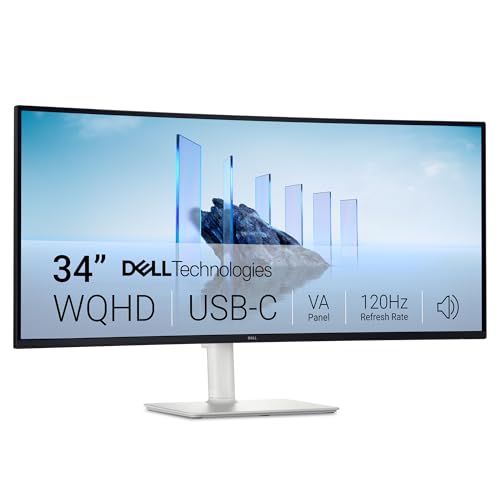
Dell 34 Plus USB-C Monitor - S3425DW, WQHD (3440x1440), 120Hz, VA, 1ms
£330.00 · Dell
Frequently asked
5 questions01Is the AOC CU34G4CA 34 inch UW-QHD Monitor Curved, 180Hz, Fast VA Panel, 1ms GtG, Adaptive Sync, HDR400, FreeSync, Height Adjustment, (3440x1440 HDMI 2x 2.0 DP 1x 1.4 USB Hub) Black good for gaming?+
Yes, it's a strong gaming monitor. The 180Hz refresh rate at 3440x1440 is one of the higher ceilings available in the upper mid-range bracket, and FreeSync Premium with Adaptive Sync support means tear-free gaming on both AMD and Nvidia GPUs. The VA panel's high native contrast (typically 3000:1 to 4500:1) makes dark scenes look genuinely dark, which is a real advantage in atmospheric games. The main caveat is that Fast VA panels can exhibit some dark-scene smearing at high speeds, though owner feedback suggests AOC's overdrive tuning keeps this manageable. Use DisplayPort 1.4 rather than HDMI to reach the full 180Hz.
02Does the AOC CU34G4CA 34 inch UW-QHD Monitor Curved, 180Hz, Fast VA Panel, 1ms GtG, Adaptive Sync, HDR400, FreeSync, Height Adjustment, (3440x1440 HDMI 2x 2.0 DP 1x 1.4 USB Hub) Black have good HDR?+
It has functional HDR rather than spectacular HDR. The VESA DisplayHDR 400 certification means it meets a minimum 400 nits peak brightness and supports HDR metadata, but there is no local dimming, which is the technology that makes HDR look genuinely impressive on premium TVs and monitors. The VA panel's strong native contrast does help HDR content look better than it would on an IPS panel at the same HDR tier, because blacks are genuinely dark without needing local dimming. For gaming, HDR here adds a wider colour range and some extra punch. For HDR film watching as a primary use case, a higher-tier monitor or a good TV would be more impressive.
03Is the AOC CU34G4CA 34 inch UW-QHD Monitor Curved, 180Hz, Fast VA Panel, 1ms GtG, Adaptive Sync, HDR400, FreeSync, Height Adjustment, (3440x1440 HDMI 2x 2.0 DP 1x 1.4 USB Hub) Black good for content creation?+
For casual content creation, yes. Published measurements on comparable AOC Fast VA panels suggest sRGB coverage in the 95% to 99% range and DCI-P3 coverage around 85% to 90%, which is solid for video editing, streaming production, and general creative work. Colour accuracy out of the box (Delta-E) is typically in the 2 to 4 range without calibration, which is fine for most creative tasks but not precise enough for professional colour grading, photography for print, or work where colour matching to external standards matters. For that level of work, a factory-calibrated IPS display would be a better choice.
04What graphics card do I need for the AOC CU34G4CA 34 inch UW-QHD Monitor Curved, 180Hz, Fast VA Panel, 1ms GtG, Adaptive Sync, HDR400, FreeSync, Height Adjustment, (3440x1440 HDMI 2x 2.0 DP 1x 1.4 USB Hub) Black?+
3440x1440 at 180Hz is demanding. To consistently hit framerates in the 144 to 180fps range in modern AAA games at high settings, you'd want something in the tier of an RTX 4070 Super, RTX 4080, RX 7800 XT, or RX 7900 GRE at minimum. For less demanding games or esports titles (CS2, Valorant, Rocket League), a mid-range card like an RTX 4060 Ti or RX 7700 XT can push high framerates more easily. The good news is that FreeSync Premium with Low Framerate Compensation means the monitor will still deliver smooth, tear-free gaming at lower framerates, so you're not stuck needing to hit 180fps to benefit from the high refresh rate.
05What warranty and returns apply to the AOC CU34G4CA 34 inch UW-QHD Monitor Curved, 180Hz, Fast VA Panel, 1ms GtG, Adaptive Sync, HDR400, FreeSync, Height Adjustment, (3440x1440 HDMI 2x 2.0 DP 1x 1.4 USB Hub) Black?+
Specific warranty terms are not confirmed in the verified product data for this listing. When buying through Amazon UK, you're covered by Amazon's standard 30-day return window and the Amazon A-to-Z Guarantee, which provides meaningful protection if the item arrives faulty or not as described. For manufacturer warranty details, check AOC's UK support pages directly before purchasing.