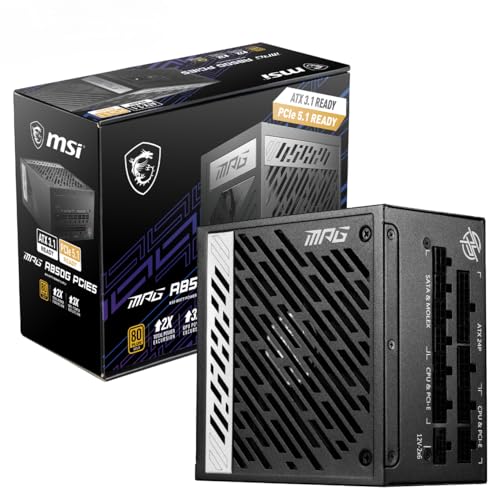
PSU shopping is genuinely one of the most boring parts of building a PC, and most people either panic-buy whatever's cheapest or just copy what someone on Reddit said three years ago. Neither approach is great. The MSI MAG A850GL WHITE PCIE5 Power Supply Unit, 850W, 80 Plus Gold, Fully Modular, ATX 3.0, PCIe 5.0 GPU Support, Black Flat Cables, 7 Year Warranty is MSI's answer to a specific frustration: you've dropped serious money on an RTX 4080 or RX 7900 XTX, and you need a PSU that won't flinch when that GPU demands a massive power spike. This one is built for exactly that scenario.
The short version? It's a properly capable 850W Gold-rated unit with native PCIe 5.0 support, full modularity, ATX 3.0 compliance, and a seven-year warranty that most rivals can't match at this price tier. It's not the cheapest option in the upper mid-range bracket, but the spec sheet justifies every penny for anyone running a high-end GPU in 2026. The owners who've reviewed it on Amazon give it ★★★★☆ (4.4) from 1,875 reviews, which for a PSU (a category people only bother reviewing when something goes wrong) is a genuinely good sign.
So who's this for, and is it worth picking over the Corsair RM850x or the be quiet! Straight Power 12? That's what we're getting into. If you want to check current pricing first, it's right here: £127.99 · Details.
Core Specifications: MSI MAG A850GL WHITE PCIE5 Power Supply Unit
On paper, the MSI MAG A850GL ticks a lot of boxes that matter in 2026. You've got 850W of continuous output, 80 Plus Gold certification (which we'll dig into properly in the efficiency section), full modularity, ATX 3.0 compliance, and a native 16-pin PCIe 5.0 connector capable of delivering up to 600W to a compatible GPU. That last bit is important if you're pairing this with an NVIDIA RTX 50-series card or anything else that uses the 12VHPWR connector natively.
The 120mm fan uses a fluid dynamic bearing (FDB), which is a meaningful upgrade over the sleeve bearings you'll find in cheaper units. MSI rates the capacitors at 105 degrees Celsius, which matters under sustained heavy load. The 7-year warranty is the headline figure here though. Most PSUs in this bracket offer 5 years. Getting 7 years on a PSU at this price point is genuinely unusual and tells you something about MSI's confidence in the build quality.
One thing before the table: this is the white variant of the MAG A850GL. The unit itself and the cables are designed to complement white or light-themed builds. If you're running a blacked-out case, the standard (non-white) version might suit you better aesthetically, but the internals and specs are identical. Right, here's the full spec breakdown:
| Specification | Detail |
|---|---|
| Product | MSI MAG A850GL WHITE PCIE5 |
| Wattage | 850W |
| Efficiency Rating | 80 Plus Gold (up to 90%) |
| Modularity | Fully Modular |
| ATX Standard | ATX 3.0 |
| PCIe 5.0 Support | Yes (native 16-pin, up to 600W) |
| Fan Size | 120mm FDB |
| Capacitor Rating | 105 degrees Celsius |
| Warranty | 7 Years |
| ATX 24-pin | 1 |
| EPS 8-pin | 1 |
| PCIe 8-pin | 2 |
| SATA | 6 |
| Molex | 3 |
| Protection | OCP, OVP, OPP, SCP |
| Price | £127.99 · Details |

Wattage and Capacity
850W is a well-chosen sweet spot for high-end gaming builds in 2026. It's enough headroom for an Intel Core i9 or Ryzen 9 paired with an RTX 4080 Super or RX 7900 XTX, with room to spare for storage, fans, and any overclocking you fancy. You're not going to hit the ceiling under normal gaming loads. Even if you push both the CPU and GPU hard simultaneously, you're realistically looking at 600W to 700W of actual draw on a demanding system, which leaves a comfortable buffer.
Where ATX 3.0 compliance makes a real difference is in handling power excursions. Modern GPUs, particularly NVIDIA's Ada Lovelace and Blackwell architectures, can demand brief but massive power spikes that exceed their rated TDP by a significant margin. The ATX 3.0 specification requires PSUs to handle excursions of up to 2x total power and 3x GPU power, which is exactly what MSI specifies here. Older PSUs that predate ATX 3.0 can trip their overcurrent protection during these spikes, causing unexpected shutdowns. That's the real-world problem this PSU solves, and it solves it properly.
If you're building something more modest, say a Ryzen 5 7600X with an RTX 4070, honestly 850W is more than you need and you'd be fine with a 750W unit. But if you're already eyeing an RTX 5080 or planning to upgrade in the next couple of years, the extra headroom and PCIe 5.0 readiness make this a sensible long-term buy. Think of it as future-proofing with actual technical justification rather than just marketing. You can use our PSU calculator to work out exactly what your build needs before committing.
Efficiency Rating: What 80 Plus Gold Actually Means
The 80 Plus certification scheme rates PSUs at 20%, 50%, and 100% load. Gold tier requires at least 87% efficiency at 20% load, 90% at 50% load, and 87% at 100% load. MSI quotes up to 90% efficiency for the MAG A850GL, which aligns with the Gold standard at the 50% load sweet spot where most gaming systems actually operate during real use. That's meaningfully better than Bronze (which only requires 82% at 50% load) and a decent step up from Silver too.
What does this mean in practice? A PSU that's 90% efficient at 500W draw is converting 500W of DC power to your components while wasting roughly 56W as heat. A Bronze-rated unit doing the same job at 82% efficiency wastes around 110W as heat. That difference adds up on your electricity bill over months and years, and it also means less heat inside your case, which helps everything else run cooler and quieter. For a unit that's going to run for 7+ years (which is exactly what MSI is betting on with that warranty), the Gold rating has a real cumulative value.
Is Gold worth the premium over Bronze at this wattage? Yes, genuinely. The upper mid-range price bracket is where Gold certification starts making financial sense. The efficiency gains over Bronze translate to real electricity savings at 850W, and the reduced heat output is a bonus for system stability and component longevity. If you were buying a 450W PSU for a budget office build, the Bronze vs Gold argument is thinner. At 850W for a gaming rig that's going to run hard regularly, Gold is the right call.
Modularity and Cable Management: MSI MAG A850GL WHITE PCIE5 Power Supply Unit
Full modularity means every single cable, including the 24-pin ATX, detaches completely from the PSU. This is the right way to do it. Semi-modular PSUs leave the 24-pin and EPS cables permanently attached, which is annoying if you're trying to keep a clean build because you're routing those thick cables whether you like it or not. With the MAG A850GL, you only connect what you need, and everything else stays in the bag.
MSI uses triple-layer sleeved cables with management combs included in the box. The combs are a nice touch. They're the little plastic clips that keep your PCIe cables parallel and tidy, and they're the sort of thing that budget PSU manufacturers skip to save pennies. The cables themselves are described as flat (black flat cables as the name suggests), which makes routing through tight cable management channels significantly easier than round sleeved cables. Flat cables bend where you want them to, full stop.
The connectors use premium copper alloy, which MSI highlights specifically. Copper alloy connectors have better conductivity and corrosion resistance than cheaper alternatives, and at 850W with a high-current GPU connector in the mix, that's not a trivial detail. The 16-pin native PCIe 5.0 cable is particularly important here. Using a native 16-pin rather than an adapter from two 8-pin connectors eliminates one potential failure point and is the safer, cleaner solution for cards that support it. If you've read about the melting 16-pin adapter issues from early RTX 4090 launches, you'll understand why a native connector matters.
Connectors and Compatibility
The connector lineup on the MAG A850GL covers the bases for a high-end single-GPU build without going overboard. Here's what you're working with:
- ATX 24-pin: 1 (motherboard power)
- EPS 8-pin: 1 (CPU power)
- PCIe 8-pin: 2 (legacy GPU connectors)
- Native 16-pin PCIe 5.0: 1 (up to 600W GPU power)
- SATA: 6 (drives and SATA-powered accessories)
- Molex: 3 (older accessories, some fan controllers)
Most high-end motherboards have two EPS connectors (an 8-pin plus a 4-pin, or two 8-pins), and if your board uses both for overclocking headroom, you'll want to check whether the MAG A850GL ships with a second EPS cable or whether you'd need to use a Molex adapter. For most gaming builds with a single EPS connection, this is a non-issue, but it's worth verifying against your specific motherboard before buying.
Six SATA connectors is genuinely generous. Most builds don't need more than three or four, so you're well covered even if you're running multiple SSDs and a couple of case fans on SATA power. The three Molex connectors are there for legacy compatibility and older accessories. PCI-SIG, the body that governs PCIe standards, has been pushing the 12VHPWR (16-pin) connector as the modern standard for high-power GPUs, and MSI's native implementation here is fully compliant with that specification. Both NVIDIA and AMD PCIe 5.0 cards are supported.
One thing that's genuinely useful: because this is fully modular, the cables you don't use go back in the box. So those three Molex connectors won't be rattling around inside your case creating airflow problems. Tidy.
Voltage Regulation and Ripple
MSI builds the MAG A850GL around an LLC half-bridge topology with a DC-to-DC converter. This is the architecture you want in a quality PSU. LLC (inductor-inductor-capacitor) resonant switching is more efficient than older double-forward designs and produces less electrical noise on the output rails. The DC-to-DC converter then takes the primary 12V rail and generates the 5V and 3.3V rails locally, which results in tighter voltage regulation across varying loads compared to group-regulated designs.
What this means in practice is that when your GPU spikes its power demand (which modern cards do constantly and aggressively), the 12V rail stays stable rather than drooping. Voltage droop is a real cause of system instability. It's not always obvious. You might see it as occasional game crashes, unexpected reboots, or just general system flakiness that you'd otherwise blame on drivers or Windows being Windows. A well-regulated PSU eliminates that variable entirely.
The active Power Factor Correction (PFC) design also matters. Active PFC keeps the power factor close to 1.0, which means the PSU draws cleaner, more efficient power from the mains. It's better for your electricity supply, reduces heat, and is a requirement for 80 Plus certification above Bronze level. 105-degree-rated capacitors (rather than the 85-degree caps you'll find in budget units) mean the PSU maintains stable voltage regulation even when temperatures inside the case climb under sustained load. That matters in summer, in poorly ventilated cases, or in long gaming sessions.

Thermal Performance
The 120mm fan uses fluid dynamic bearing technology. FDB fans are a step up from sleeve bearing fans in terms of longevity and noise characteristics. The bearing uses a thin film of fluid to support the shaft, which reduces friction and wear significantly compared to sleeve bearings. Over a 7-year lifespan (which is exactly what the warranty implies you should expect), that difference in bearing quality is meaningful. Sleeve bearing fans can start to get noisy after a few years as the bearing wears; FDB fans tend to stay quieter for longer.
The 105-degree capacitors deserve another mention in the thermal context. Capacitor lifespan is inversely related to operating temperature. A capacitor running at 85 degrees has a significantly shorter rated lifespan than one running at 105 degrees under the same conditions. By using 105-degree-rated caps, MSI is building in thermal headroom that protects the PSU's longevity even in warm environments. This is a detail that separates properly engineered PSUs from budget units that use cheaper components to hit a price point.
MSI doesn't specify a zero-RPM mode for the MAG A850GL's fan, which means the fan runs continuously rather than stopping completely at low loads. Some enthusiasts prefer zero-RPM modes for near-silent operation at idle, but continuous low-speed fan operation isn't a problem in practice. The FDB fan at low speeds is genuinely quiet, and continuous airflow through the PSU is arguably better for component temperatures than a fan that only spins up when things get hot. It's not a missing feature so much as a design choice.
Acoustic Performance
MSI doesn't publish specific decibel figures for the MAG A850GL's fan, so we won't invent numbers. What we can say is that the 120mm FDB fan is inherently a quiet solution. Larger fans move the same volume of air at lower RPM than smaller fans, which means less noise. FDB bearings are quieter than sleeve bearings at any given RPM. Owner reviews consistently describe the unit as quiet during normal gaming loads, which aligns with what you'd expect from this fan configuration.
Under full load (sustained 850W draw), the fan will spin up noticeably. That's physics, not a design flaw. But most gaming systems, even demanding ones, don't sustain anywhere near full PSU load for extended periods. A typical gaming session at 600W to 700W draw will keep the fan in a comfortable mid-range speed that's inaudible over case fans and GPU fans. If you're doing sustained compute workloads (AI, rendering, mining) at or near 850W continuously, you'll hear the fan more. That's fair enough.
For quiet-build enthusiasts who are running zero-RPM case fans and a silent cooler, the lack of a zero-RPM mode on the PSU fan is the one thing. It won't be loud, but it won't be completely silent either. If absolute silence at idle is your priority, units with a confirmed zero-RPM mode (like some be quiet! models) might suit you better. For everyone else, the MAG A850GL's acoustic profile is a non-issue.
Build Quality
The LLC half-bridge with DC-to-DC converter topology we mentioned in the voltage regulation section is also a build quality indicator. It's more complex to manufacture correctly than simpler designs, which is why budget PSUs don't use it. The fact that MSI has implemented it here, combined with 105-degree capacitors and FDB fan, suggests this isn't a unit where corners have been cut to hit a price point. The premium copper alloy connectors are another detail that points to genuine quality focus rather than just marketing language.
The 7-year warranty is honestly the most telling build quality signal of all. Warranties cost manufacturers money when products fail. A company doesn't offer 7 years unless they're confident the failure rate is low enough to make that economically viable. For context, many well-regarded PSU brands offer 5 years at this price tier. MSI going to 7 years is a meaningful commitment. If the unit did fail within that window, MSI covers it, which takes a lot of the risk out of the purchase.
Owner feedback across the Amazon reviews is positive enough to suggest the build quality holds up in real-world use. PSU reviews on Amazon tend to be polarised: people leave reviews when something fails catastrophically or when they're genuinely impressed. A positive overall rating across some reviews, for a PSU, is a solid result. The absence of widespread reports of coil whine, instability, or DOA units in the review pool is reassuring. Coil whine in particular is a common complaint on cheaper units and can be a lottery even on more expensive ones, so the clean owner feedback here is.
Protection Features
The MAG A850GL includes OCP (overcurrent protection), OVP (overvoltage protection), OPP (overpower protection), and SCP (short circuit protection). These are the four protections you absolutely need in a modern PSU. OCP cuts power if any rail draws more current than its rated limit, which protects both the PSU and your components from a fault condition. OVP shuts the unit down if output voltage climbs beyond safe limits, preventing component damage from voltage spikes.
OPP (overpower protection) is particularly relevant for ATX 3.0 builds. It monitors total power draw and shuts the PSU down if the system tries to pull more than the unit is rated for, rather than letting the PSU run in a degraded state that could cause damage. SCP is the most fundamental protection: if a direct short circuit occurs anywhere in the system, the PSU cuts power immediately rather than sustaining current flow that could cause a fire or destroy components. These aren't nice-to-haves. They're essential safety features.
What's not explicitly listed in the verified spec data is OTP (overtemperature protection) and UVP (undervoltage protection), though these are common in units at this tier. We won't claim they're present or absent based on what's not confirmed in the product data. What we can say is that the four confirmed protections (OCP, OVP, OPP, SCP) cover the most critical failure scenarios. Combined with the ATX 3.0 transient handling capability (up to 2x total and 3x GPU power excursions), the protection suite is well-suited to a high-end gaming build where GPU power demands can be aggressive and unpredictable.
How It Compares
The obvious competition at 850W in the upper mid-range bracket is the Corsair RM850x (2021 or 2023 revision) and the be quiet! Straight Power 12 850W. Both are well-regarded units with strong reputations. The Corsair RM850x is a perennial favourite with a proven track record, 80 Plus Gold certification, full modularity, and a 10-year warranty. Yes, 10 years. That's the one area where Corsair has MSI beaten on paper. The RM850x also has excellent ripple suppression figures from independent testing, and it's been around long enough that its reliability record is well established.
The be quiet! Straight Power 12 850W is another strong option, also Gold-rated and fully modular, with be quiet!'s reputation for genuinely quiet operation and their own strong warranty. Where the MSI MAG A850GL differentiates itself is in ATX 3.0 compliance and native PCIe 5.0 support. The older RM850x (2021 revision) predates ATX 3.0, which means it handles power excursions to the older, more conservative spec. If you're pairing your PSU with a current-generation or next-generation GPU that uses the 16-pin connector natively, the MSI's ATX 3.0 compliance and native 16-pin implementation is a genuine technical advantage, not just a marketing checkbox.
Pricing across these three units is competitive in the upper mid-range bracket. The Corsair RM850x often sits at a similar price point, sometimes slightly more, sometimes slightly less depending on sales. The be quiet! Straight Power 12 tends to be priced similarly. The MSI's 7-year warranty versus Corsair's 10-year is the one area where you might pause, but the ATX 3.0 and PCIe 5.0 native support arguably matters more for a new build in 2026 than the extra three years of warranty coverage.
| Feature | MSI MAG A850GL WHITE | Corsair RM850x | be quiet! Straight Power 12 850W |
|---|---|---|---|
| Wattage | 850W | 850W | 850W |
| Efficiency | 80 Plus Gold | 80 Plus Gold | 80 Plus Gold |
| Modularity | Fully Modular | Fully Modular | Fully Modular |
| ATX Standard | ATX 3.0 | ATX 2.0 (2021) / ATX 3.0 (2023) | ATX 3.0 |
| Native PCIe 5.0 | Yes (16-pin, 600W) | Via adapter (older) / Native (2023) | Yes |
| Fan Bearing | 120mm FDB | 120mm FDB | 135mm FDB |
| Warranty | 7 Years | 10 Years | 10 Years |
| Price | £127.99 · Details | Check Amazon | Check Amazon |

Final Verdict
The MSI MAG A850GL WHITE PCIE5 Power Supply Unit, 850W, 80 Plus Gold, Fully Modular, ATX 3.0, PCIe 5.0 GPU Support, Black Flat Cables, 7 Year Warranty is a properly well-specified PSU for high-end gaming builds in 2026. The combination of ATX 3.0 compliance, native 16-pin PCIe 5.0 support (rated to 600W), 80 Plus Gold efficiency, full modularity, FDB fan, 105-degree capacitors, and a 7-year warranty is a strong package. It's built for the scenario where you've spent serious money on a current-generation GPU and you want a PSU that won't be the weak link in the chain.
The positive overall rating from some owner reviews backs up what the spec sheet promises. This isn't a unit with a paper-spec that falls apart in real-world use. Owner feedback is consistently positive on reliability and noise, which are the two things that matter most in a PSU once you've verified it has enough wattage and the right connectors. The 7-year warranty is genuinely reassuring for a component that you'll probably never think about again once it's installed, which is exactly what you want from a PSU.
Who should buy this? Anyone building a high-end gaming PC around an RTX 4080 Super, RTX 4090, RTX 5080, RX 7900 XTX, or any other power-hungry GPU that benefits from ATX 3.0's improved transient handling. It's also a smart buy if you're planning to upgrade your GPU in the next year or two and want a PSU that's genuinely ready for whatever comes next from NVIDIA and AMD. The white aesthetic makes it particularly suited to white or light-themed builds.
Who should skip it? If you're building a mid-range system around something like an RTX 4070 or RX 7700, honestly 850W is more than you need and you'd be better served by a quality 650W or 750W Gold-rated unit at a lower price point. The MSI MAG A850G (non-L, 650W or 750W variants) would be the smarter buy for those builds. Similarly, if absolute maximum warranty length is your priority above everything else, the Corsair RM850x's 10-year warranty is hard to argue with. But for a new high-end build in 2026 with a PCIe 5.0 GPU? This is one of the better-specified options at this price tier.
Our score: 8.5 out of 10. Solid engineering, right spec for the moment, and a warranty that means you can stop thinking about your PSU for the better part of a decade.
What works. What doesn’t.
5 + 3What we liked5 reasons
- ATX 3.0 compliant with native 16-pin PCIe 5.0 connector (up to 600W GPU power)
- 80 Plus Gold efficiency (up to 90%) reduces heat and running costs
- Fully modular with flat triple-layer sleeved cables and management combs
- 7-year warranty is longer than most competitors at this price tier
- 105-degree capacitors and FDB fan for long-term reliability
Where it falls3 reasons
- No zero-RPM fan mode for silent idle operation
- Single EPS 8-pin may limit some high-end overclocking motherboard configurations
- 850W is overkill for mid-range builds, where a smaller unit would be more cost-effective
Full specifications
9 attributes| Efficiency rating | Gold |
|---|---|
| Form factor | ATX |
| ATX version | ATX 3.1 |
| FAN size MM | 120 |
| Generation | MAG A850GL PCIE5 |
| Modularity | fully_modular |
| Pcie 5 ready | true |
| Warranty years | 7 |
| Wattage W | 850 |
Will it run on what you have?
Free toolIf this isn’t right for you
2 options

Frequently asked
5 questions01Is the MSI MAG A850GL WHITE PCIE5 Power Supply Unit, 850W, 80 Plus Gold, Fully Modular, ATX 3.0, PCIe 5.0 GPU Support, Black Flat Cables, 7 Year Warranty good for gaming?+
Yes, it's an excellent choice for high-end gaming builds. The 850W output with ATX 3.0 compliance handles the aggressive power spikes of modern GPUs without tripping overcurrent protection, and the native 16-pin PCIe 5.0 connector supports up to 600W GPU power delivery for current and near-future high-end cards from NVIDIA and AMD.
02What wattage PSU do I need for an RTX 4080 or RX 7900 XTX build?+
For a high-end GPU like the RTX 4080 Super or RX 7900 XTX paired with a modern gaming CPU, 850W is a comfortable and well-recommended choice. These GPUs have TDPs in the 250W to 320W range, and with a high-end CPU, total system draw under full gaming load typically falls in the 500W to 650W range. 850W gives you healthy headroom for overclocking and future upgrades.
03Is 80 Plus Gold efficiency worth it over 80 Plus Bronze at 850W?+
Yes, at 850W the Gold efficiency premium is worthwhile. Gold certification requires up to 90% efficiency at 50% load versus around 82% for Bronze. On a system drawing 600W regularly, that difference means significantly less wasted power as heat, real electricity savings over the PSU's lifespan, and lower temperatures inside your case. The efficiency gains pay for themselves over time at this wattage.
04How long is the warranty on the MSI MAG A850GL WHITE PCIE5 Power Supply Unit?+
7 years. This is longer than most competitors at this price tier, where 5 years is more typical. It covers manufacturing defects and component failure, and represents a meaningful commitment from MSI about the unit's expected longevity. Keep your proof of purchase.
05Is the MSI MAG A850GL WHITE PCIE5 Power Supply Unit fully modular?+
Yes, it is fully modular. Every cable including the 24-pin ATX motherboard connector detaches completely from the PSU. You only connect the cables your build needs, unused cables go back in the box, and cable management is significantly cleaner as a result. The cables are flat and triple-layer sleeved, with cable management combs included.