True Mini-ITX motherboards under £100 are exceptionally rare in the UK market, and the handful that do exist tend to cut corners on VRM quality, connectivity, and long-term support in ways that make them poor value. For builders chasing the smallest possible footprint on a tight budget, the practical alternative is a Micro-ATX board: these are only marginally larger, fit in a wide range of compact cases, and deliver substantially better feature sets for the same money. This roundup covers six of the best compact, budget-friendly motherboards available under £100 in 2025, spanning AMD AM4 and Intel LGA1700 platforms. Whether you are putting together a first PC, upgrading an ageing system, or building a home office machine that needs to stay small and quiet, there is a board here to suit. Prices and availability have shifted since early 2024, with B550 boards in particular dropping into genuinely competitive territory.
Quick Verdict
Best Overall: MSI B550M PRO-VDH WIFI. It combines PCIe 4.0 support, built-in Wi-Fi, solid VRMs, and a mature BIOS in a Micro-ATX package that punches well above its price point for AMD Ryzen 5000 builders.
Best Value: MSI A520M-A PRO. At the lower end of the price range, it covers the essentials for a Ryzen 5000 build without unnecessary extras, making it the sensible choice for anyone who just needs a reliable foundation.
The MSI A520M-A PRO is the entry point of this roundup and, for many builders, the most sensible starting point. It is aimed squarely at people who need a functional, reliable AMD AM4 platform without spending a penny more than necessary. If you are pairing a Ryzen 5 5600 or Ryzen 5 5500 with a budget GPU for a gaming or home office machine, this board covers every base without fuss.
Built around AMD's A520 chipset, the board supports the full range of Ryzen 5000 and select Ryzen 3000 processors on the AM4 socket. It carries two DDR4 DIMM slots with support for up to 64 GB of RAM, which is more than adequate for any mainstream workload. The single M.2 slot accepts NVMe SSDs up to PCIe 3.0 speeds, and there are four SATA ports for additional storage. Display outputs include HDMI and a legacy D-Sub (VGA) port, which is useful if you are reusing an older monitor.
USB connectivity runs to four USB 3.2 Gen 1 ports on the rear panel alongside two USB 2.0 headers on the board itself. There is no Wi-Fi or Bluetooth, which keeps the cost down but means you will need either a wired connection or a separate adapter. The audio solution is a Realtek ALC892 codec, which is perfectly adequate for headphones and basic speakers.
VRM quality is modest, as you would expect at this price. MSI specifies a 4+1 power phase design, which is sufficient for non-overclocking Ryzen 5000 CPUs but not ideal for anything above a Ryzen 7 5800X. The BIOS is clean and well-organised, and MSI's Click BIOS 5 interface is one of the friendlier options for first-time builders. BIOS updates are straightforward, and the board has received consistent firmware support.
The Micro-ATX form factor means it fits in a wide range of cases, including many compact options that accept mATX boards. At its price point, the A520M-A PRO is a no-nonsense foundation for a budget AMD build, and it does exactly what it promises without any meaningful weaknesses for its intended use case.
Verdict: The best-value entry point for a Ryzen 5000 build, provided you do not need Wi-Fi or plan to push a high-end CPU.
Pros
- Supports full Ryzen 5000 lineup at a very competitive price
- Clean MSI Click BIOS 5 interface, easy for first-time builders
- Four SATA ports and one M.2 slot cover typical storage needs
Cons
- No Wi-Fi or Bluetooth requires a separate adapter for wireless connectivity
- 4+1 VRM phase design limits CPU headroom to mid-range Ryzen 5000 chips
The ASUS Prime A520M-K occupies a very similar position to the MSI A520M-A PRO, competing directly on the AMD A520 platform at a budget price. ASUS brings its own flavour of BIOS polish and build quality to the table, and for buyers who prefer the ASUS ecosystem or plan to use ASUS software tools, this board is the natural alternative to the MSI option.
The A520M-K supports AMD Ryzen 5000, 4000G, and 3000 series processors on the AM4 socket. It has two DDR4 DIMM slots capable of holding up to 64 GB of RAM, with support for speeds up to DDR4-4600 in OC mode, which is a slightly higher rated ceiling than some rivals at this price. There is one M.2 slot for NVMe storage alongside four SATA 6Gbps ports, giving you a reasonable range of storage options for a budget build.
Rear panel connectivity includes HDMI and D-Sub display outputs, two USB 3.2 Gen 1 ports, and two USB 2.0 ports. The audio codec is a Realtek ALC887, which is a step above the most basic implementations and delivers clean output for everyday use. Like the MSI board, there is no integrated Wi-Fi, so wireless connectivity requires an add-in card or USB adapter.
ASUS's UEFI BIOS is well-regarded for its clarity and feature depth, even on budget boards. The EZ Mode gives newcomers a simple overview of system status and basic settings, while Advanced Mode opens up memory tuning, fan curve controls, and other options for more experienced users. ASUS has maintained solid BIOS update support for the A520M-K, including Ryzen 5000 compatibility updates that arrived promptly.
The board's 4+1 power stage design is comparable to the MSI alternative, meaning it is best suited to Ryzen 5 and Ryzen 7 chips rather than the more power-hungry Ryzen 9 5900X or 5950X. Build quality feels solid for the price, with decent capacitor selection and a layout that makes cable management straightforward in most cases.
For a first-time builder or someone putting together a compact home office PC on a tight budget, the ASUS Prime A520M-K is a trustworthy choice backed by ASUS's generally strong after-sales support and warranty service in the UK.
Verdict: A dependable A520 board for Ryzen 5000 builds, best for those who value ASUS's BIOS and support ecosystem over raw feature count.
Pros
- ASUS UEFI BIOS is among the clearest and most feature-rich at this price tier
- Supports DDR4 up to 4600 MHz OC, slightly higher than most A520 rivals
- Strong UK warranty and after-sales support from ASUS
Cons
- No Wi-Fi or Bluetooth, same limitation as other entry-level A520 boards
- Only two rear USB 3.2 Gen 1 ports, which may feel restrictive in daily use
The MSI PRO H610M-E DDR4 is the only Intel-platform board in this roundup, and it earns its place by offering a clean, well-priced entry point into the LGA1700 ecosystem. It is aimed at builders who want to use a 12th or 13th Generation Intel Core processor, whether for a home office machine, a compact media centre, or a budget gaming rig built around an Intel CPU.
The H610 chipset is Intel's most basic mainstream option for 12th and 13th Gen processors, and it comes with some notable restrictions compared to B660 or Z690. There is no memory overclocking support, CPU overclocking is locked, and PCIe lane allocation is more limited. However, for a build using a locked Core i3, i5, or i7 processor with standard DDR4 memory, none of these restrictions matter in practice.
The board carries two DDR4 DIMM slots supporting up to 64 GB of RAM at speeds up to DDR4-3200. There is one M.2 slot for NVMe storage, running at PCIe 3.0 speeds, alongside four SATA 6Gbps ports. The rear panel is notably well-equipped for this price bracket, featuring HDMI, DisplayPort, and D-Sub outputs, which gives you flexibility when connecting monitors. USB connectivity includes two USB 3.2 Gen 1 ports and two USB 2.0 ports on the rear panel.
MSI's Click BIOS 5 is present here as well, and it translates well to the Intel platform. The interface is straightforward, and the board has received consistent BIOS updates from MSI. There is no Wi-Fi on this model, but the inclusion of DisplayPort alongside HDMI is a genuine differentiator versus some AMD budget boards.
VRM specification is modest, with a 6+1+1 phase design that is adequate for non-K Intel processors. Pairing this board with a Core i5-12400 or i5-13400 represents a solid, balanced budget build. The board's Micro-ATX footprint fits most standard and compact cases without issue.
For Intel loyalists or anyone who has picked up a 12th or 13th Gen CPU at a good price, the MSI PRO H610M-E DDR4 is the most cost-effective way to get it into a working system without sacrificing the essentials.
Verdict: The go-to budget Intel board in this roundup, offering DisplayPort output and a clean BIOS at a competitive price for LGA1700 builds.
Pros
- DisplayPort and HDMI outputs give more monitor compatibility than most budget AMD boards
- Supports both 12th and 13th Gen Intel Core processors on LGA1700
- MSI Click BIOS 5 is well-organised and beginner-friendly
Cons
- H610 chipset locks out memory and CPU overclocking entirely
- No Wi-Fi or Bluetooth, and no PCIe slot for an easy wireless upgrade path without sacrificing the GPU slot
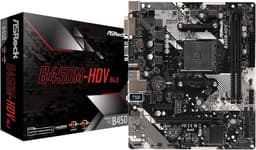
The ASRock B450M-HDV R4.0 is a slightly older design based on AMD's B450 chipset, but it remains a relevant and well-priced option for builders on the AM4 platform, particularly those who already own a compatible Ryzen processor or are picking one up second-hand. The R4.0 revision brought improved Ryzen 5000 BIOS support, making it a more complete package than earlier B450M-HDV versions.
B450 sits a step above A520 in AMD's chipset hierarchy, offering support for CPU overclocking on unlocked Ryzen processors, though the HDV's modest VRM design does limit how far you can push that in practice. The board has two DDR4 DIMM slots with a maximum capacity of 32 GB, which is the most significant hardware limitation compared to newer boards in this roundup. For a budget build, 32 GB is still more than enough, but it does close off future upgrade paths sooner.
Storage options include one M.2 slot for NVMe drives and four SATA 6Gbps ports. The rear panel carries HDMI, DVI, and D-Sub display outputs, which is an unusually broad selection that makes it easy to connect older monitors without adapters. USB connectivity is provided by two USB 3.1 Gen 1 ports and two USB 2.0 ports on the rear panel, with additional headers on the board for front-panel connections.
ASRock's UEFI is functional and clear, though it lacks some of the polish of ASUS or MSI's interfaces at this tier. BIOS update support has been maintained for Ryzen 5000 compatibility, which is the key requirement for anyone buying this board new in 2025. The Micro-ATX form factor keeps it compatible with a wide range of cases.
The B450M-HDV R4.0 is best suited to builders pairing it with a Ryzen 5 3600 or Ryzen 5 5600 on a tight budget, or those who need the three display output options for a multi-monitor setup using integrated graphics. It is a dependable workhorse rather than a feature-packed enthusiast board.
Verdict: A solid B450 option with an unusually broad display output selection, best for budget Ryzen builds where the 32 GB RAM ceiling is not a concern.
Pros
- Three display outputs (HDMI, DVI, D-Sub) offer excellent legacy monitor compatibility
- B450 chipset enables CPU overclocking on unlocked Ryzen processors
- Consistent BIOS update support for Ryzen 5000 compatibility
Cons
- 32 GB maximum RAM capacity is the lowest in this roundup, limiting future upgrades
- Older platform with no PCIe 4.0 support, capping NVMe and GPU bandwidth
Buying Guide
Chipset: What the letters actually mean
For AMD AM4 builds, the chipset hierarchy runs A520, B450, B550, with each step up adding overclocking support, more PCIe lanes, and better storage options. A520 is the most affordable and is perfectly adequate for non-overclocking Ryzen 5000 builds, but it lacks PCIe 4.0 support and limits you to a single M.2 slot on most boards. B450 adds overclocking capability but is an older design without PCIe 4.0. B550 is the sweet spot for a budget Ryzen 5000 build in 2025, offering PCIe 4.0 on the primary slots, dual M.2 support on most boards, and better memory overclocking headroom. For Intel LGA1700 builds, H610 is the entry-level option and locks out overclocking entirely, while B660 adds memory overclocking and more PCIe lanes.
Form factor: Micro-ATX versus Mini-ITX
True Mini-ITX boards measure 170 x 170 mm and fit in the smallest PC cases, but they typically cost more, offer fewer expansion slots, and have more limited VRM designs at any given price point. Micro-ATX boards at 244 x 244 mm are only slightly larger and fit in a wide range of cases, including many marketed as compact or small form factor. For a budget build where every pound counts, Micro-ATX delivers significantly more value. If case size is genuinely critical, check whether your chosen case accepts mATX before committing to a Mini-ITX-only enclosure.
RAM slots and maximum capacity
Budget boards typically offer two or four DDR4 DIMM slots. Four slots are preferable because they allow you to start with two sticks in dual-channel configuration and add more later. Maximum capacity matters if you plan to use the system for video editing, virtualisation, or other memory-intensive workloads. Most boards in this roundup support 64 to 128 GB, which is more than enough for gaming and general use.
Storage connectivity
At minimum, look for one M.2 slot for your primary NVMe SSD and at least four SATA ports for additional drives. Two M.2 slots are a significant convenience if you plan to run multiple fast drives. Check whether the M.2 slots support PCIe 4.0 or only PCIe 3.0, as this affects the maximum speed of compatible NVMe drives.
Wireless connectivity
Integrated Wi-Fi saves the cost and hassle of a separate adapter and keeps the build tidy. Wi-Fi 5 (802.11ac) is adequate for most home networks, while Wi-Fi 6 (802.11ax) offers better performance in congested environments. If Wi-Fi is not included, you will need either a PCIe Wi-Fi card or a USB adapter, both of which add cost and complexity.
VRM quality
The voltage regulator module powers the CPU, and its quality determines how much headroom you have for overclocking and how stable the system runs under sustained load. Budget boards use simpler VRM designs, which is fine for mid-range CPUs but can cause instability or thermal throttling with high-end chips. If you plan to run a Ryzen 9 or a K-series Intel processor, prioritise a board with a more robust power delivery design even if it costs a little more.
The MSI B550M PRO-VDH WIFI is the overall winner of this roundup. It delivers PCIe 4.0 support, dual M.2 slots, integrated Wi-Fi, and a capable VRM in a Micro-ATX package that sits comfortably under the £100 mark. For the vast majority of Ryzen 5000 builders on a budget, it covers every meaningful requirement and leaves room to grow. The ASUS Prime B550M-A WiFi II is the better board on paper, with Wi-Fi 6 and a stronger VRM, and it is worth the small premium if your budget stretches to it. For builders on the tightest budgets, the MSI A520M-A PRO does exactly what it needs to do at a price that leaves more money for the CPU and GPU, which is where it matters most.