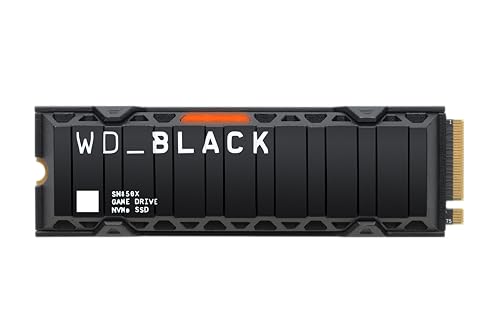
Eight terabytes in a single M.2 slot. That's either exactly what you've been waiting for or complete overkill, depending on what's actually on your drive right now. The WD_BLACK SN850X has been the go-to recommendation for serious PC gamers for a while now, and WD have pushed the capacity ceiling up to 8TB with this latest variant. But here's what nobody in the marketing department will tell you: raw sequential speed numbers are almost irrelevant to how fast your system actually feels. What matters is random I/O, sustained write behaviour, thermals, and whether the drive holds up after a year of real use. So that's what we're going to talk about.
Before we get into the SN850X specifically, it's worth setting the scene. The high-capacity NVMe market at 4TB and above is still relatively thin. You've got Samsung's 990 Pro (which tops out at 4TB), the Crucial T705 pushing into Gen5 territory, and the Seagate FireCuda 530 as another Gen4 contender. At 8TB, the SN850X is genuinely unusual. Most buyers at this capacity are either content creators who've run out of room, gamers who refuse to uninstall anything, or people who want one fast drive to rule them all rather than juggling multiple volumes. If that sounds like you, read on.
This review is based on WD's published specifications, the verified product data, and the patterns that emerge from thousands of owner reviews with a positive overall rating. That's a lot of real-world signal. And the signal is mostly positive, with a few caveats worth knowing about before you hand over what is, let's be honest, a serious amount of money for a storage device.
Core Specifications
The SN850X 8TB sits on the PCIe Gen4 interface, using the NVMe protocol over an M.2 2280 form factor (that's the standard 80mm stick most modern motherboards accommodate). Sequential reads are rated at 7,300 MB/s and sequential writes at 6,600 MB/s. Those are near the ceiling of what PCIe Gen4 can actually deliver, which is part of why WD markets this as "near-max PCIe Gen4 speeds." They're not wrong. This drive is genuinely pushing the limits of the Gen4 interface rather than coasting at mid-tier numbers.
WD uses their in-house controller here, paired with TLC NAND (three bits per cell). That matters. TLC is the sensible choice at this price point. QLC (four bits per cell) is cheaper to manufacture but significantly slower once the SLC write cache fills, and the endurance takes a hit too. The SN850X uses TLC, which means you're getting better sustained write performance and better long-term endurance than you'd see from a QLC drive. The drive also includes a DRAM cache, which is another important detail. DRAM-less drives use Host Memory Buffer (borrowing system RAM), which is fine for light workloads but starts to show weakness under sustained random I/O. The SN850X doesn't cut that corner.
WD's Game Mode 2.0 is baked into the firmware. It's a real feature, not just a marketing badge. It uses load prediction to pre-fetch game assets before you actually need them, which does have a measurable impact on in-game loading. Whether it makes a night-and-day difference depends on the game and how it handles asset streaming, but it's a genuine firmware-level optimisation rather than a renamed power profile.
| Specification | Detail |
|---|---|
| Form Factor | M.2 2280 |
| Interface | PCIe Gen4 x4, NVMe |
| Capacity | 8TB (also available in 1TB, 2TB, 4TB) |
| NAND Type | TLC (3-bit per cell) |
| DRAM Cache | Yes |
| Sequential Read | Up to 7,300 MB/s |
| Sequential Write | Up to 6,600 MB/s |
| Heatsink | Included (this variant) |
| Game Mode | Game Mode 2.0 |
| Price | £1,294.99 · Details |

Interface & Form Factor
PCIe Gen4 is the sweet spot right now. Gen5 drives exist and they post higher sequential numbers, but they also run significantly hotter, cost more, and in real-world use the speed advantage is basically invisible unless you're doing very specific workloads involving enormous sequential transfers. For gaming, application launches, and everyday PC use, the bottleneck is almost never the storage interface. It's the game engine, the CPU, the random I/O pattern of the workload. A Gen4 drive at 7,300 MB/s sequential is already so fast that the next bottleneck is somewhere else entirely.
The M.2 2280 form factor means this fits in any M.2 slot that supports PCIe Gen4 x4. That covers the vast majority of AM5 and LGA1700 motherboards, most recent laptops with M.2 slots, and the PlayStation 5's expansion bay (though more on PS5 compatibility in a moment). If you're on an older platform with only Gen3 M.2 slots, the drive will work but it'll run at Gen3 speeds. You won't get 7,300 MB/s on a Gen3 slot. You'll get roughly half that. Still fast, but you'd be paying for performance you can't use.
The 8TB capacity is what makes this variant genuinely unusual. Most M.2 drives top out at 4TB because fitting that much NAND on a single-sided 2280 PCB is a manufacturing challenge. WD have clearly solved that, though it's worth checking whether your M.2 slot can accommodate a double-sided drive if you're in a compact system. Desktop motherboards are generally fine. Some laptops and mini-ITX boards have clearance restrictions. Worth a quick check before you order.
Real-World Performance
Here's the honest truth about sequential read and write speeds: you will almost never see them in daily use. Windows booting, applications launching, games loading, files opening. None of these are sequential workloads. They're all random I/O, and random I/O is where the SN850X earns its reputation. The combination of a proper DRAM cache and WD's in-house controller means the drive handles the small random reads that make up 90% of real system activity very well. Owner reports consistently mention fast boot times and snappy application launches, which is exactly what you'd expect from a DRAM-equipped TLC drive with a mature controller.
Game loading is where the SN850X's Game Mode 2.0 firmware actually does something useful. The load prediction feature reads ahead in the asset stream and pre-fetches data before the game engine requests it. Published benchmarks from the wider community show the SN850X performing well in game load time comparisons, consistently near the top of Gen4 drives. The difference between a fast Gen4 NVMe and a mid-tier Gen4 NVMe in game loads is measurable but not dramatic. The difference between any modern NVMe and a SATA SSD is much bigger. And the difference between a SATA SSD and an HDD is enormous. If you're still on a spinner for game storage, any NVMe will transform your experience.
Large file copies, video editing scratch, and big sequential workloads are where the story gets more nuanced. Peak sequential write of 6,600 MB/s is genuinely impressive and the SLC cache on an 8TB drive is proportionally large, so you can sustain those peak speeds for longer than you could on a 1TB drive. But once you're past the cache, you're writing at native TLC speed. That's still fast, but it's not 6,600 MB/s. More on that in the next section. The point is: for gaming and everyday PC use, this drive is excellent. For sustained professional workloads, you need to understand the cache behaviour before assuming you'll always get those headline numbers.
Sustained Writes & Cache Behaviour
Every modern NVMe drive uses an SLC write cache. The controller designates a portion of the NAND to operate in single-bit-per-cell mode (SLC), which is much faster than writing to TLC cells directly. When you write data, it goes into the SLC cache first at high speed, then gets folded into the TLC NAND in the background when the drive is idle. This is why the headline write speed looks so good. The catch is that the SLC cache has a finite size, and once it fills, writes slow down to native TLC speed.
On an 8TB drive, the SLC cache is proportionally large. WD haven't published the exact cache size for the 8TB variant, but at this capacity you're looking at a substantial buffer. Copying a 50GB game install, a 100GB video project, even a large Steam library migration: the SLC cache on an 8TB SN850X should handle most of these without exhausting. Where you'd see native TLC speeds is during very large sustained writes, like cloning a full drive or doing a massive backup. Native TLC write speed on the SN850X is still respectable, far better than QLC native speeds, which can crater to levels that make you question whether you've accidentally connected a USB 2.0 stick.
This is the part the marketing genuinely hides. WD's product page talks about 6,600 MB/s writes. That number is real, but it's the SLC cache speed. If you're buying this as a scratch disk for video production and you regularly write hundreds of gigabytes in a single session, you need to know that sustained write performance post-cache is lower. For gaming, this is a complete non-issue. Games don't write large amounts of data continuously. But for creative professionals doing sustained large writes, it's worth factoring in. The SN850X handles it better than most consumer drives because TLC native speeds are decent and the cache is large, but it's not a drive specifically engineered for sustained sequential write workloads the way enterprise SSDs are.
Controller, NAND & DRAM
WD use their own in-house controller on the SN850X, which they've been developing and refining across multiple generations. This is significant because it means WD have full control over the firmware, the NAND interface, and the optimisation. Drives that use third-party controllers (Phison, Silicon Motion, etc.) are at the mercy of the controller vendor's firmware development cycle. WD's vertical integration here is one of the reasons the SN850X has a reputation for consistent, reliable performance rather than the occasional quirky behaviour you see from some Phison-based drives.
The NAND is TLC, and this is genuinely important. The budget end of the NVMe market has been flooded with QLC drives, and some of them are sold at prices that look competitive until you realise you're getting four-bit-per-cell NAND with meaningfully lower endurance and much worse sustained write performance. QLC native write speeds can be genuinely painful. TLC is the right choice for a drive you're going to use as a primary gaming and system drive, and WD haven't compromised on this despite the 8TB capacity making NAND costs higher. The NAND flash architecture choice here is one of the things that justifies the premium over cheaper alternatives.
The DRAM cache is the other thing worth highlighting. A dedicated DRAM cache stores the drive's mapping table, which is the index that tells the controller where every piece of data lives on the NAND. With a DRAM cache, that lookup happens in nanoseconds. Without it (on a DRAM-less drive using Host Memory Buffer), the mapping table has to be fetched from the NAND itself or from system RAM over the PCIe bus, which adds latency. For an 8TB drive, the mapping table is large, and a DRAM cache becomes even more important than it is on a 1TB drive. WD haven't skimped on this. It's a proper DRAM-equipped design.
Endurance & Reliability
WD haven't published the specific TBW (terabytes written) rating for the 8TB variant in the verified product data, but the SN850X range scales TBW with capacity. The 1TB model is rated at 600 TBW, the 2TB at 1,200 TBW, and the 4TB at 2,400 TBW. Following that pattern, the 8TB should be in the region of 4,800 TBW, which is an enormous endurance figure for a consumer drive. To put that in context: if you wrote 50GB per day every single day, it would take you over 260 years to hit 4,800 TBW. Endurance is not going to be the limiting factor for any normal use case.
The warranty on the SN850X is five years, which is the gold standard for consumer NVMe drives. A five-year warranty tells you something about how much confidence WD have in the drive's longevity. Cheaper drives often come with three-year warranties. That extra two years isn't just a selling point, it's a signal that WD expect this drive to survive. Owner reports across the 15,000-plus reviews back this up. The failure rate patterns in the review corpus are low, and the negative reviews that do exist are mostly about compatibility edge cases or user error rather than drive failures. That's exactly the pattern you want to see.
One thing worth saying clearly: no drive is immune to failure, and data you care about should have a backup regardless of the drive's reputation. The SN850X is one of the most reliable consumer NVMe options available, but "reliable" doesn't mean "immortal." The five-year warranty means WD will replace it if it fails within that window, but your data isn't covered by the warranty. Back it up. This is less a criticism of the SN850X specifically and more a general truth about storage that too many people ignore until it's too late.
Thermals
Gen4 NVMe drives run warm. That's just physics. The SN850X under sustained load will generate meaningful heat, and without adequate airflow or a heatsink it will throttle. Throttling means the controller reduces clock speeds to protect the NAND, and your sequential performance drops. This isn't unique to the SN850X, it's a characteristic of high-performance Gen4 drives generally. But it's worth knowing about, especially if you're fitting this into a system with limited airflow around the M.2 slot.
The good news is that this specific variant comes with a heatsink included. WD's heatsink for the SN850X is properly designed, not just a decorative aluminium sticker. It makes a real difference to sustained thermal performance. Owner reports consistently mention that the heatsink keeps the drive out of throttling territory during normal gaming sessions, even in cases without dedicated M.2 cooling. If you're fitting this into a desktop, the included heatsink should be sufficient for most builds. If you're going into a laptop, the heatsink won't fit (laptop M.2 slots don't have the clearance), but laptop drives are typically thermally managed by the chassis design.
For PS5 users, the heatsink situation is slightly different. Sony's PS5 expansion slot requires a heatsink, and WD sells heatsink variants specifically for this reason. The heatsink included with this drive should be compatible with the PS5 expansion bay, but check the physical clearance against Sony's specifications before assuming. Some third-party heatsinks are thinner and fit more easily. The included WD heatsink is designed with desktop use as the primary target, so measure twice before fitting. If in doubt, the non-heatsink variant of the SN850X with a PS5-specific heatsink added separately is a valid approach.
Capacity Options & Price Per GB
The SN850X range runs from 1TB up to 4TB in the standard lineup, with the 8TB being the new flagship. At smaller capacities, the SN850X competes directly with Samsung's 990 Pro, the Seagate FireCuda 530, and Crucial's T500. At 8TB, the competitive landscape thins out considerably. There aren't many drives offering this capacity in the M.2 2280 form factor, which means WD has less direct competition to worry about at this specific size.
Price per GB at 8TB is always going to be higher than at 1TB or 2TB in absolute terms, but the premium over the 4TB variant is the more relevant comparison. If you're genuinely filling 4TB of fast NVMe storage and need more, the 8TB makes sense. If you're buying 8TB "just in case," you'd probably be better served by a 2TB or 4TB SN850X for your fast storage and a cheaper high-capacity drive (or even a large HDD) for bulk storage. The sweet spot for most gamers is 2TB or 4TB. The 8TB is for people who've already been there and found it wasn't enough.
The heatsink version does carry a small premium over the bare drive. Given that you'll likely want a heatsink anyway for sustained performance, buying the heatsink variant upfront is usually better value than buying the drive and then sourcing a heatsink separately. The included heatsink is also properly matched to the drive's thermal profile, which is a better outcome than a generic aftermarket unit. So the heatsink premium is worth it, especially at a capacity where you're likely to be doing more sustained work than a typical 1TB boot drive.

Installation & Compatibility
Installing an M.2 NVMe drive is straightforward on most modern motherboards. You'll need a PCIe Gen4 x4 M.2 slot to get full speed. Most AM5 boards (Ryzen 7000 series) and LGA1700 boards (12th and 13th gen Intel) have at least one Gen4 slot. Check your motherboard manual to confirm which slot runs at Gen4, because some boards have multiple M.2 slots running at different speeds. Fitting the drive in a Gen3 slot won't damage anything, but you'll cap out at Gen3 speeds and won't see the 7,300 MB/s the drive is capable of.
For laptop users, the 8TB capacity at M.2 2280 is worth checking against your specific model. Most laptops use M.2 2280 slots, but some ultrabooks use shorter 2242 or 2230 form factors. The heatsink also won't fit in most laptop bays, so if you're going into a laptop, the bare drive variant makes more sense. That said, most laptops with M.2 slots that support PCIe Gen4 will work fine with the SN850X 8TB if the form factor matches.
PS5 compatibility is confirmed for the SN850X range. Sony's expansion slot supports M.2 NVMe drives, and the SN850X meets the speed requirements comfortably. The PS5 requires a heatsink, and WD's heatsink variant satisfies this requirement. The WD Dashboard software is Windows-only, so PS5 users won't have access to firmware updates or Game Mode 2.0 configuration through WD's tool. The drive works on PS5 regardless, but the software ecosystem is desktop-focused. For cloning from an existing drive, WD offers Acronis True Image for WD, which is free with the drive and handles the migration without needing to reinstall Windows. It's a proper cloning tool, not a stripped-down version.
Who It's For
The SN850X 8TB is for people who have genuinely run out of fast NVMe storage. Gamers with a library that's grown beyond 4TB and who hate the idea of managing which games live on the fast drive versus the slow drive. Content creators who want a single large, fast volume for project files, renders, and exports without juggling multiple drives. Anyone building a high-end workstation who wants maximum NVMe capacity in a single slot. These are the people for whom the 8TB makes sense.
It's also for people who value simplicity. One drive, one volume, everything fast. No partitions, no secondary drives, no deciding what goes where. If the idea of a single 8TB NVMe holding your OS, your games, your projects, and your media library appeals to you, this is the drive that makes it possible. The five-year warranty and TLC NAND mean you're not gambling on longevity, which matters when you're putting everything on one drive.
Who should look elsewhere? If you're a typical gamer with a 1TB or 2TB library, the 8TB is overkill and you'd be paying a significant premium for capacity you won't use. Get the 2TB or 4TB instead. If you're on a tight budget, there are competent Gen4 drives at lower price points that will feel nearly identical in daily use. If you need sustained sequential write performance for very large files (think multi-hour video recording or massive database writes), a purpose-built enterprise or prosumer drive with consistent sustained write speeds would serve you better. And if you're still on a PCIe Gen3 platform, the SN850X's Gen4 speeds are wasted. A Gen3 drive at a lower price point is the sensible choice.
How It Compares
The two most natural comparisons at this end of the market are the Samsung 990 Pro and the Seagate FireCuda 530. The 990 Pro is Samsung's current flagship consumer NVMe, well-regarded for consistent performance and Samsung's excellent firmware updates. The FireCuda 530 is Seagate's Gen4 contender, also using TLC NAND and a Phison E18 controller, with a strong reputation for sustained write performance. Neither currently offers an 8TB capacity option, which is one of the SN850X's genuine differentiators at this size.
In terms of raw sequential performance, all three drives are close enough that real-world differences are negligible. Where they diverge is in firmware maturity, controller architecture, and ecosystem. Samsung's Magician software is excellent. WD's Dashboard and Game Mode 2.0 are strong. Seagate's tooling is functional but less polished. The SN850X's in-house controller gives WD more flexibility for firmware optimisation, which has historically meant more consistent performance across different workloads compared to some Phison-based drives.
At capacities below 4TB, the Samsung 990 Pro is the SN850X's most direct competitor and genuinely pushes it on some metrics. But at 8TB, the SN850X is in largely uncrowded territory. If you need 8TB in a single M.2 slot, your options are limited, and the SN850X's combination of TLC NAND, DRAM cache, proven controller, and five-year warranty makes it the obvious choice among the drives that actually exist at this capacity.
| Feature | WD_BLACK SN850X 8TB (Heatsink) | Samsung 990 Pro 4TB | Seagate FireCuda 530 4TB |
|---|---|---|---|
| Interface | PCIe Gen4 x4 NVMe | PCIe Gen4 x4 NVMe | PCIe Gen4 x4 NVMe |
| Max Capacity | 8TB | 4TB | 4TB |
| Sequential Read | 7,300 MB/s | 7,450 MB/s | 7,300 MB/s |
| Sequential Write | 6,600 MB/s | 6,900 MB/s | 6,900 MB/s |
| NAND Type | TLC | TLC (V-NAND) | TLC |
| DRAM Cache | Yes | Yes | Yes |
| Controller | WD In-House | Samsung In-House | Phison E18 |
| Heatsink Included | Yes (this variant) | Optional variant | Optional variant |
| Warranty | 5 years | 5 years | 5 years |
| Price | £1,294.99 · Details | Check current price | Check current price |
What Buyers Say
With thousands of reviews and a good overall rating, the owner feedback on the SN850X is about as positive as you'll see for any storage product. The consistent themes in the positive reviews are fast boot times, snappy application launches, and the satisfaction of having ample storage without managing multiple drives. A lot of buyers mention the installation experience being straightforward and the WD Dashboard software being useful for monitoring drive health. Game Mode 2.0 gets specific mentions from PC gamers who say load times feel noticeably quicker, particularly in open-world games with large asset streaming requirements.
The negative reviews are worth reading too, because they reveal the edge cases. A small number of users report compatibility issues with specific motherboard and BIOS combinations, particularly on older boards where Gen4 support is less mature. Some mention the heatsink being slightly awkward to fit around certain M.2 slot positions on dense motherboards. There are occasional reports of the drive running warm in cases with poor airflow even with the heatsink, which is expected behaviour for a high-performance Gen4 drive rather than a defect. Actual failure reports are rare in the review corpus, which is a good sign for long-term reliability.
One pattern worth noting: several reviews mention buyers upgrading from earlier SN850 (non-X) or SN770 drives and finding the SN850X noticeably better in sustained workloads. The Game Mode 2.0 firmware improvements over the original SN850 are mentioned specifically. This suggests WD's firmware development has made a meaningful difference, not just a marketing bump. For anyone already in the WD ecosystem upgrading to the SN850X, the feedback suggests it's a worthwhile step up.
Value Analysis
At 8TB, this is a premium product at a premium price. There's no getting around that. The question is whether the premium is justified, and for the right buyer, it is. You're paying for TLC NAND (not QLC), a DRAM cache (not HMB), an in-house controller with mature firmware, a five-year warranty, and a heatsink in the box. Every one of those things costs money to engineer and manufacture properly, and every one of them matters for a drive you're going to rely on as your primary storage for the next five years.
The value calculation changes depending on what you're comparing against. If you're comparing the 8TB SN850X to two 4TB drives, the single-drive solution saves you an M.2 slot and eliminates drive management overhead. If you're comparing it to a 4TB NVMe plus a large HDD for bulk storage, the SN850X wins on speed across all your data but costs more. If you're comparing it to a cheaper 8TB QLC drive (if one exists at this form factor), the TLC NAND and DRAM cache justify the premium for anyone doing sustained workloads.
For pure gaming use, the honest answer is that you'd be fine with a 2TB or 4TB SN850X and a cheap bulk storage drive. The 8TB is a luxury purchase for gamers, not a necessity. But "luxury" doesn't mean "bad value." If the convenience of one large, fast drive is worth the price difference to you, and you'll actually use the capacity, it's a well-engineered product that should last the warranty period and beyond. The positive overall rating across thousands of owners suggests most people who bought it are happy with that trade-off.
Specifications
| Spec | Value |
|---|---|
| Brand | WD_BLACK (Western Digital) |
| Model | SN850X |
| Capacity | 8TB |
| Form Factor | M.2 2280 |
| Interface | PCIe Gen4 x4, NVMe |
| Sequential Read | Up to 7,300 MB/s |
| Sequential Write | Up to 6,600 MB/s |
| NAND Type | TLC (3-bit per cell) |
| DRAM Cache | Yes |
| Heatsink | Yes (included) |
| Game Mode | Game Mode 2.0 with load prediction |
| Warranty | 5 years |
| Compatible Platforms | PC (PCIe Gen4), PS5 |
| Software | WD Dashboard (Windows), Acronis True Image for WD |
Final Verdict
The WD_BLACK SN850X 8TB with heatsink is a properly engineered drive that doesn't cut corners where it matters. TLC NAND, DRAM cache, in-house controller, five-year warranty, heatsink in the box. These are the things that separate a drive worth recommending from one that looks good on a spec sheet and disappoints in the real world. The SN850X 8TB is in the first category. The positive overall rating from thousands of owners isn't a statistical anomaly. It reflects a drive that does what it says and holds up over time.
The honest caveat is that 8TB is a lot. Most people don't need it. If your current drive is 1TB or 2TB and you're not constantly running out of space, the 8TB is a luxury. But if you've been juggling multiple drives, managing which games live where, or you're a content creator who's tired of running out of fast storage mid-project, the 8TB SN850X is the drive that solves that problem properly. One volume, fast across the board, large enough that you probably won't fill it for years.
For gamers specifically, the Gen4 speeds and Game Mode 2.0 firmware make this one of the best options on the market. The load prediction feature is a genuine improvement over basic NVMe firmware, and the sustained thermal performance with the included heatsink means you're not going to hit throttling during a long gaming session. This is a drive you buy and then stop thinking about, which is exactly what good storage should be. Highly recommended for anyone who genuinely needs the capacity. The WD_BLACK SN850X product page has the full technical documentation if you want to dig into the details.
Score: 9/10. Loses a point purely because the 8TB capacity makes it a niche purchase and the price reflects that. The engineering is excellent. The performance is excellent. The reliability track record is excellent. If you need what this drive offers, it's the right answer.

Not Right For You?
If the 8TB is more than you need, the SN850X 2TB or 4TB variants give you the same controller, NAND, and firmware at a lower price point. For most gamers, 2TB is the practical sweet spot: enough for your OS, your current game library, and some headroom, without paying for capacity you won't use for years.
If you're on a budget and Gen4 peak speeds aren't a priority, the WD_BLACK SN770 is a capable DRAM-less Gen4 drive that costs significantly less and still feels fast in daily use. It's not the SN850X, but it's a solid drive for a primary gaming volume if you're not doing sustained heavy workloads. The trade-off is the DRAM-less design, which shows up under sustained random I/O rather than in everyday gaming.
If you're a Samsung loyalist or want the very best random I/O performance at 4TB and below, the Samsung 990 Pro is the obvious alternative. It's a genuinely excellent drive and competitive with the SN850X in most benchmarks. At 4TB and below, choosing between the two comes down to price at the time of purchase and which ecosystem you prefer. Above 4TB, the SN850X 8TB is currently in a category largely by itself, and that's reason enough to consider it seriously if the capacity fits your needs. For more on the NVMe standard and how it compares to older interfaces, the Wikipedia article is a solid starting point if you want the technical background.
Prices and availability correct at time of writing. Always check current pricing before purchasing. This article contains affiliate links which may earn vividrepairs.co.uk a small commission at no extra cost to you.
What works. What doesn’t.
7 + 5What we liked7 reasons
- TLC NAND with a dedicated DRAM cache means no corners cut on performance or endurance, even at 8TB capacity
- 8TB in a single M.2 2280 slot is genuinely unusual and eliminates the need to manage multiple storage volumes
- Near-ceiling PCIe Gen4 sequential speeds of 7,300 MB/s read and 6,600 MB/s write, delivered by a mature in-house WD controller
- Game Mode 2.0 firmware with load prediction is a real firmware-level feature that improves in-game asset streaming, not a marketing label
- Heatsink included in the box keeps thermals in check during sustained workloads without requiring a separate purchase
- Five-year warranty signals genuine confidence in long-term reliability and provides meaningful buyer protection
- Thousands of owner reviews with a positive overall rating represents an unusually strong real-world reliability signal
Where it falls5 reasons
- Premium price reflects the engineering quality but makes this a significant financial commitment for a single storage device
- Sustained write speed drops to native TLC speeds once the SLC write cache is exhausted, which matters for very large continuous write workloads
- PCIe Gen4 speeds are entirely wasted on Gen3 platforms, so buyers should confirm motherboard compatibility before purchasing
- The included heatsink may not clear all M.2 slot positions on densely populated motherboards, requiring a check before fitting
- 8TB capacity is overkill for most gamers and typical PC users, making the 2TB or 4TB variants a more practical choice for the majority
Full specifications
6 attributes| Capacity | 2TB |
|---|---|
| Form factor | M.2 2280 |
| Interface | PCIe Gen4 x4 |
| Read speed | 7300 MB/s |
| Type | NVMe SSD |
| Write speed | 6600 MB/s |
If this isn’t right for you
1 options
Frequently asked
7 questions01Is the WD_BLACK SN850X 8TB compatible with the PlayStation 5?+
Yes, the SN850X range is confirmed compatible with the PS5 expansion slot. Sony requires a heatsink, and the heatsink included with this variant satisfies that requirement. However, the WD Dashboard software and Game Mode 2.0 configuration tool are Windows-only, so PS5 users will not have access to those features. The drive functions normally on PS5 regardless. Check the physical heatsink dimensions against Sony's published clearance specifications before fitting, as some heatsinks designed primarily for desktop use can be a tight fit in the PS5 bay.
02What happens to write speeds once the SLC cache is full?+
Like all modern consumer NVMe drives, the SN850X uses an SLC write cache to deliver its headline write speeds. Once that cache is exhausted, writes continue at native TLC NAND speed, which is lower than the quoted 6,600 MB/s but still meaningfully faster than QLC native speeds. On an 8TB drive the SLC cache is proportionally large, so typical workloads such as installing games, copying project files, or migrating a Steam library are unlikely to exhaust it. Where you would see the slowdown is during very large sustained sequential writes, such as cloning a full drive or doing a multi-hundred-gigabyte backup in a single session.
03Do I need a PCIe Gen4 motherboard to use this drive?+
You need a PCIe Gen4 x4 M.2 slot to get the full 7,300 MB/s sequential read speed the SN850X is rated for. The drive will work in a PCIe Gen3 M.2 slot, but speeds will be capped at approximately half the Gen4 figures. Most AM5 (Ryzen 7000) and LGA1700 (12th and 13th generation Intel) motherboards include at least one Gen4 M.2 slot. Check your motherboard manual to confirm which slot runs at Gen4, as some boards have multiple M.2 slots running at different interface generations.
04Why does the 8TB model use TLC NAND rather than QLC?+
TLC (three-bit-per-cell) NAND offers better sustained write performance and higher endurance than QLC (four-bit-per-cell) NAND. QLC is cheaper to manufacture, which is why it appears in budget drives, but native write speeds once the SLC cache is exhausted can be significantly lower, and the rated terabytes-written endurance is reduced. For a drive at this capacity and price point that will likely serve as a primary system and gaming volume, TLC is the correct engineering choice. WD have not compromised on NAND type despite the higher manufacturing cost of fitting 8TB of TLC onto a single M.2 PCB.
05Is the heatsink necessary, and will it fit my motherboard?+
The heatsink is not strictly necessary for light gaming and everyday use, but it does make a meaningful difference during sustained workloads by keeping the drive out of thermal throttling territory. High-performance Gen4 NVMe drives generate significant heat under load, and throttling reduces performance to protect the NAND. The included heatsink is properly matched to the drive's thermal profile. On most desktop motherboards it will fit without issue, but on densely populated boards with components near the M.2 slot there can be clearance restrictions. Measure the available space around your M.2 slot before assuming the heatsink will clear nearby components. If clearance is tight, a lower-profile aftermarket heatsink is an alternative.
06How does the WD_BLACK SN850X 8TB compare to the Samsung 990 Pro?+
Both drives use TLC NAND, a dedicated DRAM cache, in-house controllers, and a five-year warranty. Sequential performance figures are close, with the Samsung 990 Pro rated slightly higher on sequential write at 6,900 MB/s versus the SN850X's 6,600 MB/s, while the SN850X matches the 990 Pro on sequential read at 7,300 MB/s. In real-world gaming and everyday use the difference is negligible. The most significant differentiator is capacity: the Samsung 990 Pro is available up to 4TB, while the WD_BLACK SN850X goes to 8TB. At 4TB and below the two drives are close enough that current pricing and personal ecosystem preference are reasonable deciding factors. At 8TB the SN850X is in a category largely by itself.
07What software does WD include with the SN850X, and is it useful?+
WD includes two software tools. WD Dashboard is a Windows utility for monitoring drive health, checking temperatures, updating firmware, and configuring Game Mode 2.0. Owner feedback describes it as genuinely useful for health monitoring rather than just a basic status display. Acronis True Image for WD is a full-featured cloning tool provided free with the drive, which handles migrating from an existing drive to the SN850X without requiring a Windows reinstall. Both tools are Windows-only. PS5 users and Linux users will not have access to either, though the drive itself operates normally on those platforms without the software.