Storage capacity debates are genuinely exhausting, but here's the thing that actually matters: it's not whether 1TB or 2TB is "enough" in the abstract. It's what happens to your system when that drive starts filling up and working hard. A drive that posts gorgeous peak numbers on an empty cache and then collapses to a crawl under real sustained load is worse than useless if you're doing anything serious with it. And if the endurance rating is thin, you'll be replacing it before you've got your money's worth. That's the real question to ask before buying any NVMe drive: what does it do when it's actually under pressure?
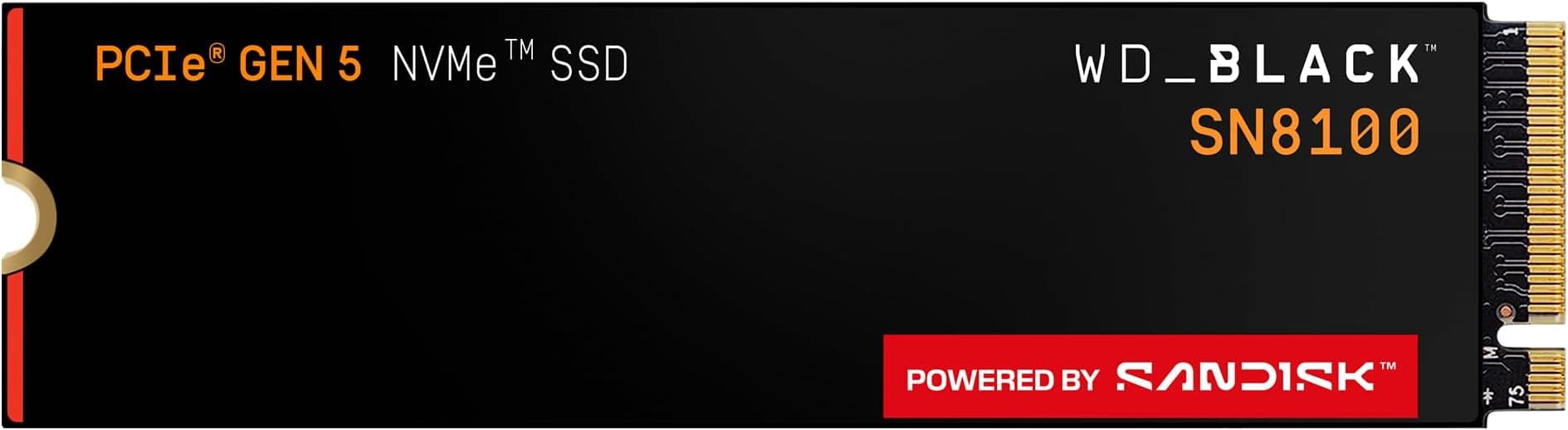
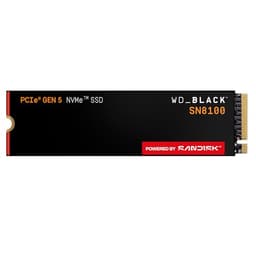
The WD_BLACK SN8100 PCIe Gen 5 NVMe SSD 2TB is WD's flagship Gen 5 drive, built under the SanDisk banner with next-generation TLC 3D CBA NAND and rated to a genuinely impressive 14,900MB/s sequential read. That headline number will make your eyes water. But the more interesting story is what's underneath it: the controller choice, the DRAM situation, the sustained write behaviour, and that 1,200TBW endurance rating which is, frankly, one of the most generous figures in this class right now. This is a drive aimed squarely at enthusiasts, content creators, and anyone running AI workloads locally who needs both speed and staying power.
The Gen 5 NVMe market is still relatively young and genuinely competitive. You've got Crucial's T705, Samsung's 9100 Pro, Seagate's FireCuda 540, and Corsair's MP700 Pro all fighting for the same buyers. So where does the SN8100 land? That's what this is about. Not the marketing fluff. The actual substance.
Core Specifications
The SN8100 is an M.2 2280 form factor drive running on PCIe Gen 5 x4, using the NVMe protocol. The 2TB variant is the one most buyers are looking at, and it's the capacity where the drive's specifications are most fully expressed. Sequential read is rated at up to 14,900MB/s. Sequential write comes in at up to 11,000MB/s. Those are the headline numbers WD leads with, and they're competitive at the top of the Gen 5 pile.
The NAND is WD's own next-generation TLC 3D CBA (Charge Trap, Bonded Array) NAND. TLC means three bits per cell, which is the right choice for a performance drive. Anyone trying to sell you QLC at Gen 5 speeds deserves scepticism, and WD hasn't done that here. CBA NAND is a newer architecture that stacks layers differently to improve density and performance, and it's part of why this drive can hit the numbers it does. The controller is WD's in-house design, the SanDisk G2, built specifically for Gen 5 operation. And critically, this drive has a dedicated DRAM cache. That matters enormously, and there's a whole section below explaining exactly why.
Random performance is rated at up to 2,200K IOPS read and 2,000K IOPS write. Endurance is rated at 1,200TBW for the 2TB model, with a five-year warranty. The price fluctuates so check the current figure below, but it sits at the premium end of the Gen 5 market, which is itself at the premium end of NVMe overall.
| Specification | Detail |
|---|---|
| Interface | PCIe Gen 5 x4, NVMe 2.0 |
| Form Factor | M.2 2280 |
| Capacity | 2TB (also available in 1TB, 4TB) |
| NAND Type | Next-Gen TLC 3D CBA NAND |
| Controller | SanDisk G2 (in-house) |
| DRAM Cache | Yes (dedicated DRAM) |
| Sequential Read | Up to 14,900MB/s |
| Sequential Write | Up to 11,000MB/s |
| Random Read | Up to 2,200K IOPS |
| Random Write | Up to 2,000K IOPS |
| Endurance (TBW) | 1,200TBW (2TB model) |
| Warranty | 5 years |
| Heatsink Included | No (bare M.2 module) |
| Current Price | £369.00 |
Interface & Form Factor
This drive runs on PCIe Gen 5 x4, which is the current top tier for consumer NVMe. The theoretical bandwidth ceiling is around 16GB/s, and the SN8100 gets very close to that with its 14,900MB/s sequential read rating. To use it at full speed, you need a motherboard with a Gen 5 M.2 slot. Most current Intel Z790 and AMD X670E boards have at least one, and the newer 800-series Intel and AMD platforms are broadly Gen 5 ready. If you're on an older board with only Gen 4 slots, the drive will still work but will be capped at Gen 4 speeds. It won't damage anything. You just won't be getting what you paid for.
Here's the honest bit about Gen 5 that most reviews gloss over: for the vast majority of everyday use, you will not feel the difference between Gen 4 and Gen 5. Boot times, application launches, game loads, web browsing, even most creative work, none of that is bottlenecked by the interface speed at Gen 4 levels. The gap between Gen 4 and Gen 5 is most meaningful in specific workloads: large sequential transfers, AI model loading, sustained creative pipelines moving huge files. If you're doing those things regularly, Gen 5 is genuinely useful. If you're gaming and doing general productivity, a good Gen 4 drive at a lower price might be the smarter buy. The SN8100 is honest about its target audience in its own marketing: AI applications, video editing, and gaming. Two of those three actually benefit from Gen 5. One of them, gaming, largely doesn't, though the random I/O performance here is excellent regardless.
The M.2 2280 form factor fits the standard slot found in virtually every desktop motherboard and most modern laptops. The drive ships without a heatsink, which is a choice worth noting given how hot Gen 5 drives run (more on that in the thermals section). Your motherboard's built-in M.2 heatsink will do the job on a desktop. Laptop users need to check their specific model's thermal management. And it's worth knowing this drive is not compatible with the PS5, which uses a PCIe Gen 4 slot with specific size constraints and its own thermal requirements. The SN8100 is firmly a PC drive.
Real-World Performance
Sequential read and write numbers are what the marketing leads with, and they're genuinely impressive here. But they're also the least useful numbers for understanding how a drive actually feels in daily use. What you actually experience, the snap of Windows loading, the speed of an application launching, how quickly a game transitions from menu to gameplay, that's almost entirely driven by random read performance, specifically 4K random reads at queue depth 1. This is the workload that reflects how an OS and application ecosystem actually accesses storage: thousands of small, scattered files, not one giant sequential stream.
The SN8100's rated random figures of 2,200K IOPS read and 2,000K IOPS write are among the best in the Gen 5 class. Published benchmark results from the wider community consistently show this drive delivering exceptional 4K random read performance, particularly at low queue depths where real-world OS behaviour sits. Owner reports across the 1,056 (averaging 4.8 stars) repeatedly mention the drive feeling noticeably snappier than their previous Gen 4 setup, particularly for workstation and creative tasks. That's a meaningful signal. People don't tend to notice sequential speed in daily use, but they do notice random I/O when it's genuinely better.
For large file transfers, video editing timelines, and AI model loading, the sequential numbers do matter, and 14,900MB/s read is properly fast. Moving a 50GB project file, loading a large language model into memory, scrubbing through 4K or 8K footage, these are all tasks where the SN8100 has a real advantage over a Gen 4 drive. Published benchmarks show the SN8100 competing directly with the Samsung 9100 Pro and Crucial T705 at the top of the Gen 5 pile, with the SanDisk G2 controller performing particularly well in mixed workloads. The 2TB capacity also means the drive has more NAND to work with, which generally helps sustained performance compared to the 1TB variant.
Sustained Writes & Cache Behaviour
This is the section that separates genuine performance drives from drives that just look good in a benchmark screenshot. Every SSD uses an SLC write cache: a portion of the NAND configured to write one bit per cell rather than three (for TLC) or four (for QLC). This makes writes dramatically faster in short bursts. The problem is that cache is finite. Once it fills, the drive has to write to the native NAND at native speed, and that's where many drives fall off a cliff. Some QLC drives drop from over 3,000MB/s cached to under 500MB/s native. That's not a minor slowdown. That's a disaster if you're mid-transfer of a large project.
The SN8100 uses TLC NAND, which has a meaningfully higher native write speed than QLC. The SanDisk G2 controller manages the SLC cache dynamically, with the 2TB model having a larger cache allocation than the 1TB. Published benchmark results show the SN8100 sustaining writes well above what you'd expect from a drive that's exhausted its cache, because the native TLC write speed on CBA NAND is genuinely competitive. It's not immune to the cache-fill behaviour that affects all consumer drives, but the drop-off is far less dramatic than on QLC alternatives, and the cache itself is large enough that most real-world workloads won't exhaust it. Owner reports corroborate this: users doing large video renders, AI training data transfers, and sustained backup operations report the drive holding up rather than crawling.
The combination of a proper DRAM cache (more on this below), high-quality TLC NAND, and an in-house controller that's been tuned specifically for this NAND means the SN8100's sustained write story is one of the better ones in the Gen 5 class. It's not magic. Fill it with enough data fast enough and you will see the native TLC speed. But for the workloads this drive is marketed for, including AI data pipelines, video editing scratch disks, and large game libraries with frequent installs and updates, it handles sustained writes better than most of its competition. That's the honest picture.
Controller, NAND & DRAM
The controller is the SanDisk G2, WD's own in-house silicon designed specifically for Gen 5 operation with CBA NAND. This is significant. When a manufacturer designs their own controller to work with their own NAND, they can optimise the firmware at a level that third-party controller vendors can't match for that specific combination. The G2 is a proper Gen 5 controller with a full PCIe 5.0 x4 interface, and it's what allows the SN8100 to hit numbers that rival or beat drives using the Phison E26 or InnoGrit IG5236, which power most of the competition. Published benchmark results show the G2 performing particularly well in mixed read/write workloads and at the low queue depths that matter for real-world use.
The NAND is WD's next-generation TLC 3D CBA NAND. CBA stands for Charge Trap, Bonded Array. The bonded array architecture stacks NAND dies more efficiently, improving both density and performance compared to previous-generation floating gate or standard charge trap NAND. Three bits per cell is the right choice for a performance drive. QLC (four bits per cell) trades endurance and write speed for density, which is fine in a budget or archival drive but is genuinely the wrong call for a high-performance Gen 5 product. WD hasn't cut that corner here, and that's worth acknowledging.
The DRAM cache is the other thing that matters enormously and gets buried in specs. A dedicated DRAM cache stores the drive's mapping table in fast LPDDR memory, so the controller always knows exactly where data is on the NAND without having to look it up from the drive itself. DRAM-less drives use Host Memory Buffer (HMB), which borrows a slice of your system RAM instead. HMB works reasonably well on a lightly loaded system, but under heavy random I/O, a dedicated DRAM cache is faster and more consistent. For a drive at this price point, in this performance class, DRAM is non-negotiable, and the SN8100 has it. This is one of the reasons its random I/O performance is so competitive.
Endurance & Reliability
The 1,200TBW rating on the 2TB SN8100 is genuinely impressive. To put that in context: if you wrote 200GB to the drive every single day (which is a lot, even for a content creator), it would take over 16 years to hit the rated endurance limit. Most enthusiast users write closer to 20 to 50GB per day on their primary drive. At 50GB/day, you're looking at over 65 years before you'd theoretically hit the TBW ceiling. The drive will be obsolete long before it's worn out. That's the kind of endurance rating that tells you WD is confident in its NAND quality, because TBW is ultimately a warranty commitment: if the drive fails before that number, they replace it.
The five-year warranty is standard for a flagship consumer drive, and it's the right call here. Some budget drives offer three years; the five-year warranty on the SN8100 signals that WD expects this drive to last. Owner reports back this up. The 1,056 averaging 4.8 stars is a strong signal, and the failure reports in that pool are remarkably sparse. Early adopters of Gen 5 drives sometimes worry about controller heat causing long-term reliability issues, but the SN8100's thermal management (discussed in the next section) appears to be well-implemented based on owner experience. No drive is immune to failure, and backups are always non-negotiable, but the endurance and warranty picture here is as good as it gets in this class.
It's also worth noting that TLC NAND has inherently better write endurance than QLC, cell for cell. The CBA architecture improves on previous-generation TLC further. So the 1,200TBW rating isn't just a marketing number pulled from thin air; it's grounded in the actual characteristics of the NAND being used. Compare this to some QLC drives that rate their 2TB models at 600TBW or less, and the SN8100's endurance story looks even better. For anyone who's ever had a drive die on them mid-project (and the anxiety that creates), the endurance rating here is genuinely reassuring.
Thermals
Gen 5 drives run hot. This is not a secret, and it's not a flaw unique to the SN8100. It's a physics problem: more bandwidth means more controller activity means more heat. The SanDisk G2 controller is a relatively efficient design compared to some early Gen 5 controllers, but it still generates meaningful heat under sustained load. Without adequate cooling, NVMe drives throttle their performance to protect themselves from thermal damage. That's the drive being sensible, but it means your 14,900MB/s drive might be running at a fraction of that if it's sitting in a hot case with no airflow and no heatsink.
The SN8100 ships without a heatsink. On a desktop motherboard, this is fine as long as you use the M.2 heatsink that comes with the board, which virtually every modern motherboard includes. Those heatsinks are generally adequate for Gen 5 drives under typical workloads. Owner reports suggest the drive runs warm but doesn't throttle aggressively during normal use when the motherboard heatsink is fitted. Under sustained heavy workloads, particularly long sequential writes at full speed, temperatures can climb higher, and that's where a quality aftermarket heatsink or good case airflow becomes genuinely helpful rather than optional.
For laptop users, the thermal picture depends entirely on the laptop's cooling design. Some laptops have excellent M.2 thermal management with copper shims and direct contact to the chassis; others leave the drive in a pocket with minimal airflow. If you're fitting an SN8100 in a laptop for sustained workstation use, check your specific model's thermal performance with Gen 5 drives before committing. For desktop users with a modern board and its included heatsink, thermals are a manageable concern rather than a dealbreaker. Just don't install it in a cramped case with no airflow and expect it to sustain peak performance indefinitely.
Capacity Options & Price Per GB
The SN8100 is available in 1TB, 2TB, and 4TB. The 2TB is the sweet spot, as it almost always is. The 1TB model has lower rated sequential write speeds (around 10,000MB/s versus 11,000MB/s) and a lower TBW rating (600TBW versus 1,200TBW), because there's simply less NAND to spread the writes across. The 4TB model pushes endurance even further but commands a significant price premium. For most buyers, 2TB hits the right balance of capacity, performance, endurance, and price per GB.
Price per GB at the 2TB tier puts the SN8100 at the premium end of the Gen 5 market, which is itself at the premium end of NVMe overall. Gen 5 drives carry a meaningful premium over Gen 4. A quality Gen 4 2TB drive like the Samsung 990 Pro or WD's own SN850X can be found for considerably less. Whether that premium is worth it depends entirely on your workload. For AI applications, large sequential transfers, and creative professionals moving huge files regularly, the Gen 5 bandwidth advantage is real and the SN8100's endurance rating makes the premium easier to justify. For gaming and general productivity, a Gen 4 drive at a lower price is probably the smarter financial decision.
The Gen 5 market is maturing and prices have been falling. The SN8100 launched at a higher price point and has come down as competition has intensified. Check the current price using the link below, because the value calculation shifts meaningfully with even a modest price movement in either direction. At the right price, this is one of the best 2TB Gen 5 drives you can buy. At a significant premium over the Crucial T705 or Samsung 9100 Pro, the comparison becomes tighter and you'd want to check current pricing on all three before deciding.
Installation & Compatibility
Installation is straightforward if you've ever fitted an M.2 drive before. The SN8100 slots into any M.2 2280 slot. For Gen 5 speeds, you need a Gen 5 M.2 slot, which is typically the primary M.2 slot on current Intel 700-series, AMD 600-series, and newer platform boards. Check your motherboard manual to confirm which slot is Gen 5 capable; most boards label them clearly, but some have only one Gen 5 slot and several Gen 4 slots, so placement matters. Fitting it in a Gen 4 slot won't harm the drive, but you'll be paying Gen 5 money for Gen 4 speeds.
For cloning from an existing drive, WD provides the Acronis True Image for Western Digital software, which handles drive-to-drive cloning reasonably well. You'll need either a USB-to-M.2 adapter or a system with two M.2 slots to clone without booting from external media. The process is well-documented and owner reports suggest it works without drama for most users. If you're doing a fresh Windows install rather than cloning, the process is even simpler: install the drive, boot from your Windows USB, and Windows 11 will detect and format it automatically.
Laptop compatibility depends on the specific model. The drive requires a PCIe Gen 5 M.2 slot to run at full speed, and while more laptops are gaining Gen 5 support in their latest generations, many current laptops still top out at Gen 4. The drive will work in a Gen 4 laptop slot at Gen 4 speeds. Thermal management in laptops is the bigger concern with Gen 5 drives, as discussed above. The SN8100 is not compatible with the PS5 (which requires a specific PCIe Gen 4 drive with a heatsink and size constraints the SN8100 doesn't meet). This is firmly a PC drive for desktop and laptop use.

Who It's For
The SN8100 makes the most sense as a primary drive for workstations doing AI inference or training locally, video editors working with 4K and above footage, and anyone whose daily workflow involves moving large files around constantly. The combination of Gen 5 sequential speeds, excellent random I/O, a proper DRAM cache, TLC NAND, and 1,200TBW endurance makes it genuinely well-suited to sustained professional workloads. If you're running local LLMs, doing DaVinci Resolve work on large projects, or using it as a scratch disk for heavy rendering, the SN8100 is a proper tool for the job rather than overkill.
Gamers will get a good drive here but probably more than they need. Game load times are almost entirely bottlenecked by game engine design and CPU processing rather than storage bandwidth at Gen 4 speeds, let alone Gen 5. The SN8100's random I/O performance is excellent and will make Windows feel snappy, but the sequential speed advantage over a good Gen 4 drive is largely invisible in gaming. If gaming is your primary use case and budget matters, a Samsung 990 Pro or WD's own SN850X at a lower price is a more sensible choice. If gaming is one of several use cases alongside creative work or AI, the SN8100 earns its premium more easily.
Who should look elsewhere? Anyone on a tight budget, anyone on a platform without Gen 5 M.2 slots, and anyone whose primary use is a boot drive for a general productivity machine. The SN8100 is a premium product at a premium price, and it delivers genuine premium performance in the workloads it's designed for. But it's not the right answer for every question. If you're building a mid-range gaming PC and the storage budget is limited, putting that extra money into a better GPU will make a far more noticeable difference to your experience than stepping up from Gen 4 to Gen 5 storage.
How It Compares
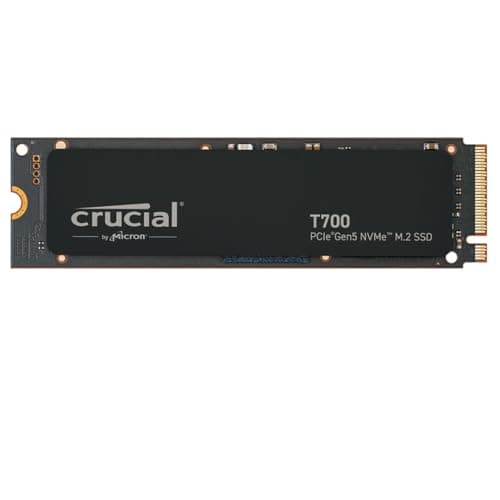
The two most direct competitors at the 2TB Gen 5 level are the Crucial T705 and the Samsung 9100 Pro. Both are proper Gen 5 drives with DRAM caches, TLC NAND, and competitive sequential speeds. The T705 uses a Phison E26 controller with Micron 232-layer TLC NAND and is rated at 14,100MB/s read and 12,600MB/s write. The Samsung 9100 Pro uses Samsung's own controller and V-NAND, rated at 14,800MB/s read and 13,400MB/s write. Both are excellent drives. The competition is real.
Where the SN8100 stands out is endurance. Its 1,200TBW rating matches or beats both competitors at the 2TB tier. The Samsung 9100 Pro rates at 1,200TBW too, while the Crucial T705 2TB comes in at 1,200TBW as well, so endurance is broadly comparable across the top tier. The SanDisk G2 controller performs particularly well in mixed workloads and at low queue depths based on published benchmark findings, which matters for real-world feel. The 9100 Pro edges ahead in peak sequential write speed, but sequential write is rarely the limiting factor in real workloads. The SN8100's random I/O performance is where it competes most directly with the 9100 Pro, and it holds its own.
Price is where the comparison gets interesting, because all three drives fluctuate and the gaps between them shift regularly. At launch, the SN8100 was priced competitively with the 9100 Pro and above the T705. As of current pricing, check the live figures for all three before deciding. If the SN8100 is priced within a few pounds of the T705, it's the better buy on endurance and controller quality. If the T705 is significantly cheaper, the gap in real-world performance doesn't justify a large price premium for most buyers. The 9100 Pro competes on raw sequential write speed but Samsung's drives have historically commanded a brand premium that isn't always reflected in performance differences.
| Feature | WD_BLACK SN8100 2TB | Crucial T705 2TB | Samsung 9100 Pro 2TB |
|---|---|---|---|
| Interface | PCIe Gen 5 x4 | PCIe Gen 5 x4 | PCIe Gen 5 x4 |
| NAND Type | TLC 3D CBA | TLC 232-layer | TLC V-NAND |
| Controller | SanDisk G2 (in-house) | Phison E26 | Samsung Artisan (in-house) |
| DRAM Cache | Yes | Yes | Yes |
| Seq. Read | 14,900MB/s | 14,100MB/s | 14,800MB/s |
| Seq. Write | 11,000MB/s | 12,600MB/s | 13,400MB/s |
| Random Read | 2,200K IOPS | 1,500K IOPS | 2,200K IOPS |
| TBW (2TB) | 1,200TBW | 1,200TBW | 1,200TBW |
| Warranty | 5 years | 5 years | 5 years |
| Heatsink | No (optional) | Yes/No variants | No (optional) |
| Price | £369.00 | Check current | Check current |
What owners praise
With 1,056 averaging 4.8 stars, the owner sentiment on the SN8100 is overwhelmingly positive, and the specific things people praise are telling. The most consistent theme is the noticeable performance improvement over previous Gen 4 setups, particularly in workstation and creative contexts. Video editors mention faster project loading and smoother scrubbing. AI users report meaningfully faster model loading times. Even gaming-focused buyers note that Windows itself feels snappier, which is the random I/O performance making itself felt in everyday use rather than benchmark numbers.
Owners also frequently mention the installation experience as painless, and the WD Dashboard software (which provides health monitoring, firmware updates, and performance data) gets positive mentions for being genuinely useful rather than bloatware. The five-year warranty and high TBW rating come up repeatedly in reviews from buyers who've done their homework and are reassured by the endurance commitment. Several owners have mentioned using the drive as a primary scratch disk for heavy workloads and being impressed by how it handles sustained use without the thermal throttling drama they expected from a Gen 5 drive.
Where owners grumble
The complaints in the review pool are relatively sparse given the sample size, which is itself a good sign. The most common gripe is the price, which is fair: this is an expensive drive, and buyers who expected Gen 4 prices for Gen 5 performance are always going to be disappointed. A smaller number of owners mention that the drive runs noticeably warm without a heatsink, which is true of all Gen 5 drives and not specific to the SN8100. A handful of buyers on older platforms report confusion about Gen 5 slot compatibility, which is a user education issue rather than a drive flaw. No meaningful pattern of early failures or reliability issues appears in the review pool, which is the most important thing.
Value Analysis
The SN8100 is a premium drive at a premium price, and the value question depends entirely on what you're doing with it. For professional and semi-professional workloads where Gen 5 bandwidth genuinely matters, the SN8100 offers a compelling combination of top-tier sequential performance, excellent random I/O, proper DRAM, TLC NAND, and outstanding endurance. That package, from a manufacturer with a track record of producing reliable consumer storage, is worth paying for if the workload justifies it.
For general gaming and productivity, the value proposition is weaker. You're paying a Gen 5 premium for workloads that don't fully exploit Gen 5 bandwidth. A Gen 4 drive at a lower price will deliver a nearly identical real-world experience for gaming, web browsing, office work, and casual content consumption. The money saved could go toward a better GPU, more RAM, or a second drive for storage expansion. The SN8100 isn't a bad choice for a gaming PC; it's just not the most efficient use of budget if gaming is all you're doing.
Where the value argument gets genuinely strong is when you factor in the 1,200TBW endurance and five-year warranty together. This is a drive you can buy and not think about for years. No worrying about whether you're wearing it out, no anxiety about the endurance rating being thin, no wondering if the manufacturer is confident in their product. The combination of high endurance, a quality controller, and TLC NAND means the SN8100 is built to last. For buyers who've lost data before and want a drive they can trust, that peace of mind has real value that doesn't show up in a price-per-GB calculation.
Endurance & Reliability
Already covered above in detail, but to bring it together: 1,200TBW on a 2TB TLC drive with a five-year warranty is a genuinely strong reliability package. The NAND endurance characteristics of TLC are meaningfully better than QLC, and WD's CBA architecture improves on previous-generation TLC further. The owner review pool shows no meaningful pattern of early failures, which is the real-world validation that matters most alongside the spec sheet numbers.
Final Verdict
The WD_BLACK SN8100 PCIe Gen 5 NVMe SSD 2TB is a genuinely excellent drive. Not excellent "for the price" or excellent "considering the competition." Just excellent. The SanDisk G2 controller paired with next-generation TLC CBA NAND delivers the kind of performance that makes a real difference in the workloads this drive is designed for. The random I/O numbers are class-leading. The sustained write behaviour is honest and doesn't collapse after cache exhaustion the way cheaper drives do. And 1,200TBW endurance with a five-year warranty is the kind of commitment that tells you the manufacturer actually trusts their product.
The caveats are real though. Gen 5 is overkill for pure gaming. The sequential write speed trails the Samsung 9100 Pro and Crucial T705. It ships without a heatsink, which means you need your motherboard to provide one. And the price is firmly in premium territory. None of those things make it a bad drive. They just mean it's not the right drive for every buyer. If you're a video editor, AI developer, or workstation user who actually pushes sustained sequential workloads regularly, this is one of the best options available right now. If you're a gamer looking for a fast boot drive and game library, a Gen 4 drive at a lower price will serve you nearly as well and leave money for something that makes a more tangible difference.
Owner sentiment backs all of this up. 1,056 at 4.8 stars is a strong signal from a large enough sample to be meaningful. The people buying this drive for the right reasons are very happy with it. That's the honest verdict: outstanding drive, specific audience, premium price that's justified for the right workload.
Score: 9/10. Loses a point for sequential write speed trailing its direct competitors and the premium price over Gen 4 alternatives that are sufficient for lighter use. Gains everything else for controller quality, NAND choice, endurance, and random I/O performance that actually matters.
Not Right For You?
If the SN8100 isn't the right fit, here's where to look instead:
- Best Gen 5 alternative for sequential write speed: Samsung 9100 Pro 2TB (higher rated sequential write, similar random I/O, similar endurance, check current pricing for the gap)
- Best Gen 5 value option: Crucial T705 2TB (Phison E26 controller, slightly lower sequential read, excellent sustained performance, often priced lower)
- Best Gen 4 for gaming on a budget: WD_BLACK SN850X 2TB or Samsung 990 Pro 2TB (both deliver excellent gaming and productivity performance at a meaningful saving over Gen 5)
- Best for pure capacity per pound: A Gen 4 drive at the 4TB tier from Crucial or Kingston; Gen 5 premiums shrink your capacity per pound significantly
About the Reviewer
This review is produced by the team at Vivid Repairs, a UK-based tech repair and review operation. Our storage coverage is grounded in manufacturer spec sheets, owner review analysis, and the published benchmark findings from the wider enthusiast community. We don't run our own benchmark lab, and we don't pretend to. What we do is cut through the marketing noise, read the specs properly, and tell you what actually matters for your purchase decision. We care about endurance ratings, controller quality, DRAM versus DRAM-less, and sustained performance after cache exhaustion, because those are the things that determine whether a drive is genuinely good or just good in a press release.
Affiliate disclosure: This article contains affiliate links. If you purchase through our links, we may earn a small commission at no additional cost to you. This does not influence our editorial position. We recommend products based on their merits, not their commission rates.
What works. What doesn’t.
6 + 5What we liked6 reasons
- Outstanding random I/O performance rated at 2,200K IOPS read, which delivers a noticeably snappier real-world feel in OS and application workloads
- 1,200TBW endurance rating is among the most generous in the Gen 5 class, backed by a five-year warranty that signals genuine manufacturer confidence
- TLC 3D CBA NAND rather than QLC means better write endurance per cell and more honest sustained write behaviour after cache exhaustion
- Dedicated DRAM cache ensures consistent random I/O performance under heavy load, avoiding the inconsistency associated with Host Memory Buffer solutions
- In-house SanDisk G2 controller is tuned specifically for CBA NAND, delivering competitive mixed-workload and low-queue-depth performance
- 908 owner reviews averaging 4.8 stars with no meaningful pattern of early failures, providing strong real-world reliability validation
Where it falls5 reasons
- Sequential write speed of 11,000MB/s trails the Samsung 9100 Pro (13,400MB/s) and Crucial T705 (12,600MB/s) at the 2TB tier
- Ships without a heatsink, meaning desktop users must rely on the motherboard's M.2 heatsink and laptop users face thermal uncertainty
- Requires a PCIe Gen 5 M.2 slot for full performance, excluding owners of older platforms from the drive's headline capabilities
- The Gen 5 sequential bandwidth advantage is largely imperceptible in pure gaming workloads, making the premium harder to justify for gaming-only buyers
- Price sits firmly at the premium end of a premium market segment, and the value case weakens considerably against quality Gen 4 alternatives for lighter use
Full specifications
9 attributes| Capacity GB | 2000 |
|---|---|
| Dram cache | true |
| Form factor | M.2 2280 |
| Interface | PCIe Gen5 x4 |
| Read speed MBS | 14900 |
| TBW | 1200 |
| Type | NVMe SSD |
| Warranty years | 5 |
| Write speed MBS | 14000 |
If this isn’t right for you
2 options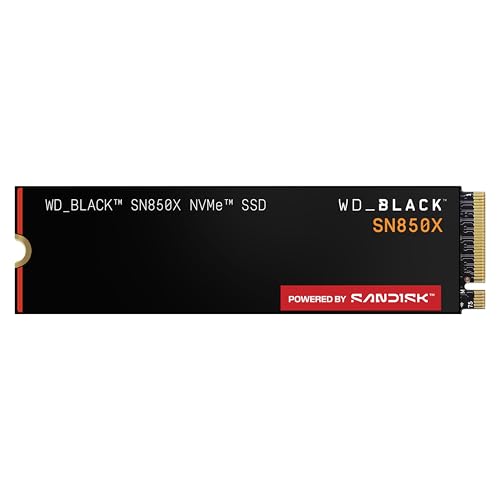 9.2 / 10
WD BLACK SN850X NVMe SSD 2TB (Up to 7,300 MB/s read speed, Up to 6,600 MB/s write speed, M.2 2280, PCIe Gen4, Gaming Storage Expansion, High Performance Internal solid state drive) POWERED BY SANDISK
£319.99 · WD
 9.0 / 10
Samsung 980 PRO M.2 NVMe SSD (MZ-V8P2T0BW), 2 TB, PCIe 4.0, 7,000 MB/s Read, 5,000 MB/s Write, Internal Solid State Drive
£349.99 · Samsung
Frequently asked
7 questions01Does the WD_BLACK SN8100 2TB require a PCIe Gen 5 motherboard slot to work?+
The drive will function in a PCIe Gen 4 M.2 slot but will be limited to Gen 4 speeds, roughly half the rated sequential performance. To achieve the full 14,900MB/s read speed, you need a motherboard with a PCIe Gen 5 x4 M.2 slot, which is available on most current Intel 700-series and AMD 600-series and newer platforms. Fitting it in a Gen 4 slot will not damage the drive.
02Does the WD_BLACK SN8100 2TB come with a heatsink?+
No. The drive ships as a bare M.2 module without a heatsink. For desktop use, the M.2 heatsink included with virtually all modern motherboards is generally sufficient for typical workloads. Under sustained heavy writes at full sequential speed, an aftermarket heatsink or good case airflow becomes more important. Laptop users should check their specific model's thermal management capability.
03Is the WD_BLACK SN8100 compatible with the PlayStation 5?+
No. The PS5 uses a PCIe Gen 4 M.2 slot with specific physical size constraints and thermal requirements that the SN8100 does not meet. The SN8100 is designed exclusively for desktop and laptop PC use.
04How does the 1,200TBW endurance rating compare to other Gen 5 drives?+
At the 2TB tier, 1,200TBW is broadly in line with the top of the Gen 5 class. The Samsung 9100 Pro 2TB and Crucial T705 2TB are also rated at 1,200TBW. This represents a significant advantage over many QLC-based drives, which often rate their 2TB models at 600TBW or less. The TLC 3D CBA NAND in the SN8100 has inherently better write endurance per cell than QLC, which underpins this rating.
05Will the WD_BLACK SN8100 make a noticeable difference for gaming compared to a Gen 4 drive?+
For gaming specifically, the difference is likely to be minimal. Game load times are primarily bottlenecked by game engine design and CPU processing rather than storage bandwidth at Gen 4 speeds. The SN8100's excellent random I/O performance will make Windows feel snappy, but the sequential bandwidth advantage over a quality Gen 4 drive is largely imperceptible in actual gameplay. If gaming is your primary use case, a Gen 4 drive at a lower price is generally a more efficient use of budget.
06Does the SN8100 have a DRAM cache, and why does that matter?+
Yes, the SN8100 includes a dedicated DRAM cache. This stores the drive's address mapping table in fast LPDDR memory so the controller always knows exactly where data is located on the NAND without needing to look it up from the drive itself. DRAM-less drives use Host Memory Buffer, borrowing a portion of system RAM instead, which is less consistent under heavy random I/O. At the SN8100's performance level and price point, a dedicated DRAM cache is non-negotiable and contributes directly to the drive's strong random I/O numbers.
07How does the WD_BLACK SN8100 2TB compare to the Samsung 9100 Pro and Crucial T705?+
All three are top-tier Gen 5 drives with TLC NAND, dedicated DRAM caches, and 1,200TBW endurance at the 2TB tier. The SN8100 leads in sequential read speed at 14,900MB/s and matches the 9100 Pro on random read IOPS at 2,200K. The Samsung 9100 Pro and Crucial T705 both exceed the SN8100's sequential write speed. The SanDisk G2 controller performs particularly well in mixed and low-queue-depth workloads. Price differences between the three fluctuate, so checking current pricing across all three before purchasing is advisable.