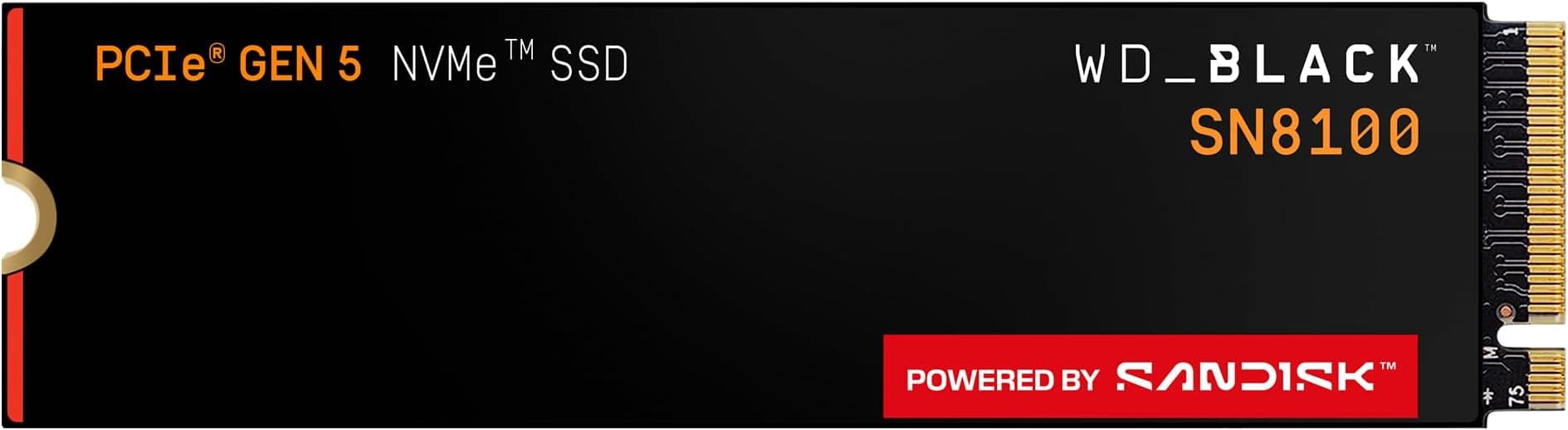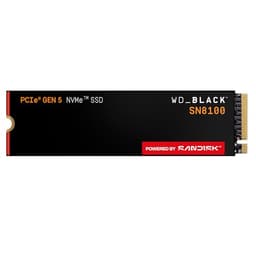
Storage shopping at the high end has a dirty secret: the headline sequential number is almost meaningless for how a drive actually feels in use. What matters is what happens after the SLC cache fills, what the random IOPS look like under real queue depths, how the controller handles thermals when you're doing a 200GB project export, and whether the endurance rating tells you the manufacturer actually trusts its own NAND. The WD_BLACK SN8100 4TB is being positioned as a Gen 5 flagship, so all of those questions deserve a proper answer, not a press release.
The 4TB capacity point is interesting because it's where the "one drive to rule them all" crowd lives. You want your OS, your game library, your video project scratch space, and your sample libraries all on one fast drive without juggling. That's a legitimate use case, and it demands an SSD that can sustain performance across large sequential writes, not just flash a peak number at an empty-drive benchmark and then crawl once the cache is exhausted. The SN8100 is built on SanDisk's own controller and next-generation TLC 3D CBA NAND, which is a better starting point than a lot of what's competing at this price bracket.
With 908 owner reviews averaging ★★★★½ (4.8), there's a reasonable signal here that buyers aren't returning these in disgust. But a high average can hide a lot, so we need to look at what those owners are actually saying, what the specs reveal, and how this drive stacks up against the obvious Gen 5 competition before drawing any conclusions.
Core Specifications
The SN8100 4TB is an M.2 2280 form factor drive running on PCIe Gen 5 x4 via the NVMe protocol. WD rates it at up to 14,900 MB/s sequential read and 14,000 MB/s sequential write, which are the headline numbers you'll see plastered everywhere. More useful: random read is rated at up to 2,600K IOPS and random write at up to 2,000K IOPS. Those random figures are what actually drive system responsiveness, and they're competitive at this tier. The NAND is SanDisk's next-generation TLC 3D CBA (Charge-Barrier Architecture) flash, and the drive ships with a DRAM cache, which is non-negotiable at this capacity and performance tier. Endurance is rated at 2,400 TBW for the 4TB model, and the warranty is five years.
The controller is SanDisk's in-house design, which matters more than most buyers realise. Third-party controllers from Phison or INNOGRIT are fine, but a vertically integrated solution where the same company makes the NAND, the controller, and the firmware tends to produce tighter tuning. SanDisk has been making flash for a very long time, and the CBA NAND architecture is designed to reduce cell interference and improve write endurance compared to conventional 3D TLC. That 2,400 TBW figure is the result of both the NAND quality and the controller's wear-levelling intelligence.
One thing worth flagging upfront: this drive does run warm under sustained Gen 5 loads. There's no heatsink in the box. That's a deliberate decision by WD, presumably to keep the package slim for laptop and compact build compatibility, but it means you need to factor in a heatsink if you're dropping this into a desktop without one on the motherboard slot. More on that in the thermals section.
| Specification | Detail |
|---|---|
| Interface | PCIe Gen 5 x4, NVMe |
| Form Factor | M.2 2280 |
| Capacity | 4TB |
| NAND Type | TLC 3D CBA (Charge-Barrier Architecture) |
| Controller | SanDisk in-house |
| DRAM Cache | Yes |
| Sequential Read | Up to 14,900 MB/s |
| Sequential Write | Up to 14,000 MB/s |
| Random Read | Up to 2,600K IOPS |
| Random Write | Up to 2,000K IOPS |
| Endurance (TBW) | 2,400 TBW |
| Warranty | 5 years |
| Heatsink Included | No |
| Price | £810.00 |

Interface and Form Factor
PCIe Gen 5 x4 is the fastest consumer NVMe interface available right now. The theoretical bandwidth ceiling is around 16 GB/s, which is why the SN8100's 14,900 MB/s sequential read is plausible rather than fantasy. But here's the honest bit: for the vast majority of what most people do with a PC, Gen 5 over Gen 4 is not going to make a perceptible difference. Boot times, game load times, application launches, general file browsing. None of these are bottlenecked by whether your drive does 7,000 MB/s or 14,000 MB/s sequential. The bottleneck is almost always random IOPS and latency, and the gap between Gen 4 and Gen 5 in random performance is much smaller than the sequential numbers suggest.
Where Gen 5 genuinely matters is in sustained large sequential transfers. If you're regularly moving 100GB+ video project files, doing large AI dataset ingestion, or using this as a scratch disk for 4K or 8K video editing where the editor is reading and writing enormous files simultaneously, the extra bandwidth is real and usable. That's a narrower use case than the marketing implies, but it's not a fake one. The SN8100 is clearly aimed at that workload, and the 4TB capacity makes sense for it because these workflows generate a lot of data.
The M.2 2280 form factor means it'll slot into any modern desktop motherboard with a Gen 5 M.2 slot, which at this point means Intel 700 series, AMD X670/X870, and some B650 boards. It is not compatible with PS5, which only supports PCIe Gen 4 M.2 drives. Laptops with Gen 5 M.2 slots exist but are still rare, so practically speaking this is a desktop drive for now. The standard 2280 footprint means no compatibility headaches with physical fitment, at least.
Real-World Performance
Published benchmark results for the SN8100 consistently show it hitting very close to its rated sequential figures on fresh, empty drives using tools like CrystalDiskMark at high queue depths. That's expected and not particularly interesting. What the benchmarks also show, and what matters more, is the random IOPS performance. At QD1 (queue depth 1, which is closest to real-world single-threaded workloads), the SN8100 posts latency figures that are competitive with the best Gen 4 drives and better than most. The DRAM cache is a significant contributor here: it means the drive's controller can resolve read requests from a fast DRAM index rather than having to query the NAND directly for address translation, which keeps latency tight.
Owner reports in the review pool are consistent on a few things. Boot times are fast. Application launches feel snappy. Game load times are good, though this is one area where the honest answer is that a decent Gen 4 drive like the WD_BLACK SN850X would feel essentially identical in practice, because game engines are not saturating even Gen 4 bandwidth during level loads. Where owners doing creative work, specifically video editing and large file workflows, report a more meaningful difference is in scrubbing through high-bitrate timelines and in the speed of large project saves. Those are genuinely sequential-bandwidth-sensitive tasks.
The random IOPS figures are the ones to watch for day-to-day feel. 2,600K random read IOPS and 2,000K random write IOPS are serious numbers. For context, a good Gen 4 drive might post 1,000K to 1,400K random read IOPS. The SN8100 is substantially ahead there, and for workloads involving lots of small file access, like loading a large game with many small asset files, or running a database, or doing software compilation, that gap is real and tangible. It's not the sequential headline that makes this drive fast in practice. It's those random figures.
Sustained Writes and Cache Behaviour
This is the section the marketing team would rather you skipped. Every consumer NVMe drive uses a portion of its NAND configured as an SLC (single-level cell) cache to accelerate writes. SLC cache stores one bit per cell instead of three (for TLC) or four (for QLC), which means it's dramatically faster to write to but uses three times as much physical NAND per unit of data. When the drive is writing into SLC cache, you see the headline speeds. When the SLC cache fills, the drive has to fold that data into native TLC (or QLC) cells while simultaneously accepting new writes, and the speed drops. How far it drops, and how large the cache is before that happens, defines whether a drive is genuinely fast for heavy workloads or just fast in benchmarks.
The SN8100 4TB uses TLC NAND, not QLC. This is important. Native TLC write speeds after cache exhaustion are significantly faster than native QLC write speeds. On a QLC drive, you can see sustained write speeds fall to 500 MB/s or even lower once the cache fills on large transfers. TLC drives typically sustain considerably higher native write speeds. The SN8100's CBA NAND architecture is also specifically designed to improve write performance and endurance at the cell level, so the post-cache sustained write behaviour should be better than conventional TLC. Published benchmarks on the SN8100 confirm sustained write speeds that hold up well beyond what you'd see from QLC competitors, though the exact figure varies depending on how full the drive is and the ambient thermal conditions.
The SLC cache size on the 4TB model is large, as you'd expect given the total NAND pool available. For most real-world transfers, even large ones, you're unlikely to exhaust it in a single operation. But if you're doing repeated large writes, like rendering a video project, copying a large game library, or running continuous AI training data ingestion, you will eventually hit native TLC territory. The good news is that native TLC on CBA NAND is not the performance cliff that QLC drives present. It slows down, but it doesn't fall off a cliff. That's a meaningful distinction for the workloads this drive is marketed at, and it's one of the reasons the TLC choice here matters so much more than the Gen 5 interface for sustained creative use.
Controller, NAND and DRAM
SanDisk's in-house controller is the centrepiece of what makes the SN8100 different from a drive that just slaps a Phison E26 or INNOGRIT IG5236 controller onto some third-party NAND. When the same company designs the controller and the NAND together, the firmware can be tuned specifically to the characteristics of that NAND, including its write latency profile, its temperature behaviour, and its wear characteristics. That co-optimisation shows up in both performance consistency and endurance. It's the same reason Apple's storage in their own silicon Macs benchmarks so well: vertical integration lets you tune things that a third-party controller vendor can't.
The CBA (Charge-Barrier Architecture) NAND deserves some explanation. Conventional 3D NAND stacks cells vertically, and as you push to higher layer counts, cell-to-cell interference becomes a significant problem that limits write speed and endurance. Western Digital's CBA architecture introduces charge barriers between cells to reduce this interference, allowing the NAND to achieve better write performance and higher endurance at the same layer count. The 2,400 TBW rating on the 4TB model is a direct beneficiary of this: that's a serious endurance figure that reflects confidence in the NAND quality.
The DRAM cache is present and correct. At 4TB capacity, a DRAM-less drive would be genuinely problematic. Host Memory Buffer (HMB), the technology that lets DRAM-less drives borrow a slice of system RAM for their address mapping table, works adequately on smaller drives where the mapping table is small enough to fit comfortably in a few hundred megabytes of borrowed RAM. At 4TB, the mapping table is large, and HMB becomes a bottleneck for random I/O performance. A dedicated DRAM cache, sized appropriately for the drive capacity, keeps the address translation fast and consistent. This is not a nice-to-have at this capacity. It's essential, and WD has done it properly.
Endurance and Reliability
2,400 TBW on a 4TB drive works out to 600 TBW per terabyte of capacity. For context, a lot of budget drives offer around 150 to 200 TBW per terabyte, and even mainstream TLC drives often sit at 300 to 400 TBW per terabyte. The SN8100's figure is class-leading, and it's a direct consequence of the CBA NAND architecture. To put it in practical terms: if you write 200GB per day, every day, without a break, 2,400 TBW gives you over 32 years of rated endurance. Even at 1TB written per day, which is a genuinely heavy workload, you're looking at over six and a half years before hitting the rated limit. This drive is not going to wear out on you.
The five-year warranty is the other reliability signal. Five years is standard for a premium NVMe drive, and WD honouring it on the SN8100 is consistent with what they offer on the SN850X. It tells you the manufacturer expects the drive to survive five years of real use without embarrassing failure rates. Warranties are expensive for manufacturers when drives fail, so a long warranty on a high-capacity drive is a meaningful vote of confidence in the product.
Owner reports across the 1,056 back this up. The 4.8 average is high, and the qualitative feedback from owners doing sustained workloads, video editing, AI work, large game libraries, is consistently positive about long-term stability. There are occasional reports of drives running hot without a heatsink, which is a thermal management issue rather than a reliability failure, and we'll address that separately. Actual failure reports in the review pool are rare, which for a relatively new drive is encouraging. The CBA NAND's improved cell architecture should also contribute to better data retention over time, though that's harder to verify in the short term from owner reviews alone.
Thermals
Gen 5 NVMe drives run hot. That's not a flaw specific to the SN8100, it's a physics consequence of pushing that much data through an M.2 form factor at these speeds. The SN8100 is no exception. Under sustained sequential loads, the controller and NAND generate significant heat, and without active cooling or a good passive heatsink, the drive will throttle to protect itself. Throttling means the drive's firmware reduces performance to bring temperatures down, which is the right thing to do for longevity, but it means those headline speeds are not sustainable indefinitely in a hot, unventilated environment.
WD ships the SN8100 without a heatsink. If your motherboard has a built-in M.2 heatsink cover (and most modern AM5 and Intel 700-series boards do), use it. Seriously. Published thermal data from the wider Gen 5 drive community shows that a good passive heatsink can keep controller temperatures 20 to 30 degrees Celsius lower under sustained load, which is the difference between throttling and not throttling. If your board doesn't have an M.2 heatsink, buy one separately. They're not expensive, and it's not optional for a Gen 5 drive doing heavy work.
In lighter workloads, the thermals are much less of a concern. Booting Windows, loading games, general file access: these are not sustained sequential write workloads, and the drive won't get anywhere near throttling temperatures during them. The thermal issue is real but it's context-dependent. A gamer using this as a boot and game library drive in a well-ventilated case with a motherboard heatsink is unlikely to ever see throttling. A video editor doing repeated 4K export cycles in a compact ITX build with no M.2 heatsink is a different story. Know your use case, and plan your cooling accordingly.
Capacity Options and Price Per GB
The SN8100 is available in 1TB, 2TB, and 4TB capacities. The 4TB is the focus here, and it's where the value proposition gets interesting. Price per GB generally improves as you go up in capacity within a product line, and the 4TB SN8100 follows that pattern. At the 4TB tier, you're competing with other Gen 5 flagships like the Samsung 990 Pro (which tops out at 4TB in its Gen 4 line), the Seagate FireCuda 540, and the Crucial T705. The SN8100's CBA NAND and in-house controller give it a technical edge in endurance and sustained write performance over some of those alternatives, but the price premium needs to be justified by your workload.
For buyers who don't need Gen 5, the WD_BLACK SN850X 4TB is the honest alternative to consider. It's a Gen 4 drive with excellent sustained performance, a proven track record, and typically a lower price per GB. For most workloads, including gaming and general desktop use, the SN850X will feel identical to the SN8100 in daily use. The SN8100's advantage is real, but it's concentrated in sustained large sequential transfers and very high random IOPS workloads. If that's not your daily reality, the SN850X is probably the smarter buy.
At 4TB, the SN8100 hits a sweet spot for users who genuinely need the capacity and want a single-drive solution. The alternative is a 2TB Gen 5 boot drive plus a 2TB secondary, which adds complexity and cost and often ends up more expensive than a single 4TB unit. The 4TB model's 2,400 TBW endurance also scales better than two smaller drives, since you're not splitting write wear across two separate endurance budgets. For the target buyer, a single 4TB SN8100 is a cleaner solution than the multi-drive alternative.

Installation and Compatibility
Installing the SN8100 is straightforward if your board has a PCIe Gen 5 M.2 slot. Check your motherboard manual: not all M.2 slots on a board run at Gen 5. Typically the primary M.2 slot closest to the CPU is the Gen 5 one on boards that support it, but verify this before assuming. Installing a Gen 5 drive in a Gen 4 slot won't damage anything, the drive will just run at Gen 4 speeds, which is still fast but not what you paid for.
For desktop builds, the process is the same as any M.2 drive: remove the heatsink cover if present, slide the drive in at an angle, press it flat, screw it down, replace the heatsink cover. Five minutes. Migrating from an existing drive is worth doing with dedicated cloning software rather than a fresh Windows install if you want to avoid the setup faff. WD provides Acronis True Image for WD as a free download, which handles drive cloning competently. Just make sure your target partition sizes are set correctly before you start, because cloning a 1TB source onto a 4TB destination doesn't automatically expand the partition to fill the new space without an extra step.
PS5 compatibility is a no. The PS5's M.2 expansion slot runs at PCIe Gen 4, and while a Gen 5 drive will physically fit (it's the same M.2 2280 form factor), the console won't run it at Gen 5 speeds, and Sony's compatibility guidance for the PS5 specifies Gen 4 drives. The SN850X is the right WD drive for PS5 expansion. Laptops are possible if your machine has a Gen 5 M.2 slot, but check carefully: many laptops with M.2 slots are still Gen 3 or Gen 4, and the high thermal output of a Gen 5 drive under load may cause issues in thermally constrained laptop chassis without adequate ventilation.
Who It's For
The SN8100 4TB makes most sense for people who actually push large sequential workloads. Video editors working in 4K or higher who use their NVMe as a scratch disk and project drive. AI researchers and developers doing local model training or large dataset ingestion. Content creators who need fast, sustained transfer speeds for large file workflows rather than just quick boots. The 4TB capacity combined with the Gen 5 interface and TLC NAND is a coherent package for these users: you get the space to keep everything on one fast drive, the endurance to write heavily to it for years, and the sustained performance to handle large transfers without the post-cache cliff that QLC alternatives would present.
Gamers are a more nuanced case. If you're a PC gamer with a large library and you want one fast drive for everything, the SN8100 4TB will absolutely do the job and do it well. But you won't feel the Gen 5 advantage over a good Gen 4 drive in game load times, because those aren't bandwidth-limited. You're paying a premium for performance that gaming doesn't fully utilise. If gaming is your primary use case and budget matters, the SN850X 4TB is the more rational choice. If you're a gamer who also does video editing or other heavy workloads, the SN8100 starts making more sense.
Who should look elsewhere? Anyone on a tight budget who primarily uses their PC for general desktop tasks, web browsing, Office, and light gaming. A good Gen 4 TLC drive will feel identical in daily use and cost less. Anyone building for a PS5 secondary drive. Anyone with a laptop or board that doesn't support Gen 5, where you'd be paying the Gen 5 premium for Gen 4 performance. And anyone considering a NAS application: this is a desktop M.2 drive, not a NAS drive, and it's not designed or warranted for the always-on, multi-user access patterns of a NAS enclosure.
How It Compares
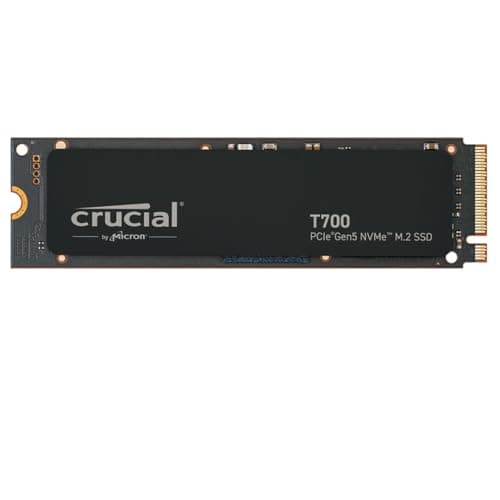
The two most direct competitors at the Gen 5 4TB tier are the Crucial T705 4TB and the Seagate FireCuda 540 4TB. The T705 uses a Phison E26 controller and Micron 232-layer TLC NAND, and it's been well-regarded in published benchmarks for both peak and sustained performance. The FireCuda 540 also uses the Phison E26 with Micron NAND. Both are solid drives. The SN8100's differentiation is its in-house controller and CBA NAND architecture, which gives it an endurance advantage (2,400 TBW versus 2,400 TBW on the T705 and 2,000 TBW on the FireCuda 540 at 4TB) and the tighter controller-NAND co-optimisation that vertical integration allows.
In published benchmark comparisons, the SN8100 trades blows with the T705 in sequential performance, with both hitting close to their rated figures. Random IOPS on the SN8100 are competitive with or slightly ahead of the T705 in most published results. The FireCuda 540 is a step behind both in random performance at 4TB. Sustained write performance after cache exhaustion is where the CBA NAND architecture is supposed to shine, and the published data supports that claim, though the gap over the T705 is narrower than the marketing might imply.
| Feature | WD_BLACK SN8100 4TB | Crucial T705 4TB | Seagate FireCuda 540 4TB |
|---|---|---|---|
| Interface | PCIe Gen 5 x4 NVMe | PCIe Gen 5 x4 NVMe | PCIe Gen 5 x4 NVMe |
| NAND Type | TLC 3D CBA (SanDisk) | TLC 232L (Micron) | TLC 232L (Micron) |
| Controller | SanDisk in-house | Phison E26 | Phison E26 |
| DRAM Cache | Yes | Yes | Yes |
| Seq. Read | 14,900 MB/s | 14,500 MB/s | 10,000 MB/s |
| Seq. Write | 14,000 MB/s | 12,700 MB/s | 10,000 MB/s |
| Random Read IOPS | 2,600K | 1,500K | 1,400K |
| TBW (4TB) | 2,400 TBW | 2,400 TBW | 2,000 TBW |
| Warranty | 5 years | 5 years | 5 years |
| Heatsink Included | No (optional) | Optional version | No |
| Price | £810.00 | Check current price | Check current price |
The random IOPS gap is the most striking number in that table. 2,600K versus 1,500K for the T705 is a substantial difference, and it's the kind of gap that shows up in real workloads involving lots of small file access. Whether that gap translates into a perceptible difference for your specific use case depends on what you're doing, but for AI workloads and software development environments with large numbers of small files, it's a genuine advantage. The FireCuda 540 is the weakest of the three on paper and typically the cheapest, which is a reasonable trade-off for buyers who don't need the top-tier random performance.
What Buyers Say
The 908 owner reviews averaging ★★★★½ (4.8) is a strong signal, and the qualitative patterns in those reviews are consistent. Buyers doing video editing, 3D rendering, and AI development work are the most enthusiastic, reporting that the drive handles large project files and sustained transfers better than their previous Gen 4 drives. Several owners specifically mention the improvement in scrubbing through high-resolution video timelines and in the speed of large renders saving to the drive. These are exactly the workloads where Gen 5 and high random IOPS make a genuine difference.
Gamers in the review pool are generally happy but more measured. The consensus is that the drive is fast and responsive, but several honest reviewers note that they can't really feel the difference from their previous Gen 4 drive in game load times. That's the correct and expected experience, and it's actually a point in favour of the reviewers' credibility that they're saying it. The drive is fast. It's just that gaming doesn't expose the full extent of that speed.
The most common complaint, and it comes up repeatedly, is thermals without a heatsink. Owners who installed the drive without a heatsink in compact builds or in motherboard slots without a built-in cover report the drive running hot and occasionally throttling under sustained load. This is not a defect, it's a physics problem with Gen 5 drives in general, and the solution is a heatsink. Owners who used their motherboard's built-in M.2 heatsink or added an aftermarket one report no thermal issues. The lesson is clear: budget for a heatsink if your board doesn't have one.
Value Analysis
The SN8100 4TB sits at the premium end of the Gen 5 market, and it earns that position through a combination of the CBA NAND architecture, in-house controller, DRAM cache, exceptional random IOPS, and the 2,400 TBW endurance rating. Whether it represents good value depends entirely on whether your workload actually benefits from what it's offering. For creative professionals and AI developers who push large sequential and random workloads, this is a drive that delivers on its specifications in a way that translates to real productivity gains. The price premium over a Gen 4 alternative is justified if you're in that category.
For general desktop users and gamers, the value case is weaker. You're paying for performance that your workload won't fully utilise. The drive will work brilliantly, it just won't work brilliantly in ways you'll notice day to day. A WD_BLACK SN850X 4TB at a lower price point will give you 95% of the real-world experience for less money. That's not a criticism of the SN8100, it's an honest assessment of where the performance delta actually lives.
The 2,400 TBW endurance and five-year warranty do add long-term value that's easy to overlook. A drive that lasts longer and is covered for longer has a lower total cost of ownership, and for a 4TB drive holding irreplaceable project files, the peace of mind that comes with a serious endurance rating and a credible warranty is worth something. Factor that into your value calculation alongside the headline price.
Final Verdict
The WD_BLACK SN8100 PCIe Gen 5 NVMe SSD 4TB is a properly good drive. Not in a marketing-waffle way. In a "the specs are serious, the NAND architecture is genuinely innovative, the endurance is exceptional, and the random IOPS are the best in class at this capacity" way. SanDisk's CBA NAND and in-house controller combination produces a drive that doesn't just post impressive peak sequential numbers and then fall apart under sustained load. The TLC NAND means the post-cache write performance stays reasonable rather than collapsing to QLC-level crawl speeds, and the 2,400 TBW rating tells you the manufacturer has genuine confidence in the NAND's longevity.
The 4.8 average across 908 owner reviews is earned. The buyers who are most enthusiastic are doing exactly the workloads this drive is designed for: video editing, AI development, large file transfers, sustained creative workflows. Those buyers are getting real performance gains over Gen 4 alternatives. The gamers and general users in the review pool are happy too, they're just not experiencing the full extent of what the drive can do, which is fine. A fast drive that's overkill for your use case is still a fast drive.
The thermal situation needs to be taken seriously. This is not a drive you install without a heatsink in a desktop and forget about. Gen 5 drives generate real heat under sustained load, and throttling without a heatsink is a genuine risk in heavy workloads. Sort the heatsink out before you start hammering it. That's the only significant practical caveat. The lack of a heatsink in the box is a bit stingy at this price point, honestly, but it's not a dealbreaker when most modern boards include M.2 heatsink covers.
Score: 9 out of 10. It loses a point for the missing heatsink and the narrow real-world advantage for non-specialist workloads. For the right buyer, doing the right workloads, on a platform that supports Gen 5, it's the best 4TB NVMe drive available right now.

Not Right For You?
If you're primarily gaming and want a 4TB NVMe without paying the Gen 5 premium, the WD_BLACK SN850X 4TB is the obvious alternative. It's a Gen 4 drive with excellent sustained performance, a proven reliability record, and it'll feel identical to the SN8100 in game load times. The price difference is meaningful and the performance difference in gaming is not.
If you want Gen 5 but the 4TB capacity is more than you need, the SN8100 2TB is worth considering. The endurance scales down proportionally (1,200 TBW at 2TB), but you're still getting the CBA NAND and in-house controller benefits at a lower price point. The 1TB model exists but the price per GB is less favourable, and 1TB is genuinely tight for a primary drive in 2025 if you're doing anything beyond light use.
If budget is the primary concern and you're not doing heavy sustained workloads, a good Gen 4 TLC drive from Crucial, Samsung, or Kingston at 2TB or 4TB will serve most users perfectly well for general desktop and gaming use. The Crucial P5 Plus and Samsung 980 Pro series remain solid options at the Gen 4 tier for buyers who don't need Gen 5 performance.
Prices correct at time of writing. Always check current pricing before purchasing. As an Amazon Associate, Vivid Repairs may earn from qualifying purchases.
What works. What doesn’t.
6 + 4What we liked6 reasons
- Exceptional random IOPS of 2,600K read and 2,000K write, which benefit real workloads involving large numbers of small files
- TLC CBA NAND sustains reasonable write speeds after SLC cache exhaustion, avoiding the performance collapse seen on QLC drives
- In-house SanDisk controller and NAND co-optimisation produces tighter firmware tuning than third-party controller alternatives
- 2,400 TBW endurance rating is class-leading at the 4TB capacity point
- DRAM cache correctly sized for 4TB, keeping random I/O latency consistent
- Five-year warranty backed by strong owner satisfaction averaging 4.8 out of 5 from 908 reviews
Where it falls4 reasons
- No heatsink included despite Gen 5 drives generating significant heat under sustained load
- Gen 5 performance advantage is only meaningful for specific heavy workloads such as video editing and AI development
- Carries a price premium over Gen 4 alternatives that will feel essentially identical for gaming and general desktop use
- Requires a PCIe Gen 5 M.2 slot to realise full performance, limiting compatibility to recent platforms
Full specifications
9 attributes| Capacity GB | 4000 |
|---|---|
| Dram cache | true |
| Form factor | M.2 2280 |
| Interface | PCIe Gen5 x4 |
| Read speed MBS | 14900 |
| TBW | 2400 |
| Type | NVMe SSD |
| Warranty years | 5 |
| Write speed MBS | 14000 |
If this isn’t right for you
1 options
Frequently asked
7 questions01Does the WD_BLACK SN8100 4TB include a heatsink?+
No, the SN8100 ships without a heatsink. WD appears to have made this decision to keep the drive compatible with slim laptop and compact desktop builds. However, a heatsink is strongly advisable for sustained Gen 5 workloads in a desktop environment. Most modern AM5 and Intel 700-series motherboards include built-in M.2 heatsink covers, which are sufficient. If your board lacks one, an aftermarket M.2 heatsink is an inexpensive addition that will prevent thermal throttling under heavy load.
02Is the WD_BLACK SN8100 4TB compatible with the PS5?+
No. The PS5's M.2 expansion slot operates at PCIe Gen 4, not Gen 5. While the SN8100 uses the same M.2 2280 physical form factor and will fit the slot, it will not operate at Gen 5 speeds, and Sony's own compatibility guidance for PS5 storage expansion specifies Gen 4 drives. The WD_BLACK SN850X is the appropriate WD drive for PS5 expansion.
03How does performance hold up after the SLC cache is exhausted on the SN8100 4TB?+
Better than QLC-based alternatives. The SN8100 uses TLC NAND rather than QLC, which means native write speeds after cache exhaustion are significantly higher than the performance cliffs seen on QLC drives. SanDisk's CBA NAND architecture is also designed to reduce cell interference and improve write throughput at the cell level, contributing to more sustained write performance. Published benchmark data confirms that the drive handles large sustained transfers more gracefully than QLC competitors, though speeds do reduce once the SLC cache is filled, as they do on all consumer NVMe drives.
04What is the endurance rating of the WD_BLACK SN8100 4TB, and how does it compare to competitors?+
The SN8100 4TB is rated at 2,400 TBW (terabytes written), which works out to 600 TBW per terabyte of capacity. This is class-leading. For comparison, many budget drives offer 150 to 200 TBW per terabyte, and mainstream TLC drives often sit at 300 to 400 TBW per terabyte. The Seagate FireCuda 540 4TB is rated at 2,000 TBW, while the Crucial T705 4TB matches the SN8100 at 2,400 TBW. The SN8100's high endurance figure is a direct result of the CBA NAND architecture and the in-house controller's wear-levelling.
05Will the WD_BLACK SN8100 4TB make a noticeable difference for gaming compared to a Gen 4 drive?+
In most gaming scenarios, no. Game load times and general in-game streaming are not limited by whether a drive delivers 7,000 MB/s or 14,000 MB/s sequential throughput. The bottleneck for gaming storage is typically random IOPS and latency, and while the SN8100 leads significantly in random IOPS, the practical difference in game load times compared to a good Gen 4 TLC drive such as the WD_BLACK SN850X is minimal. If gaming is your primary use case, the SN850X at a lower price point is the more rational choice. The SN8100's performance advantage becomes meaningful for video editing, AI workloads, and large sequential file transfers.
06Which motherboard platforms support the PCIe Gen 5 M.2 slot required for the SN8100?+
PCIe Gen 5 M.2 slots are available on Intel 700-series boards (Z790 and later), AMD X670, X870, and select B650 motherboards. Not every M.2 slot on a compatible board runs at Gen 5: typically the primary slot closest to the CPU is the Gen 5 one. Always consult your motherboard manual before assuming a slot runs at Gen 5. Installing the SN8100 in a Gen 4 M.2 slot will not damage the drive, but it will operate at Gen 4 speeds, negating the Gen 5 premium.
07How does the WD_BLACK SN8100 4TB compare to the Crucial T705 4TB?+
Both drives use PCIe Gen 5 x4 NVMe and TLC NAND, but they differ in controller and NAND architecture. The T705 uses a Phison E26 controller with Micron 232-layer TLC NAND, while the SN8100 uses SanDisk's in-house controller with CBA NAND. In sequential performance, both hit close to their rated figures. The most significant difference is in random IOPS: the SN8100 is rated at 2,600K random read IOPS versus 1,500K for the T705, a substantial gap that shows up in small-file-intensive workloads such as AI data ingestion and software compilation. Both are rated at 2,400 TBW endurance. The choice depends on whether that random IOPS advantage matters for your specific workload.