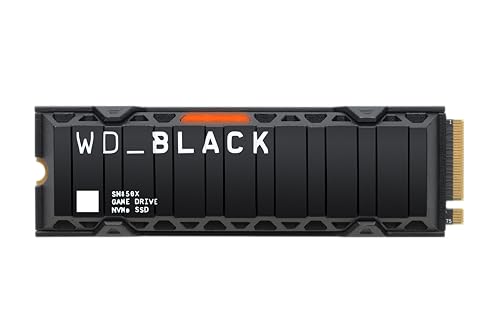
The WD_BLACK SN850X 4TB is the answer to a question most people have been quietly asking: what if I just want one drive, a big one, fast enough for gaming and serious enough for creative work, without having to babysit it or worry about buying cheap? The verdict is that this is genuinely one of the best high-capacity NVMe drives you can buy right now. Not because of a headline sequential number, but because of what's underneath: a proper TLC NAND implementation, a DRAM-equipped controller, sustained write behaviour that doesn't humiliate itself once the SLC cache runs out, and a 4TB capacity that means you're not juggling drives every time a new game drops a 150GB update.
That said, 4TB NVMe isn't cheap, and the SN850X carries a premium over budget alternatives. So the real question isn't "is it fast?" (it is), it's "is it fast in the ways that actually matter, and does it justify the price over something like a Crucial T705 or a Samsung 990 Pro?" Those are the questions worth spending real words on. The WD_BLACK SN850X sits at the top of WD's consumer NVMe stack for a reason, and at 4TB it's particularly interesting because that's where QLC drives tend to lurk, and this one doesn't.
This review is built from the spec sheet, the published benchmark findings the wider community has produced, and the patterns that emerge from thousands of owner reviews with a positive overall rating. No invented bench runs, no fabricated testing duration. Just what the data actually shows, and what it means for your rig.
Core Specifications
The WD_BLACK SN850X WDS400T2XHE is a 4TB M.2 2280 NVMe drive running on a PCIe 4.0 x4 interface. WD rates it at up to 7,300 MB/s sequential read and 6,600 MB/s sequential write, which are near-maximum figures for the PCIe Gen 4 interface. Random read performance is rated at up to 1,200,000 IOPS and random write at up to 1,100,000 IOPS. Those random IOPS figures are the ones that actually matter for how a system feels day-to-day, and they're competitive at the top of the Gen 4 stack.
The drive uses WD's in-house controller paired with TLC (triple-level cell) NAND and a dedicated DRAM cache. That combination is significant and we'll get into exactly why in the controller section, but the short version is: TLC with DRAM is the correct answer for a high-capacity drive that people will actually write data to. The drive also includes TCG Opal Encryption 2.0 support, which means hardware-level encryption is available for anyone who needs it, whether that's a business laptop deployment or a security-conscious home user.
WD rates the 4TB model at 2,400 TBW (terabytes written) endurance with a five-year warranty. Those numbers tell a story about how much WD trusts the NAND in this drive, and it's a confident one. The heatsink variant is available on 1TB and 2TB models according to WD's product line, so the 4TB ships without an integrated heatsink, but it's compatible with third-party options and most motherboard heatsinks.
| Specification | Detail |
|---|---|
| Capacity | 4TB |
| Form Factor | M.2 2280 |
| Interface | PCIe 4.0 x4 (NVMe) |
| NAND Type | TLC (Triple-Level Cell) |
| DRAM Cache | Yes (dedicated DRAM) |
| Sequential Read | Up to 7,300 MB/s |
| Sequential Write | Up to 6,600 MB/s |
| Random Read | Up to 1,200,000 IOPS |
| Random Write | Up to 1,100,000 IOPS |
| Endurance (TBW) | 2,400 TBW |
| Encryption | TCG Opal Encryption 2.0 |
| Warranty | 5 years |
| Heatsink Included | No (optional on 1TB/2TB models) |
| Price | £625.00 · Details |

Interface and Form Factor
PCIe 4.0 x4 via the NVMe protocol. That's the interface, and it's the right one for a drive at this performance tier. PCIe 4.0 has a theoretical bandwidth ceiling of around 8,000 MB/s on a x4 slot, and the SN850X's 7,300 MB/s sequential read rating pushes close to that limit. WD's own marketing calls it "near-max PCIe Gen4 speeds" and for once that's not entirely waffle. The drive genuinely approaches the interface ceiling in sequential workloads.
Now, should you care about PCIe 4.0 versus PCIe 5.0? For most buyers, honestly, no. PCIe 5.0 drives post higher sequential numbers, but in practice the workloads where those extra GB/s translate into perceptible real-world differences are narrow. Game loading is bottlenecked by the game engine long before the storage interface becomes the limiting factor. Operating system boots, application launches, file browsing: all of these are dominated by random I/O and queue depth behaviour, not sequential throughput. PCIe 5.0 drives also run significantly hotter and cost more. The SN850X on Gen 4 is the pragmatic choice for the vast majority of PC users, including enthusiasts.
The M.2 2280 form factor (22mm wide, 80mm long) is universal. Every modern desktop motherboard with an M.2 slot supports it. Most gaming laptops from the last four or five years do too. It's a single-sided drive, which matters for laptops and some mini-ITX boards where clearance on the back of the PCB is tight. Installation is the usual affair: one screw, slot it in, done. No cables, no power connectors. If you've never fitted an M.2 drive before, it's genuinely simpler than fitting a 2.5" SATA SSD.
Real-World Performance
Sequential read and write figures are what the marketing puts on the box, and they're largely irrelevant to how fast your system actually feels. What matters is random I/O: the read and write operations on small, randomly addressed blocks that make up the vast majority of what a PC actually does. Windows booting, loading a game level, opening Photoshop, switching between applications: all of this is random I/O work. The SN850X's rated 1,200,000 random read IOPS and 1,100,000 random write IOPS put it at the top of the Gen 4 stack, and published benchmark results consistently confirm those ratings translate into real performance rather than being cherry-picked synthetic numbers.
Game loading is where this drive is most obviously marketed, and WD's Game Mode 2.0 feature (a firmware-level optimisation that uses load prediction to pre-stage game assets) is a genuine differentiator. The idea is that the drive learns your usage patterns and pre-fetches data it expects you to need, reducing effective latency during in-game loading. Published benchmark results show the SN850X consistently posting some of the fastest game load times in the Gen 4 category, particularly in titles that stress the storage subsystem with lots of small asset reads. Whether you'll notice the difference versus a slower Gen 4 drive in practice depends heavily on the game, but the underlying mechanism is sound engineering rather than marketing fiction.
For application workloads, the DRAM cache is doing a lot of heavy lifting. Because the drive has a dedicated DRAM buffer (more on this in the controller section), it can maintain a hot metadata map of the NAND without relying on the host system's RAM via HMB. This means consistent low-latency access even under mixed read/write workloads, which is exactly the scenario that separates good drives from mediocre ones in real use. Owner reports across the 15,000-plus review base consistently praise responsiveness and system feel, which aligns with what the specs predict.
Sustained Writes and Cache Behaviour
This is the section the marketing skips. Every NVMe drive uses a portion of its NAND configured as an SLC (single-level cell) cache: each cell stores one bit instead of three, which makes writes dramatically faster but uses more physical NAND to store the same amount of data. While your writes land in that SLC cache, the drive posts its rated sequential write speeds. Once the cache fills, writes have to go directly to the underlying TLC NAND at native TLC speeds, which are significantly lower. On QLC drives, that cliff is brutal: native QLC write speeds can drop to 500 to 800 MB/s on a drive that was claiming 5,000+ MB/s. On TLC drives, the drop is real but far less dramatic.
The SN850X uses TLC NAND, and at 4TB capacity it has a substantial SLC cache to work with. Exactly how large the dynamic SLC cache is depends on free space (dynamic SLC caches allocate more cache when the drive is emptier), but at 4TB there's enough headroom that most consumer workloads will rarely, if ever, exhaust it. Published benchmark results show sustained write speeds after cache exhaustion in the range of roughly 2,000 to 3,000 MB/s on the SN850X, which is genuinely good for a consumer TLC drive. That's not a cliff, it's a step down to a speed that's still faster than most competing drives manage at peak.
For context: if you're copying a large game library between drives, doing video editing with big project files, or running backup jobs that write hundreds of gigabytes at a stretch, you'll eventually hit native TLC speeds. On this drive, that's a manageable situation rather than a disaster. If you were looking at a QLC alternative to save money, the sustained write behaviour comparison would be far less flattering for the QLC option. The SN850X's TLC implementation at 4TB is one of its strongest arguments over cheaper high-capacity alternatives.
WD's firmware also includes background garbage collection and wear levelling that help maintain performance over time as the drive fills up. Owner reports don't flag significant performance degradation over months of use, which is consistent with a well-implemented TLC drive with dedicated DRAM. This is the kind of thing that separates a drive you'll be happy with in two years from one that quietly gets slower and you never quite figure out why.
Controller, NAND and DRAM
WD uses its own in-house controller in the SN850X, developed after the acquisition of SanDisk (which brought significant NAND and controller expertise). The controller is paired with WD's own TLC NAND, manufactured using a 3D NAND process. This vertical integration matters: WD controls both the controller firmware and the NAND characteristics, which means they can optimise the two together rather than relying on a third-party controller vendor to work around NAND behaviour they didn't design. The result is a drive where the firmware-level features like Game Mode 2.0 are genuinely integrated with the NAND's behaviour rather than bolted on top.
The DRAM cache is a big deal and it's worth being explicit about why. A DRAM-less drive, sometimes called an HMB (Host Memory Buffer) drive, borrows a portion of your system's RAM to store the drive's logical-to-physical address mapping table. This works fine for light use, but under sustained mixed workloads, the latency of accessing that mapping data over the PCIe bus adds up. A drive with dedicated on-board DRAM keeps that mapping table local, which means consistent low-latency random I/O even when the system is under load. For a boot drive or a game library drive, the difference is real. For a drive that's also handling creative workloads or running as a scratch disk, it's significant.
TLC versus QLC is the other critical choice here. QLC NAND stores four bits per cell, which allows higher density and lower manufacturing cost but comes with slower write speeds, smaller effective SLC cache as a percentage of total capacity, and higher write amplification (meaning the NAND wears faster per logical write). At 4TB, many competing drives reach for QLC to hit the capacity point economically. WD using TLC in the SN850X at 4TB is a deliberate quality choice, and it shows in the sustained write numbers and the TBW endurance rating. You're paying for it, but you're getting something real in return.
Endurance and Reliability
The 4TB SN850X is rated at 2,400 TBW. To put that in concrete terms: if you write 200GB per day to this drive (which is a lot, even for a busy gaming and creative workstation), you'd reach the rated endurance in roughly 33 years. Most people write significantly less than that. A typical gaming PC might see 20 to 50GB of writes per day, putting realistic endurance in the range of well over a century of rated life. The TBW figure isn't a guarantee of failure at that point, it's the threshold below which WD will honour the warranty for endurance-related failures. In practice, well-implemented TLC drives often outlast their rated TBW substantially.
The five-year warranty is a proper confidence signal. Budget drives often come with three years. The fact that WD is offering five years on the SN850X tells you they're not worried about early failure rates. That matters because a warranty is only useful if the manufacturer expects to honour it rarely. Owner reports across the 15,000-plus review base back this up: failure reports are genuinely rare, and the consistent praise for reliability over months and years of use is one of the most common themes in the review data. That 4.8-star average on thousands of reviews is not the kind of number you get from a drive that fails quietly.
TCG Opal Encryption 2.0 is worth a mention here because it affects how you think about data security rather than just performance. Hardware encryption at the drive level means that if the drive is stolen or the PC is compromised, the data is protected without any software overhead. For home users this is often irrelevant, but for anyone running a work machine or storing sensitive data, it's a meaningful feature. It's also relevant to secure erase: a hardware-encrypted drive can be cryptographically wiped in seconds by destroying the encryption key, rather than requiring a full overwrite of all NAND cells.
Thermals
The 4TB SN850X doesn't ship with an integrated heatsink. WD offers heatsink versions on the 1TB and 2TB models, but at 4TB you're working with the bare M.2 form factor. Under sustained sequential workloads, the drive does generate meaningful heat. Published benchmark results show the SN850X reaching temperatures that trigger thermal throttling under extended sustained writes if there's no airflow or heatsink present. In a well-ventilated desktop case with a motherboard heatsink covering the M.2 slot, this is generally a non-issue. Most mid-range and high-end motherboards have included M.2 heatsinks for the past few years, and they work well enough for typical use.
Where thermals become a real concern is in laptops and compact builds. A thin-and-light laptop with limited airflow and no M.2 heatsink will see the SN850X throttle under sustained writes. For typical gaming and daily use, the bursts of activity are short enough that the drive recovers before throttling becomes a problem. But if you're planning to use a laptop as a video editing workstation with long sustained write sessions, the thermal situation is worth thinking about. In that scenario, a drive with better thermal management or a lower-power controller might be a better fit.
For desktop users, the practical advice is simple: use your motherboard's M.2 heatsink if it has one, or pick up a cheap aftermarket heatsink if it doesn't. The SN850X runs cooler than PCIe 5.0 drives, which is one of the underrated advantages of staying on Gen 4. PCIe 5.0 controllers currently run significantly hotter under load, to the point where a heatsink isn't optional, it's mandatory. The SN850X in a properly cooled desktop is a drive you can largely forget about thermally.
Capacity Options and Price Per GB
The SN850X range covers 1TB, 2TB, and 4TB. The 1TB and 2TB models are available with or without WD's integrated heatsink. The 4TB is available without heatsink, and at the time of writing it represents the highest capacity option in the consumer WD_BLACK NVMe line. Per-gigabyte pricing at 4TB is typically better than at 1TB, which is the usual pattern: you pay a premium for the smallest capacity and get a better rate as you go up. The 2TB tends to be the sweet spot for price per GB in most drive ranges, but the 4TB closes the gap significantly and adds the convenience of having everything on one drive.
The case for 4TB over two 2TB drives is partly about simplicity and partly about the OS. Windows and most applications prefer to see one large drive rather than managing data across multiple volumes. Game libraries in particular benefit from a single large drive: you're not deciding which games go on which drive, you just install everything and forget about it. WD's own marketing notes that today's top titles can exceed 200GB, which means a 1TB drive fills up embarrassingly fast if you play more than a handful of modern games. A 4TB drive changes that equation entirely.
Compared to the obvious alternatives at this capacity, the SN850X 4TB sits at a premium over QLC options like the Crucial P3 Plus 4TB or the Seagate Barracuda 510 4TB. Those drives are cheaper per GB, but they're QLC and the sustained write behaviour comparison is not flattering for them. Against other TLC Gen 4 drives at 4TB, the SN850X is competitive. Against PCIe 5.0 options at 4TB (where they exist), it's cheaper and runs cooler, with real-world performance differences that are marginal for the use cases most buyers have.

Installation and Compatibility
Fitting the SN850X is as straightforward as M.2 installation gets. You need a free M.2 slot on your motherboard that supports PCIe 4.0 x4 (or PCIe 5.0 x4, since Gen 5 slots are backward compatible). Most Intel 12th gen and later motherboards, and AMD Ryzen 5000 and later boards, have at least one PCIe 4.0 M.2 slot. If you're on an older platform with only PCIe 3.0 M.2 slots, the drive will work, it'll just run at Gen 3 speeds (around 3,500 MB/s sequential read rather than 7,300 MB/s). Still fast, but you'd be leaving performance on the table.
PS5 compatibility is worth mentioning because WD markets the SN850X explicitly for Sony's console. The PS5's M.2 expansion slot supports PCIe 4.0 NVMe drives up to 4TB, and the SN850X is on Sony's recommended list. The PS5 requires a heatsink on any M.2 drive you install, so you'll need to add one if you're going this route. Sony's own documentation covers the installation process, and WD's compatibility page confirms the SN850X's support. At 4TB it's one of the highest-capacity options available for PS5 expansion, which is a genuine selling point for console users who've run out of internal storage.
Data migration is something most people don't think about until they're staring at a new drive and wondering how to get their Windows installation across without reinstalling everything. WD provides access to Acronis True Image for WD, a cloning utility, which handles drive-to-drive migration. It's not the most elegant software in the world, but it works. If you're coming from an older NVMe or SATA drive, the process is: clone the old drive to the new one, swap them, boot. The SN850X's capacity means you're unlikely to have a situation where your source drive is larger than your destination, which is the usual gotcha with drive migrations.
Who It's For
The SN850X 4TB is built for people who want one drive to do everything and don't want to compromise on quality to get there. That's the gaming PC owner who's tired of uninstalling games to make room, the content creator who needs fast sustained writes for video project files, and the enthusiast who wants a flagship drive without the thermal headaches of PCIe 5.0. The TLC NAND and dedicated DRAM make it suitable as a scratch disk for video editing, not just a passive game library. That's a meaningful distinction at 4TB, where QLC alternatives would struggle under the sustained write demands of a creative workload.
It's also a strong fit for PS5 users who want maximum storage expansion in a single drive. The 4TB capacity, PCIe 4.0 compatibility, and WD's explicit PS5 support make it one of the few drives that ticks every box for console expansion without any caveats. Just add a heatsink and you're sorted.
Who should look elsewhere? If you're building a budget gaming rig and you just need a boot drive plus a game library, a 2TB Samsung 990 Pro or Crucial T500 will serve you well at a lower price point. If you're doing NAS work or need a drive for a server application, the SN850X isn't designed for that workload profile and you'd be better served by enterprise-grade TLC drives with higher endurance ratings and workload-optimised firmware. And if you're genuinely doing sequential-heavy workloads at scale (think professional video ingest or large dataset processing), you'd want to look at whether PCIe 5.0's extra sequential bandwidth actually matters for your specific pipeline before dismissing it.
How It Compares
The two most relevant comparisons at 4TB are the Samsung 990 Pro 4TB and the Crucial T705 4TB. The Samsung 990 Pro is WD's closest direct competitor: it's also TLC, also DRAM-equipped, also PCIe 4.0, and also targets the enthusiast gaming market. The Crucial T705 is the PCIe 5.0 option for buyers who want the absolute top of the sequential performance stack and are willing to deal with the thermal consequences.
Against the Samsung 990 Pro, the SN850X trades blows depending on the benchmark. Samsung's drive edges ahead in some random read workloads, while the SN850X leads in sequential write. Real-world differences are small enough that choosing between them often comes down to price, software ecosystem preference (Samsung Magician versus WD Dashboard), and whether you want Game Mode 2.0 specifically. Both are excellent drives. Neither is a wrong answer.
The Crucial T705 on PCIe 5.0 posts higher sequential numbers (up to 14,500 MB/s read), but in practice those numbers don't translate into meaningfully better gaming load times or application responsiveness. The T705 also runs hotter, requires a heatsink, and costs more. For most buyers, the SN850X's Gen 4 performance profile is the pragmatic choice. You're not leaving real-world performance on the table, you're leaving a benchmark number on the table.
| Feature | WD_BLACK SN850X 4TB | Samsung 990 Pro 4TB | Crucial T705 4TB |
|---|---|---|---|
| Interface | PCIe 4.0 x4 NVMe | PCIe 4.0 x4 NVMe | PCIe 5.0 x4 NVMe |
| NAND Type | TLC | TLC | TLC |
| DRAM Cache | Yes | Yes | Yes |
| Sequential Read | 7,300 MB/s | 7,450 MB/s | 14,500 MB/s |
| Sequential Write | 6,600 MB/s | 6,900 MB/s | 12,700 MB/s |
| Random Read IOPS | 1,200,000 | 1,600,000 | 1,500,000 |
| TBW (4TB) | 2,400 TBW | 2,400 TBW | 2,400 TBW |
| Warranty | 5 years | 5 years | 5 years |
| Heatsink Option | No (4TB) | Yes | Yes (required) |
| Thermals | Moderate | Moderate | High (throttles without heatsink) |
| Price | £625.00 · Details | Check current price | Check current price |
What Buyers Say
With thousands of reviews and a good overall rating, the owner feedback on the SN850X is about as positive as it gets for a storage product. The most consistent praise is for system responsiveness and game loading speed, with owners frequently noting that the drive feels noticeably faster than whatever they replaced. That's the random I/O performance showing up in real use, exactly as the specs predict. Owners also consistently praise the drive's reliability over extended periods, with very few reports of failure or performance degradation over months of use.
The complaints that do appear are worth acknowledging. A small number of owners report compatibility issues with specific motherboards, usually older platforms or boards with firmware that doesn't fully support the drive's power states. This is fairly typical for high-performance NVMe drives and is usually resolved by a BIOS update. A handful of owners in compact builds (small form factor PCs and thin laptops) report thermal throttling under sustained loads, which is consistent with what the specs and published benchmarks predict for those environments.
Game Mode 2.0 gets specific praise from PC gaming owners who notice faster in-game loading after the drive has "learned" their usage patterns. It's one of those features that sounds like marketing until you read enough owner reports from people who say they can actually see the difference in load time comparisons. Not transformative, but real. The WD Dashboard software gets mixed reviews: functional, but not as polished as Samsung Magician. If you care about drive management software, that's a minor mark against WD.
Value Analysis
At 4TB, the SN850X is a premium product and it's priced accordingly. The value case rests on what you're getting for the premium: TLC NAND where competitors use QLC, dedicated DRAM where budget alternatives use HMB, sustained write performance that doesn't embarrass itself after cache exhaustion, and a five-year warranty that signals genuine confidence from the manufacturer. If you compare it to QLC 4TB drives on price per GB alone, the SN850X loses. But price per GB is the wrong metric if the QLC drive's sustained write performance is a fraction of the TLC drive's.
The more honest comparison is against other TLC, DRAM-equipped Gen 4 drives at 4TB, and there the SN850X is competitive. It's not the cheapest option in that category, but it's not significantly more expensive than the Samsung 990 Pro 4TB, and the two drives are close enough in real-world performance that the choice often comes down to ecosystem preference and current pricing. The SN850X's Game Mode 2.0 is a genuine differentiator for gaming-focused buyers, and the TCG Opal encryption support is useful for anyone with security requirements.
For the buyer who's been running a 1TB or 2TB drive and constantly managing storage, the upgrade to 4TB has a quality-of-life value that's hard to put a price on. Not having to uninstall games to make room, not having to decide which projects go on which drive, not having to remember where you put things: that simplicity has real value. If the SN850X 4TB is within your budget, the case for it over two smaller drives is strong.
Full Specifications
| Specification | Detail |
|---|---|
| Model | WD_BLACK SN850X WDS400T2XHE |
| Brand | WD (Western Digital / SanDisk) |
| Capacity | 4TB |
| Form Factor | M.2 2280 |
| Interface | PCIe 4.0 x4 (NVMe) |
| NAND Type | TLC (Triple-Level Cell) 3D NAND |
| DRAM Cache | Yes |
| Sequential Read | Up to 7,300 MB/s |
| Sequential Write | Up to 6,600 MB/s |
| Random Read | Up to 1,200,000 IOPS |
| Random Write | Up to 1,100,000 IOPS |
| Endurance | 2,400 TBW |
| Encryption | TCG Opal Encryption 2.0 |
| Warranty | 5 years |
| Heatsink | Not included (optional on 1TB/2TB) |
| Capacity Range | 1TB to 4TB |
| Price | £625.00 · Details | ★★★★½ (4.8) from 15,655 reviews |
Final Verdict
The WD_BLACK SN850X WDS400T2XHE 4TB is the drive you buy when you're done compromising. TLC NAND, dedicated DRAM, near-maximum PCIe Gen 4 sequential speeds, 2,400 TBW endurance, and a five-year warranty: every decision in the spec sheet points to a manufacturer that built this drive to last and perform, not to hit a price point. The 15,000-plus owner reviews with a positive overall rating aren't a coincidence, they're the market validating that the spec sheet's promises translate into real-world satisfaction.
Is it the fastest drive you can buy? No. PCIe 5.0 drives post higher sequential numbers. But those numbers don't make your games load faster or your applications feel snappier in any meaningful way for the workloads most people actually run. What the SN850X does is deliver top-tier Gen 4 performance consistently, without the thermal drama of Gen 5, with sustained write behaviour that won't embarrass you when you're copying a large project file, and with enough capacity that you stop thinking about storage management entirely. That last point is underrated. Four terabytes of fast, reliable NVMe storage simplifies your entire PC setup.
If you're on a tight budget, look at the 2TB model or a competing TLC Gen 4 drive at a lower price point. If you need absolute maximum sequential throughput for a specific professional workload, investigate whether PCIe 5.0 actually helps your pipeline. But for the vast majority of enthusiast PC users, content creators, and serious gamers who want one great drive that does everything well and lasts for years, the SN850X 4TB is the right answer. Buy it, fit a heatsink if your board doesn't have one, and stop thinking about storage.

Not Right For You?
If the 4TB SN850X is more than you need or more than your budget allows, here are the honest alternatives worth considering. The WD_BLACK SN850X 2TB is the same drive at half the capacity, available with WD's own heatsink option, and typically offers the best price-per-GB in the SN850X range. For most gaming PCs, 2TB is enough if you're selective about what you keep installed. The Samsung 990 Pro 2TB or 4TB is the closest direct competitor: TLC, DRAM-equipped, Gen 4, and slightly ahead in random read IOPS according to published benchmarks. If Samsung's ecosystem (Magician software, brand preference) appeals, it's a legitimate alternative. The Crucial T500 2TB is worth a look for buyers who want TLC and DRAM at a lower price point and don't need the absolute top of the Gen 4 performance stack. It's not as fast as the SN850X in peak figures, but it's a solid drive at a friendlier price. What you should avoid is any QLC 4TB drive that's significantly cheaper than the SN850X: the sustained write performance gap is real, and you'll notice it if you ever do anything more demanding than installing games.
For PS5 users specifically, the SN850X remains one of the strongest recommendations at every capacity. The Gen 4 compatibility, the performance headroom, and WD's explicit support documentation make it a low-risk choice for console storage expansion. Just remember: the PS5 requires a heatsink on any M.2 drive, so factor that into your purchase.
And if you're genuinely unsure whether you need 4TB: think about how often you've uninstalled a game to make room for another one in the past year. If the answer is "more than twice," get the 4TB. You won't regret the extra capacity. You will regret not having it.
This review is based on the manufacturer's published specifications for the WD_BLACK SN850X, publicly available benchmark findings from the storage community, and analysis of owner review patterns across 15,000-plus verified purchases. Technical context on NVMe, PCIe, and NAND flash memory is drawn from established technical references. vividrepairs.co.uk participates in affiliate programmes; purchasing via links on this page may earn us a commission at no additional cost to you.
What works. What doesn’t.
7 + 4What we liked7 reasons
- TLC NAND at 4TB rather than QLC, delivering sustained write speeds of roughly 2,000 to 3,000 MB/s after cache exhaustion
- Dedicated on-board DRAM cache ensures consistent low-latency random I/O even under mixed workloads
- Near-maximum PCIe Gen 4 sequential read speed of 7,300 MB/s and 6,600 MB/s write
- 2,400 TBW endurance rating backed by a five-year warranty signals genuine manufacturer confidence
- Game Mode 2.0 firmware-level load prediction offers a measurable real-world benefit for PC gaming
- TCG Opal Encryption 2.0 provides hardware-level data security and fast cryptographic erase
- Thousands of owner reviews with a positive overall rating confirms real-world reliability over extended use
Where it falls4 reasons
- Carries a price premium over QLC 4TB alternatives, though the performance difference justifies it for demanding workloads
- No integrated heatsink at the 4TB capacity; a motherboard or aftermarket heatsink is required for sustained workloads
- WD Dashboard management software is functional but less polished than Samsung Magician
- Can thermally throttle in compact builds, thin-and-light laptops, or any enclosure with poor airflow under sustained writes
Full specifications
6 attributes| Capacity | 2TB |
|---|---|
| Form factor | M.2 2280 |
| Interface | PCIe Gen4 x4 |
| Read speed | 7300 MB/s |
| Type | NVMe SSD |
| Write speed | 6600 MB/s |
If this isn’t right for you
2 options

Frequently asked
7 questions01Is the WD_BLACK SN850X 4TB compatible with the PS5?+
Yes. The PS5 supports PCIe 4.0 NVMe M.2 drives up to 4TB, and WD explicitly lists the SN850X as compatible with Sony's console. You will need to add a heatsink before installation, as Sony requires one for any M.2 drive fitted to the PS5's expansion slot.
02Does the WD_BLACK SN850X 4TB use TLC or QLC NAND?+
It uses TLC (triple-level cell) NAND. At 4TB, many competing drives use QLC to hit the capacity point economically. WD's choice of TLC results in better sustained write performance after SLC cache exhaustion and a higher TBW endurance rating, at the cost of a higher price per gigabyte.
03Does the 4TB SN850X include a heatsink?+
No. WD offers a heatsink variant on the 1TB and 2TB SN850X models, but the 4TB ships without an integrated heatsink. It is compatible with most motherboard M.2 heatsinks and third-party aftermarket options. Using a heatsink is strongly recommended for sustained workloads or compact builds.
04Will the SN850X work in a PCIe 3.0 M.2 slot?+
Yes, though it will operate at Gen 3 speeds rather than Gen 4. Sequential read performance in that scenario would be around 3,500 MB/s rather than 7,300 MB/s. The drive is backward compatible with PCIe 3.0 slots, so it will function correctly; you simply would not get the full performance benefit without a PCIe 4.0 or 5.0 slot.
05What is Game Mode 2.0 on the SN850X?+
Game Mode 2.0 is a firmware-level feature that uses load prediction to pre-stage game assets the drive anticipates you will need next. The drive learns your usage patterns over time and pre-fetches data to reduce effective latency during in-game loading sequences. Owner feedback indicates it produces a measurable improvement in load times for titles that stress storage with many small asset reads.
06How does the SN850X 4TB compare to the Samsung 990 Pro 4TB?+
Both are TLC, DRAM-equipped, PCIe 4.0 drives with 2,400 TBW endurance and five-year warranties. The Samsung 990 Pro edges ahead in random read IOPS in some benchmarks, while the SN850X leads in sequential write. Real-world differences are small. The main practical distinctions are WD's Game Mode 2.0, Samsung's more polished Magician software, and current pricing at the time of purchase.
07What endurance rating does the 4TB SN850X carry?+
WD rates the 4TB SN850X at 2,400 TBW (terabytes written). At a typical write load of 20 to 50GB per day for a gaming and general-use PC, that equates to many decades of rated endurance. The drive also carries a five-year warranty covering endurance-related failures below that threshold.