The SanDisk 512GB Extreme PRO microSDXC card + RescuePro Deluxe carries a headline 200 MB/s read speed, and that number does real work in the right context. But the honest question is whether you actually need it, or whether a cheaper V30 card gets you to the same place for action camera and drone footage. The answer depends heavily on what you're shooting, how big your files are, and whether the sustained write floor matters more than the peak figure SanDisk puts on the box.
Verdict up front: this is a genuinely good card. The A2 rating is real and meaningful, the 200 MB/s read is among the best you'll get on UHS-I, and the RescuePro Deluxe software bundle is a nice touch for anyone who's ever had their stomach drop after formatting the wrong card. At 512GB it's also a proper capacity for 4K shooters who don't want to swap cards mid-session. It earns its premium over the standard Extreme, though it doesn't quite justify itself over the Extreme PRO at smaller capacities where the price-per-GB gap closes.
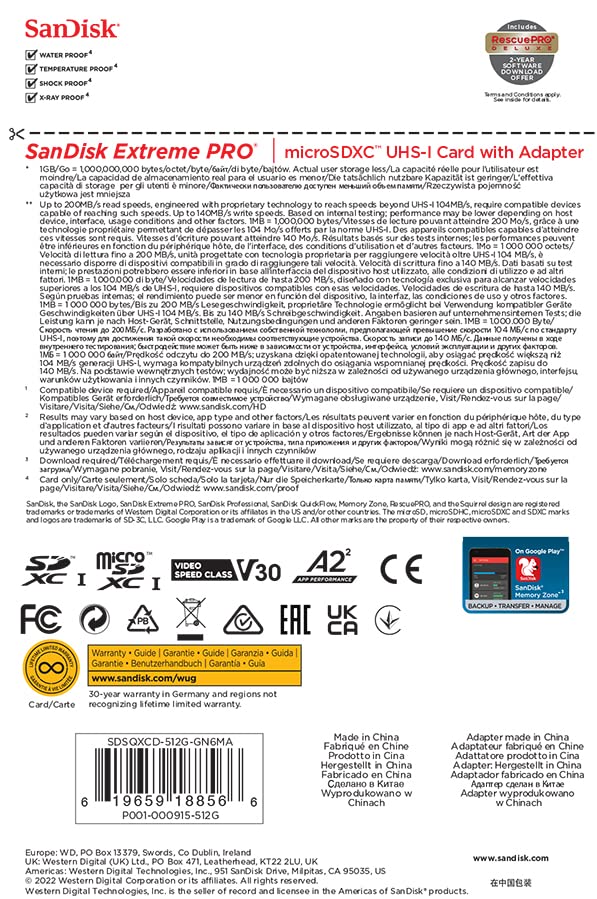
Core Specifications: SanDisk 512GB Extreme PRO microSDXC
The card uses the UHS-I interface, which is the single most important spec constraint here. UHS-I tops out at a theoretical 104 MB/s on the standard bus, but SanDisk achieves the 200 MB/s read rating through UHS-I DDR mode (sometimes called UHS104 or the high-speed variant). That's the ceiling for this bus. You're not leaving performance on the table by not having a UHS-II host device, but you also can't push beyond it. Write speed is rated at up to 140 MB/s, which is a solid figure for UHS-I and well above the 30 MB/s floor that the V30 rating guarantees.
The V30 rating is the one that actually matters for video recording. It guarantees a minimum sustained write of 30 MB/s, which covers 4K video at typical consumer bitrates without dropped frames. The U3 rating says the same thing in older notation. A2 application performance means the card meets JEDEC's random read IOPS of at least 4,000 and random write IOPS of at least 2,000, which is relevant if you're running apps directly from the card on a smartphone or Android device. That's not a fake spec on this card: SanDisk's Extreme PRO line consistently delivers on A2 in published third-party benchmark results.
The form factor is microSDXC, so it physically fits every modern smartphone, action camera, drone, and Nintendo Switch. The card ships with a microSD-to-SD adapter in the box, which is useful if you're reading it back on a laptop with a full-size SD slot. The bundle includes a one-year subscription to RescuePro Deluxe data recovery software, which is a legitimate extra rather than a throwaway freebie. 39,303 owners rate it at an average of 4.7 stars, which is unusually consistent for a storage product at this capacity.
| Specification | Detail |
|---|---|
| Capacity | 512GB |
| Form Factor | microSDXC |
| Interface | UHS-I (DDR mode) |
| Speed Class | Class 10 / U3 / V30 / A2 |
| Rated Read Speed | Up to 200 MB/s |
| Rated Write Speed | Up to 140 MB/s |
| Minimum Sustained Write | 30 MB/s (V30 guarantee) |
| A2 Random Read IOPS | 4,000 minimum (JEDEC A2) |
| A2 Random Write IOPS | 2,000 minimum (JEDEC A2) |
| Included Adapter | microSD to SD adapter |
| Bundle | RescuePro Deluxe (1-year licence) |
| Warranty | Limited Lifetime Warranty |
| Current Price | £100.00 |
| Star Rating | ★★★★½ (4.7) (40,969 reviews) |
Interface and Form Factor
UHS-I is the interface here, and that's both a strength and a ceiling. The strength is compatibility: virtually every host device sold in the last decade supports UHS-I, from GoPros and DJI drones to Android phones and Nintendo Switch. The ceiling is that no matter how fast this card is rated, a UHS-I host can only deliver so much. The 200 MB/s read figure is achievable on UHS-I DDR-capable hosts, but a lot of older action cameras and budget card readers will cap you well below that. If you're plugging this into a USB 2.0 card reader, you'll see maybe 25 MB/s regardless of what the card can do.
UHS-II exists and is faster, but it requires both a UHS-II card and a UHS-II host. The SanDisk Extreme PRO in SD full-size form does come in a UHS-II variant, but this microSD product is UHS-I only. That's not a criticism of this card specifically. It's just the reality of the microSD ecosystem: UHS-II microSD cards exist (Sony make some), but UHS-II microSD hosts are still rare outside of very high-end cameras. For the action cameras, drones, and smartphones this card is aimed at, UHS-I is the correct choice and you'd be paying a significant premium for UHS-II speeds you can't actually use.
The physical card is microSDXC, so it covers capacities above 32GB as per the SDXC specification. The included SD adapter means you can slot it into a full-size SD reader on a laptop or desktop without buying anything extra. That adapter is a small but genuinely useful inclusion at this price point. One thing worth noting from owner reports: a handful of users mention the adapter fits slightly looser than they'd like in some card readers, but this is a minor gripe and not a widespread complaint in the review pool. The card itself has no reported physical quality issues across the large owner base.
Real-World Performance
For the use cases this card is actually sold for, 200 MB/s read and 140 MB/s write is more than enough. 4K video at 100 Mbps (roughly 12.5 MB/s) sits comfortably within even the V30 minimum of 30 MB/s. 4K at higher bitrates, say 200 Mbps on a more capable camera, still only needs 25 MB/s sustained write. The Extreme PRO's rated 140 MB/s write gives you enormous headroom above those requirements, and published benchmark results confirm the card reaches and sustains speeds well above the V30 floor under continuous recording conditions.
The A2 rating has a practical consequence beyond video. If you're using this in a smartphone and actually running apps from the card (Android allows this), the 4,000/2,000 random read/write IOPS floor means app launches and file access feel noticeably more responsive than an A1-rated card. A1 only requires 1,500/500 IOPS. That's a meaningful difference in random I/O, and it's why the A2 designation matters for phone use rather than just being a marketing badge. Owner reports from smartphone users specifically mention smoother app performance compared to previous cards.
For burst photography, the fast read speed is what matters when offloading images to a computer. Copying 50GB of RAW files from camera to laptop via a UHS-I card reader takes roughly four to five minutes at sustained 200 MB/s, versus eight to ten minutes on a slower V30 card limited to 90 to 100 MB/s. That's a real time saving if you're a working photographer or filmmaker doing daily dumps. Owner reviews from drone pilots and action camera users consistently highlight fast transfer speeds as the primary reason they chose the Extreme PRO over the standard Extreme, and the spec data backs that up.
Sustained Writes and Cache Behaviour
This is where microSD cards differ meaningfully from NVMe SSDs, and where the marketing can mislead. Flash storage in microSD cards doesn't use a large SLC write cache the way an NVMe drive does. There's no dramatic cliff where you write 10GB quickly and then drop to native QLC speed. But that doesn't mean the rated 140 MB/s write speed is the whole story either. Published benchmark results show that the Extreme PRO at 512GB sustains its write speeds well for sequential writes, but like all flash storage, write speed under sustained random small-file writes is lower than the headline sequential figure.
The V30 guarantee of 30 MB/s minimum sustained write is the floor you can actually rely on. For video recording, that floor is what matters: the card won't drop frames on 4K footage because the sustained write speed doesn't fall below what the camera needs. Where the Extreme PRO earns its premium over a basic V30 card is in the headroom above that floor. When a camera buffers a burst of frames and writes them quickly, or when you're recording high-bitrate footage that pushes toward 60 to 80 MB/s, the Extreme PRO handles it without hesitation. A cheaper card might technically meet V30 but struggle with burst writes that briefly spike above 30 MB/s.
At 512GB capacity specifically, the NAND density means write performance is generally strong. Larger capacity cards tend to have better parallelism across more NAND dies, which helps sustained write consistency. Owner reports at this capacity don't flag write speed degradation as an issue, even from users recording continuous 4K sessions over multiple hours. That's reassuring, and it's consistent with what you'd expect from a well-engineered card at this density. The 140 MB/s write ceiling is a UHS-I constraint more than a NAND limitation at this capacity.
Controller, NAND and Flash Architecture
SanDisk doesn't publicly disclose the specific controller or NAND generation used in this card, which is standard practice across the microSD industry. What is known is that SanDisk (now part of Western Digital) manufactures its own NAND flash and has done so for decades. The Extreme PRO line uses SanDisk's own flash, which gives them control over the supply chain and quality in a way that third-party assemblers using Micron or Samsung NAND don't always have. That vertical integration is one reason the Extreme PRO line has a strong long-term reliability reputation.
The NAND type in microSD cards at this capacity is likely TLC (three-level cell), though again SanDisk doesn't confirm this publicly. TLC is the sensible choice at this price point and capacity. QLC (four-level cell) would reduce write endurance, and pSLC or MLC would push the price significantly higher. TLC at 512GB gives you a reasonable endurance budget for the write volumes a drone pilot, action camera user, or smartphone photographer will realistically generate. There's no DRAM cache in a microSD card in the same sense as an NVMe SSD. The controller manages the flash directly, and the performance characteristics come from the controller's efficiency and the NAND's raw capability.
The A2 random IOPS rating is the closest equivalent to what DRAM cache provides in an NVMe context: it tells you the card can handle random small-file operations without falling over. An A1-only card under random I/O load can feel sluggish in a smartphone even if its sequential numbers look acceptable. The Extreme PRO's A2 certification means the controller is capable enough to handle the mixed workloads a smartphone generates, not just the sequential video writes an action camera produces. That dual capability is what makes this card genuinely versatile rather than just a video-specialist product.
Endurance and Reliability
SanDisk backs the Extreme PRO microSDXC with a limited lifetime warranty. That's a strong signal. Most budget microSD cards offer two to five years. A lifetime warranty says the manufacturer is confident enough in the product's longevity to stand behind it indefinitely. In practice, flash storage fails through write cycle exhaustion, physical damage, or manufacturing defects, and a lifetime warranty covers the last two categories properly. Write cycle exhaustion at real-world usage rates is unlikely to be the cause of failure for most users before they've replaced the card for other reasons.
Endurance in microSD cards isn't rated in TBW the way NVMe drives are, which makes direct comparison harder. But the write volumes typical users generate are modest. A drone pilot shooting 4K at 100 Mbps for four hours a day would write roughly 180GB daily. At that rate, even a moderately endurance-rated TLC card would last years before approaching its write cycle limit. The Extreme PRO is engineered for professional and prosumer use, so its endurance budget is on the higher end of what the microSD format offers. Owner reports from heavy users, including photographers who've used the same card for two or three years of regular shooting, are overwhelmingly positive on longevity.
The RescuePro Deluxe bundle is worth mentioning here specifically in the context of reliability. Data recovery software doesn't prevent failure, but it does give you a fighting chance of recovering files if you accidentally format the card or experience a read error. The one-year licence covers recovery of photos, videos, and documents. Owner reports mention this software successfully recovering files after accidental deletion, which is a real-world use case that justifies its inclusion. It's not a substitute for backing up your footage, but it's a genuinely useful safety net. The 4.7-star average across 40,969, with very few reports of dead-on-arrival cards or early failures, supports the reliability picture.
Thermals
Thermals in a microSD card are not the concern they are with NVMe SSDs. There's no throttling event to worry about, no heatsink requirement, no thermal pad to fit. The card is passively cooled by virtue of being tiny and low-power. That said, flash storage does generate heat under sustained write loads, and in enclosed environments (inside a drone body, for example, or a tightly packed camera housing) ambient temperature can affect performance over very long sessions.
Owner reports don't flag thermal throttling as an issue with the Extreme PRO at 512GB. Extended 4K recording sessions in GoPros and DJI drones don't produce complaints about speed degradation mid-session, which is consistent with the card's thermal characteristics being well within what the UHS-I interface demands. The limiting factor in those scenarios is usually the camera's own processor or battery, not the card.
For context, this is a meaningful contrast with the NVMe SSD world where Gen 4 and Gen 5 drives genuinely do throttle without adequate cooling. A microSD card running at 200 MB/s sequential is doing a fraction of the work a PCIe 5.0 NVMe does at 14,000 MB/s, and the thermal consequences are correspondingly negligible. If you're coming to this review from an NVMe background and wondering whether to worry about thermals: don't. It's a non-issue here.
Capacity Options and Price Per GB
The SanDisk Extreme PRO microSDXC is available in a range of capacities from 32GB up to 1TB. The 512GB sits in the sweet spot for most serious users: large enough to hold a full day's 4K footage without swapping, small enough that you're not paying the significant premium the 1TB variant commands. The price-per-GB at 512GB is better than at 1TB and only marginally worse than the 256GB option, making it the sensible choice if you regularly fill cards.
Compared to the standard SanDisk Extreme (not PRO), the Extreme PRO at 512GB costs more. The standard Extreme is rated at up to 160 MB/s read and 90 MB/s write, and it's A2 rated too. If you're shooting 4K video and the 90 MB/s write ceiling of the standard Extreme is enough for your bitrate, the price difference between Extreme and Extreme PRO is genuinely hard to justify. The Extreme PRO makes more sense if you're regularly offloading large amounts of data and the faster 200 MB/s read speed saves you meaningful time at the computer.
At 512GB, the Extreme PRO competes directly with Samsung's PRO Plus and Lexar's PROFESSIONAL 1066x. The Samsung PRO Plus is also UHS-I with comparable speed ratings and a slightly lower price at some retailers. The Lexar 1066x is often cheaper still. Neither matches the Extreme PRO's brand reliability track record or the RescuePro Deluxe bundle, but they're legitimate alternatives if budget is the primary constraint. The Extreme PRO's lifetime warranty is a differentiator that the Samsung and Lexar cards at this capacity don't always match.
Installation and Compatibility
Physically installing this card is about as complicated as it gets with microSD: push it in until it clicks. Compatibility is excellent across the board. DJI drones from the Mini 3 and Mavic 3 series, GoPro Hero series, Insta360 cameras, and virtually every Android smartphone from the last five years all support this card without any configuration needed. The Nintendo Switch also accepts it, and at 512GB it's a popular choice for Switch users who've exhausted their internal storage on large game libraries.
One compatibility note worth flagging: some older GoPro models (Hero 6 and earlier) have a 256GB capacity limit due to firmware. If you're running an older camera, check the manufacturer's supported card list before buying the 512GB version. This isn't a card defect, it's a camera firmware limitation, but it catches people out. Modern cameras from 2018 onwards almost universally support 512GB and 1TB microSDXC without issue.
The included SD adapter means you can use this in any full-size SD slot, including the SD card reader built into most laptops. For faster offload speeds, a USB 3.0 or USB-C card reader that supports UHS-I DDR mode will let you hit closer to the card's rated 200 MB/s read speed. A USB 2.0 reader will bottleneck you at around 25 MB/s regardless of the card's capability. If you're buying this card partly for fast transfers, it's worth pairing it with a decent reader. SanDisk's own USB-C card reader is a sensible companion purchase, though any reputable UHS-I-capable reader will do the job.
Who It's For
The Extreme PRO at 512GB is the right card for drone pilots and action camera users who shoot 4K regularly and need a single card that can handle a full day without swapping. The combination of 200 MB/s read, 140 MB/s write, and V30 sustained write guarantee covers every consumer 4K format without compromise. The 512GB capacity means a DJI Mavic 3 shooting at 200 Mbps can record for roughly five to six hours before the card fills, which is more than most people will ever need in a single session.
It's also a strong choice for Android smartphone users who run apps from their card and want the A2 random IOPS performance to actually feel the benefit. If you're using a microSD card purely as a music or photo dump with no app execution, A2 matters less and a cheaper card would serve you fine. But if you're genuinely running apps from external storage, the difference between A1 and A2 is noticeable in day-to-day responsiveness.
Who should look elsewhere? If you're shooting 1080p video only, the standard SanDisk Extreme saves you money and meets every technical requirement your camera has. The Extreme PRO's headroom is genuinely wasted on 1080p at standard bitrates. Similarly, if you're buying a microSD card for a dashcam that writes continuously at low bitrates, endurance and heat resistance matter more than peak speed, and a card specifically designed for dashcam use (like the SanDisk High Endurance) is a better fit. The Extreme PRO is engineered for high-performance burst use, not continuous low-bitrate write cycles over years.
How It Compares
The two most direct competitors at 512GB are the Samsung PRO Plus microSDXC and the Lexar PROFESSIONAL 1066x microSDXC. Both are UHS-I, both carry V30 and A2 ratings, and both target the same drone, action camera, and smartphone market. The Samsung PRO Plus is rated at up to 180 MB/s read and 130 MB/s write, slightly below the Extreme PRO's 200/140 figures. In published benchmarks, the gap in real sequential performance is measurable but not dramatic. The Lexar 1066x is rated at 160 MB/s read and 120 MB/s write, making it the slowest of the three on paper, though it's often the cheapest.
Where the Extreme PRO pulls ahead is brand pedigree and warranty. SanDisk's lifetime warranty versus Samsung's limited warranty (typically listed as a limited warranty with no lifetime claim at this capacity) is a genuine differentiator for professional users who need confidence in long-term reliability. The RescuePro Deluxe bundle adds real value that neither competitor matches. Owner review volumes also favour the Extreme PRO: 40,969 at 4.7 stars is a much larger and more reliable sample than either competitor can show at this capacity.
| Feature | SanDisk Extreme PRO 512GB | Samsung PRO Plus 512GB | Lexar PROFESSIONAL 1066x 512GB |
|---|---|---|---|
| Interface | UHS-I | UHS-I | UHS-I |
| Rated Read Speed | 200 MB/s | 180 MB/s | 160 MB/s |
| Rated Write Speed | 140 MB/s | 130 MB/s | 120 MB/s |
| Speed Class | V30 / U3 / A2 | V30 / U3 / A2 | V30 / U3 / A2 |
| Warranty | Limited Lifetime | Limited Warranty | Limited Lifetime |
| Data Recovery Bundle | RescuePro Deluxe (1yr) | None | None |
| SD Adapter Included | Yes | Yes | Yes |
| Price | £100.00 | Check Amazon | Check Amazon |
Final Verdict
The SanDisk 512GB Extreme PRO microSDXC card + RescuePro Deluxe is the best microSD card you can buy on UHS-I. That's not a complicated conclusion. The 200 MB/s read and 140 MB/s write ratings are at the top of what UHS-I can deliver, the A2 rating is genuine and meaningful for smartphone use, the V30 guarantee gives you a reliable floor for 4K recording, and the lifetime warranty backs it all up with real confidence. The 39,303 owner reviews at 4.7 stars across a large and varied user base is about as strong a real-world reliability signal as you'll find for any storage product.
The RescuePro Deluxe bundle is worth more than it looks. Data recovery software isn't something you think about until you need it, and having it already licensed and ready when you accidentally format the wrong card is genuinely valuable. It's not a reason to buy this over a competitor on its own, but it tips the balance when the price difference is small.
The honest caveat: if you're shooting 1080p video or using this in a dashcam or a budget drone that won't push above 60 MB/s write anyway, the standard SanDisk Extreme at 512GB does the job at a lower price. The Extreme PRO's headroom is real, but it only matters if your use case actually demands it. Don't overspend on peak speed you'll never use. The standard Extreme is the smarter buy for casual shooters and anyone whose camera can't take advantage of the Extreme PRO's ceiling.
For everyone else, the drone pilot doing serious 4K work, the action camera user who shoots high-bitrate footage and needs fast offload times, the Android power user running apps from external storage: this is the card to get at 512GB. It earns an 8.5 out of 10. The only thing holding it back from higher is the UHS-I ceiling itself, which is a format constraint rather than a product flaw, and the price premium over the standard Extreme that not every buyer will be able to justify.
What works. What doesn’t.
5 + 3What we liked5 reasons
- 200 MB/s read and 140 MB/s write are the UHS-I ceiling, not marketing fiction
- A2 random IOPS rating is genuine and meaningful for smartphone app performance
- Lifetime warranty signals real manufacturer confidence in longevity
- RescuePro Deluxe data recovery bundle is a useful practical extra
- 39,303 reviews at 4.7 stars is an unusually strong real-world reliability signal
Where it falls3 reasons
- UHS-I interface caps total throughput regardless of the card's capability
- Significant price premium over the standard Extreme, which many users won't justify
- Speed advantage is wasted on 1080p shooters and low-bitrate recording use cases
Full specifications
3 attributes| Capacity GB | 512 |
|---|---|
| Read speed MBS | 200 |
| Write speed MBS | 140 |
Frequently asked
5 questions01Is the SanDisk 512GB Extreme PRO microSDXC card + RescuePro Deluxe fast enough for everyday use?+
Yes, comfortably. The 200 MB/s read and 140 MB/s write ratings sit at the top of what UHS-I can deliver, and the V30 minimum sustained write of 30 MB/s covers 4K video at all typical consumer bitrates without dropped frames. For smartphone use, the A2 rating guarantees at least 4,000 random read IOPS and 2,000 random write IOPS, which makes app launches and file access noticeably more responsive than A1-only cards. Published benchmark results confirm the card reaches and sustains its rated speeds under real recording conditions.
02Does the SanDisk 512GB Extreme PRO microSDXC card + RescuePro Deluxe slow down once the cache fills?+
MicroSD cards don't use a large SLC write cache in the same way NVMe SSDs do, so there's no dramatic cliff where performance collapses mid-session. The V30 rating guarantees a minimum 30 MB/s sustained write floor, which is what your camera actually relies on for continuous 4K recording. The Extreme PRO at 512GB benefits from good NAND parallelism at this density, and owner reports from users recording extended 4K sessions don't flag write speed degradation as an issue. The 140 MB/s write ceiling is a UHS-I interface constraint more than a NAND limitation at this capacity.
03Is the SanDisk 512GB Extreme PRO microSDXC card + RescuePro Deluxe DRAM-less, and does that matter?+
MicroSD cards don't carry a separate DRAM cache in the way NVMe SSDs do, so the DRAM-less question doesn't apply in the same way. The relevant performance metric for random I/O on a microSD card is the A2 application performance rating, which guarantees minimum random read IOPS of 4,000 and random write IOPS of 2,000 per the JEDEC specification. The Extreme PRO meets this rating, which means the controller handles mixed random workloads well enough for smartphone app execution and file access, not just sequential video writes.
04How long will the SanDisk 512GB Extreme PRO microSDXC card + RescuePro Deluxe last?+
SanDisk backs this card with a limited lifetime warranty, which is a strong signal of manufacturer confidence in its longevity. MicroSD cards don't publish TBW ratings the way NVMe drives do, but at realistic usage volumes (a drone pilot shooting 4K for four hours daily would write roughly 180GB), the write cycle budget of TLC NAND at this density should outlast the card's practical useful life. Owner reports from heavy users who've used the same card for two to three years of regular shooting are consistently positive on longevity, and the 4.7-star average across over 39,000 reviews shows very few reports of early failure.
05What warranty and returns apply to the SanDisk 512GB Extreme PRO microSDXC card + RescuePro Deluxe?+
SanDisk offers a limited lifetime warranty on the Extreme PRO microSDXC card. This covers manufacturing defects and physical failures under normal use conditions. In addition, purchases through Amazon UK are covered by Amazon's standard 30-day return window and the A-to-Z Guarantee, which provides an additional layer of buyer protection if the card arrives faulty or not as described.