You know that spot in your house where the Wi-Fi just gives up? The spare bedroom, the downstairs loo, the garage where your smart TV keeps buffering mid-episode. Your router isn't broken. It's just that walls, floors, and distance are genuinely hostile to radio signals, and the box your ISP shoved through the letterbox on day one was never designed to cover a real British home properly. That's the problem the TP-Link RE450 is built to fix. It's a range extender, not a mesh system, not a new router. It plugs into the wall somewhere between your router and the dead zone, grabs the signal, and rebroadcasts it. Simple idea. Does it actually work?
With over 38,000 owner reviews on Amazon and an average of 4.2 stars, the RE450 has clearly found its audience. That's a big number. Most networking kit lives and dies by word of mouth from frustrated people who bought it to solve a specific problem, so a 4.2 average across that many reviews tells you something real. But ratings don't tell you everything. They don't tell you whether it'll cope with your particular house layout, your specific mix of devices, or whether it'll still be behaving itself six months from now without a weekly reboot. That's what we're going to get into.
The RE450 sits firmly in the budget tier of networking kit. It's an 802.11ac (Wi-Fi 5) dual-band extender with a Gigabit Ethernet port bolted on, which is actually more useful than it sounds. It's not the newest standard, it's not mesh, and it won't win any spec-sheet beauty contests against 2025 kit. But for a lot of people with a specific dead zone problem, it might be exactly what's needed without the faff or the cost of replacing everything.
Core Specifications: What the RE450 Actually Is
The RE450 is a dual-band Wi-Fi 5 (802.11ac) range extender. It operates on both 2.4GHz and 5GHz simultaneously, which matters because a single-band extender would force everything onto one frequency and create a proper bottleneck. The headline speed figure is 1750 Mbps, which is the theoretical combined maximum across both bands. In practice, nobody's devices will ever see that number. It's marketing arithmetic: add the theoretical peak of each band together and print it on the box. The real-world figure is always a fraction of that, especially at range. But the dual-band architecture is still genuinely useful, because it means the extender can serve 5GHz devices at higher speeds while keeping 2.4GHz free for the longer-range, lower-bandwidth stuff like smart home sensors and older kit.
The Wi-Fi standard here is 802.11ac, which also covers 802.11n, 802.11g, and 802.11b for backwards compatibility. So anything you own will connect to it. The Gigabit Ethernet port is a genuine highlight for this price point. Most basic extenders at this level either skip the Ethernet port entirely or give you a 100Mbps port, which is a pointless bottleneck. The RE450 gives you full Gigabit, which means you can wire a smart TV, games console, or desktop directly to it and get a stable wired connection even in a room your router's Wi-Fi struggles to reach. That's a proper useful feature, not box-filler.
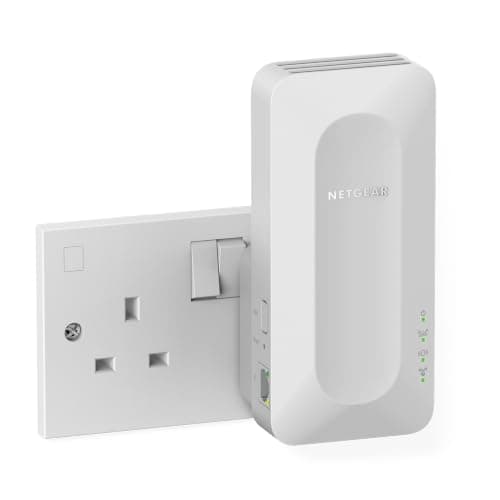
There's also a WPS button for one-press pairing, and a signal strength indicator built in, which helps you find the sweet spot when positioning it. Extender placement is where most people go wrong, and having a visual indicator removes a lot of the guesswork. It's a small thing, but it genuinely matters for setup success. The unit plugs directly into a wall socket, so no trailing cables, which keeps things tidy.
| Specification | Detail |
|---|---|
| Wi-Fi Standard | 802.11ac (Wi-Fi 5), also 802.11n/g/b |
| Frequency Bands | 2.4GHz and 5GHz (dual-band) |
| Headline Speed | Up to 1750 Mbps (combined theoretical) |
| Ethernet Port | 1 x Gigabit Ethernet |
| WPS | Yes, one-button pairing |
| Signal Indicator | Yes, smart signal strength lights |
| Form Factor | Wall plug (no trailing cables) |
| Version | 1.1 |
| Price | Check price |

Real-World Coverage: What Owners Actually Report
TP-Link's own coverage claims for the RE450 are best understood as ideal-conditions figures. Line of sight, no thick walls, no interference. Real British homes are not like that. We've got Victorian plasterwork, concrete floors in newer builds, thick internal walls, and the general chaos of a house full of people and devices. Coverage in practice will always be less than the box suggests, and anyone who tells you otherwise is selling something.
That said, the pattern from owners across those 38,000-plus reviews is broadly positive on coverage. The most common use case is a two-storey semi or terraced house where the router lives downstairs and the upstairs rooms are struggling. Owners consistently report that the RE450 sorted that problem. The 5GHz band gives a decent speed boost in rooms that were previously limping along on a weak signal, and the 2.4GHz band reaches further for devices that are further away or behind more walls. The dual-band setup means it's not a one-size-fits-all situation: your phone or laptop picks up 5GHz when it can, and falls back to 2.4GHz when it needs the range.
Where it gets trickier is in larger homes, older properties with very thick walls, or situations where the extender itself is being asked to cover a lot of ground from a weak starting signal. An extender can only work with what it receives. If you place it in a spot where the router signal is already weak, it'll rebroadcast a weak, noisy signal. The signal indicator helps here, but the general rule is: place it where the router signal is still decent (say, halfway between the router and the dead zone), not at the very edge of the router's reach. Get that placement right and owners report it works well. Get it wrong and you'll wonder why you bothered.
Sustained Speed Under Load: The Honest Picture
The 1750 Mbps headline figure is the sum of the theoretical maximums for both bands. Nobody's getting that. Not even close. What you actually get through an extender like this depends on a few things: how strong the signal is from your router to the extender, how many devices are active, and how far your device is from the extender itself. The RE450 uses a process called single-radio extension on each band, meaning the same radio that receives the signal from your router also rebroadcasts it to your devices. This is the fundamental trade-off with any traditional extender: it halves the available bandwidth on each band compared to a direct router connection.
In practical terms, owners report usable speeds for streaming, gaming, and general browsing in rooms that previously had almost nothing. For most people's internet connections in the UK, where the bottleneck is the broadband speed itself rather than the Wi-Fi, this doesn't actually matter much. If your broadband is 100Mbps or 200Mbps, the RE450's extended Wi-Fi is fast enough to deliver that in full. Where you'll notice the limitation is if you have gigabit broadband and you're trying to pull those speeds through the extender to a device far from the router. You won't get gigabit speeds wirelessly through an extender. But that's true of every extender, not just this one.
The Gigabit Ethernet port sidesteps this problem neatly for wired devices. A console or smart TV wired directly to the RE450 gets a stable, low-latency connection without any of the wireless bandwidth-halving overhead. For gaming in particular, this is the right way to use it. Owners who've used the Ethernet port for consoles consistently report solid, stable connections. That port earns its keep.
Mesh and Backhaul: This Isn't Mesh, and That Matters
The RE450 is not a mesh networking device. This distinction is worth being clear about because the marketing around home Wi-Fi has blurred the lines considerably. A mesh system uses multiple nodes that communicate intelligently with each other, often with a dedicated backhaul channel so the nodes can talk to each other without eating into the bandwidth available for your devices. The RE450 is a traditional range extender. It receives your router's signal on one band and rebroadcasts it. There's no dedicated backhaul, no intelligent roaming between nodes, and no single unified network management.
What this means in practice is that the RE450 creates a separate extended network, typically with a different SSID (network name) unless your router supports smooth band steering. Some routers will handle the handoff automatically, but many won't, and you might find your phone stubbornly clinging to the router's network even when you're standing next to the extender. This is a known annoyance with traditional extenders. It's not unique to the RE450, but it's worth knowing about before you buy. If you want your devices to roam automatically between the router and the extender without you having to think about it, a proper mesh system is the better answer.
That said, for a lot of use cases, the lack of mesh doesn't matter much. If your dead zone is a specific room where you park a TV, a console, or a desktop, you don't need smooth roaming. You need signal and a wired port. The RE450 delivers both. The mesh conversation becomes relevant when you're trying to cover a large house with multiple floors and you need your phone or laptop to move between areas without dropping the connection. For a targeted fix in a specific room, the RE450's simpler approach is fine.
Device Capacity: How Many Devices Can It Handle?
Modern homes have a lot of connected devices. Phones, laptops, tablets, smart TVs, games consoles, streaming sticks, smart speakers, doorbells, cameras, smart plugs, bulbs. Thirty to fifty connected devices in a family home is genuinely normal now, and cheap networking kit can start to choke when everything piles on at once. The RE450 is a mid-range extender rather than a budget throwaway, so it handles a reasonable device load, but it's not enterprise kit and it's not going to manage fifty simultaneous high-bandwidth streams without breaking a sweat.
The RE450 supports the 802.11ac standard, which includes some MU-MIMO capability. MU-MIMO (Multi-User Multiple Input Multiple Output) allows the device to communicate with multiple clients simultaneously rather than taking turns. This helps in households where several devices are active at the same time. It's not the more advanced OFDMA technology you'd find in Wi-Fi 6 devices, which is better at handling many small simultaneous requests from lots of devices, but MU-MIMO is a meaningful step up from older single-user MIMO kit.
For a typical household scenario where the RE450 is serving a handful of devices in a specific room or area, it handles the load well according to owner reports. Problems tend to emerge when people are using it as the primary connection point for a large number of devices simultaneously, particularly if those devices are doing bandwidth-heavy things at the same time. For its intended purpose of extending coverage to a dead zone with a moderate device load, it does the job. If you've got a genuinely packed smart home with dozens of IoT devices all reporting back constantly, you might eventually hit its limits, but for most households it's not going to be the bottleneck.
Wi-Fi Standard and Future-Proofing: Is Wi-Fi 5 Still Good Enough?
The RE450 runs on Wi-Fi 5 (802.11ac). The current mainstream standard is Wi-Fi 6 (802.11ax), with Wi-Fi 6E adding the 6GHz band, and Wi-Fi 7 now appearing in premium kit. So is Wi-Fi 5 obsolete? Not really, no. Not for an extender at this price point used in a typical UK home.
Here's the honest picture on Wi-Fi 6 and beyond: most of the gains from newer standards are most visible in dense environments with lots of devices and lots of simultaneous traffic. The OFDMA technology in Wi-Fi 6 is genuinely good at handling many small requests from many devices at once, which is why it matters in busy homes and offices. Wi-Fi 6E's 6GHz band adds more spectrum and less congestion. Wi-Fi 7 brings even higher theoretical speeds and better multi-link operation. But the practical difference for someone who just wants to stream 4K in their bedroom, game on a console, or video call without dropping out? Often smaller than the marketing suggests, especially if your broadband speed is the real bottleneck.
The RE450 being Wi-Fi 5 means it won't benefit from Wi-Fi 6 or 6E features, and if you buy a Wi-Fi 6 router in future, the extender will still work but won't pass through any Wi-Fi 6 advantages to your devices. For a lot of people, that's fine. For someone who's just upgraded to a Wi-Fi 6 router and wants to extend its coverage while keeping the Wi-Fi 6 benefits, a Wi-Fi 6 extender would be the smarter buy. The RE450 is a known quantity that does what it does well, but it's not a long-term investment in the latest standard.

Features and QoS: What You Get Beyond the Basics
The RE450 is a range extender, not a router, so the feature set is deliberately simpler than you'd find on a full router. There's no QoS (Quality of Service) traffic prioritisation built into the extender itself. QoS, for those not familiar, is the ability to tell your network to prioritise certain traffic types, like video calls or gaming, over less time-sensitive stuff like background downloads. That lives in your router, not your extender. If your router has QoS, it'll still apply to traffic flowing through the RE450, but the extender itself doesn't add any.
What the RE450 does offer is the signal strength indicator, which is more useful than it sounds. Getting extender placement right is genuinely the most important factor in how well it performs, and having a visual indicator that shows you whether the signal from your router is strong, medium, or weak at a given socket takes the guesswork out of it. There's also the WPS button for one-press pairing with your router, which makes initial setup straightforward. Press the WPS button on your router, then the button on the RE450 within two minutes, and it pairs automatically without needing to log into any admin interface.
There's no parental controls built into the extender, no VPN functionality, no guest network management at the extender level, and no buffer-bloat mitigation. Again, these are router-level features, and expecting them from an extender is the wrong frame. The RE450 is a signal relay with a Gigabit port. Judge it on those terms and it's good value. Judge it against a full router and you're comparing the wrong things. If you need those features, they need to live in your router, and the RE450 works alongside whatever router you already have.
Firmware, App and Security Updates: The Long-Term Picture
TP-Link has a reasonable track record on firmware support for its range extender lineup, though it's worth being realistic: a budget extender is not going to get the same update cadence as a flagship router. The RE450 has been around for several years, and TP-Link has continued to ship firmware updates for it. You can manage it through TP-Link's Tether app (available on iOS and Android) or through a web browser interface at the device's local IP address. The Tether app is generally well-regarded for being simple and functional without being overwhelming.
Owner reports on reliability are mostly positive, but there's a pattern worth flagging: some owners report the device needing a restart after extended periods, particularly after firmware updates or if the connection to the router drops and doesn't re-establish cleanly. This isn't universal, and plenty of owners report it running for months without touching it, but it's a known thing. If you're the kind of person who wants to set it and genuinely forget it forever, manage your expectations slightly. Most owners find it stable, but a small minority deal with periodic dropouts that a reboot fixes.
On security, TP-Link publishes firmware updates and security advisories through its official support page. For a device that sits between your router and your devices on the network, keeping the firmware current is worth doing, and pairing your network with a good VPN adds a privacy layer on top of it while also protecting you on public Wi-Fi when you are away from home. The setup process includes setting a password for the extender's admin interface, which is the minimum you'd expect. There's no WPA3 support here (that's a Wi-Fi 6 era feature), but WPA2 is still the standard in most homes and is secure for typical home use.
Setup and Management: Is It Actually Easy?
Setup is one area where the RE450 genuinely earns its owner reviews. The WPS method is about as simple as it gets: plug it in, press two buttons, done. For people who don't want to log into admin interfaces or configure anything, this is a proper win. The signal indicator then helps you find the best position. Most owners report being up and running in under ten minutes, which for networking kit is genuinely good.
The alternative setup route, through the Tether app or web browser, is also straightforward. TP-Link's interface is cleaner than a lot of competitors at this price point. You connect to the extender's temporary setup network, follow the prompts, select your home Wi-Fi network, enter the password, and it configures itself. The Tether app adds the ability to monitor connected devices and check signal strength from your phone, which is handy during setup when you're trying to find the ideal wall socket position.
Ongoing management is minimal, which is appropriate for an extender. There's not much to manage day-to-day. You're not setting up routing rules or firewall policies. The main thing you might want to do occasionally is check the firmware version and update it if a new version is available, which you can do through the web interface or Tether app. For a non-technical buyer who just wants to fix a dead zone without becoming a network administrator, the RE450's setup and management experience is one of its genuine strengths.
Ports and Connectivity: The Gigabit Port Earns Its Place
The RE450 has one Gigabit Ethernet port. That's it for physical connectivity, and honestly, for an extender in this category, that's the right call. A single Gigabit port is significantly more useful than the 100Mbps ports you'll find on cheaper extenders. The difference matters when you're wiring up a games console or a smart TV: 100Mbps is a genuine bottleneck for 4K streaming and online gaming, whereas Gigabit is effectively never the limiting factor in a home environment.
The practical use case is straightforward. You've got a room where the Wi-Fi is weak, but you've got a device there that you'd rather wire up anyway. The RE450 lets you do both at once: it extends the Wi-Fi coverage for wireless devices in the area, and it gives you a wired connection for whatever you plug into the Ethernet port. For a living room setup with a smart TV and a games console, this is genuinely useful. The TV gets the wired connection, the console gets the wired connection (if you have a switch), and your phone or laptop picks up the extended Wi-Fi.
There's no USB port, no second Ethernet port, and no link aggregation. For an extender, none of those are expected. USB storage sharing and link aggregation are router features. The absence of a second Ethernet port does mean you'd need a small switch if you want to wire up multiple devices, but that's a minor point and a cheap fix. The Gigabit port that is there is properly specified and works as advertised, which is what matters.
How It Compares: RE450 vs the Competition
The main alternatives to the RE450 at this price point are the Netgear EX6150 and the TP-Link RE550. The EX6150 is another dual-band Wi-Fi 5 extender with a similar feature set, while the RE550 is TP-Link's own step-up model with slightly higher headline speeds and a similar Gigabit Ethernet port. It's worth being clear that all three of these are traditional extenders rather than mesh systems. If you want mesh, you're looking at a different budget entirely, with systems like the TP-Link Deco range or the Amazon Eero starting at a higher price point.
The Netgear EX6150 is a reasonable competitor but typically costs more than the RE450 for a similar spec. The RE450's Gigabit Ethernet port and dual-band architecture put it ahead of the EX6150 on paper, and the owner review volume for the RE450 is substantially higher, which gives you more confidence in the consistency of the experience. The RE550 adds slightly higher theoretical speeds but at a higher price, and for most UK broadband connections the practical difference is negligible. The RE450 hits a sweet spot of spec, reliability, and price that makes the step up to the RE550 hard to justify unless you specifically need the extra headroom.
One thing worth noting is that the Wi-Fi 6 extender market has matured enough that you can now get Wi-Fi 6 extenders for not much more than the RE450. If you've already got a Wi-Fi 6 router and you want to extend its coverage while keeping Wi-Fi 6 capability for your newer devices, spending a bit more on a Wi-Fi 6 extender makes sense. But if your router is Wi-Fi 5 or older, or if your devices are mostly older hardware, the RE450 is the right tool for the job at the right price.
| Feature | TP-Link RE450 | Netgear EX6150 | TP-Link RE550 |
|---|---|---|---|
| Wi-Fi Standard | Wi-Fi 5 (802.11ac) | Wi-Fi 5 (802.11ac) | Wi-Fi 5 (802.11ac) |
| Dual Band | Yes (2.4GHz + 5GHz) | Yes (2.4GHz + 5GHz) | Yes (2.4GHz + 5GHz) |
| Headline Speed | 1750 Mbps | 1200 Mbps | 1900 Mbps |
| Ethernet Port | 1 x Gigabit | 1 x Fast Ethernet (100Mbps) | 1 x Gigabit |
| WPS | Yes | Yes | Yes |
| Signal Indicator | Yes | Yes | Yes |
| Mesh Compatible | No | No | No |
| Price | Check price | Check Amazon | Check Amazon |

Final Verdict: TP-Link RE450 WiFi Extender UK Review (2026)
The TP-Link RE450 is a straightforward device that does what it promises, and does it better than most of the competition at this price. It's not mesh, it's not Wi-Fi 6, and it won't turn a bad router into a good one. But if you've got a specific dead zone, a room that gets almost nothing from your router, and you want a quick, affordable fix that doesn't require replacing your entire networking setup, the RE450 is a genuinely good answer.
The Gigabit Ethernet port is the feature that lifts it above the crowd. At this price, most extenders give you a 100Mbps port or nothing. The RE450 gives you full Gigabit, which means it's actually useful for wiring up a console or TV rather than just providing a token port that bottlenecks everything. The dual-band setup, the signal indicator for placement, and the simple WPS setup all add up to a device that's been properly thought through for its intended use case. 7,527 at 4.2 stars doesn't happen by accident.
The trade-offs are real but predictable. It's Wi-Fi 5, so if you've upgraded to a Wi-Fi 6 router and you want to extend those benefits, look at a Wi-Fi 6 extender instead. It's a traditional extender rather than mesh, so smooth roaming between the router and the extender isn't guaranteed without the right router configuration. And like most extenders, it halves the available wireless bandwidth on each band compared to a direct router connection. None of these are surprises, and none of them are unique to the RE450. They're the nature of the category.
For the right buyer, this is a solid buy. For someone who needs mesh or Wi-Fi 6 coverage extension, it's the wrong tool. Know which one you are before you click add to cart, and you won't be disappointed.
Editorial score: 7.5 out of 10. A well-specified, reliable extender at a fair price. Not the future of Wi-Fi, but a proper fix for a real problem.
What works. What doesn’t.
5 + 4What we liked5 reasons
- Gigabit Ethernet port is genuinely useful, not a token 100Mbps afterthought
- Dual-band 2.4GHz and 5GHz coverage handles a wide range of devices
- Signal strength indicator takes the guesswork out of placement
- WPS setup is fast and simple, even for non-technical buyers
- Strong owner review track record across 38,000+ ratings
Where it falls4 reasons
- Wi-Fi 5 only, so no Wi-Fi 6 benefits even with a newer router
- Traditional extender, not mesh, so smooth roaming is not guaranteed
- Wireless bandwidth halved on each band compared to direct router connection
- Some owners report occasional dropouts requiring a reboot over time
Full specifications
8 attributes| Antennas | 3 |
|---|---|
| Launch year | 2014 |
| Mesh capable | false |
| Ports | 1x Gigabit Ethernet |
| Security protocols | WPA2 |
| TOP speed mbps | 1750 |
| Type | extender |
| Wifi standard | Wi-Fi 5 |
Frequently asked
5 questions01Will the TP-Link RE450 cover my whole house?+
That depends heavily on your home's size, layout, and construction. The RE450 is a range extender designed to fix a specific dead zone rather than blanket an entire large home. In a typical two-storey semi or terraced house, owners consistently report it solving upstairs coverage problems when placed on the first floor between the router and the dead zone. In larger detached homes or properties with thick walls, you may find it covers the target area well but doesn't extend much further. Placement is critical: position it where your router's signal is still decent, not at the very edge of its range. The built-in signal indicator helps you find that sweet spot.
02Do I need Wi-Fi 6 or Wi-Fi 7 instead of the RE450?+
For most people in most UK homes, no. The RE450 runs on Wi-Fi 5 (802.11ac), which is still the dominant standard in most homes and handles streaming, gaming, and general browsing without issue. Wi-Fi 6 brings real benefits in dense device environments through better multi-device handling, and Wi-Fi 6E adds more spectrum. But if your router is Wi-Fi 5, or your devices are mostly older hardware, the RE450 is the right match. If you have a Wi-Fi 6 router and newer Wi-Fi 6 devices, and you want to extend coverage while keeping Wi-Fi 6 capability, then yes, a Wi-Fi 6 extender would be a better fit.
03Is the RE450 mesh, and does that matter?+
The RE450 is not a mesh device. It is a traditional range extender. The practical difference is that a mesh system uses intelligent node-to-node communication, often with a dedicated backhaul channel, and allows your devices to roam automatically between nodes without you noticing. The RE450 creates a separate extended network that your devices need to connect to explicitly, and it does not have dedicated backhaul. For a fixed dead zone with a TV or console you plan to wire up, this does not matter much. For whole-home coverage where you need your phone or laptop to move between areas smoothly, a mesh system is the better answer.
04Is the TP-Link RE450 easy to set up and is it reliable?+
Setup is one of its genuine strengths. The WPS method takes under ten minutes: plug it in, press the WPS button on your router and then on the RE450, and it pairs automatically. The Tether app and web interface are both straightforward for those who prefer a manual setup. Reliability is generally good across owner reports, with the majority running it for extended periods without issues. A minority of owners report occasional dropouts that a reboot resolves, particularly after firmware updates or if the router connection drops and does not re-establish cleanly. Keeping the firmware updated through TP-Link's support page is recommended.
05What warranty and returns apply to the TP-Link RE450?+
Amazon offers 30-day returns on most items. TP-Link typically provides a 2-year warranty on its networking kit, covering manufacturing defects. You are also covered by Amazon's A-to-Z guarantee for purchases made through Amazon UK, which provides additional buyer protection if the item is not as described or does not arrive.