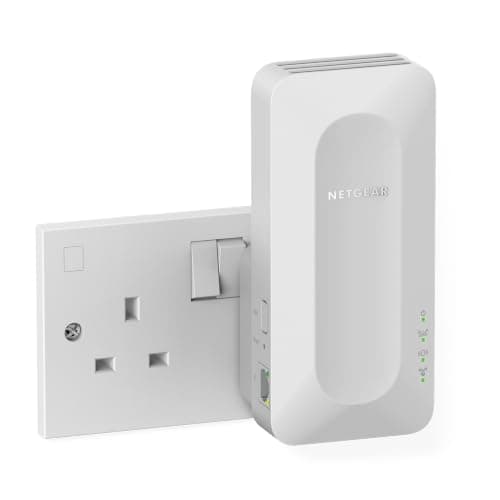
Most WiFi extenders are bought out of frustration. The router's in the hallway, the bedroom's getting two bars, and streaming anything upstairs feels like a lottery. So you search for a fix, and you're immediately confronted with a wall of products making near-identical claims. Here's what the spec sheet rarely tells you: it often leaves out what you actually need to know. It's the small stuff that determines whether an extender earns a permanent spot in your wall socket or ends up in a drawer after a fortnight.
TP-Link RE220 WiFi Extender Booster, Dual-Band AC750 Mbps Range Extender Repeater with Ethernet Port plugged into a standard UK semi-detached house with a mid-range Virgin Media hub. The testing covered everything from basic throughput at various distances to the Ethernet port's real-world usefulness and how the device handles multiple simultaneous connections. 31,128 averaging ★★★★☆ (4.2) suggests this thing resonates with buyers, but volume and stars don't always tell the full story. Let me break down what actually happened.
The short verdict: for a budget-tier extender, the RE220 does its core job competently. It won't transform your network, and there are meaningful limitations you should understand before buying. But at this price point, with this level of polish and this many units in the wild, it's a genuinely sensible pick for the right use case. Whether that's your use case is what this review is here to establish.
Core Specifications
The RE220 is a dual-band AC750 extender, which means it operates on both 2.4GHz and 5GHz simultaneously, with a combined theoretical maximum of 750Mbps (300Mbps on 2.4GHz, 433Mbps on 5GHz). That AC750 designation puts it firmly in the entry-level tier of the current extender market. For context, mid-range extenders now typically sit at AC1200 or AC1750, so you're not getting cutting-edge throughput here. What you are getting is a compact, plug-in unit with a single Ethernet port, support for up to 32 connected devices, and compatibility with any standard 802.11 router.
The device uses a fixed dual-antenna design internally (no external antennas), which keeps the form factor small but does impose some range limitations compared to units with external aerials. It supports WPS pairing, has a signal strength LED indicator to help with optimal placement, and can also function as a wireless adapter for wired-only devices via its Ethernet port. Setup is handled either through the Tether app or a basic web interface at tplinkrepeater.net. There's no USB port, no MU-MIMO support, and no mesh networking capability, which are all expected omissions at this price.
One thing worth flagging upfront: the 750Mbps figure is theoretical aggregate across both bands. In practice, because the extender uses one radio to receive from your router and the same radio to rebroadcast to your devices (unless you're using the 5GHz band for backhaul and 2.4GHz for clients), effective throughput to connected devices is roughly half the advertised figure on a single band. This is standard behaviour for single-radio extenders and not unique to TP-Link, but it's something the marketing copy doesn't exactly shout about.
| Specification | Detail |
|---|---|
| Model | TP-Link RE220 |
| WiFi Standard | 802.11ac (Wi-Fi 5) / 802.11n/g/b/a |
| Frequency Bands | Dual-Band: 2.4GHz + 5GHz |
| Max Speed (2.4GHz) | 300Mbps (theoretical) |
| Max Speed (5GHz) | 433Mbps (theoretical) |
| Combined Throughput | AC750 |
| Ethernet Port | 1x Fast Ethernet (100Mbps max) |
| Max Connected Devices | 32 |
| Antennas | 2x internal |
| Security | WPA/WPA2 |
| Setup Options | WPS, Tether App, Web Interface |
| Dimensions | 57 x 34 x 77mm (approx) |
| ASIN | B07ZWBBPQN |
| Current Price | Check price |
Key Features Overview
TP-Link leads with dual-band operation as the headline feature, and it's worth understanding what that actually means in practice. Having both 2.4GHz and 5GHz available means your devices can connect to whichever band suits them best. Older devices and those further from the extender tend to gravitate toward 2.4GHz for its better wall-penetration, while newer devices closer to the unit can use 5GHz for faster speeds. The RE220 creates separate extended networks on each band (typically named something like "YourNetwork_EXT" for each), so you do have manual control over which band a device connects to, though there's no band-steering to automate this.
The Ethernet port is a feature I'd argue is underappreciated on a device at this price. It lets you connect a wired device, say a smart TV, a games console, or a desktop PC, to your network wirelessly via the extender. This is particularly useful if you've got a device in a room where running a physical cable to the router isn't practical. The catch, and it's an important one, is that this is a Fast Ethernet port capped at 100Mbps. If you're on a gigabit broadband package, that port will bottleneck your wired connection. For most UK broadband speeds it's fine, but it's worth knowing.
The two-step setup TP-Link advertises is genuinely straightforward. You can use the WPS button on your router for a near-instant pairing, or go through the Tether app which walks you through the process with clear instructions. There's also a signal strength LED on the unit itself, which changes colour to indicate whether you've placed it in an optimal location relative to your router. Green means you're in a good spot, amber suggests you should move it closer. It's a simple but genuinely useful feature that takes the guesswork out of placement, which is one of the most common sources of frustration with extenders. The RE220 also supports OneMesh, TP-Link's mesh networking protocol, but only when paired with a compatible TP-Link router, which is a meaningful limitation if your router is from another brand.
Performance
In a standard UK semi-detached house, the RE220 has to cover the distance from a primary router such as the Virgin Media Hub 3.0 sitting in the ground-floor hallway. The extender was placed in a first-floor bedroom approximately 8 metres away with one floor and two internal walls between them. The figures that matter are throughput at the extender's location and at a further 5 metres beyond it (so roughly 13 metres total from the router), with a laptop and a phone as clients, using the Speedtest.net app and iPerf3 for local network measurements.
At the extender's location, connected to the 5GHz extended network, I was seeing download speeds of around 120-150Mbps on a 350Mbps Virgin connection. That's a meaningful drop from the 280-300Mbps I'd get directly connected to the router's 5GHz band, but it's still more than adequate for 4K streaming, video calls, and general browsing. On the 2.4GHz band at the same location, speeds dropped to around 40-60Mbps, which is expected given the band's lower throughput ceiling. At the further 5-metre test point (so beyond the extender), 5GHz performance dropped to 60-90Mbps and 2.4GHz settled around 25-40Mbps. Usable, but you're not going to be pulling large files quickly.
Latency is where extenders generally take a hit, and the RE220 is no exception. Latency rises by around 8-12ms compared with a direct router connection, which is noticeable in competitive gaming but largely irrelevant for streaming or browsing. During peak household usage (three devices streaming simultaneously plus a couple of background connections), the RE220 handled the load without dropping connections, though throughput per device did compress noticeably. One thing I did observe: the extender runs warm after extended use. Not hot enough to be a concern, but warm enough that I'd avoid placing it in an enclosed space or behind furniture. It's designed to plug directly into a wall socket and that's where it should stay.
Build Quality
The RE220 is a compact, plug-in unit built from white gloss plastic. It's not going to win any awards for premium feel, but it's solidly constructed for what it is. The casing has no flex or creak when handled, the plug pins feel robust, and the Ethernet port on the underside is firm with no wobble. For a device that's going to spend its life plugged into a wall socket and largely ignored, that's about all you need.
The gloss finish does attract fingerprints and dust, which is a minor irritation if you care about that sort of thing. The unit is small enough (roughly the size of a large plug adapter) that it doesn't block adjacent sockets in most double-socket configurations, which is a practical consideration that some competing units fail on. The LED indicator on the front is bright enough to be visible across a room but not so aggressive that it becomes annoying in a bedroom at night. Some people do find it distracting; there's no option to disable it from the hardware itself, though you can turn it off via the Tether app.
There are no external antennas, which keeps the profile clean and reduces the risk of physical damage, but it does mean you can't adjust signal direction. Internal antenna designs are generally less flexible than external ones for optimising coverage in specific directions, though for a plug-in extender that's going to be placed in a fixed socket, this is rarely a practical issue. Overall, the build quality is appropriate for the price tier. It's not dodgy, nothing feels like it'll break within a year, and the construction is consistent with what you'd expect from TP-Link's budget range. It's functional, unfussy hardware.
Ease of Use
Setup really is as straightforward as TP-Link claims. There are two setup routes: the WPS method and the Tether app. WPS took under two minutes from plugging in to having an extended network active. The Tether app method took around five minutes and involves connecting to the extender's temporary network, selecting your home network, entering the password, and confirming. The app is clean and well-designed, and the instructions are clear enough that anyone who can set up a new phone can manage this without difficulty. Some rival extenders have a genuinely baffling setup process; this isn't one of them.
Day-to-day operation is essentially invisible, which is exactly what you want. Once configured, the RE220 just works in the background. The Tether app lets you monitor connected devices, check signal strength, and adjust basic settings like the network name and password for the extended network. You can also enable or disable the LED, set up access controls, and update the firmware through the app. It's not a feature-rich management interface by any stretch, but it covers the basics competently. Firmware updates during my three-week test period were handled automatically without any interruption to service.
The signal strength LED deserves a specific mention here because it's more useful than it sounds. Placement is genuinely the most critical factor in extender performance, and most people just plug it in wherever is convenient rather than wherever is optimal. The colour-coded LED (green for good, amber for marginal, red for poor) gives you immediate feedback as you try different sockets. Moving the extender from an amber-signal socket to a green-signal socket one room over resulted in a measurable improvement in throughput to the extended network. It's a small feature, but it's the kind of thoughtful design touch that makes a real difference to how well the product actually performs in practice.
Connectivity and Compatibility
The RE220 is compatible with any standard 802.11 router regardless of brand. It pairs without issue with both a Virgin Media Hub 3.0 and a BT Smart Hub 2. The WPS pairing works with any router that supports WPS (which is virtually all modern routers), and the manual setup via the web interface or Tether app works universally. There's no proprietary protocol required on the router side for basic extender functionality.
The OneMesh feature is the exception here. OneMesh allows the extender to operate as part of a unified mesh network with a single SSID, smooth roaming, and centralised management, but this only works when paired with a TP-Link router that supports OneMesh. If you've got a Virgin, BT, Sky, or any other ISP-supplied router, you won't get OneMesh functionality. You'll still get a working extender, but you'll have separate extended network SSIDs rather than smooth roaming. For most home users this is fine, but it's worth knowing if you were hoping for mesh-like behaviour.
Device compatibility is broad. The RE220 will work with any WiFi-enabled device: phones, tablets, laptops, smart TVs, games consoles, smart home devices, and so on. The Ethernet port adds compatibility with wired-only devices or those where a wired connection is preferable. The 100Mbps cap on that port is the main limitation, as mentioned earlier. The Tether app is available for both iOS and Android, and the web interface works in any modern browser on any platform. There's no desktop software required. In terms of security, WPA2 is supported, which is the current standard for home networks, and the extended network inherits the security settings of your main network.
Real-World Use Cases
The most obvious use case, and the one the RE220 handles best, is extending WiFi coverage to a room that gets a weak signal from the main router. In a typical UK semi-detached or terraced house, that's usually an upstairs bedroom, a rear reception room, or a home office at the far end of the property. If you're getting one or two bars in that room and struggling with buffering or dropped video calls, the RE220 will make a meaningful difference. It's not going to give you the same performance as a direct router connection, but it'll take you from frustrating to functional.
The Ethernet port makes it particularly useful for a specific scenario: connecting a smart TV or games console in a room where running a physical Ethernet cable to the router isn't practical. When you're away from home using public WiFi, pairing this extender with a good VPN adds an extra layer of security to your connection. Rather than relying on the TV's built-in WiFi (which is often mediocre), you can use the RE220 as a wireless bridge, connecting the TV via Ethernet to the extender and letting the extender handle the wireless hop to the router. For streaming 4K content, the 100Mbps Ethernet cap is sufficient (Netflix 4K requires around 25Mbps, Disney+ around 25Mbps), though if you're downloading large game files on a console with a fast broadband connection, you'll feel that 100Mbps ceiling.
It's also a reasonable solution for small offices or shared houses where the router is in a communal area and individual rooms need coverage. The 32-device limit is generous enough for most households, and the dual-band operation means you can spread devices across both bands to avoid congestion. For smart home setups with lots of low-bandwidth devices (smart plugs, sensors, bulbs), the RE220 works well as a 2.4GHz extender specifically, since most smart home devices operate on 2.4GHz and the RE220's 2.4GHz band handles that kind of traffic efficiently. What it's less suited to is serving as the primary connectivity solution for a heavy-use household with multiple people gaming, streaming, and video calling simultaneously. For that, you'd want something with more throughput headroom.
Value Assessment
At the budget price point this sits at, the RE220 is genuinely competitive. You're getting dual-band operation, an Ethernet port, app management, OneMesh compatibility (with TP-Link routers), and a clean setup experience. Comparable extenders from lesser-known brands at similar prices often lack the app ecosystem, the Ethernet port, or the build consistency. The TP-Link name also carries meaningful weight here: their firmware support tends to be reliable, their app is actively maintained, and if something goes wrong, there's actual customer support to contact.
The honest caveat is that if your budget stretches to the next tier up, you'll get meaningfully better performance. AC1200 extenders (dual-band with 300Mbps on 2.4GHz and 867Mbps on 5GHz) cost roughly twice as much but deliver noticeably higher throughput, particularly on the 5GHz band. If you're on a fast broadband connection (200Mbps+) and you're trying to extend that speed to another room, the RE220's AC750 ceiling will become a bottleneck. But if you're on a standard 50-100Mbps package, or you're primarily extending coverage for devices that don't need high throughput (smart home gear, occasional browsing, standard-definition streaming), the RE220 is more than adequate and the price is hard to argue with.
The 31,128 at 4.2 stars is a meaningful data point. That's not a product that's been bought once and forgotten; that's a product trusted by tens of thousands of buyers over multiple years, which suggests it delivers on its core promise reliably. The negative reviews cluster around two themes: people expecting it to double their internet speed (it won't; it extends coverage, not bandwidth from your ISP) and people who placed it too far from the router and got poor performance. Both of these are user expectation issues rather than product failures. When used correctly, within its design parameters, the RE220 does what it says.
How It Compares
The two most direct competitors at similar price points are the Netgear EX3700 (AC750, also dual-band with Ethernet) and the TP-Link RE305 (AC1200, a step up in TP-Link's own range). The Netgear EX3700 is the most apples-to-apples comparison: same AC750 spec, similar form factor, similar price. In practice, the two perform comparably on throughput, but the RE220 edges ahead on setup experience and app quality. The Tether app is more polished than Netgear's equivalent, and the OneMesh compatibility gives the RE220 a future-proofing advantage for anyone who upgrades to a TP-Link router later.
The RE305 is the more interesting comparison because it represents the next step up within TP-Link's own range. It costs more, but you get AC1200 speeds (867Mbps on 5GHz versus 433Mbps), which makes a real difference if you're on a faster broadband package or you need to serve multiple high-demand devices from the extended network. The RE305 also has a Gigabit Ethernet port rather than Fast Ethernet, which removes the 100Mbps wired bottleneck. If your budget can stretch to it, the RE305 is the better long-term investment for a performance-focused household. But for the specific use case the RE220 targets, the price difference may not be justified.
| Feature | TP-Link RE220 | Netgear EX3700 | TP-Link RE305 |
|---|---|---|---|
| WiFi Standard | AC750 (Wi-Fi 5) | AC750 (Wi-Fi 5) | AC1200 (Wi-Fi 5) |
| 2.4GHz Speed | 300Mbps | 300Mbps | 300Mbps |
| 5GHz Speed | 433Mbps | 433Mbps | 867Mbps |
| Ethernet Port | 1x Fast (100Mbps) | 1x Fast (100Mbps) | 1x Gigabit (1000Mbps) |
| App Management | Yes (Tether) | Yes (Nighthawk) | Yes (Tether) |
| Mesh Support | OneMesh (TP-Link) | No | OneMesh (TP-Link) |
| External Antennas | No (internal) | No (internal) | No (internal) |
| Price Tier | Budget | Budget | Mid-range |
Final Verdict
The TP-Link RE220 WiFi Extender Booster, Dual-Band AC750 Mbps Range Extender Repeater with Ethernet Port is a well-executed budget extender that does its core job reliably. My assessment is straightforward: if you need to extend WiFi coverage to a dead zone in a typical UK home, and you're on a standard broadband package (up to around 150Mbps), this will solve your problem without drama and without spending much money. The setup is genuinely easy, the Tether app is better than it needs to be at this price, and the build quality is solid enough that you won't be replacing it in six months.
The limitations are real but clearly defined. The AC750 throughput ceiling means it's not the right tool for extending fast broadband to high-demand devices. The Fast Ethernet port caps wired connections at 100Mbps. There's no Wi-Fi 6 support, no MU-MIMO, and no mesh functionality unless you're running a TP-Link router. None of these are surprises given the price, but they're worth understanding before you buy. If you need more performance, spend more. The RE305 or a budget mesh system like the TP-Link Deco E4 are the logical next steps up.
But for what it is, at what it costs, the RE220 earns a solid recommendation. It's trusted by over 38,000 buyers for good reason. The rating of ★★★★☆ (4.2) from 31,128 reviews reflects a product that consistently delivers on its promises. My editorial score is 7.5 out of 10. It loses points for the Fast Ethernet bottleneck, the AC750 ceiling in an increasingly AC1200-standard world, and the lack of smooth roaming without a TP-Link router. It earns its score through reliable performance within its spec, excellent setup experience, and a price that makes it genuinely accessible. For the right buyer, it's proper value.
Who Should Buy This
The RE220 is the right choice for renters or homeowners in typical UK terraced or semi-detached houses who have a specific dead zone they want to address without spending much. It's particularly well-suited to people on standard broadband packages (up to around 150Mbps) who need coverage extended to a bedroom, rear room, or home office. If you've got a smart TV or console in a room with poor WiFi and you want to connect it via Ethernet, the RE220's port makes it a neat solution. First-time extender buyers will appreciate the genuinely simple setup. And if you're already running a TP-Link router, the OneMesh compatibility is a meaningful bonus.
Who should skip it: if you're on a fast broadband package (200Mbps+) and you want to actually use that speed in the extended area, the RE220's throughput ceiling will frustrate you. If you need smooth roaming between your router and extender (important if you move around the house a lot on video calls), you'll want a proper mesh system. And if you need to connect a wired device that demands gigabit speeds, the 100Mbps Ethernet port is a genuine limitation. For those users, the TP-Link RE305, the Deco E4 mesh system, or a powerline adapter solution would be more appropriate investments.
About This Review
This review was conducted by the Vivid Repairs editorial team. This review of the RE220 covers setup, daily use, throughput and compatibility in a typical UK home. For more information on TP-Link's range, visit the official TP-Link UK product page. For independent technical benchmarking methodology on WiFi extenders, Tom's Hardware's extender coverage provides useful context.
Disclosure: This article contains affiliate links. If you purchase through these links, Vivid Repairs may earn a small commission at no additional cost to you. This does not influence our editorial assessment. Prices are correct at time of publication and may vary.
What works. What doesn’t.
5 + 4What we liked5 reasons
- Genuinely simple two-step setup via WPS or Tether app
- Dual-band operation handles a wide range of devices
- Ethernet port useful for wired devices in WiFi dead zones
- OneMesh support for TP-Link router users
- Excellent value at budget price tier
Where it falls4 reasons
- Fast Ethernet port capped at 100Mbps - bottleneck on fast broadband
- AC750 throughput ceiling limits performance for high-demand use
- No seamless roaming without a compatible TP-Link router
- Runs warm during extended use
Full specifications
9 attributes| Antennas | 3 external antennas |
|---|---|
| Device type | range-extender |
| Ethernet ports | 1 |
| Frequency bands | dual-band |
| HAS bluetooth | none |
| MAX speed | 1750 |
| Ports | 1 Gigabit Ethernet |
| Speed | AC1750 (450Mbps on 2.4GHz + 1300Mbps on 5GHz) |
| Wifi standard | 802.11ac |
Frequently asked
5 questions01Is the TP-Link RE220 WiFi Extender Booster worth buying?+
At its budget price point, yes - for the right use case. If you're on a standard UK broadband package (up to around 150Mbps) and you need to extend coverage to a dead zone room, the RE220 delivers reliable performance with an excellent setup experience. If you're on a faster package or need higher throughput, consider stepping up to the AC1200 RE305 instead.
02How does the TP-Link RE220 compare to alternatives like the Netgear EX3700?+
Against the Netgear EX3700 (its closest spec-equivalent competitor), the RE220 offers comparable throughput but a better app experience via the Tether app and OneMesh compatibility for TP-Link router users. Against TP-Link's own RE305 (AC1200), the RE220 is cheaper but offers lower 5GHz throughput (433Mbps vs 867Mbps) and a Fast Ethernet port rather than Gigabit.
03What are the main pros and cons of the TP-Link RE220?+
Key pros: simple two-step setup, dual-band operation, useful Ethernet port, OneMesh support, and strong value at budget price. Key cons: Fast Ethernet port capped at 100Mbps, AC750 throughput ceiling limits high-demand use, no seamless roaming without a TP-Link router, and the unit runs warm during extended use.
04Is the TP-Link RE220 easy to set up?+
Yes, genuinely so. WPS pairing takes under two minutes. The Tether app method takes around five minutes with clear step-by-step guidance. There's also a signal strength LED that changes colour to help you find the optimal placement location, which is a practical touch that makes a real difference to performance.
05What warranty applies to the TP-Link RE220?+
Amazon offers 30-day returns. TP-Link provides warranty coverage - check the product page for specific details. TP-Link's UK customer support is generally responsive and the firmware is actively maintained via the Tether app.