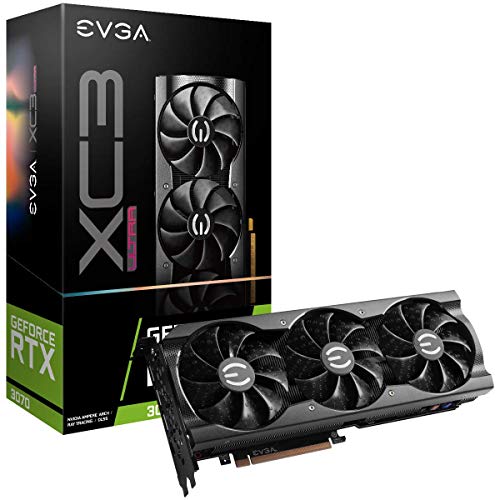


The GPU market moves fast, and cards that were headline news a few years ago can feel like ancient history by the time you're actually shopping. But the NVIDIA GeForce RTX 2070 Super Founders Edition Graphics Card (900-1G180-2515-000) is one of those cards that refuses to quietly disappear. You still see it everywhere: second-hand listings, pre-built systems being flogged on Facebook Marketplace, and the occasional new-old-stock deal that makes you do a double take. So is it worth your money in 2024, or is it a relic you should walk past?
Short answer: it depends enormously on what you're paying and what you're playing. At 1440p on a mix of modern and slightly older titles, the 2070 Super is still genuinely capable. It's not embarrassing. But it has real weaknesses, and if you're buying new at anything close to launch pricing, there are better options. The hundreds of owners who've reviewed this card give it a good overall rating, which is remarkable for a card this age, but owner reviews skew positive for a reason: most of these people bought it when it was the right card at the right time. Context matters.
This review is going to be straight with you about where the 2070 Super still holds up, where it's started to show its age, and whether the alternatives make more sense for your situation right now. No waffle, no pretending it's something it isn't.
Core Specifications: What You're Actually Getting
The RTX 2070 Super is built on NVIDIA's Turing architecture, fabbed on TSMC's 12nm process. It uses the TU104 die, which is actually the same silicon as the RTX 2080 but with some units disabled and clocks adjusted. That's not a bad thing. It means there's quality silicon underneath, and NVIDIA was conservative enough with the binning that the 2070 Super punches meaningfully above the original 2070 it replaced.
You get 2,560 CUDA cores, 40 RT cores, and 320 Tensor cores. The card carries 8GB of GDDR6 memory on a 256-bit bus, with a bandwidth of 448 GB/s. The Founders Edition specifically boosts to 1,800 MHz, which is slightly above NVIDIA's reference boost clock of 1,770 MHz. Total Graphics Power sits at 215W, and the card draws power via two 8-pin connectors. Display outputs are two DisplayPort 1.4 ports, two HDMI 2.0b ports, and one USB-C (VirtualLink, though that standard never really took off).
The Founders Edition is a dual-fan design with a flow-through cooler that exhausts some heat out the rear bracket. It's a proper two-slot card, measuring around 267mm in length, which means it'll fit in most mid-tower cases without drama. Build quality on the Founders Edition is genuinely good. Metal shroud, solid backplate, no flex, no cheap plastic. NVIDIA's own cards have always had a premium feel, and this one is no exception. Owners consistently mention the build quality in their reviews, which tracks with the spec sheet.
| Specification | Detail |
|---|---|
| GPU Architecture | Turing (TU104) |
| CUDA Cores | 2,560 |
| RT Cores | 40 (1st Gen) |
| Tensor Cores | 320 (2nd Gen) |
| Base Clock | 1,605 MHz |
| Boost Clock (FE) | 1,800 MHz |
| VRAM | 8GB GDDR6 |
| Memory Bus | 256-bit |
| Memory Bandwidth | 448 GB/s |
| TGP | 215W |
| Power Connectors | 2x 8-pin |
| Display Outputs | 2x DisplayPort 1.4, 2x HDMI 2.0b, 1x USB-C |
| Card Length | 267mm |
| Slot Width | 2-slot |
| PCIe Interface | PCIe 3.0 x16 |

Architecture and Cores: Turing's Legacy
Turing was NVIDIA's big leap when it launched in 2018. Before Turing, real-time ray tracing was essentially theoretical for consumer GPUs. NVIDIA built dedicated RT cores into Turing specifically to handle ray tracing calculations, and added Tensor cores for AI-based operations like DLSS. At the time, this was genuinely exciting. Looking back, Turing's first-gen RT cores are noticeably slower than what came after in Ampere and Ada Lovelace, but the hardware is there, and it works.
The TU104 die gives the 2070 Super a meaningful step up over the TU106-based original RTX 2070. More CUDA cores (2,560 vs 2,304), more RT cores, more Tensor cores, and higher clocks. In practice, published benchmarks from the launch period showed the 2070 Super trading blows with the RTX 2080 in many titles, which was an embarrassing situation for NVIDIA's own product stack but a great outcome for buyers. The 2070 Super sat at roughly 90 to 95 percent of RTX 2080 performance at a significantly lower price point.
The 12nm process node is obviously not competitive with modern 4nm or 5nm cards, and you feel that in the power consumption and heat output compared to newer silicon. But it's not like the card falls apart because of it. The architecture is mature, drivers are stable (NVIDIA has kept supporting Turing through recent driver updates), and the shader count is still meaningful. For rasterisation workloads, which is still the majority of what games actually use, 2,560 CUDA cores at 1,800 MHz has plenty left to give at 1080p and 1440p.
Clock Speeds and Boost: How It Behaves Under Load
NVIDIA's boost clock system on Turing is dynamic. The GPU boosts as high as thermals and power limits allow, so the 1,800 MHz figure on the Founders Edition is more of a ceiling than a guarantee. In practice, published benchmark data from the launch period consistently showed the 2070 Super FE sustaining boosts in the 1,815 to 1,860 MHz range during gaming loads, which is slightly above the rated boost. That's not unusual for NVIDIA Founders Edition cards, which have historically been binned slightly better than reference designs.
The gap between the 1,605 MHz base clock and the 1,800 MHz boost is fairly wide, which means the card's behaviour depends heavily on your case airflow and ambient temperature. In a well-ventilated mid-tower with decent airflow, you'll see sustained boost clocks near the top of that range. Shove it into a cramped mini-ITX build with poor airflow and you'll see more variance. This isn't unique to the 2070 Super, but it's worth knowing if you're planning a small form factor build.
Factory overclocking headroom on the 2070 Super is generally reported as modest but present. Most owners who've pushed it report stable operation with memory overclocks of around 500 to 700 MHz on top of the stock 14 Gbps effective speed, and GPU core overclocks of 50 to 100 MHz on top of the boost clock. Nothing dramatic, but it's there if you want to squeeze a few extra frames. The Founders Edition's cooler handles the extra heat from mild overclocking without much drama, based on what owners report.
VRAM Analysis: The 8GB Elephant in the Room
This is where things get genuinely complicated. 8GB of GDDR6 on a 256-bit bus with 448 GB/s of bandwidth was perfectly respectable in 2019. At 1080p and 1440p in most titles, 8GB is still enough today. Published VRAM usage data for titles like Cyberpunk 2077, Hogwarts Legacy, and Assassin's Creed Mirage at 1440p with high settings tends to land in the 6 to 8GB range, which means you're occasionally bumping against the ceiling but not consistently blowing through it.
At 4K, the picture changes. Modern texture packs and ultra settings in demanding titles can push well past 8GB. Starfield, for instance, has been documented exceeding 10GB at 4K ultra. When a Turing card runs out of VRAM, performance doesn't just drop, it falls off a cliff as assets start spilling into system RAM over the PCIe bus. So if 4K gaming is your goal, 8GB is a real problem, not a theoretical one. The 2070 Super is not a 4K card in 2024, full stop.
For 1080p and 1440p, though, 8GB holds up better than the doom-and-gloom crowd suggests. The bandwidth figure of 448 GB/s is still decent (the RTX 3060, for comparison, has 360 GB/s despite being a newer card). Most owners playing at 1440p report no obvious VRAM-related stuttering in the titles they're playing, and the benchmark data backs that up for the majority of games. The concern is more about longevity: will 8GB be enough in 2026? Probably not for every new release, and that's a legitimate worry if you're buying this as a long-term investment.
Ray Tracing and Upscaling: First-Gen Limitations
The 2070 Super supports NVIDIA's DLSS, but only DLSS 2, not DLSS 3 or DLSS 3.5. DLSS 3's Frame Generation feature requires Ada Lovelace architecture specifically, so you won't get that here. DLSS 2, though, is still genuinely useful. At Quality preset, the upscaling quality is very good in supported titles, and it can recover 20 to 40 percent of your frame rate in games that push the card hard. For a card of this age, having DLSS 2 support is a meaningful advantage over AMD's Polaris and Vega-era cards.
Ray tracing performance is where Turing shows its age most clearly. The first-generation RT cores are slower than Ampere's and much slower than Ada Lovelace's. In published benchmarks for titles like Control and Metro Exodus with ray tracing enabled at 1440p, the 2070 Super typically lands in the 35 to 50 FPS range depending on RT quality settings, which is playable but not comfortable. Enable DLSS alongside ray tracing and you can push that to something more usable, but you're still not getting the RT experience that a 30-series or 40-series card delivers. If ray tracing is important to you, Turing is not the architecture to be on in 2024.
The card does support DirectX 12 Ultimate features including hardware-accelerated ray tracing, mesh shaders, and variable rate shading. It also supports NVIDIA Reflex for latency reduction in supported titles. AMD's FSR is also compatible since FSR runs on any GPU, so you're not completely locked out of upscaling options in games that don't support DLSS. FSR 2 and FSR 3 work fine on the 2070 Super, though the image quality is generally considered slightly below DLSS 2 Quality preset in most comparisons.
Video Encoding: NVENC Holds Up
The 2070 Super uses NVIDIA's 7th generation NVENC encoder, which is the same generation found in Turing-based cards across the RTX 20 series. It's not the newer dual NVENC setup you get on RTX 30 and 40 series cards, but it's still a capable encoder for streaming. For OBS users streaming at 1080p60 to Twitch or YouTube, NVENC on the 2070 Super produces noticeably better quality than x264 at equivalent bitrates, and it offloads the encoding work from your CPU entirely. That's still a real benefit in 2024.
AV1 encoding is not supported on Turing. That's a genuine limitation if you're doing serious content creation work, since AV1 is increasingly the format of choice for high-quality video at lower file sizes. The 2070 Super can decode AV1 in hardware (Turing added hardware AV1 decode), but encoding AV1 requires Ampere or newer. For casual streaming, this doesn't matter. For anyone producing YouTube content at scale or doing professional video work, it's a reason to look at a newer card.
H.264 and H.265 encoding both work well on the 7th gen NVENC. For 1080p60 streaming, the encoder is perfectly adequate and the output quality is good. Shadow Play / NVIDIA Share for game capture also works without issue. If streaming is a secondary consideration rather than your primary use case, the 2070 Super's encoder won't let you down. It's only when you compare it to what a 3060 Ti or 4060 offers in encoding that the gap becomes obvious.
Power Consumption: A 215W Card in a 200W World
The 2070 Super has a 215W TGP, drawn through two 8-pin PCIe power connectors. That's a reasonable ask for the performance on offer, and it means any decent 550W to 650W PSU will handle it comfortably alongside a modern mid-range CPU. NVIDIA recommends a 650W PSU, which is sensible advice. You could probably get away with a quality 550W unit if your CPU is efficient, but don't push your luck with a cheap unit.
Published system-level power consumption figures for a 2070 Super system typically land in the 280 to 330W range at full gaming load depending on the CPU pairing. At idle, the card drops to very low power states and the fans stop entirely (more on that in the acoustics section). The 12nm process node means the 2070 Super is less efficient per frame than a modern 4nm card. An RTX 4060, for instance, achieves comparable or better gaming performance at around 115W, which is roughly half the power draw. Over a year of gaming, that difference in electricity cost adds up, particularly with UK energy prices where they are.
Transient power spikes are worth mentioning. Turing cards can spike briefly above their rated TGP during certain workloads, which is why NVIDIA recommends a PSU with some headroom. Nothing dramatic, and the two 8-pin connector setup is well within safe limits, but if you're running a borderline PSU, it's something to be aware of. The Founders Edition doesn't use the 12VHPWR connector that caused so much drama on the RTX 4090, so there are no connector melt concerns here. Two standard 8-pin connectors, well understood, no issues.

Thermal Performance: The Flow-Through Cooler
NVIDIA's Founders Edition cooler on the 2070 Super uses a dual-fan, flow-through design where one fan pulls air in from the front and the second pushes it out through the rear bracket. This is different from the open-air triple-fan designs you see on most AIB partner cards. The advantage is that some heat exits the case rather than recirculating inside it, which can help overall system temperatures. The downside is that the cooler has to work harder to keep the GPU cool compared to a large open-air heatsink.
Published benchmark data from the card's launch period showed GPU temperatures in the 75 to 82 degrees Celsius range under sustained gaming load in typical case environments. That's within NVIDIA's thermal targets and well below the 88 degrees thermal throttle threshold. The card doesn't throttle under normal conditions. Hotspot temperatures (the maximum temperature recorded on any point of the die) run roughly 10 to 12 degrees above the reported GPU temperature, so expect hotspot readings around 85 to 94 degrees under load. That sounds alarming but is normal for Turing.
Owners generally report good thermal behaviour over time, with no degradation in performance after extended use. A few reviews mention that after a couple of years, reapplying thermal paste improved temperatures by 5 to 8 degrees, which is typical for any card at that age. The Founders Edition cooler is not as impressive as some of the three-fan AIB designs, but it does its job. If you're in a hot climate or a particularly warm room, case airflow becomes more important with this cooler than it would be with a larger open-air design.
Acoustic Performance: Quieter Than You'd Expect
The 2070 Super Founders Edition has a zero-RPM mode: at idle and during light workloads, the fans stop completely. This is genuinely nice if you're doing anything other than gaming, browsing, video playback, light productivity. The card is completely silent. No fan noise at all. Several owners specifically call this out as one of their favourite things about the card, and it's easy to see why.
Under gaming load, the fans spin up and the noise level depends on the workload. Published acoustic measurements from the launch period put the 2070 Super FE at around 36 to 40 dB(A) under full gaming load, which is noticeable but not unpleasant. It's not a jet engine. The fan noise character is generally described as a smooth whoosh rather than a high-pitched whine, which makes it easier to tolerate even when the fans are spinning fast. At 1080p gaming where the card isn't being fully pushed, you'll hear less than that.
Compared to some of the more aggressive AIB partner cards from the same era, the Founders Edition is actually one of the quieter options. The flow-through design means the fans have to work a bit harder than a triple-fan open-air cooler would, but NVIDIA tuned the fan curve conservatively enough that noise levels stay manageable. A few owners with particularly noise-sensitive setups mention using custom fan curves via MSI Afterburner to reduce noise further at the cost of slightly higher temperatures, which works fine. Overall, acoustics are a genuine strength of this card, not a weakness.
Gaming Performance: Still Relevant at 1440p
At 1080p, the RTX 2070 Super is frankly overkill for most situations. Published benchmark results consistently show it delivering well above 100 FPS in demanding titles at 1080p high settings: Cyberpunk 2077 at 1080p ultra without RT lands around 65 to 75 FPS (with DLSS Quality that climbs to 90 to 100 FPS), while less demanding titles like Fortnite, Valorant, and CS2 push well past 144 FPS. For a 1080p 144Hz monitor, this card is more than capable.
At 1440p, which is where this card really lives, published benchmarks show it averaging around 60 to 75 FPS in demanding titles at high settings. Cyberpunk 2077 at 1440p ultra without RT sits around 45 to 55 FPS on published data, which is the hard end of playable, but enable DLSS Quality and you're back to 65 to 75 FPS with minimal visual compromise. Games like Shadow of the Tomb Raider, Horizon Zero Dawn, and F1 2023 all run comfortably above 60 FPS at 1440p high settings. For a 1440p 75Hz or 1440p 144Hz monitor, the 2070 Super handles the former easily and gets you most of the way to the latter in most titles.
At 4K, the 2070 Super struggles. Published benchmarks show demanding titles dropping to 30 to 45 FPS at 4K high settings, which isn't acceptable for smooth gaming. You can enable DLSS Quality to recover frames, but you're then rendering at effectively 1440p and upscaling, which somewhat defeats the purpose of a 4K monitor. The 8GB VRAM ceiling also becomes a real issue at 4K as mentioned earlier. This is not a 4K card. If you have a 4K monitor, you need something newer. The 2070 Super was never really a 4K card even at launch, and it certainly isn't one now.
How It Compares: The Honest Competition Check
The two most relevant comparisons right now are the RTX 3060 and the RTX 4060. These are the cards people actually consider when they're looking at a 2070 Super deal. The RTX 3060 is often cheaper second-hand and is a newer architecture, but it has a narrower 192-bit memory bus and only 360 GB/s of bandwidth despite its 12GB VRAM. The 2070 Super actually beats the RTX 3060 in most rasterisation benchmarks, sometimes by 10 to 15 percent, which makes the 3060 a strange choice unless VRAM capacity is your specific concern.
The RTX 4060 is a more interesting comparison. Published benchmarks show the RTX 4060 trading blows with the 2070 Super in rasterisation, with the 4060 winning in some titles and the 2070 Super winning in others, often within 5 to 10 percent either way. But the 4060 is dramatically more power efficient (115W vs 215W), supports DLSS 3 Frame Generation, has newer NVENC with AV1 encoding, and runs cooler and quieter. If you can get the 4060 at a reasonable price, it's a better all-round package for a new build. The 2070 Super's advantage is value on the second-hand market.
So to directly answer the questions people actually search for: yes, the 2070 Super is still a good graphics card for 1440p gaming in 2024. It's not outdated in the sense of being unusable, but it is showing its age in specific areas (ray tracing, VRAM for 4K, power efficiency, AV1 encoding). The 4060 is better in almost every way except raw rasterisation performance at the same price point, where the 2070 Super can still compete. The 3060, despite being newer, is actually slower than the 2070 Super in most benchmarks, so "newer" doesn't automatically mean "better" here.
| Feature | RTX 2070 Super FE | RTX 3060 (12GB) | RTX 4060 |
|---|---|---|---|
| Architecture | Turing (12nm) | Ampere (8nm) | Ada Lovelace (4nm) |
| CUDA Cores | 2,560 | 3,584 | 3,072 |
| VRAM | 8GB GDDR6 | 12GB GDDR6 | 8GB GDDR6 |
| Memory Bus | 256-bit | 192-bit | 128-bit |
| Memory Bandwidth | 448 GB/s | 360 GB/s | 272 GB/s |
| TGP | 215W | 170W | 115W |
| DLSS Version | DLSS 2 | DLSS 2 | DLSS 3 (Frame Gen) |
| AV1 Encode | No | No | Yes |
| 1440p Gaming (approx) | 60 to 75 FPS | 50 to 65 FPS | 60 to 75 FPS |
| RT Performance | Weak | Moderate | Good |
What Buyers Actually Say
With hundreds of reviews and a good overall rating, the owner sentiment for this card is overwhelmingly positive. ★★★★½ (4.7) and 399 back this up. The praise is pretty consistent across reviews: excellent build quality from the Founders Edition, strong 1440p performance, quiet operation at idle, and the zero-RPM fan mode getting particular love. Multiple owners specifically mention the card running cooler and quieter than they expected, which is a recurring theme.
The complaints, where they exist, cluster around a few areas. Some owners mention the card running warm in poorly ventilated cases, which is expected given the flow-through cooler design. A handful mention that the card felt like poor value by the time they bought it (late 2020 or 2021), when 30-series cards were theoretically available but impossible to find at sane prices. One or two mention the USB-C VirtualLink port being completely useless since VR headsets never adopted it, which is fair criticism of NVIDIA's forward-looking gamble that didn't pay off.
The longer-term owner reviews are particularly interesting. People who've had this card for three to four years consistently report it still performing well in the games they play, with no reliability issues. That's a good sign for anyone buying second-hand. The Founders Edition's build quality seems to hold up, and NVIDIA's drivers have continued to support Turing without obvious performance regressions. A few owners mention reapplying thermal paste after a couple of years with positive results, but none report hardware failures. For a card that's now five years old, that's a solid track record.
Value Analysis: Where This Card Actually Makes Sense
New and sealed, the RTX 2070 Super Founders Edition is a tough sell in 2024. You're paying for five-year-old architecture when newer, more efficient cards exist at similar or lower prices. The RTX 4060 offers comparable rasterisation performance at half the power draw, better ray tracing, DLSS 3 Frame Generation, and AV1 encoding. If you're buying new, the 4060 is the sensible choice for most people, and the 2070 Super is really only interesting if you find it significantly cheaper.
On the second-hand market, the calculation changes. A used 2070 Super in good condition at the right price is genuinely good value for a 1440p gaming build. It outperforms the RTX 3060 in most benchmarks despite being an older card, it handles 1440p high settings comfortably in the majority of current titles, and the Founders Edition's build quality means used examples are often in good shape. If you're building a budget gaming PC and you find a 2070 Super for significantly less than a new 4060, it's worth serious consideration.
The longevity question is real, though. The 8GB VRAM is going to become more of a constraint over the next couple of years, particularly as game texture budgets increase. If you're buying this as a card to last you five more years, that's optimistic. Three years at 1440p with some compromises on settings in newer titles? More realistic. Buy it with clear eyes about what it is: a capable card that's past its prime but not yet useless, at a price that reflects that position. That's the honest value assessment.

Final Verdict: Honest, No Waffle
The NVIDIA GeForce RTX 2070 Super Founders Edition Graphics Card (900-1G180-2515-000) is a genuinely good card that's in an awkward spot in 2024. It's not bad. It's not outdated in the "completely useless" sense. At 1440p, it still delivers real gaming performance in the majority of titles, the build quality is excellent, it runs quieter than you'd expect, and the positive overall rating reflects genuine satisfaction from people who've lived with it.
But the weaknesses are real and you shouldn't ignore them. First-gen RT cores that struggle with modern ray tracing workloads. 8GB VRAM that's fine now but will become a constraint. A 215W power draw that feels excessive compared to modern alternatives. No DLSS 3 Frame Generation. No AV1 encoding. These aren't dealbreakers if you're buying second-hand at the right price, but they matter for new purchases.
Who should buy it: someone building a 1440p gaming PC on a tight budget who finds a good second-hand deal, or someone who specifically needs the Founders Edition's build quality and form factor. Who should skip it: anyone buying new when an RTX 4060 exists, anyone who wants serious ray tracing, anyone with a 4K monitor, and anyone who cares about power efficiency. The 4060 is better in almost every practical way for a new purchase. The 2070 Super's best days are as a value proposition on the used market, not as a new buy in 2024.
Score: 7.5 out of 10. Excellent for its time, still capable today, but the competition has moved on and the price needs to reflect that.
What works. What doesn’t.
6 + 6What we liked6 reasons
- Still delivers 60 to 75 FPS at 1440p high settings in most current titles, making it genuinely capable for 1440p gaming in 2024
- Founders Edition build quality is excellent with a metal shroud, solid backplate, and no cheap plastics, which holds up well in used examples
- Zero-RPM fan mode means the card is completely silent at idle and during light workloads, a feature owners consistently praise
- Memory bandwidth of 448 GB/s outpaces both the RTX 3060 (360 GB/s) and RTX 4060 (272 GB/s), giving it an edge in bandwidth-sensitive workloads
- Outperforms the RTX 3060 by around 10 to 15 percent in most rasterisation benchmarks despite being an older card
- DLSS 2 support provides a meaningful 20 to 40 percent frame rate recovery in supported titles at Quality preset
Where it falls6 reasons
- 215W TGP is roughly double the RTX 4060's 115W, making it significantly less power efficient per frame and more costly to run at UK energy prices
- 8GB VRAM is adequate for most 1440p gaming today but will become an increasing constraint over the next two to three years as texture budgets grow
- First-generation RT cores deliver noticeably weaker ray tracing performance than Ampere or Ada Lovelace, with demanding RT titles struggling below comfortable frame rates at 1440p
- No DLSS 3 Frame Generation support, as this feature is exclusive to Ada Lovelace architecture, limiting upscaling options compared to newer cards
- No AV1 hardware encoding, which is a genuine limitation for content creators and streamers who work at scale or prioritise modern codec support
- 4K gaming is not viable due to both the 8GB VRAM ceiling and raw GPU performance, with demanding titles dropping to 30 to 45 FPS at 4K high settings
Full specifications
11 attributes| Vram GB | 8 |
|---|---|
| Boost clock MHZ | 1770 |
| Chipset | RTX 2070 Super |
| Core clock MHZ | 1605 |
| Generation | RTX 20 Series |
| Length MM | 267 |
| Memory BUS BIT | 256 |
| Memory type | GDDR6 |
| Power connectors | 1x 6-pin + 1x 8-pin |
| Slot width | 2 |
| TDP W | 215 |
Frequently asked
7 questions01Is the RTX 2070 Super a good graphics card in 2024?+
Yes, for 1080p and 1440p gaming it is still capable. Published benchmarks consistently show it delivering 60 to 75 FPS at 1440p high settings in most current titles. It is not a card to be embarrassed about, but the caveats are real: 8GB VRAM becomes a constraint at 4K, first-gen ray tracing is weak compared to newer cards, and the 215W power draw is high relative to modern alternatives at similar performance levels.
02Is the RTX 2070 still good in 2024?+
The original RTX 2070 (not Super) is slightly behind the 2070 Super but still functional for 1080p gaming. If you are choosing between the two, the 2070 Super is the better option. Both cards are showing their age but remain usable for current games at 1080p to 1440p on high settings, provided you are not targeting ray tracing or 4K output.
03Is a 2070 Super better than a 3060?+
In most rasterisation benchmarks, yes. The 2070 Super is faster than the RTX 3060 by around 10 to 15 percent in the majority of titles at 1440p without ray tracing. The RTX 3060's advantages are its 12GB VRAM capacity and slightly better ray tracing performance due to second-generation RT cores. For pure gaming frame rates at 1440p with ray tracing off, the 2070 Super generally comes out ahead.
04Is a 4060 better than a 2070 Super?+
For most practical purposes, yes. The RTX 4060 matches or slightly beats the 2070 Super in rasterisation performance while using roughly half the power (115W versus 215W). It also supports DLSS 3 Frame Generation, includes AV1 hardware encoding, and offers better ray tracing performance. The 2070 Super can match or exceed the 4060 in some raw rasterisation scenarios, but the 4060 is the better all-round package for anyone buying new.
05Is the 2070 Super outdated?+
It depends on how you define outdated. It cannot run DLSS 3 Frame Generation, struggles at 4K, and has first-generation RT cores that are not competitive with Ampere or Ada Lovelace cards. However, it still delivers playable performance at 1440p in most current titles. A fair description is that it is past its prime rather than completely outdated, particularly at 1080p or 1440p without ray tracing.
06What power supply do I need for the RTX 2070 Super?+
NVIDIA recommends a 650W power supply for a system using the RTX 2070 Super. A quality 550W unit may suffice if your CPU is efficient, but using a borderline or low-quality PSU is not advisable given the card's 215W TGP and potential for brief transient power spikes. The card draws power through two standard 8-pin PCIe connectors, which is a well-understood and reliable setup with no connector concerns.
07Does the RTX 2070 Super support DLSS?+
Yes, the RTX 2070 Super supports DLSS 2, which provides genuine image quality upscaling and can recover 20 to 40 percent of frame rate in supported titles at Quality preset. It does not support DLSS 3 Frame Generation, which is exclusive to Ada Lovelace architecture. AMD's FSR 2 and FSR 3 also work on the 2070 Super since those run on any GPU, giving additional upscaling options in games that do not support DLSS.