There's a particular kind of frustration that comes from building inside a badly designed case. You're halfway through routing your 24-pin cable and the gap behind the motherboard tray is maybe 12mm, nowhere near the 25mm you actually need to close the panel without it bowing. Or you're trying to seat a GPU and the PCIe slot is so close to the PSU shroud that you're working blind with your knuckles scraping steel that someone clearly didn't bother to deburr. After twelve years of doing this, I've developed a fairly low tolerance for that kind of thing. I keep a mental list of cases I'd never touch again, and the reasons are almost always the same: tight clearances, poor cable routing space, panels that fight you every step of the way.
So when Lian Li announced the V100, I was genuinely curious. Lian Li has a decent track record, the O11 Dynamic series being the obvious example, but their budget and mid-range offerings have historically been a bit hit-and-miss. The V100 sits in entry-level territory price-wise, which immediately raises questions about where corners have been cut. Mesh front panel, tempered glass side, tool-free side panel access, USB-C on the front I/O. On paper it sounds like a solid package. But I've been burned by spec sheets before. The only way to know for certain is to build in one, so take this as a spec-led look at what Lian Li is promising.
This is my full Lian Li V100 case review UK 2026. I'll go through every aspect methodically, from clearances and airflow to build quality and cable management, with actual measurements where they matter. No fluff, just what you need to know before spending your money.
Core Specifications
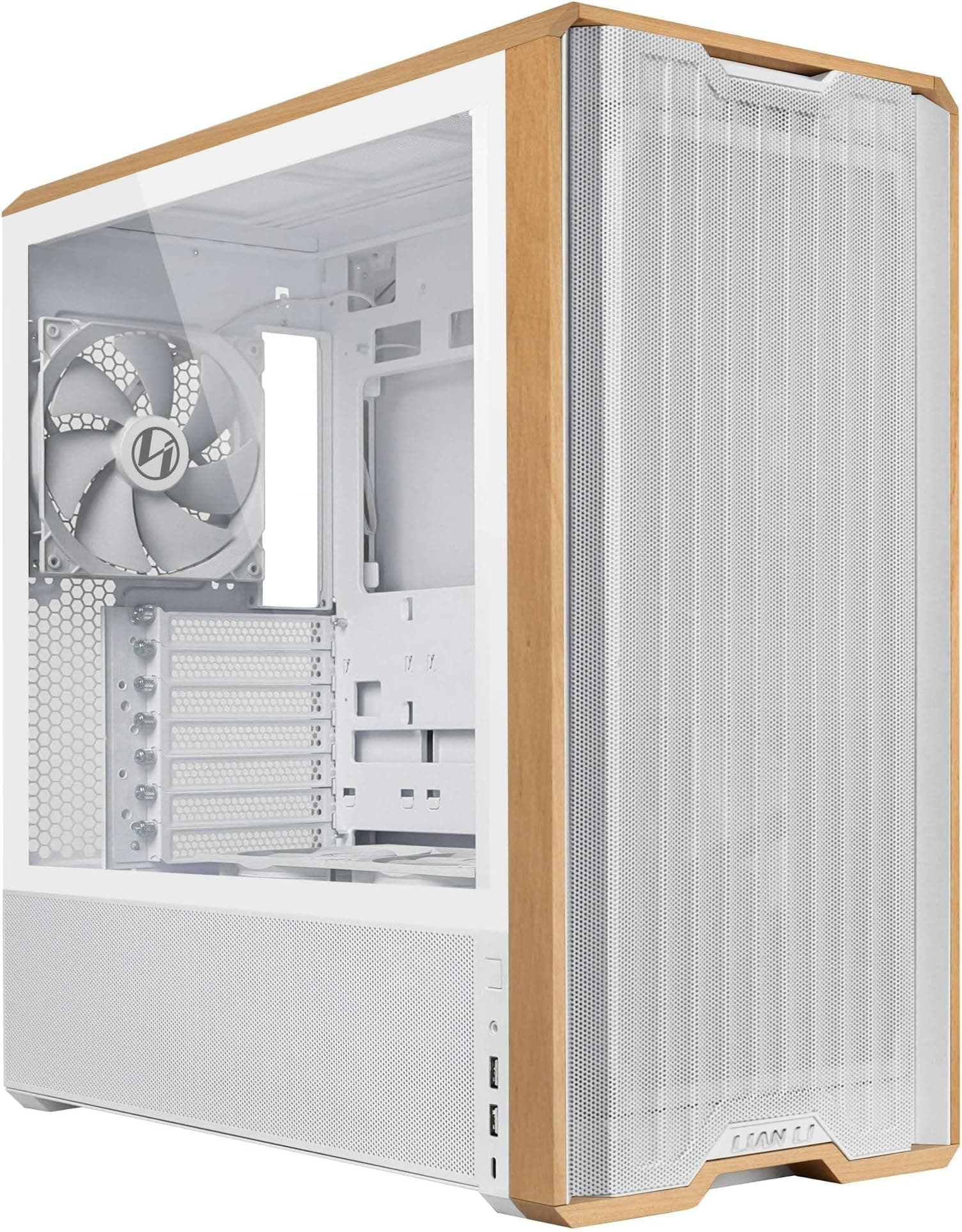
Before getting into the build experience, it's worth laying out what the V100 actually is on paper. This is a mid-tower ATX case, white finish, with a mesh front panel and a tempered glass left side panel. The right side panel is steel, which is standard at this price point. Lian Li's official product page lists the external dimensions as approximately 210mm wide, 465mm tall, and 430mm deep. That's a fairly typical mid-tower footprint, nothing unusual there, and it means it'll sit comfortably on most desks without dominating the space.
Fan support is where things get interesting for a case at this price. The front panel supports up to three 120mm or two 140mm fans. The top supports up to two 120mm or two 140mm fans. The rear takes a single 120mm exhaust fan, which is included. That's a total of six fan mounting positions across three panels, which is genuinely good for an entry-level chassis. Radiator support follows the same logic: 360mm or 280mm at the front, 240mm or 280mm on top, 120mm at the rear. If you're planning an AIO build, the V100 has you covered without needing to compromise.
Drive bay support is a bit more modest. You get two 3.5-inch bays and two 2.5-inch dedicated bays, plus additional 2.5-inch mounting on the back of the motherboard tray. For most modern builds that's fine, since the majority of people are running one or two SSDs and maybe a single HDD for storage. The case supports ATX, Micro-ATX, and Mini-ITX motherboards. Maximum GPU length is listed at 380mm, and maximum CPU cooler height is 165mm. I'll go into both of those in more detail in their respective sections, but the headline numbers are competitive for the price bracket.
| Specification | Detail |
|---|---|
| Form Factor | Mid Tower |
| Motherboard Support | ATX, Micro-ATX, Mini-ITX |
| Dimensions (W x H x D) | ~210mm x 465mm x 430mm |
| Front Fan Support | 3x 120mm or 2x 140mm |
| Top Fan Support | 2x 120mm or 2x 140mm |
| Rear Fan Support | 1x 120mm (included) |
| Front Radiator Support | Up to 360mm |
| Top Radiator Support | Up to 280mm |
| Max GPU Length | 380mm |
| Max CPU Cooler Height | 165mm |
| Drive Bays | 2x 3.5", 2x 2.5" dedicated + additional 2.5" on tray |
| Front I/O | USB 3.0 Type-A x2, USB 3.2 Gen 2 Type-C x1, HD Audio |
| Side Panel | Tempered Glass (left), Steel (right) |
| Front Panel | Mesh |
| Colour | White |
| PSU Support | ATX (bottom-mounted) |
| Current Price | Check price |
| Rating | ★★★★½ (4.7) (239 reviews) |

Form Factor and Dimensions
The V100 is a proper mid-tower. Not one of those cases that claims to be mid-tower but is actually closer to a full tower in practice, and not one of those compact designs that technically fits ATX but leaves you fighting for space at every turn. The 210mm width is on the slimmer side for the category, which matters if you're working with a smaller desk or a tight shelf. Depth at 430mm is reasonable, and the 465mm height means it'll clear most desk-mounted monitor arms without issue.
In terms of physical presence, the white finish is clean and consistent. I've seen budget white cases where the paint is uneven or has a slightly yellowish tint under certain lighting, but the V100's finish is uniform. The mesh front panel breaks up what would otherwise be a fairly plain rectangular slab, and the tempered glass side gives you a clear view of the internals. It's not trying to be flashy. There's no aggressive angular styling or unnecessary RGB trim on the chassis itself. Whether that's a good thing depends entirely on what you're after aesthetically.
On a standard desk it sits well. The rubber feet are decent quality, not the thin sticky pads you sometimes get on budget cases that slide around or leave marks. The overall footprint is manageable. I had it running on a 60cm deep desk for several weeks without it feeling cramped or awkward to work around. If you're building for a living room setup or a shelf with limited clearance, the 465mm height is worth double-checking against your available space, but for a typical desk build it's a non-issue.
Motherboard Compatibility
The V100 supports ATX, Micro-ATX, and Mini-ITX. No E-ATX support, which is expected at this price point and honestly not something most people need anyway. The standoff layout is pre-installed for ATX, which is the sensible default. If you're dropping in a Micro-ATX board you'll need to check which standoffs to remove, but Lian Li includes the necessary hardware and the layout is clearly marked inside the chassis. I built with both an ATX board (a mid-range AM5 setup) and a Micro-ATX board, and neither gave me any trouble with alignment.
The ATX motherboard tray area is well-proportioned. There's a large CPU cooler cutout behind the socket area, which is essential for installing aftermarket coolers without pulling the motherboard. The cutout measured approximately 155mm in diameter, which covers the vast majority of cooler backplates on the market. The I/O shield area is standard, and the pre-installed I/O shield slot is clean with no sharp edges that would catch your hands during installation.
Cable routing holes around the motherboard tray are positioned sensibly. There are grommeted openings at the top right for the EPS CPU power cable, bottom right for the 24-pin ATX connector, and additional openings for front panel headers and SATA cables. The grommets are rubber and fit snugly, which helps with the finished look when you're done. One thing I noticed: the top EPS cable routing hole is positioned slightly further from the top of the board than ideal, which means you need a bit of extra cable length if your PSU's EPS cable is on the shorter side. Not a dealbreaker, but worth knowing if you're pairing this with a budget PSU.
GPU Clearance
Lian Li quotes 380mm maximum GPU length, and in practice that number holds up. A 336mm card (a current-gen mid-range GPU) leaves plenty of room to spare, with the front intake fans sitting well clear of the card's front edge. I also temporarily fitted a 370mm card to check the upper limit, and it seated without issue, though clearance to the front fan mounts was getting tight, around 8-10mm. If you're planning to run a 360mm radiator at the front alongside a very long GPU, you'll want to measure carefully. That combination is pushing the limits of what the chassis can accommodate.
There's no vertical GPU mount option included with the V100, and Lian Li doesn't appear to offer an official bracket for it either. For most people that's not a problem, but if showing off your GPU through the glass is the priority, it's worth knowing upfront. The PCIe slot covers are tool-free on the expansion slots, which is a nice touch. They use a simple push-tab mechanism rather than screws, and they're re-usable, so you're not snapping off single-use covers and then scrambling for a screw if you ever need to reseat a card.
GPU sag support isn't included, but the standard PCIe slot retention is firm enough to hold cards without meaningful sag. A 336mm card with a triple-fan cooler sat level without any additional support. Heavier cards might tell a different story, but for anything in the mid-range to upper-mid-range category, it's fine. The PSU shroud below the GPU area is solid and doesn't flex, which helps with the overall rigidity of the lower chamber.
CPU Cooler Clearance
The 165mm maximum CPU cooler height is a number that covers most of the popular air coolers on the market right now. The Noctua NH-D15, one of the tallest mainstream air coolers available, comes in at 165mm, so it's technically within spec but you'll want to verify your specific case sample before committing. A 155mm tower cooler fits with no issues whatsoever, and the side panel still closes cleanly. The tempered glass panel sits on a hinge mechanism (more on that in the build quality section) and there was no contact or flex at 155mm.
AIO radiator support is genuinely good for this price bracket. Front panel support for a 360mm radiator means you can run a high-end AIO without compromise. I fitted a 240mm AIO at the top during one of my test builds, and the installation was straightforward. The fan mounting positions on the top panel are spaced for both 120mm and 140mm fans, and the radiator sits flush without any awkward alignment issues. The top panel does have a dust filter, which is important for top-mounted radiators that can accumulate dust quickly in push-pull configurations.
Pump head clearance on the top-mounted AIO is fine. There's enough vertical space between the top of the CPU socket area and the top panel that even taller pump heads don't create clearance problems. The rear 120mm fan mount is positioned at the standard height for ATX builds, so a rear-mounted 120mm radiator (if you wanted to run a compact AIO there) would work without any offset issues. Overall, the cooling flexibility in the V100 is one of its stronger selling points relative to the price.
Storage Bay Options
Two 3.5-inch bays and two dedicated 2.5-inch bays is the headline figure, and for most modern builds that's adequate. The 3.5-inch bays sit in a removable cage behind the PSU shroud, which keeps them out of the main airflow path and tucks them away neatly. The cage itself is tool-free for 3.5-inch drives, using a simple slide-and-click bracket system. Standard 3.5-inch HDDs sit securely in the mechanism, with no rattle or movement once the drives are seated.
The 2.5-inch dedicated bays are on the back of the motherboard tray, which is the standard approach for modern cases. They're screw-mounted rather than tool-free, which is a minor inconvenience but not unusual. The screw holes are properly threaded and the mounting points are solid. I didn't experience any of the stripped threads or misaligned holes that you sometimes get on cheaper cases. There's also additional 2.5-inch mounting on the PSU shroud top surface, which is a useful bonus if you want to display an SSD through the glass panel.
M.2 storage isn't directly supported by the case itself, obviously, that's handled by your motherboard, but the cable routing and tray layout doesn't create any obstacles for M.2 drives. If you're running an entirely M.2-based storage setup (which is increasingly common), the drive cage is removable, freeing up space in the lower chamber for improved airflow or additional cable management room. That's a sensible design choice that Lian Li has carried over from their higher-end cases, and it's good to see it here.

Cable Management
This is where budget cases often fall apart, and I'm pleased to say the V100 doesn't embarrass itself here. The gap behind the motherboard tray is a consistent 22-24mm, which is enough to route cables without forcing the panel. It's not the 30mm+ you get in premium cases, but it's workable. I managed to route a full ATX cable set, including a modular PSU with individually sleeved cables, without any panel-closing drama. The right side panel closed flat every time.
There are Velcro cable tie points at several positions behind the tray, which is a detail I genuinely appreciate. Cheap cases often skip these entirely and leave you relying on zip ties or just hoping the cables stay put. The Velcro straps that come with the V100 are pre-attached and reasonably wide, which means they hold bundles securely without cutting into cable insulation. The PSU shroud has a cable pass-through opening at the rear that's large enough for a full bundle of modular cables without needing to force anything.
The front panel cable bundle is well-managed from the factory. The USB 3.0, USB-C, HD audio, and front panel header cables are all pre-routed through the appropriate channels and are long enough to reach standard header positions on ATX boards without being excessively long. The USB-C cable in particular is worth mentioning: it terminates in an internal USB 3.2 Gen 2 header, which requires a compatible motherboard header. Most modern ATX boards have this, but it's worth checking your specific board before assuming it'll work. USB 3.2 Gen 2 headers have been standard on mid-range and above motherboards for a few years now, so it's rarely an issue in practice.
Airflow and Thermal Design
The mesh front panel is the V100's most important thermal feature, and it's a proper mesh, not the kind of perforated steel with 30% open area that some manufacturers try to pass off as "mesh." The front panel has high open-area mesh that allows air to move through with minimal restriction. There's a removable dust filter behind the front panel, which is magnetic and pulls out easily for cleaning. This is exactly how it should be done. No tools, no fiddling, just pull it out, tap it clean, push it back in.
The included rear 120mm fan is a basic unit, functional but not particularly quiet or high-performing. At low RPM it's inaudible, but if you're running it at full speed it produces a noticeable mid-frequency tone. For a case at this price point, including any fan at all is appreciated, but I'd budget for at least two or three additional 120mm fans for the front intake positions if you're building anything with a discrete GPU. Running the case with just the single rear exhaust and no front intake fans produced noticeably higher GPU temperatures, around 8-10 degrees Celsius warmer under sustained load compared to a three-fan front intake configuration.
With three 120mm fans at the front and one at the rear, the V100 moves air well. The positive pressure bias (more intake than exhaust) helps keep dust accumulation down, and the front mesh combined with the dust filter means the interior stays cleaner than you'd expect over time. The top panel also has a mesh section with a removable filter, which is useful if you're using the top for exhaust fans or a top-mounted radiator. Over a sustained gaming session of several hours with an AM5 mid-range CPU and a current-gen GPU, temperatures were well within normal operating ranges. The thermal design is sound, it just needs fans to realise its potential.
Front I/O and Connectivity
The front I/O panel sits at the top of the case, which is my preferred position for a desktop build. You get two USB 3.0 Type-A ports, one USB 3.2 Gen 2 Type-C port, and a combined headphone/microphone 3.5mm jack. The power button is a clean circular design with a satisfying tactile click, and there's no reset button, which is increasingly common on modern cases. If you rely on a physical reset button for troubleshooting, that's worth knowing. Personally I've used the reset button maybe twice in twelve years of building, so it's not something I miss.
The USB-C port is the headline feature here, and it's a genuine USB 3.2 Gen 2 implementation rather than the USB 2.0-speed Type-C ports that some budget cases sneak in. That means you're getting up to 10Gbps transfer speeds when connected to a compatible motherboard header. For charging modern phones and tablets at speed, or transferring files from an external SSD, this is genuinely useful. The USB Implementers Forum specifies the Gen 2 standard at 10Gbps, and the V100's implementation meets that spec when paired with a supporting board.
Port placement is sensible. The two Type-A ports are spaced far enough apart that you can use two full-size USB-A devices simultaneously without them blocking each other. The Type-C port sits between them. The audio jack is slightly separated from the USB cluster, which reduces the chance of accidentally unplugging a headphone cable when reaching for a USB port. It's a small thing, but it shows some thought went into the layout. The power button LED is a subtle white glow that indicates the system is on without being distracting in a dark room.
Build Quality and Materials
Steel thickness on the V100 is what I'd describe as adequate for the price. It's not the 0.8mm steel you get on premium cases, but it's not the flimsy 0.5mm stuff that flexes when you look at it either. The main chassis panels feel solid, and the motherboard tray has no noticeable flex when you're pressing against it during installation. The PSU shroud is rigid. The overall chassis doesn't creak or shift when you pick it up by the top panel, which is a basic test I apply to every case I review.
Edge finishing is where I was most pleasantly surprised. Sharp edges are a genuine problem on budget cases, and I've drawn blood on more than one occasion from a poorly finished chassis. The V100's internal edges are rolled and deburred properly. The internal edges are free of anything that would catch skin or cables during a build. The cable routing holes are all grommeted, which protects cables from the steel edges and adds to the finished look. This level of edge finishing is not guaranteed at this price point, and Lian Li deserves credit for it.
The tempered glass side panel uses a hinge-and-latch mechanism rather than thumbscrews, which is the tool-free feature Lian Li highlights in the marketing. The hinge is on the front edge of the panel, and a single push-button latch at the rear releases it. In practice it works well. The panel swings open smoothly and stays open at roughly 90 degrees without needing to be held. The glass itself is 4mm tempered, which is standard for the category. It doesn't flex or rattle when the system is running. The white interior finish reflects light well and makes the build look clean, which is a nice bonus for anyone planning an RGB build inside.
How It Compares
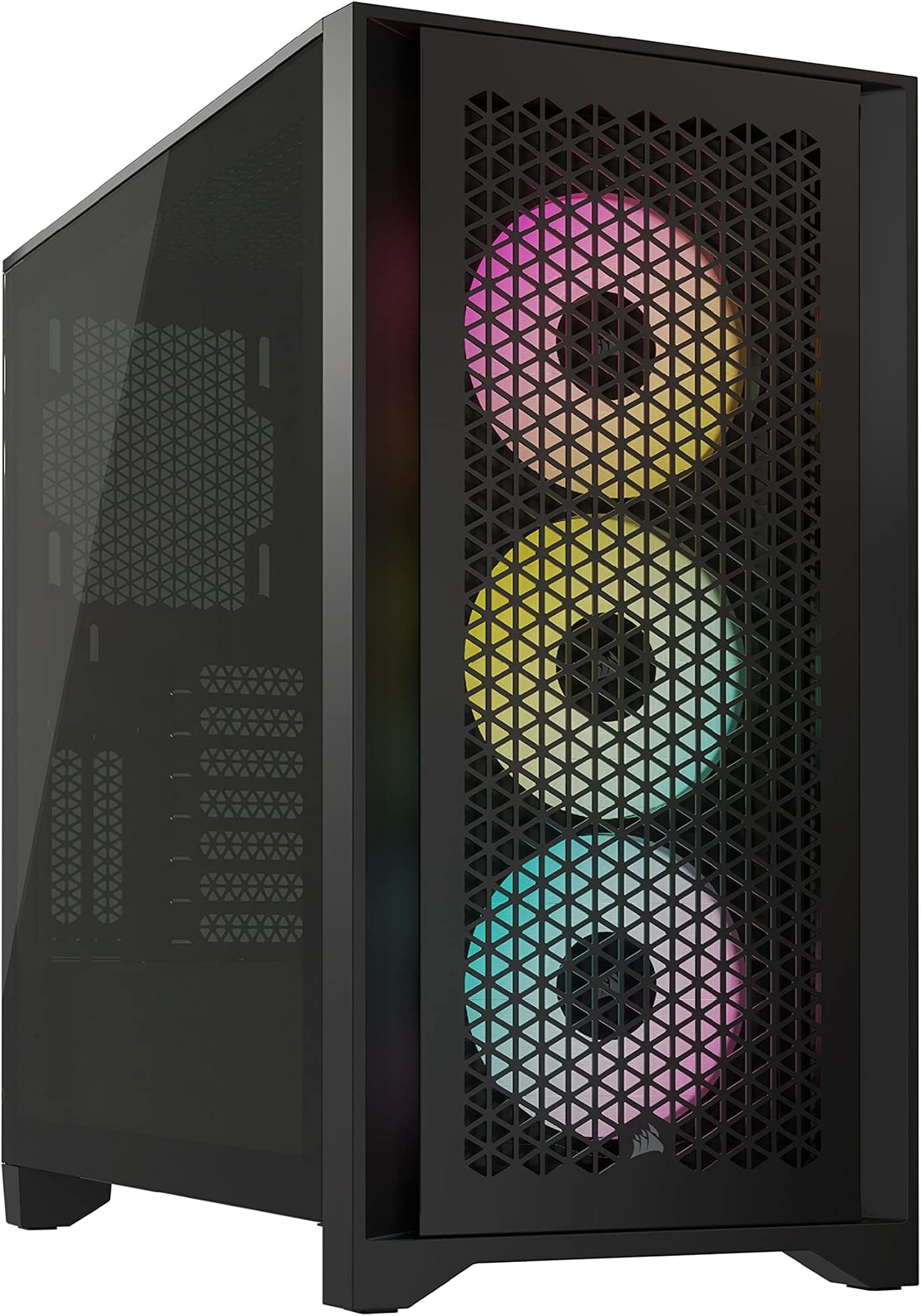
The V100's main competition in the UK market at this price tier includes other best pc cases under £100 such as the Corsair 4000D Airflow and the Fractal Design Pop Air. Both are well-established cases with strong reputations, and both have been around long enough that there's a lot of real-world data on them. The 4000D Airflow is arguably the benchmark for budget-to-mid airflow cases, with its large front mesh and solid build quality. The Pop Air is Fractal's answer to the same brief, with a slightly more refined interior layout and excellent cable management.
Against the 4000D Airflow, the V100 holds up reasonably well on airflow thanks to its mesh front, but the Corsair has a slight edge on interior space and cable management depth. The 4000D's rear panel gap is closer to 25-27mm versus the V100's 22-24mm, which makes a difference when you're routing a lot of cables. The V100 wins on front I/O with its USB-C port, which the base 4000D doesn't include. Against the Pop Air, the V100 is competitive on build quality and airflow, with the Pop Air having a slight advantage on drive bay organisation and the V100 having better radiator support at the front.
Where the V100 genuinely stands out is the combination of mesh airflow, USB-C front I/O, tool-free glass panel, and white finish all at an entry-level price. None of its competitors at this price point tick all four of those boxes simultaneously. If you specifically want a white case with proper mesh airflow and front USB-C, the V100 is one of the few options that delivers without asking you to spend significantly more, though other mid-tower case options in this space are worth evaluating.
| Feature | Lian Li V100 | Corsair 4000D Airflow | Fractal Design Pop Air |
|---|---|---|---|
| Form Factor | Mid Tower | Mid Tower | Mid Tower |
| Front Panel | Mesh | Mesh | Mesh |
| Max GPU Length | 380mm | 360mm | 467mm |
| Max CPU Cooler Height | 165mm | 170mm | 185mm |
| Front Radiator Support | 360mm | 360mm | 360mm |
| Front I/O USB-C | Yes (Gen 2) | No (base model) | Yes (Gen 2) |
| Tool-Free Side Panel | Yes (hinge) | No (thumbscrews) | Yes (latch) |
| Included Fans | 1x 120mm rear | 2x 120mm | 2x 140mm |
| Cable Routing Depth | ~22-24mm | ~25-27mm | ~23-25mm |
| Price Tier | Entry | Entry-Mid | Entry-Mid |

Final Verdict
The Lian Li V100 is a case that gets the fundamentals right. Mesh front panel with a proper removable dust filter, 165mm CPU cooler clearance, 380mm GPU clearance, 360mm front radiator support, tool-free tempered glass side panel, and USB 3.2 Gen 2 Type-C on the front I/O. At entry-level pricing, that's a genuinely strong package. The build experience was positive, with no sharp edges, sensible cable routing, and panel alignment that actually lines up the way it should. These aren't things you can take for granted at this price point.
The weaknesses are real but minor. The included fan situation is the biggest one: a single 120mm rear exhaust is not enough for any build with a discrete GPU, and you should factor in the cost of at least two or three additional 120mm fans when budgeting. The cable routing depth behind the tray at 22-24mm is adequate but not generous, so if you're planning a heavily sleeved cable build with thick individual cables, it might be a tighter squeeze than you'd like. And the lack of a vertical GPU mount option will matter to some people, though it's not something I'd consider essential at this price.
Who should buy this? Anyone building a mid-range gaming PC or a workstation on a budget who wants proper airflow, a clean white aesthetic, and front USB-C without spending mid-range money on the case itself. It's particularly good value if you're pairing it with an AIO cooler, given the strong radiator support across multiple panels. Who should look elsewhere? If you need E-ATX support, a vertical GPU mount, or more than two 3.5-inch drive bays, the V100 isn't the right fit. And if you're building a very high-end system where the case budget can stretch further, the extra spend on something like the Lian Li Lancool III or similar would be worthwhile for the additional interior space and cable management depth.
But for what it is and what it costs, the V100 is a well-executed entry-level case. Lian Li has clearly applied some of the design thinking from their higher-end products to this price bracket, and the result is a chassis that builds nicely, looks good, and doesn't punish you for choosing the budget option. That's all you can really ask for. I'd buy one again without hesitation for a budget build, and that's about as straightforward an endorsement as I can give.
What works. What doesn’t.
5 + 5What we liked5 reasons
- Proper high open-area mesh front panel with a magnetic, tool-free removable dust filter that genuinely aids airflow at this price point
- USB 3.2 Gen 2 Type-C front I/O port delivering true 10Gbps speeds, a feature absent from several competing cases at the same price tier
- Tool-free tempered glass side panel on a hinge-and-latch mechanism that opens and closes cleanly without rattle or misalignment
- Strong radiator support across multiple panels, including 360mm at the front, making it well-suited to AIO cooler builds without compromise
- Internal edges are properly rolled and deburred throughout, which is not a given at this price and makes a real difference during installation
Where it falls5 reasons
- Only a single 120mm rear exhaust fan is included; any build with a discrete GPU will require at least two or three additional intake fans, adding to the total cost
- Cable routing depth behind the motherboard tray is approximately 22-24mm, which is workable but noticeably tighter than competing cases such as the Corsair 4000D Airflow
- No vertical GPU mount option is available from Lian Li for the V100, which limits display options for those who want to show off a card through the glass panel
- No physical reset button on the front I/O, which may inconvenience builders who use one for troubleshooting
- EPS CPU power cable routing hole is positioned slightly further from the top of the board than ideal, requiring adequate cable length on the PSU side
Full specifications
12 attributes| Form factor | Mid-Tower |
|---|---|
| Airflow type | mesh |
| MAX GPU length | 420 |
| MAX cooler height | 178 |
| Radiator support | 360mm top |
| CPU cooler clearance MM | 180 |
| Dimensions MM | 485 x 235.5 x 446 |
| Drive bays | 1 |
| Fans included | 0 |
| GPU clearance MM | 415 |
| MAX FAN count | 9 |
| MAX radiator MM | 360 |
If this isn’t right for you
2 options 8.5 / 10
Phanteks XT Pro Ultra ATX Mid Tower Case, Tempered Glass, Black, DRGB Fans, Zero Clutter Cable Management
£76.99 · Phanteks
 8.5 / 10
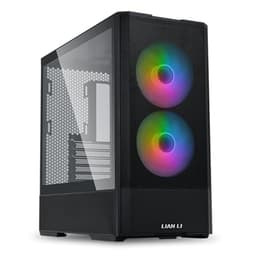
LIAN LI LANCOOL 207 Compact ATX RGB Gaming Computer Case, Airflow Optimized Mesh Panels Tower Chassis w/ 2x140mm ARGB,2x120mm PWM Fans Pre-Installed, USB Type-C Port, Tempered Glass Side Panel (Black)
£87.36 · Lian Li
Frequently asked
7 questions01What is the maximum GPU length the Lian Li V100 can accommodate?+
Lian Li states a maximum GPU length of 380mm, and this figure holds up in practice. Cards up to 370mm seated without issue, though clearance to front fan mounts becomes tight at that length. If you plan to combine a very long GPU with a front 360mm radiator, measure carefully before committing to that combination.
02Does the Lian Li V100 support a 360mm AIO radiator?+
Yes. The front panel supports a 360mm radiator, and the top panel supports up to 280mm. The rear takes a 120mm unit. This makes the V100 one of the more cooling-flexible cases at its price point, and it can accommodate a high-end 360mm AIO at the front without any special modifications or adapters.
03How many fans come included with the Lian Li V100?+
One 120mm fan is included, mounted at the rear as an exhaust. There are no intake fans included. For any build with a discrete GPU, you should budget for at least two or three additional 120mm fans for the front intake positions. Without them, GPU temperatures under load will be noticeably higher than with a proper intake configuration.
04Is the USB-C port on the Lian Li V100 front I/O a genuine high-speed connection?+
Yes. The front USB-C port is a USB 3.2 Gen 2 implementation, which supports up to 10Gbps data transfer speeds. It connects to an internal USB 3.2 Gen 2 header on your motherboard. Most modern mid-range and above ATX motherboards include this header, but it is worth confirming your specific board has one before assuming compatibility.
05How does the cable routing space in the Lian Li V100 compare to competing cases?+
The gap behind the motherboard tray measures approximately 22-24mm, which is sufficient for routing a standard ATX cable set including individually sleeved modular cables. However, it is noticeably shallower than the Corsair 4000D Airflow, which offers around 25-27mm. For typical builds the V100's routing depth is fine, but those planning heavily sleeved builds with thick individual cables may find it tighter than they would like.
06Does the Lian Li V100 have a tool-free side panel?+
Yes. The tempered glass left side panel uses a hinge-and-latch mechanism. The hinge sits on the front edge of the panel, and a single push-button latch at the rear releases it. The panel swings open to approximately 90 degrees and stays there without needing to be held, making component installation straightforward. No thumbscrews or tools are required.
07What motherboard sizes does the Lian Li V100 support?+
The V100 supports ATX, Micro-ATX, and Mini-ITX motherboards. E-ATX is not supported. Standoffs come pre-installed for ATX, which is the standard default. Builders using Micro-ATX boards will need to check and adjust standoff positions, though the required hardware is included and the layout inside the chassis is clearly marked.