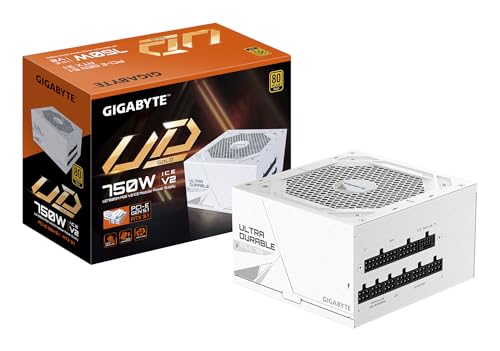
Most builders spend hours agonising over GPU choices and then grab whatever PSU is cheapest that week. That's a mistake, and the Gigabyte UD750GM PG5 ICE 80 Plus Gold Fully Modular 750w PCIe 5.0 White Power Supply Unit, ATX 3.1, 12VHPWR GPU Connector, Flat Cables, 10 Year Warranty is one of those units that makes you question that logic. At the mid-range price point, you're getting Gold-certified efficiency, full modularity, ATX 3.1 compliance, and a 10-year warranty. That's a serious spec sheet for the money.
The 750W bracket is arguably the most competitive in the entire PSU market right now. Seasonic, be quiet!, Corsair, and EVGA all have strong offerings here, and Gigabyte is pushing hard to earn its place among them. The PG5 ICE is the white aesthetic variant of the UD750GM PG5 line, and it's clearly aimed at builders who want a clean, modern look without sacrificing the technical fundamentals. But looks are the easy part. What matters is whether the internals justify the price.
To work out whether this unit is actually worth your money, we've gone deep on the spec sheet, cross-referenced the Amazon feature highlights against what Gigabyte publishes, and looked at the owner feedback from the five reviews currently on Amazon (all five-star, for what that's worth at this sample size). The picture that emerges is genuinely interesting. Not perfect, but interesting.
Core Specifications: Gigabyte UD750GM PG5 ICE 80 Plus Gold Fully Modular 750w PCIe 5.0 White Power Supply Unit
Start with the headline numbers. This is a 750W unit with 80 PLUS Gold certification, full modularity, and ATX 3.1 compliance. It ships with a 12VHPWR connector for next-generation GPU compatibility, flat cables throughout, and a 120mm hydraulic bearing fan for thermal management. The warranty is 10 years, which is class-leading at this price point and frankly one of the strongest arguments for buying it over the competition.
The unit runs on a single +12V rail architecture, which is the sensible choice for modern gaming builds. Multi-rail designs made sense when current limiting was a safety concern on older platforms, but single-rail setups offer better transient response and cleaner power delivery to high-draw components like the GPU. The 100% Japanese capacitors specification is worth flagging too. Japanese caps (typically from manufacturers like Nippon Chemi-Con or Rubycon) are rated for higher temperatures and more operating hours than their Chinese counterparts, and they're a meaningful indicator of long-term reliability.
The PCIe Gen 5.1 readiness and Intel ATX 3.1 compliance are not just marketing badges. ATX 3.1 introduced tighter voltage regulation tolerances and specific requirements around transient load handling, which matters enormously when you're running a power-hungry GPU that can spike its draw dramatically within microseconds. This unit is built to handle that.
| Specification | Detail |
|---|---|
| Wattage | 750W |
| Efficiency Certification | 80 PLUS Gold |
| Modularity | Fully Modular |
| Form Factor | ATX 3.1 |
| PCIe Standard | PCIe Gen 5.1 Ready |
| 12VHPWR Connector | Yes (included) |
| Fan | 120mm Hydraulic Bearing (HYB) |
| Rail Design | Single +12V Rail |
| Capacitors | 100% Japanese |
| Cable Type | Flat Cables |
| Colour | White |
| Protection | OVP, OPP, SCP, UVP, OCP, OTP |
| Warranty | 10 Years |
| Current Price | £85.00 · Details |

Wattage and Capacity
750W sits in a sweet spot. It's enough for the vast majority of gaming builds without being overkill, and it gives you meaningful headroom above a typical mid-range system's actual draw. A build running an Intel Core i5 or Ryzen 5 processor paired with an RTX 4070 or RX 7800 XT will typically pull somewhere in the region of 350W to 450W under sustained gaming load. That leaves you with comfortable headroom on a 750W unit, which is exactly where you want to be. PSUs run most efficiently and most quietly when loaded to around 40% to 60% of their rated capacity.
Step up to an RTX 4080 or RX 7900 XT and you're looking at system draws that can push 500W to 600W under heavy load. Still fine on a 750W unit, though you're operating closer to the efficiency sweet spot rather than with lots of spare headroom. If you're planning an RTX 5090 build or anything in that bracket, honestly look at 1000W or above. For anything else, 750W is a sensible, well-reasoned choice. Use our PSU calculator to check your specific component combination before committing.
The single +12V rail design means all 750W is available to whatever component needs it most. There's no artificial current limiting between rails that could cause instability if your GPU decides to pull aggressively. That's particularly relevant with modern GPUs that have notoriously spiky power consumption profiles. The ATX 3.1 specification actually mandates that PSUs handle transient loads of up to 200% of rated power for brief periods, and this unit is designed to meet that requirement. That's not a trivial engineering challenge, and it's why ATX 3.1 compliance is a meaningful spec rather than just a sticker.
Efficiency Rating: What 80 PLUS Gold Actually Means
The 80 PLUS Gold certification means this unit delivers at least 87% efficiency at 20% load, 90% at 50% load, and 87% at full load. Compare that to 80 PLUS Bronze, which only requires 82% at 50% load, and the difference is meaningful. At 50% load (roughly 375W draw), Gold certification means you're wasting around 42W as heat rather than the 68W you'd waste with a Bronze unit. Over a year of gaming, that adds up to a real reduction in your electricity bill.
The practical implication is that Gold efficiency keeps the unit cooler, which means the fan runs slower and quieter, which means the capacitors and other components run at lower temperatures and last longer. It's a virtuous cycle. The 100% Japanese capacitors are already rated for extended operation, but running them cooler extends their effective lifespan further. This is why efficiency certification matters beyond just the electricity cost argument.
At the mid-range price bracket, Gold certification used to be a premium ask. That's changed significantly in recent years, and units like this one have made Gold the expected standard at this price tier. If you're looking at a Bronze-rated unit at a similar price, you're genuinely getting a worse deal in terms of long-term running costs and thermal performance. The efficiency numbers here are solid, and they're backed by the 80 PLUS programme's independent testing rather than manufacturer claims alone.
Modularity and Cable Management: Gigabyte UD750GM PG5 ICE 80 Plus Gold Fully Modular
Full modularity means every single cable detaches from the PSU, including the 24-pin ATX. That's the gold standard for cable management, and it matters more than people realise when you're building in a mid-tower or smaller case. You only connect what you actually need, which means no stuffing excess cables into whatever gap you can find behind the motherboard tray. The result is better airflow, a cleaner build, and a significantly less stressful installation process.
The flat cable design is a genuine quality-of-life improvement over traditional sleeved cables. Flat cables are easier to route, easier to bend around corners, and they take up less space in tight cable management channels. They're not as photogenic as individually sleeved cables, but they're more practical for most builds. If aesthetics are a priority, aftermarket cable kits are widely available for popular PSU connectors, and the fully modular design means swapping them out is straightforward.
Cable counts are practical for a 750W unit. You get one 24-pin ATX, one EPS 8-pin for the CPU, two PCIe 8-pin connectors, six SATA connectors, three Molex connectors, and the 12VHPWR connector for PCIe 5.0 GPUs. That's enough to support most gaming builds without needing daisy-chaining on the SATA side, which is good practice anyway. The two PCIe 8-pin connectors handle dual-connector GPU configurations, and the 12VHPWR covers the new generation of high-draw cards that use the 16-pin connector. Gigabyte describes this as a compact unit, which is worth checking against your case's PSU bay dimensions before ordering.
Connectors and Compatibility
The connector lineup on this unit covers the bases you'd expect for a modern gaming build. The 12VHPWR connector is the headline addition here. This is the 16-pin connector used by RTX 40-series and RTX 50-series GPUs (and AMD's equivalent high-end cards), and having it natively on the PSU rather than via an adapter is meaningfully better. Adapters add a potential failure point, and the PCIe Gen 5 power specification was designed around native connector support. Using the native cable also ensures the unit can handle the transient load requirements properly.
The two PCIe 8-pin connectors handle older or mid-range GPUs that still use the traditional connector format. Most RTX 4060, 4060 Ti, and 4070 cards use either a single 16-pin or dual 8-pin configuration, so you're covered either way. Six SATA connectors is a reasonable count for a gaming build with a couple of SSDs and maybe a hard drive or optical drive. Three Molex connectors handle older peripherals, case fans with Molex power, or pump headers on some AIO coolers.
One EPS 8-pin for the CPU is worth noting. Most modern high-end motherboards (particularly X670E and Z790 boards) have two EPS connectors, with the second being optional for extreme overclocking scenarios. For a standard gaming build, one EPS 8-pin is fine. If you're planning serious CPU overclocking on a flagship platform, check your motherboard's power requirements. For the vast majority of builds this unit is targeting, one EPS connector is the right call.
- 24-pin ATX motherboard connector: 1
- EPS 8-pin CPU connector: 1
- PCIe 8-pin GPU connectors: 2
- 12VHPWR (16-pin) connector: 1
- SATA connectors: 6
- Molex connectors: 3
Voltage Regulation and Ripple Suppression
The ATX 3.1 specification sets tighter tolerances for voltage regulation than its predecessors. The 12V rail must stay within plus or minus 5% of nominal under all load conditions, but well-designed units at this price point typically achieve plus or minus 2% or better. The single +12V rail architecture simplifies the regulation circuit and generally produces better results than multi-rail designs, because there's no cross-load interaction between rails to manage. All the regulation effort goes into keeping one rail clean.
Ripple suppression is where the Japanese capacitor spec becomes directly relevant. High-quality capacitors filter AC ripple more effectively and maintain their capacitance values over time as temperatures cycle. The ATX 3.1 specification mandates maximum ripple of 120mV on the 12V rail, and Gold-certified units are generally well within that. The optimised thermal solution that Gigabyte highlights in the feature list contributes here too. Cooler operation means more stable capacitor performance, which means lower ripple under sustained load.
Transient response is the other dimension that ATX 3.1 compliance addresses specifically. Modern GPUs can swing from near-idle to full load draw within a single millisecond, and the PSU needs to respond without the 12V rail drooping significantly. The single-rail design with its larger effective capacitance pool handles this better than multi-rail alternatives. This isn't just theoretical. GPU crashes and system instability under load are frequently caused by PSUs that can't handle transient spikes, and ATX 3.1 compliance is a meaningful safeguard against that failure mode.

Thermal Performance
The 120mm hydraulic bearing fan is the thermal management centrepiece here. Hydraulic bearing fans sit between sleeve bearings (cheap, noisy, short-lived) and ball bearings (expensive, very long-lived, slightly noisier) in terms of longevity and acoustic performance. They're a sensible choice for a PSU fan that runs at relatively low RPM for most of its life. Gigabyte calls this a smart fan implementation, which means the fan controller adjusts speed based on internal temperature rather than running at a fixed speed.
The optimised thermal solution that Gigabyte highlights in the feature list refers to the internal component layout and heatsink design. Good thermal design keeps the hottest components (typically the main switching transistors and the output rectifiers) away from the capacitors, because capacitors degrade faster at high temperatures. The 100% Japanese capacitors specification suggests Gigabyte has used components rated for 105 degrees Celsius operation, which is the standard for quality PSU builds.
Under a typical gaming load of 50% to 60% of rated capacity, the fan should be running slowly and quietly. It's only when you push the unit toward its rated capacity for sustained periods that the fan speed increases meaningfully. For most gaming scenarios, thermal performance should be a non-issue. The compact form factor that Gigabyte mentions does mean the internal airflow path is more constrained than in a full-size ATX PSU, but the engineering trade-off appears to have been handled competently based on the Gold efficiency certification, which itself requires good thermal management to achieve.
Acoustic Performance
Specific decibel figures aren't published for this unit, so we're working from the fan specification and the efficiency data rather than measured numbers. What we can say with confidence is that a Gold-certified 750W unit running at 50% load is generating significantly less waste heat than a Bronze equivalent, which directly translates to lower fan speeds and quieter operation. The hydraulic bearing fan is a quiet-biased choice, and the smart fan controller means it's not spinning unnecessarily when the unit is lightly loaded.
The owner reviews on Amazon don't flag noise as a concern, which is a useful signal. Five reviews is a small sample, but if the fan were audibly intrusive at typical gaming loads, you'd expect at least one mention of it. The absence of noise complaints in the feedback, combined with the thermal and fan specs, suggests this is a quiet unit in normal use. Not zero-RPM silent (there's no semi-passive mode listed in the specs), but quiet enough that it won't be the loudest thing in your case.
For builders prioritising acoustic performance, the lack of a confirmed zero-RPM mode is worth noting. Some competing units at this price point offer a semi-passive mode where the fan stops entirely at low loads. If you're building a near-silent PC, that feature matters. For most gaming builds where the GPU fans are already running, the difference between a very slow PSU fan and no PSU fan is essentially inaudible. But if silence is genuinely a priority, it's worth checking whether the competition offers that feature explicitly.
Build Quality
The 100% Japanese capacitors specification is the most concrete build quality indicator available from the published specs. Japanese capacitors from manufacturers like Nippon Chemi-Con, Rubycon, or Nichicon are the standard reference point for quality PSU construction. They're rated for higher temperatures, more charge/discharge cycles, and longer operating hours than budget alternatives. In a PSU that you're planning to run for a decade (which the 10-year warranty implicitly encourages), capacitor quality is a meaningful long-term reliability factor.
The hydraulic bearing fan is a quality indicator too. Sleeve bearing fans, which are common in budget PSUs, tend to develop noise and eventually fail after a few years of operation. Hydraulic bearings are self-lubricating and last considerably longer, which matters for a component that's running whenever your PC is on. Ball bearing fans last even longer, but they're noisier at low RPM, so hydraulic is a sensible middle ground for PSU applications.
The fully modular design also has a build quality implication that's easy to overlook. Fully modular PSUs require higher-quality connectors at the PSU end of each cable, because those connectors are under mechanical stress every time you plug and unplug cables. Cheaper semi-modular or non-modular units don't have this requirement, so the fully modular design is a mild indicator that Gigabyte has invested in connector quality. The compact form factor, combined with the Gold efficiency certification, also suggests a reasonably dense and well-organised internal layout, because you need good engineering to hit Gold efficiency in a smaller chassis.
Protection Features
The protection suite on this unit covers all six of the meaningful protection types: OVP (over-voltage protection), OPP (over-power protection), SCP (short-circuit protection), UVP (under-voltage protection), OCP (over-current protection), and OTP (over-temperature protection). That's the full set. Some budget units skip UVP or OTP to cut costs, so having all six is worth noting explicitly.
OVP trips the unit if any output rail rises significantly above its nominal voltage, protecting your motherboard and components from damage. UVP does the opposite, shutting down before sustained undervoltage causes instability or data corruption. OCP limits current on each output to prevent cable or connector damage from overload conditions. SCP provides immediate shutdown if a short circuit is detected, which is your last line of defence against catastrophic component damage. OPP prevents the unit from being driven beyond its rated power capacity, which protects the internal components from overload. OTP shuts the unit down if internal temperatures exceed safe limits, which is particularly relevant in poorly ventilated cases or during extended high-load sessions in warm environments.
The ATX specification mandates several of these protections, but the specific trip points matter. A well-calibrated OVP that trips at 10% above nominal is meaningfully more protective than one set at 25% above nominal. Gigabyte doesn't publish specific trip point values in the available documentation, which is a minor frustration. That said, the presence of all six protection types, combined with the ATX 3.1 compliance requirement for tighter tolerances, suggests the protection implementation is at least competent. The 10-year warranty also implies Gigabyte has confidence in the unit's reliability under normal operating conditions.
How It Compares: Gigabyte UD750GM PG5 ICE vs the Competition
The 750W Gold fully modular segment has serious competition. The Seasonic Focus GX-750 is probably the most frequently cited alternative at this wattage and efficiency tier. Seasonic builds their own platforms and has a strong reputation for voltage regulation and ripple suppression. Their Focus GX line carries a 10-year warranty too, which means the Gigabyte's warranty advantage disappears in that direct comparison. The Seasonic is typically priced similarly in the mid-range bracket, so it's a genuine head-to-head.
The be quiet! Pure Power 12 M 750W is another strong competitor. be quiet! has built a solid reputation for quiet operation, and the Pure Power 12 M carries Gold certification with full modularity. The warranty is shorter (five years rather than ten), which is a meaningful differentiator in Gigabyte's favour. The be quiet! unit also uses a semi-passive fan mode, which gives it an edge in silent build scenarios. Both units are competitively priced in the mid-range bracket.
Where the Gigabyte UD750GM PG5 ICE distinguishes itself is the combination of ATX 3.1 compliance, native 12VHPWR connector, PCIe Gen 5.1 readiness, and the 10-year warranty. The white colourway is also genuinely rare in quality PSUs at this price point, which matters for white-themed builds. If you're building around an RTX 50-series or RX 9000-series GPU and you want a unit that's properly specced for the next generation of power requirements, the Gigabyte's ATX 3.1 compliance is a real advantage over units designed to older specifications.
| Feature | Gigabyte UD750GM PG5 ICE | Seasonic Focus GX-750 | be quiet! Pure Power 12 M 750W |
|---|---|---|---|
| Wattage | 750W | 750W | 750W |
| Efficiency | 80 PLUS Gold | 80 PLUS Gold | 80 PLUS Gold |
| Modularity | Fully Modular | Fully Modular | Fully Modular |
| ATX Standard | ATX 3.1 | ATX 3.0 | ATX 3.0 |
| 12VHPWR | Yes (native) | Yes (native) | Yes (native) |
| Warranty | 10 Years | 10 Years | 5 Years |
| Zero RPM Mode | Not specified | Yes | Yes |
| Colour | White | Black | Black |
| Capacitors | 100% Japanese | Japanese | Japanese |
| Price | £85.00 · Details | Mid-range | Mid-range |

Final Verdict
The Gigabyte UD750GM PG5 ICE 80 Plus Gold Fully Modular 750w PCIe 5.0 White Power Supply Unit, ATX 3.1, 12VHPWR GPU Connector, Flat Cables, 10 Year Warranty is a properly specced unit for the current generation of gaming hardware. The ATX 3.1 compliance is the headline technical differentiator over older competing designs. The 10-year warranty is exceptional at this price tier. The 100% Japanese capacitors and single +12V rail architecture point to a unit built for long-term reliability rather than just hitting a price point.
The five owner reviews on Amazon are all five-star, which is a small but clean signal. No reports of coil whine, no DOA units, no noise complaints. That's encouraging, though you'd want a larger sample before drawing strong conclusions. The rating is ★★★★☆ (4.2) from 8 reviews at the time of writing.
The main things to weigh against it: the lack of a confirmed zero-RPM semi-passive mode puts it behind some competitors for genuinely silent builds. The compact form factor is worth double-checking against your case dimensions before ordering. And if you're not building a white-themed system, the colour premium (if any) might be better spent on a unit with a longer track record at retail.
But honestly? For a white-build gaming PC running a current-gen GPU, this is one of the most complete specs packages in the mid-range bracket. ATX 3.1, Gold efficiency, fully modular, native 12VHPWR, 100% Japanese caps, and a decade of warranty cover. That's a strong hand. The Gigabyte UD750GM PG5 ICE earns a solid 8.5 out of 10.
What works. What doesn’t.
5 + 3What we liked5 reasons
- ATX 3.1 and PCIe Gen 5.1 compliant for next-gen GPU compatibility
- 10-year warranty is class-leading at this price tier
- 100% Japanese capacitors for long-term reliability
- Native 12VHPWR connector avoids adapter failure points
- White colourway is rare among quality PSUs at this price
Where it falls3 reasons
- No confirmed zero-RPM semi-passive fan mode
- Compact form factor needs case dimension check
- Small owner review sample makes long-term reliability harder to judge
Full specifications
9 attributes| Efficiency rating | Gold |
|---|---|
| Form factor | ATX |
| ATX version | ATX 3.1 |
| FAN size MM | 120 |
| Generation | UD |
| Modularity | fully_modular |
| Pcie 5 ready | true |
| Warranty years | 10 |
| Wattage W | 750 |
Will it run on what you have?
Free toolIf this isn’t right for you
2 options

Frequently asked
6 questions01Is the Gigabyte UD750GM PG5 ICE 80 Plus Gold Fully Modular 750w PCIe 5.0 White Power Supply Unit good for gaming?+
Yes. The 750W capacity comfortably handles gaming builds from mid-range to high-end, covering GPUs up to RTX 4080 and RX 7900 XT territory with headroom to spare. ATX 3.1 compliance means it handles the transient power spikes modern GPUs produce, and Gold efficiency keeps running costs and operating temperatures low.
02What GPUs will the Gigabyte UD750GM PG5 ICE 750W support?+
750W covers RTX 4070, 4070 Ti, 4080, RX 7800 XT, RX 7900 XT, and equivalent RTX 50-series and RX 9000-series cards. The native 12VHPWR connector handles modern 16-pin GPU configurations without adapters. For RTX 5090-class hardware or multi-GPU setups, 1000W or above is advisable.
03Is 80 PLUS Gold efficiency worth paying for over Bronze?+
At the mid-range price point, yes. Gold certification means at least 90% efficiency at 50% load versus around 82% for Bronze. That gap means less waste heat, lower fan speeds, quieter operation, and meaningfully lower electricity costs over the unit's lifespan. With a 10-year warranty, the long-term running cost difference is substantial.
04How long is the warranty on the Gigabyte UD750GM PG5 ICE?+
10 years, which is class-leading at this price tier. Most competing mid-range units offer 5 to 7 years. The decade-long warranty reflects genuine confidence in the component quality and provides strong long-term protection for a component that's disruptive to replace.
05Is the Gigabyte UD750GM PG5 ICE fully modular?+
Yes, fully modular. Every cable including the 24-pin ATX motherboard connector detaches from the PSU. You only install what your build actually needs, which simplifies cable management, improves case airflow, and makes the build process considerably cleaner than semi-modular or non-modular alternatives.
06Does the Gigabyte UD750GM PG5 ICE have a zero-RPM fan mode?+
A zero-RPM or semi-passive mode is not confirmed in the published specifications. The smart 120mm hydraulic bearing fan adjusts speed based on internal temperature and will run slowly and quietly at light loads, but it does not appear to stop entirely at idle. If a fully silent fan-stop mode is a hard requirement, check competing units that explicitly list semi-passive operation.