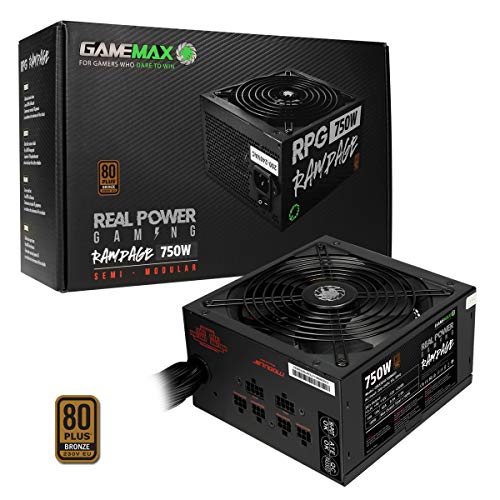
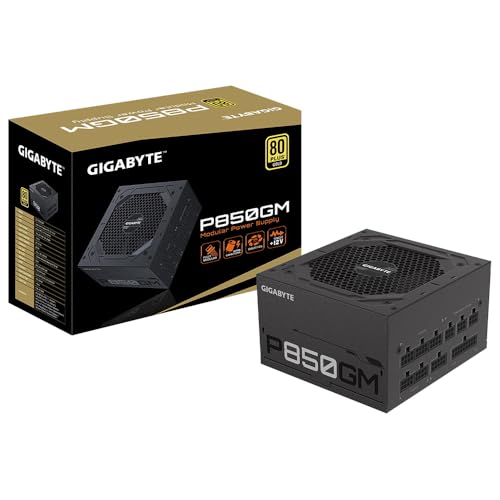
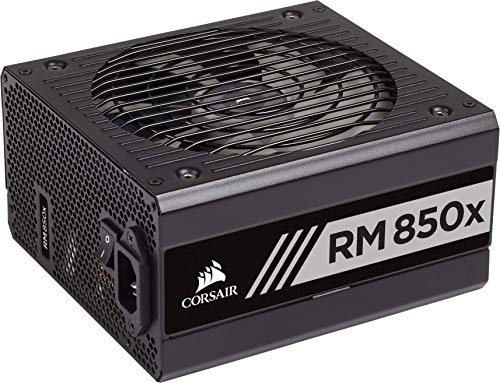
If you are building or upgrading a high-end gaming PC in 2025, an 850W power supply sits in a particularly sensible sweet spot. It is powerful enough to run an RTX 4080 or RX 7900 XTX without breaking a sweat, yet it avoids the unnecessary cost and bulk of a 1000W unit for most single-GPU systems. Since last year, ATX 3.1 and PCIe 5.0 connector support have become far more common at this price tier, meaning you no longer need an adapter cable for the latest graphics cards. Efficiency ratings have also crept upward, with 80 Plus Platinum units now available for under £150 alongside the more traditional Gold options. This guide is aimed at enthusiast builders who want a reliable, quiet, fully modular PSU that will not become a bottleneck for a current-generation GPU, without spending over the odds on a 1200W unit they will never fully utilise.
Quick Verdict
Best Overall: Corsair RM850x. A proven, whisper-quiet Gold-rated unit with a ten-year warranty and rock-solid voltage regulation that has earned its reputation over multiple generations.
Best Value: ASUS ROG Loki SFX-L 850W Platinum. Its Platinum efficiency and compact SFX-L form factor make it a standout bargain at under £115, especially for small-form-factor builders who need genuine 850W headroom.
The Corsair RM850x has been one of the most consistently recommended power supplies in the enthusiast community for several years, and the current generation continues that tradition. It is aimed squarely at mainstream high-end builders who want a dependable, quiet unit without paying a premium for Platinum efficiency. If you are pairing an Intel Core i7 or Ryzen 7 processor with an RTX 4080 or RX 7900 XTX, 850W is a comfortable margin and the RM850x will handle it without complaint.
The unit is built around a fully modular cable system, which keeps your case tidy and means you only route the cables you actually need. Corsair uses a single 12V rail design, which simplifies power delivery and avoids the potential issues of multi-rail units under heavy transient loads. The 135mm fan operates in a zero-RPM mode at low and medium loads, meaning the PSU is completely silent during everyday tasks and light gaming. It only spins up under sustained heavy load, and even then it remains impressively quiet.
Voltage regulation is tight, typically within one percent on the 12V rail, which matters for system stability when running a demanding GPU. The RM850x carries an 80 Plus Gold certification, meaning it operates at 87 to 90 percent efficiency across its load range. That is not quite Platinum territory, but the difference in real-world electricity cost is marginal for a home gaming PC. The ten-year warranty is a genuine confidence booster and matches the best in class at this price point.
One consideration is that the RM850x uses an older ATX 2.4 specification rather than the newer ATX 3.1 standard. This means it does not include a native 12VHPWR or 16-pin PCIe 5.0 connector. Corsair supplies an adapter cable in the box, which works perfectly well, but if you want a native connection for an RTX 4090 or future cards, the NZXT C850 or ASUS ROG Strix would be a better fit. For RTX 4080 and below, the adapter is a non-issue.
Capacitors are sourced from reputable Japanese manufacturers, and Corsair's track record for reliability is strong. This is the unit to buy if you want something that simply works, year after year, with minimal fuss. It is our top overall pick because it balances performance, noise, warranty, and brand support better than anything else at the price.
Pros
- Ten-year warranty provides genuine long-term peace of mind
- Zero-RPM fan mode keeps the PSU completely silent at low and medium loads
- Tight voltage regulation within 1% on the 12V rail for excellent stability
Cons
- ATX 2.4 specification means no native 16-pin PCIe 5.0 connector, requiring an adapter for RTX 4090
- 80 Plus Gold rather than Platinum, so marginally less efficient than some rivals at the same price
NZXT has steadily improved its power supply lineup over the past few years, and the C850 Gold ATX 3.1 represents the current high point of that effort. Released in 2024, it is one of the most up-to-date 850W units available, built around the latest ATX 3.1 specification with a native 16-pin PCIe 5.0 connector and support for the transient load handling that modern GPUs demand.
The C850 Gold is manufactured by Seasonic under contract, which is a significant endorsement of its quality. Seasonic is widely regarded as one of the best OEM PSU manufacturers in the world, and units built on their platforms tend to perform well in independent testing. Voltage regulation is tight, fan noise is well controlled, and component quality is high. The 80 Plus Gold certification means efficiency sits between 87 and 90 percent across the load range, which is entirely adequate for a home gaming PC.
The fully modular cable system uses NZXT's own connectors and cables, which are flat and flexible. The included cable set covers the typical needs of a high-end build: one 24-pin ATX, one 8-pin CPU, one 16-pin PCIe 5.0, and several SATA and Molex connectors. The 16-pin cable is particularly well made, with a strain relief that reduces the risk of the connector loosening over time, which has been a concern with some third-party adapters.
The 135mm fan operates in a semi-passive mode, remaining completely silent at low loads and spinning up gradually as the system draws more power. At full load, it is audible but not intrusive, and in a typical gaming scenario it remains quiet. The ten-year warranty is among the best in the category and reflects the confidence that comes with Seasonic-built internals.
At around £137, the C850 Gold is not the cheapest option here, but it offers a compelling combination of modern specification, proven internals, and long warranty coverage. It is the pick for builders who want ATX 3.1 compliance and Gold efficiency without paying the premium for Platinum certification.
Pros
- Built by Seasonic OEM, providing proven reliability and tight voltage regulation
- Full ATX 3.1 compliance with a native, well-made 16-pin PCIe 5.0 cable included
- Ten-year warranty and semi-passive fan mode for silent operation at low loads
Cons
- 80 Plus Gold rather than Platinum means slightly lower efficiency than the ASUS ROG Strix at a similar price
- Priced at the higher end of the budget, leaving little room compared to Platinum alternatives
The Corsair HX1000 is the one 1000W unit in this selection, included because it raises a question many builders genuinely face: should you buy an 850W or 1000W PSU? At around £125, the HX1000 is priced below some of the 850W units on this list, which makes it a genuinely interesting proposition. It carries an 80 Plus Platinum certification, a fully modular cable system, and a ten-year warranty, all of which put it firmly in the premium category.
The HX series uses Corsair's highest-grade components, with Japanese capacitors, a single 12V rail, and a 140mm fan that operates in a zero-RPM mode below 40 percent load. The result is a unit that is completely silent during everyday use and quiet even under sustained heavy load. Voltage regulation is excellent, with the 12V rail holding tightly across a wide range of loads.
The case for buying the HX1000 over an 850W unit comes down to headroom and future-proofing. If you plan to add a second storage drive, a high-end CPU cooler with multiple fans, and perhaps upgrade to a more power-hungry GPU in a year or two, the extra 150W of headroom is genuinely useful. PSUs also tend to run more efficiently and cooler when operating at 50 to 70 percent of their rated capacity rather than 80 to 90 percent, so a 1000W unit powering a system that draws 700W will run cooler and potentially last longer than an 850W unit at 85 percent load.
The main caveat is that the HX1000 uses an older ATX 2.4 specification, so it does not include a native 16-pin PCIe 5.0 connector. Corsair supplies an adapter, which works reliably, but if native connectivity is important to you, the ASUS ROG Strix or NZXT C850 are better choices. For builders who prioritise Platinum efficiency, extra headroom, and a ten-year warranty at a competitive price, the HX1000 is a compelling alternative to a straight 850W purchase.
Pros
- 80 Plus Platinum efficiency with 1000W capacity provides excellent headroom and cooler operation at typical gaming loads
- Zero-RPM fan mode below 40% load makes the unit completely silent during everyday use
- Ten-year warranty and Corsair's strong UK support network
Cons
- ATX 2.4 specification means no native 16-pin PCIe 5.0 connector, requiring the bundled adapter for RTX 4090 builds
- 1000W capacity is unnecessary for most single-GPU builds, adding slight bulk and cost without benefit for typical users
Buying Guide
What wattage do you actually need?
The most common question when buying a power supply is whether 850W is enough. For the vast majority of single-GPU gaming builds in 2025, it is. An RTX 4080 has a TDP of around 320W, and a high-end CPU such as the Core i9-14900K or Ryzen 9 7950X adds another 125 to 253W at peak. Add 50 to 75W for storage, fans, and other components, and a fully loaded high-end system draws somewhere between 500W and 700W under sustained gaming load. An 850W PSU provides a comfortable 20 to 40 percent headroom above that, which is the recommended operating range for efficiency and longevity.
An RTX 4090 is the one GPU that genuinely pushes the boundaries of 850W, particularly when paired with a power-hungry CPU and overclocked. In that specific scenario, a 1000W unit is a sensible choice, which is why the Corsair HX1000 is included in this guide. For everything else, 850W is sufficient.
Can a PSU be too powerful?
A common misconception is that a higher-wattage PSU will draw more power from the wall. This is not how power supplies work. A PSU only draws as much power as the system requests, regardless of its rated capacity. The only downside of an oversized PSU is that it may operate at a low percentage of its rated load, which can reduce efficiency slightly on some units. Most modern Gold and Platinum PSUs are optimised to be efficient between 20 and 80 percent load, so a 1000W unit powering a 400W system is still efficient. The main practical downsides of an oversized PSU are cost and physical size.
Gold vs Platinum: does it matter?
80 Plus Gold means the PSU is at least 87 percent efficient at 20 percent load, 90 percent efficient at 50 percent load, and 87 percent efficient at full load. 80 Plus Platinum raises those figures to 90, 92, and 89 percent respectively. The real-world electricity cost difference between Gold and Platinum for a gaming PC running four hours a day is typically less than £5 per year at UK electricity rates. Platinum is worth choosing if the price difference is small, as it also tends to correlate with better component quality and tighter voltage regulation, but Gold is not a compromise worth worrying about.
What is ATX 3.1 and do you need it?
ATX 3.1 is the latest power supply specification, released in 2023. Its key improvements over ATX 3.0 include support for higher transient power excursions, up to 200 percent of rated wattage for brief periods, and a standardised 16-pin PCIe 5.0 connector. For RTX 4080 and 4090 owners, ATX 3.1 compliance means the PSU is specifically designed to handle the sharp power spikes these cards produce without triggering protection circuits. If you are buying a new PSU today, choosing an ATX 3.1 unit is sensible future-proofing. If your budget only stretches to an ATX 2.4 or 3.0 unit, a quality adapter cable will work reliably for all but the most extreme overclocked configurations.
Modular vs semi-modular vs non-modular
At the 850W price point, all the units in this guide are fully modular, meaning every cable can be removed. This makes cable management significantly easier and keeps airflow cleaner inside the case. Semi-modular units fix the 24-pin ATX and CPU cables permanently, which saves a small amount of cost but creates more clutter. Non-modular units are rarely found at this wattage and price tier. Always choose fully modular at this budget.
The Corsair RM850x remains the overall winner for most builders. Its combination of tight voltage regulation, silent zero-RPM operation, a ten-year warranty, and Corsair's strong UK support network makes it the most well-rounded 850W PSU under £150. The only meaningful compromise is the lack of a native PCIe 5.0 connector, which the included adapter addresses adequately for all but RTX 4090 builds. For those who want Platinum efficiency and full ATX 3.1 compliance in a standard ATX chassis, the ASUS ROG Strix 850W Platinum is the next step up and is priced competitively. Small-form-factor builders should go straight to the ASUS ROG Loki SFX-L 850W Platinum, which is the best value unit in the entire selection. Whichever you choose from this list, you are buying a quality, reliable PSU that will serve a high-end gaming system well for the next decade.