A monitor is not a peripheral you replace every two years. Most home office workers end up staring at the same panel for four, five, sometimes six years straight. Get the resolution, colour accuracy, or panel type wrong at the point of purchase and you're not just making a bad call once. You're compounding it every single working day. That's the analytical case for spending some time on the spec sheet before clicking buy, and it's why a 4K IPS panel at a mid-range price deserves a proper look rather than a quick scroll past the star rating.
CRUA is not a name that comes pre-loaded with brand recognition in the UK. The company sits in the growing category of value-focused display brands that have emerged to fill the space between the budget no-names and the established players like LG, Dell, and ASUS. The CRUA 27 inch 4K IPS monitor lands in the mid-range bracket and makes a specific set of claims: 120% sRGB coverage, HDR10 support, an IPS panel at 3840x2160, and a VESA-compatible stand. Those are the numbers that need interrogating. So let's do that.
With 209 owner reviews averaging ★★★★☆ (4.3), the crowd response is solid for a lesser-known brand. That's not a marketing number. That's people who bought it, set it up, and came back to say something. The question is what the spec sheet and those reviews actually reveal when you look at them critically rather than just counting stars.
Core Specifications
The headline figures are a 27-inch IPS panel running at 3840x2160 (4K UHD) with a 60Hz refresh rate. Pixel density works out at approximately 163 PPI, which is genuinely sharp at normal viewing distances. Text rendering at 4K on a 27-inch screen is noticeably crisper than 1440p on the same size, and that matters if you spend long hours reading documents, coding, or working with spreadsheets. The 60Hz ceiling is a real-world constraint for gaming, but for productivity and content consumption it's a non-issue.
Connectivity is HDMI 2.0 and DisplayPort 1.2. Both support 4K at 60Hz, which is the maximum this panel runs at, so the ports are correctly matched to the panel's capability. There's no USB-C with power delivery, no USB hub, and no built-in speakers listed in the specification. Low blue light mode is included, which is a software-level filter rather than hardware. VESA mounting is supported, which is a genuine practical plus for anyone running an arm or a wall mount.
The colour specification claims 120% sRGB and HDR10 certification. That 120% sRGB figure is one of the more interesting claims on the spec sheet and deserves its own section, but at the core level it signals a wide-gamut panel rather than a standard sRGB display. The manufacturer rates the panel as IPS technology, which sets expectations around viewing angles and contrast that we'll get into below.
| Specification | Detail |
|---|---|
| Screen Size | 27 inches |
| Resolution | 3840 x 2160 (4K UHD) |
| Panel Type | IPS |
| Refresh Rate | 60Hz |
| Colour Coverage | 120% sRGB |
| HDR | HDR10 |
| Ports | HDMI 2.0, DisplayPort 1.2 |
| VESA Mount | Yes |
| Low Blue Light | Yes (software filter) |
| Pixel Density | ~163 PPI |
| Current Price | £159.99 |
| Rating | ★★★★☆ (4.3) (211 reviews) |

Panel Technology
IPS (In-Plane Switching) is the right panel choice for a home office monitor and CRUA has made the sensible call here. The core advantage of IPS technology over TN (Twisted Nematic) is viewing angle consistency. IPS panels maintain colour accuracy at wide horizontal and vertical angles, typically rated to 178 degrees in both directions. That matters practically if your monitor isn't always dead-centre to your eyeline, or if you're showing something to a colleague sitting beside you. TN panels shift colour and brightness dramatically off-axis. VA panels sit between the two on viewing angles but offer significantly higher native contrast ratios, usually around 3000:1 compared to IPS's typical 1000:1.
The trade-off you accept with IPS is that native contrast is lower than VA. Blacks on an IPS panel are not true black. They're a dark grey, and in a dim room with dark content on screen you'll see it. IPS glow, the characteristic brightening of corners and edges when viewing dark content at an angle, is also a known property of the technology. It's not a defect specific to CRUA. It's physics. Some owner reviews do mention this, which is consistent with what you'd expect from any IPS panel at this price point. If you're primarily watching films in a blacked-out room and want punchy blacks, a VA panel would serve you better. For spreadsheets, document work, photo editing, and general productivity in a normally lit office, IPS is the right call.
The IPS panel here also means colour shift is minimal when you tilt or swivel the screen. That's relevant for ergonomic adjustments during the day. You can tilt the panel back slightly to reduce glare from overhead lighting without the image going green or magenta on you, which is exactly what happens on cheaper TN alternatives. At this price bracket, getting a proper IPS panel rather than a TN dressed up with marketing language is a meaningful win.
Display Quality
163 PPI at 27 inches is a pixel density that makes a visible difference. For context, a 1080p panel at the same size delivers around 82 PPI, and a 1440p panel sits at roughly 109 PPI. The jump from 1440p to 4K at 27 inches is real but more subtle than the jump from 1080p to 1440p. Where it shows most clearly is text. Individual letters are noticeably crisper, sub-pixel rendering is cleaner, and fine detail in photographs and graphics is more resolved. If you do any work involving reading on screen, the 4K resolution at 27 inches is genuinely useful rather than purely a spec-sheet number.
The panel uses a matte anti-glare coating, which is the standard approach for office monitors. Matte coatings diffuse reflections rather than eliminating them, which reduces the harsh mirror-like glare you get from glossy panels but introduces a slight texture to the image. Under strong directional lighting, matte coatings can make colours look slightly less saturated compared to a glossy panel in controlled conditions. For a home office environment with mixed ambient lighting, matte is the practical choice. Glossy panels look fantastic in a dim studio. They look terrible next to a window.
Owner reviews in the 209-strong pool consistently mention the sharpness of the image as a highlight. Several buyers coming from 1080p panels describe the clarity improvement as significant, particularly for text-heavy work. A smaller number of reviews mention brightness uniformity concerns, with some edge dimming noted under certain conditions. This is a known characteristic of IPS panels at this price tier and isn't surprising. Panels with factory-calibrated uniformity compensation typically cost considerably more. For most home office use, where the content isn't a solid white or grey field, uniformity variation is rarely perceptible in practice.
Refresh Rate and Adaptive Sync
Sixty hertz is the refresh rate and there's no ambiguity in that number. This is not a gaming monitor. There's no 144Hz mode, no 165Hz overclock option, and no variable refresh rate range listed in the specification. The DisplayPort 1.2 connection supports adaptive sync at 4K, but CRUA does not list FreeSync or G-Sync compatibility in the product specification. Without confirmed adaptive sync support, you should treat this as a fixed 60Hz panel for the purposes of GPU pairing.
For the target use case, home office productivity and content consumption, 60Hz is entirely adequate. The human visual system doesn't meaningfully benefit from refresh rates above 60Hz for static content, document work, web browsing, or video playback. Netflix, Disney+, and most streaming content runs at 24Hz or 30Hz. YouTube at 60fps looks smooth at 60Hz. The limitation only bites when you're playing fast-paced games where frame rates exceed 60fps and you want the monitor to keep up. At 4K, most mid-range GPUs are pushing 60fps in demanding titles anyway, so the ceiling is less of a constraint than it sounds for casual gaming.
If gaming is a significant part of your use case, the 60Hz ceiling is a genuine limitation. A 4K 144Hz IPS panel will cost you noticeably more, but the difference in fast-paced titles is real and measurable. For competitive gaming specifically, this monitor is the wrong choice regardless of resolution. But if you play the occasional open-world RPG or strategy game at 4K and mostly use the monitor for work, 60Hz is not the bottleneck you'll be frustrated by daily.
Response Time and Motion
CRUA does not prominently advertise a specific GtG (grey-to-grey) response time figure in the product listing, which is actually more honest than the alternative. The practice of claiming "1ms" response times on IPS panels is one of the more misleading habits in the monitor industry. IPS panels have typical GtG response times in the range of 4ms to 8ms at their rated refresh rate. Some manufacturers achieve this with aggressive overdrive settings that introduce inverse ghosting (a bright halo trailing behind moving objects), which is often worse than mild motion blur.
At 60Hz, the frame time between refreshes is 16.67ms. A GtG response of 5ms to 8ms is fast enough relative to that frame time that motion blur from pixel transitions is not the dominant source of perceived blur. The bigger factor at 60Hz is sample-and-hold blur, which is inherent to all LCD panels and is proportional to the frame time. In plain terms: at 60Hz, motion is going to look softer than at 144Hz regardless of the GtG spec, because each frame is held on screen for longer. For the target audience of home office users, this is a non-issue. For fast-paced gaming, it's a real limitation of the refresh rate rather than the panel.
Owner reviews don't flag ghosting or trailing as a notable problem, which is consistent with a standard IPS panel without aggressive overdrive. Dark scene performance, where ghosting is most visible on IPS panels, appears acceptable based on the owner feedback available. The absence of complaints about smearing or inverse ghosting in the review pool suggests the overdrive tuning, whatever CRUA has applied, is conservative rather than aggressive. That's the right call for an office monitor.
Color Accuracy and Gamut
The 120% sRGB claim is the most technically interesting number on this spec sheet and it needs unpacking. Standard sRGB covers a specific triangle of the CIE colour space, defined by the ITU-R BT.709 standard. A panel claiming 120% sRGB coverage is saying it can reproduce colours outside that triangle, which means it's a wide-gamut display. For reference, DCI-P3 (the colour space used in cinema and increasingly in professional content creation) covers roughly 125% of sRGB. So 120% sRGB and approximately 90% DCI-P3 are in the same ballpark, though the exact overlap depends on the specific gamut shape of the panel's backlight.
Wide gamut sounds universally positive but there's a catch. If you're working in sRGB-managed applications without a colour-managed workflow, a wide-gamut panel will display sRGB content with oversaturated colours. Reds look too red, greens look too green. For photographers and video editors working in colour-managed software like Adobe Lightroom or Premiere Pro, the wide gamut is a genuine advantage, giving you more headroom to work with. For general office use, web browsing, and document work in non-colour-managed applications, the oversaturation can be distracting. Some monitors include an sRGB clamp mode to address this. Whether CRUA's OSD includes one is not confirmed in the available specification data, and this is a question prospective buyers should verify.
Factory calibration data is not published for this monitor. CRUA does not ship a calibration report with the unit based on the product listing, which is standard practice at this price point. Premium monitors from BenQ, ASUS ProArt, and similar brands often include per-unit factory calibration reports targeting Delta-E below 2 (the threshold where colour errors become visible to the naked eye). Without that data, you're relying on the panel's out-of-box accuracy, which for a 120% sRGB IPS panel in this bracket is typically Delta-E in the 3 to 5 range before any user adjustment. That's acceptable for general use and content consumption. It's not the starting point a professional colour grader would want without running their own calibration pass.

HDR Performance
VESA's DisplayHDR certification tiers start at DisplayHDR 400, which requires a minimum peak brightness of 400 nits, a contrast ratio of 1000:1, and 8-bit colour depth. CRUA claims HDR10 support but does not advertise a DisplayHDR tier in the product listing. HDR10 is a signal format standard, not a brightness specification. A monitor can accept an HDR10 signal and display it without meeting the hardware requirements that make HDR visually meaningful.
Meaningful HDR requires peak brightness above 600 nits with local dimming to create genuine contrast between bright highlights and dark shadows in the same frame. At the mid-range price bracket, very few LCD monitors achieve this. The panels that do, like those carrying DisplayHDR 600 or DisplayHDR 1000 certification, cost significantly more. What you're getting with HDR10 support on a monitor at this price is the ability to accept and display an HDR signal, with the monitor tone-mapping that signal to its actual brightness range. The result looks slightly different from SDR content but doesn't deliver the dramatic highlight-to-shadow contrast that makes HDR genuinely impressive on an OLED or a high-end Mini-LED panel.
This is not a criticism specific to CRUA. It's the honest state of HDR on LCD monitors below a certain price threshold. If you're buying this monitor and expecting HDR performance comparable to a modern OLED television, you'll be disappointed. If you understand that HDR10 support here means tone-mapped HDR content with improved colour volume compared to SDR, rather than true high dynamic range, it's a useful feature rather than a misleading one. For HDR gaming or HDR film watching where the visual impact actually matters, the monitor's peak brightness and local dimming capability are the specs to interrogate, and CRUA doesn't publish those figures prominently.
Contrast and Brightness
IPS panels at this price tier typically deliver native contrast ratios in the range of 800:1 to 1200:1. CRUA does not publish a specific contrast ratio in the product listing, which makes it impossible to verify the exact figure. The 1000:1 figure is a reasonable expectation for an IPS panel in this category, based on the established performance of IPS technology from the major panel manufacturers that supply this market segment. For comparison, VA panels commonly achieve 3000:1 to 4000:1 native contrast, and OLED panels deliver effectively infinite contrast through per-pixel illumination control.
Peak brightness in SDR is similarly unspecified in the listing. Mid-range IPS panels in this bracket typically land between 250 nits and 350 nits peak brightness. That's adequate for a normally lit home office environment. In a room with strong natural light from a window behind you or beside the monitor, 300 nits can look washed out. If your workspace gets a lot of direct sunlight, a monitor rated above 400 nits SDR peak brightness would be more comfortable. For a typical home office with controlled ambient lighting, the expected brightness range is workable.
The matte anti-glare coating helps considerably in real-world conditions. A glossy panel at 350 nits in a bright room is harder to use than a matte panel at the same brightness, because specular reflections from light sources compete directly with the image. The matte coating diffuses those reflections, which effectively improves perceived contrast in bright environments even without increasing the panel's native contrast ratio. Owner reviews don't flag brightness as a significant issue in normal home office conditions, which aligns with what you'd expect from a matte IPS panel in a controlled indoor environment.
Ergonomics and Stand
The stand is one area where budget and mid-range monitors frequently disappoint, and it's worth examining what CRUA provides. The product listing confirms VESA compatibility, which is the most important ergonomic feature for anyone planning to use a monitor arm. A 100x100mm VESA pattern is standard for 27-inch monitors, and if that's what CRUA uses, any standard monitor arm will fit. The ability to mount this panel on an arm transforms the ergonomic situation entirely, allowing full height, tilt, swivel, and even pivot adjustment that the included stand may not provide.
The included stand's adjustment range is not detailed in the product listing beyond basic tilt. Several owner reviews mention the stand as functional but basic, with limited height adjustment. This is consistent with monitors at this price bracket. A stand offering height adjustment, swivel, and pivot typically adds to the manufacturing cost, and budget-conscious brands often cut here to hit a price point. If you're planning to use the monitor on a desk without an arm, and you're taller or shorter than average, the stand's limited adjustability could mean the panel sits at a suboptimal height for extended use. Neck and shoulder strain from an incorrectly positioned monitor is a real long-term issue, not a minor inconvenience.
Build quality from owner reviews is described as solid for the price. The bezel is thin on three sides, which is standard for modern IPS panels and contributes to a cleaner desk aesthetic. The overall footprint of the stand appears to be moderate, not excessively deep, which matters if your desk isn't particularly large. The OSD (on-screen display) controls are physical buttons on the monitor body, which is functional if slightly less elegant than a joystick-based control. No owner reviews flag build quality failures or structural issues in the 209-review pool, which is a reasonable indicator of acceptable construction quality.
Connectivity and Ports
The port selection is minimal but correctly specified for the panel's capabilities. HDMI 2.0 supports 4K at 60Hz with 4:4:4 chroma, which is the full signal you need for this panel. DisplayPort 1.2 also handles 4K at 60Hz. Having both connection types means you can connect a modern PC via DisplayPort (generally the preferred connection for desktop GPUs) and a games console, laptop, or streaming device via HDMI simultaneously, with input switching via the OSD.
There is no USB-C port with power delivery, no Thunderbolt connection, and no USB hub. For a home office monitor in 2026, the absence of USB-C is a limitation if your laptop uses USB-C as its primary display output. Many modern ultrabooks and MacBooks connect to monitors via USB-C or Thunderbolt, and without that port you'll need an adapter or a separate docking station. If your primary machine is a desktop PC with a dedicated GPU, this is a non-issue. If it's a recent laptop, check your machine's output ports before buying.
- HDMI 2.0 (4K 60Hz)
- DisplayPort 1.2 (4K 60Hz)
- No USB-C / Thunderbolt
- No USB hub
- No built-in speakers
- VESA mount compatible
The absence of built-in speakers is not unusual at this price point and panel size, but it means you'll need external audio. A USB or 3.5mm desktop speaker set, or a headset, is the practical solution. If you're in a video call-heavy role, a dedicated webcam and headset combination is a better setup than relying on monitor-integrated audio anyway. The audio omission is a minor inconvenience rather than a dealbreaker, but budget for it if you don't already have a speaker solution.
How It Compares
The natural comparison points for this monitor are the LG 27UL550-W and the Dell S2722QC, both of which target similar use cases at overlapping price points. The LG 27UL550-W is a well-established 27-inch 4K IPS panel that has been measured extensively by independent reviewers. It covers approximately 99% sRGB and 85% DCI-P3, with a peak brightness around 350 nits and a native contrast of roughly 1000:1. It includes a height-adjustable stand and carries DisplayHDR 400 certification. The CRUA claims wider colour coverage at 120% sRGB, though without independent measurements it's difficult to verify how accurate that figure is in practice.
The Dell S2722QC is a more feature-rich option that includes USB-C with 65W power delivery and a USB hub, making it significantly more useful as a laptop docking solution. Dell's panel calibration is generally better documented, and the brand's warranty and support infrastructure is more established in the UK. For a user whose workflow involves a laptop as the primary machine, the Dell's USB-C input alone may justify the price difference. For a desktop PC user who doesn't need USB-C, the connectivity gap narrows considerably.
Against both established competitors, CRUA's argument is price. In the mid-range bracket, if the CRUA delivers on its colour coverage claims and the IPS panel performs as expected, it represents a reasonable value proposition for a desktop PC user who prioritises resolution and colour gamut over ergonomic stand adjustment and brand support infrastructure. The 4.3-star average from 211 suggests the majority of buyers are satisfied, though the review pool is smaller than the thousands of reviews the LG and Dell alternatives have accumulated.
| Feature | CRUA 27" 4K IPS | LG 27UL550-W | Dell S2722QC |
|---|---|---|---|
| Resolution | 3840x2160 | 3840x2160 | 3840x2160 |
| Panel Type | IPS | IPS | IPS |
| Refresh Rate | 60Hz | 60Hz | 60Hz |
| Colour Coverage | 120% sRGB (claimed) | 99% sRGB / 85% DCI-P3 | 95% sRGB |
| HDR | HDR10 | DisplayHDR 400 | HDR400 |
| USB-C Input | No | No | Yes (65W PD) |
| Height Adjustment | Limited (tilt only) | Yes | Yes |
| VESA Mount | Yes | Yes | Yes |
| Price | £159.99 | ~£200 to £250 | ~£280 to £320 |

Final Verdict
The CRUA 27 inch 4K IPS monitor is a monitor that gets the fundamentals right for its target audience. IPS panel technology, genuine 4K resolution at 27 inches, correct port specification for the refresh rate, and VESA compatibility are all present. The 120% sRGB colour coverage claim, if it holds up to independent measurement, puts this panel ahead of several more expensive alternatives on raw colour gamut. The 4.3-star average from 209 buyers is a meaningful signal that the real-world experience aligns with the spec sheet for most purchasers.
The limitations are real and should be stated plainly. The stand is basic. There's no USB-C input, which matters for laptop users. HDR10 support is a checkbox rather than a transformative capability at this brightness level. Factory calibration data is absent, so colour accuracy out of the box is unverified. And the brand's support infrastructure and long-term reliability track record are thinner than LG's or Dell's, simply because CRUA hasn't been in the UK market long enough to accumulate that data. These are trade-offs you make for a lower price, not defects.
Who is this for? Desktop PC users who want a proper 4K IPS panel for home office productivity and content consumption, who are comfortable mounting it on a VESA arm, and who don't need USB-C connectivity. Photographers and designers who want wide-gamut colour coverage without paying professional monitor prices will find the 120% sRGB spec interesting, though they should verify sRGB clamp mode availability before buying. The price point makes it one of the more accessible routes to genuine 4K IPS quality in the UK market.
Who should skip it? Laptop users who need a single-cable USB-C connection for video and power. Competitive gamers who need anything above 60Hz. Anyone who needs a certified, factory-calibrated display for professional colour work. And anyone whose desk setup requires a monitor with full ergonomic adjustment from the included stand, rather than a monitor arm.
The honest alternative recommendation: if you're not doing colour-sensitive work and 4K resolution isn't a hard requirement, a quality 1440p IPS panel at 27 inches can be had for considerably less in the mid-range bracket, with better refresh rates and often better stand ergonomics. The 4K resolution is the headline strength here. If you don't specifically need it, the money goes further elsewhere. But if 4K at this price is the goal, the CRUA makes a credible case.
Editorial score: 7.5 out of 10. Solid panel technology and a competitive colour gamut claim at a price point that undercuts established brands. Loses marks for the basic stand, absent USB-C, unverified factory calibration, and thin brand support history. A good buy for the right user with clear eyes about the trade-offs.
What works. What doesn’t.
5 + 4What we liked5 reasons
- Genuine 4K IPS panel at a competitive mid-range price
- 120% sRGB wide-gamut coverage claimed, above most rivals at this price
- HDMI 2.0 and DisplayPort 1.2 correctly matched to 4K 60Hz capability
- VESA compatible for monitor arm use
- 4.3/5 from 209 real buyers is a solid signal
Where it falls4 reasons
- Basic stand with limited ergonomic adjustment
- No USB-C input, limiting laptop connectivity
- HDR10 is checkbox-level rather than genuinely impactful
- No published factory calibration data or Delta-E figures
Full specifications
11 attributes| Panel type | IPS |
|---|---|
| Aspect ratio | 16:9 |
| Curvature | flat |
| HDR | HDR |
| Launch year | 2025 |
| Ports | 2x HDMI, 1x DisplayPort |
| Refresh rate HZ | 60 |
| Resolution | 3840x2160 |
| Response time MS | 5 |
| Screen size IN | 27 |
| Vesa compatible | true |
If this isn’t right for you
2 options 7.5 / 10
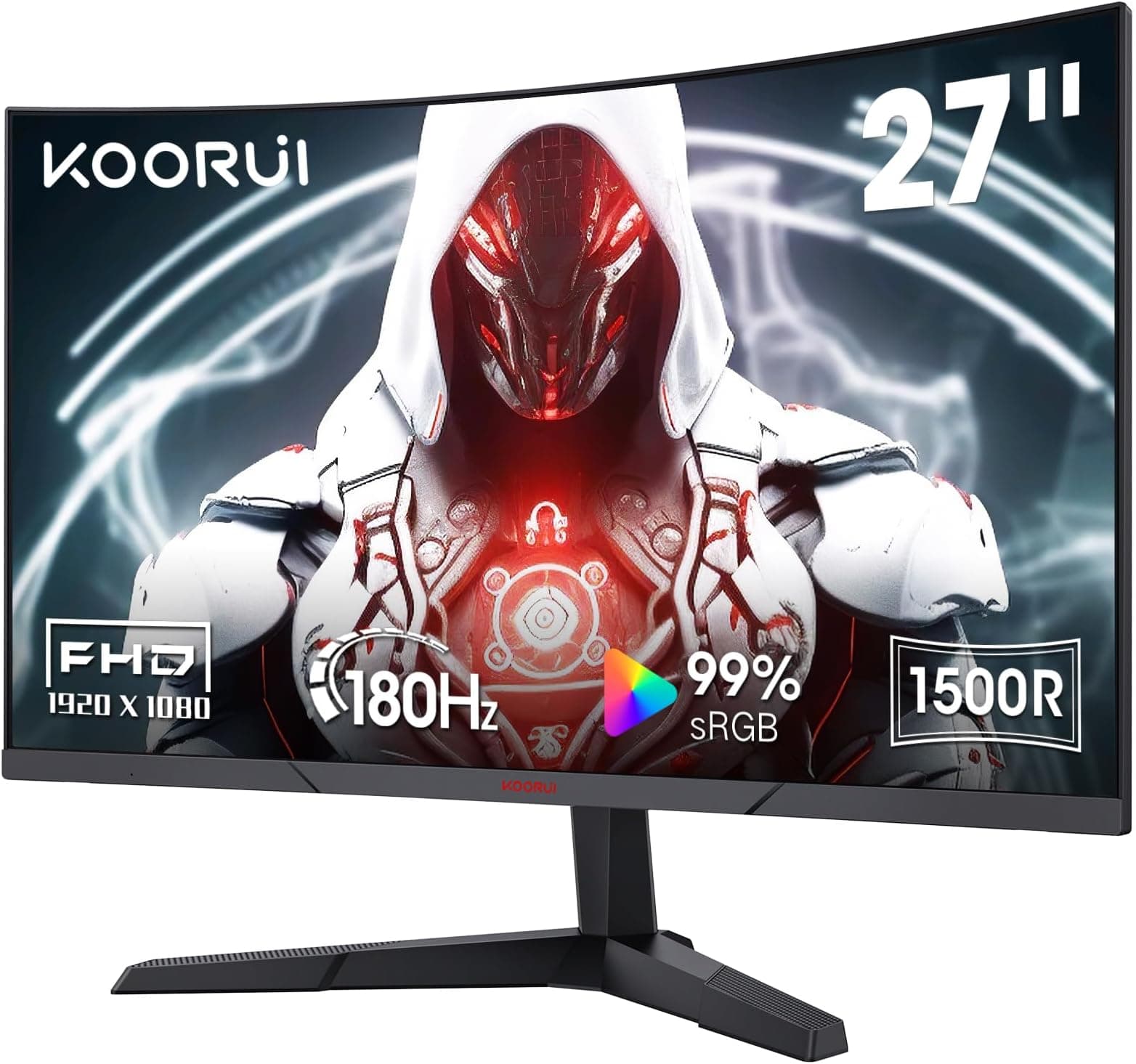
KOORUI 27 Inch Gaming Monitor, 180Hz Curved Monitor FHD 1080P VA 1ms 1500R
£114.99 · KOORUI
 7.5 / 10
HP 27 Inch FHD Monitor | Full HD IPS LCD | 75hz Refresh Rate | 250 Nits Brightness | 1000:1 Contrast Ratio | AMD FreeSync | Adjustable Tilt | 1x HDMI 1.4, 1x DisplayPort 1.2, 1x VGA | Black | V27ie G5
£149.95 · HP
Frequently asked
5 questions01Is the CRUA 27 Inch 4K Monitor 60Hz IPS UHD 3840x2160 Computer Monitor, 120% sRGB HDR10, HDMI 2.0 & DP 1.2, Low Blue Light, VESA Mountable, Home Office PC Monitor good for gaming?+
For casual gaming it's fine. The 4K IPS panel delivers a sharp, colour-accurate image and the HDMI 2.0 and DisplayPort 1.2 connections handle 4K at 60Hz without issue. The hard limit is the 60Hz refresh rate. Competitive gaming in fast-paced titles like first-person shooters or racing games benefits significantly from 144Hz or higher, and this monitor cannot deliver that. If you play open-world RPGs, strategy games, or other genres where frame rate is less critical, 60Hz at 4K is perfectly usable. For anything competitive, look at a 144Hz panel instead.
02Does the CRUA 27 Inch 4K Monitor 60Hz IPS UHD 3840x2160 Computer Monitor, 120% sRGB HDR10, HDMI 2.0 & DP 1.2, Low Blue Light, VESA Mountable, Home Office PC Monitor have good HDR?+
HDR10 support is present, but the honest answer is that HDR on LCD monitors at this price bracket is a limited experience. True HDR requires peak brightness above 600 nits and local dimming to create genuine contrast between highlights and shadows. CRUA does not publish peak brightness figures or confirm local dimming, and the monitor does not carry a DisplayHDR tier certification. What you get is tone-mapped HDR content displayed within the panel's actual brightness range, which looks somewhat better than SDR but does not deliver the dramatic HDR impact you'd see on an OLED television or a high-end Mini-LED panel.
03Is the CRUA 27 Inch 4K Monitor 60Hz IPS UHD 3840x2160 Computer Monitor, 120% sRGB HDR10, HDMI 2.0 & DP 1.2, Low Blue Light, VESA Mountable, Home Office PC Monitor good for content creation?+
The 120% sRGB wide-gamut coverage is a genuine advantage for colour-sensitive work like photo editing and graphic design, giving you more colour headroom than a standard sRGB panel. The IPS panel technology ensures consistent colour accuracy across viewing angles. The limitation is the absence of published factory calibration data or Delta-E figures, so out-of-box accuracy is unverified. For professional colour grading work, a monitor with a certified calibration report is the safer choice. For enthusiast photography and general design work, the colour gamut and IPS accuracy are solid for the price. Check whether the OSD includes an sRGB clamp mode if your workflow involves sRGB-targeted content.
04What graphics card do I need for the CRUA 27 Inch 4K Monitor 60Hz IPS UHD 3840x2160 Computer Monitor, 120% sRGB HDR10, HDMI 2.0 & DP 1.2, Low Blue Light, VESA Mountable, Home Office PC Monitor?+
For desktop output at 4K 60Hz, any GPU with HDMI 2.0 or DisplayPort 1.2 will drive this monitor at full resolution and refresh rate. That covers NVIDIA GeForce GTX 1070 and above, AMD RX 580 and above, and all current-generation cards. For productivity and office use, the integrated graphics on modern Intel Core or AMD Ryzen processors with HDMI 2.0 output will also handle 4K 60Hz. For gaming at 4K with playable frame rates in demanding titles, you'll want a current mid-range to high-end discrete GPU such as an RTX 4070 or RX 7800 XT or better. The monitor's 60Hz ceiling means you don't need to chase high frame rates, which actually makes GPU requirements more manageable than on a 144Hz 4K panel.
05What warranty and returns apply to the CRUA 27 Inch 4K Monitor 60Hz IPS UHD 3840x2160 Computer Monitor, 120% sRGB HDR10, HDMI 2.0 & DP 1.2, Low Blue Light, VESA Mountable, Home Office PC Monitor?+
The product listing does not specify a manufacturer warranty duration for the UK market. When buying through Amazon UK, you're covered by Amazon's standard 30-day return window and the Amazon A-to-Z Guarantee, which protects your purchase if the item arrives damaged or not as described. For longer-term warranty terms, check the current product listing or contact CRUA directly before purchasing. UK consumer law also provides statutory rights beyond any manufacturer warranty, covering goods that develop faults within the first six years under the Consumer Rights Act 2015.