Crypto trading places a distinct set of demands on a desktop PC. You need rock-solid stability for 24/7 uptime, enough RAM and CPU headroom to run multiple charting platforms, exchange tabs, and algorithmic bots simultaneously, and sufficient GPU grunt to drive two, three, or even four monitors without breaking a sweat. Unlike pure gaming rigs, raw frame rates matter far less than consistent, low-latency performance and the connectivity to support a multi-screen workspace. Since last year, the arrival of Nvidia's RTX 50-series GPUs and AMD's Ryzen 8000-series processors has raised the baseline considerably, meaning you can now get genuinely capable multi-monitor hardware at prices that would have bought you a mid-range system in 2024. This guide covers five carefully chosen desktops from the UK catalogue, ranging from a compact mini PC to a high-end tower, so whether you are a part-time swing trader or a full-time algorithmic trader running bots around the clock, there is a pick here suited to your workflow and budget.
Quick Verdict
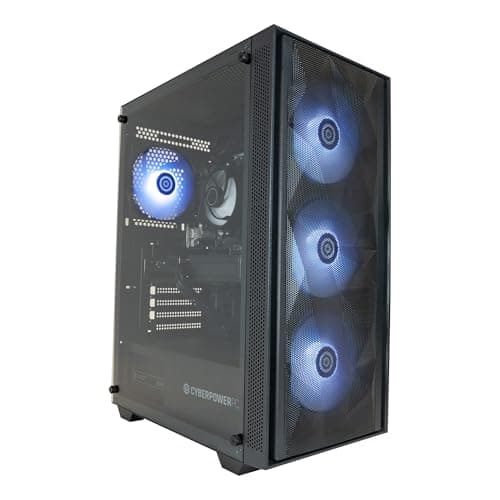
Best Overall: CyberPowerPC Luxe Gaming PC (Intel Core Ultra 7 265KF, RTX 5070 Ti), the combination of a 32 GB DDR5 platform, 2 TB NVMe storage, and a modern GPU with plenty of display outputs makes it the most capable all-round trading workstation in this group.
Best Value: GMKtec K8 Plus Mini PC (Ryzen 7 8845HS), a surprisingly capable compact machine with 32 GB DDR5 RAM and PCIe 4.0 storage at a price that leaves room in the budget for extra monitors and peripherals.
The CyberPowerPC Luxe is the pick for traders who want a desktop that can handle everything from high-frequency charting to running multiple virtual machines for isolated trading environments, without ever feeling constrained. At its heart sits the Intel Core Ultra 7 265KF, a processor built on Intel's latest architecture with strong multi-threaded performance that keeps algorithmic bots, browser-based exchange platforms, and data feeds running smoothly in parallel. The 32 GB of DDR5 RAM is a genuine differentiator at this price point: it means you can have dozens of browser tabs, a Python trading environment, TradingView, MetaTrader, and a Telegram alert bot all open simultaneously without the system slowing to a crawl.
The Nvidia GeForce RTX 5070 Ti is, frankly, more GPU than any trader strictly needs, but it brings a crucial practical benefit: modern Nvidia cards in this tier support three or four simultaneous display outputs, making it trivial to build a four-monitor trading desk without purchasing a secondary GPU or a DisplayLink adapter. The 2 TB NVMe SSD is equally welcome, providing ample space for historical price data, backtest results, and log files that accumulate quickly on active trading systems. Windows 11 is pre-installed, so you are up and running immediately.
For power users who also want to run machine-learning-based signal models, the RTX 5070 Ti's CUDA cores will accelerate PyTorch or TensorFlow workloads considerably compared to mid-range alternatives. The tower form factor means upgrades, whether adding more RAM, a second NVMe drive, or a capture card for streaming analysis sessions, are entirely straightforward. Noise levels under typical trading loads (not gaming) are modest, and the system is well-suited to all-day, every-day operation.
The price is high relative to what a trader strictly needs for execution, but if you are running a professional setup and want a machine that will not become the bottleneck in your workflow for the next four or five years, the Luxe justifies its cost. It is the best overall desktop in this group for serious crypto traders.
Pros
- 32 GB DDR5 RAM handles heavy multi-tasking across multiple trading platforms without slowdown
- RTX 5070 Ti supports three or four simultaneous monitor outputs, ideal for a professional trading desk
- 2 TB NVMe SSD gives ample room for historical data, backtests, and trading logs
Cons
- Price is significantly higher than what most retail traders require for basic execution tasks
- GPU capability is overkill for charting alone, so part of the cost goes unused in a pure trading context
The Apple iMac with M4 chip occupies a unique position in this list. It is the only macOS machine, the only all-in-one, and the only product here built around Apple Silicon. For a certain type of crypto trader, particularly those already embedded in the Apple ecosystem, running iOS apps via Mac, using Shortcuts for automation, or preferring the macOS security model for storing wallet credentials and API keys, it is a genuinely compelling option that no Windows tower can replicate.
The M4 chip's ten-core CPU delivers exceptional single-core performance, which benefits trading applications that are not heavily multi-threaded, and the integrated ten-core GPU is efficient enough to drive the iMac's own display plus one or two external monitors. The unified memory architecture means the 16 GB of RAM is shared efficiently between CPU and GPU tasks, and in practice the system feels very responsive running multiple browser-based platforms, a local Python environment, and communication tools simultaneously.
The 512 GB SSD is the most significant limitation for serious traders who accumulate large datasets. Historical tick data for multiple assets can fill this relatively quickly, so you would need to rely on external storage or cloud solutions for archiving. The RAM is also soldered and non-upgradeable, so the 16 GB configuration is what you have for the life of the machine. That said, macOS's memory management is efficient, and most traders will find 16 GB workable.
The built-in 24-inch Retina display is genuinely excellent for reading charts and order books, and the all-in-one design keeps cable clutter to a minimum. The M4 iMac is best suited to traders who prioritise ecosystem integration, a clean desk, and long-term reliability over raw expandability. It is not the right choice for those who need four monitors or GPU-accelerated backtesting, but for a focused, professional single-screen or dual-screen setup it is a premium and polished option.
Pros
- Apple M4 chip delivers outstanding single-core performance and excellent power efficiency for 24/7 use
- macOS security model and Keychain integration suit traders storing API keys and wallet credentials locally
- Built-in 24-inch Retina display reduces overall desk cost and cable clutter
Cons
- 512 GB SSD fills quickly when storing historical tick data and backtest archives
- RAM is soldered and non-upgradeable, limiting future-proofing for more demanding workflows
The ADMI Gaming PC is the entry-level tower in this selection, and it is aimed squarely at traders who are just starting out or who want a dedicated second machine for running bots and alerts without committing to a large budget. The AMD Ryzen 5 5500 is a capable six-core processor that handles everyday trading tasks, including running MetaTrader, TradingView, a Python script or two, and a handful of browser tabs, without complaint. It is not a powerhouse for heavily parallel workloads, but for the majority of retail crypto traders it is entirely sufficient.
The NVIDIA GeForce RTX 3050 with 6 GB of GDDR6 VRAM is the key component that separates this machine from integrated-graphics alternatives. Even a modest discrete GPU like the RTX 3050 can drive two or three external monitors reliably, which is the baseline requirement for a functional trading setup. It also means the machine can handle light GPU-accelerated tasks if needed, and the dedicated VRAM ensures smooth rendering of complex, multi-indicator charts without the stuttering that can occur on integrated graphics under load.
The 16 GB of DDR4 RAM at 3200 MHz is adequate for most trading workflows, though power users running multiple virtual machines or large Python data science environments may find it a touch limiting. The 1 TB NVMe SSD is a sensible allocation for this price bracket, providing enough space for the operating system, trading applications, and a moderate archive of market data. Windows 11 is included, and the Ryzen 5 5500 platform, while not the newest, will continue to receive software support for the foreseeable future.
The main trade-off here is that the Ryzen 5 5500 and RTX 3050 are both previous-generation components, meaning this machine will age faster than the newer-platform picks in this list. For traders on a strict budget who need a reliable, multi-monitor-capable tower today, however, the ADMI is a sensible and honest choice. It does the job without unnecessary expense.
Pros
- RTX 3050 discrete GPU enables reliable dual or triple-monitor output at an entry-level price
- Windows 11 pre-installed with a genuine NVMe SSD keeps the out-of-box experience clean and fast
Cons
- Ryzen 5 5500 and RTX 3050 are previous-generation components that will age faster than newer-platform rivals
- 6 GB VRAM on the RTX 3050 is a tight allocation if you later add GPU-accelerated workloads
- 16 GB DDR4 RAM leaves limited headroom for running multiple virtual machines simultaneously
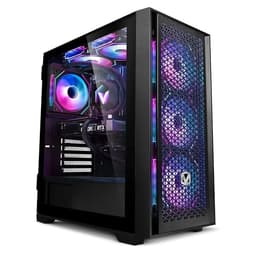
The Vibox VIII-75 is the most powerful machine in this group by a considerable margin, and it occupies a very specific niche: the professional or institutional-grade crypto trader who also runs GPU-intensive workloads alongside their trading activity. The Intel Core i9 12900KF remains a strong processor with sixteen cores and excellent multi-threaded throughput, making it capable of handling complex algorithmic strategies, multiple data feeds, and background processes without any perceptible slowdown. The 32 GB of RAM and 2 TB NVMe SSD are both generous allocations that will serve a demanding workflow for years.
The headline component is, of course, the NVIDIA RTX 5090 with 32 GB of GDDR7 VRAM. For trading purposes, this is extraordinary overkill for charting and execution, but it has specific applications: traders running deep learning-based signal generation, large language model inference for news sentiment analysis, or high-resolution multi-monitor setups with six or more screens will find the RTX 5090's output capabilities and VRAM headroom genuinely useful. The 32 GB of GPU memory in particular is a significant advantage for in-memory model inference that would cause smaller GPUs to page to system RAM.
The Windows 11 installation is clean, and the tower form factor means the system is fully upgradeable. Noise and power consumption will be higher than other picks in this list, which is worth factoring in if the machine runs continuously. The price reflects the RTX 5090's premium positioning in the GPU market.
For the majority of crypto traders, this machine is more than they will ever need, and the cost is difficult to justify on trading utility alone. However, for the trader who doubles as a quantitative researcher, runs GPU-accelerated backtesting frameworks, or wants a single machine that can serve as both a trading workstation and a high-performance compute node, the Vibox VIII-75 is a uniquely capable option in the UK market.
Pros
- RTX 5090 with 32 GB GDDR7 VRAM supports deep learning inference and GPU-accelerated backtesting at scale
- 2 TB NVMe SSD and 32 GB RAM provide ample headroom for large historical datasets and complex multi-process workflows
- Tower form factor allows straightforward future upgrades to RAM, storage, or additional GPUs
Cons
- Price is very high and the RTX 5090's capabilities are largely wasted in a pure charting and execution context
- High power draw and noise output make it less suited to a quiet home office running 24/7
Buying Guide
How Much RAM Do You Actually Need?
For crypto trading, RAM is often the most important specification to get right. A basic setup running one or two browser-based platforms and a single bot can manage on 16 GB, but the moment you add a Python environment, a local database for tick data, multiple exchange connections, and a communication tool like Discord or Telegram running in the background, 16 GB starts to feel tight. If you are running any kind of algorithmic strategy with a backtesting component, or if you use virtual machines to isolate different trading environments for security reasons, 32 GB is strongly recommended. All of the top three picks in this list offer 32 GB, and it is worth prioritising this over GPU specification if you are on a budget.
Do You Need a Discrete GPU?
For basic trading, a discrete GPU is primarily about monitor connectivity rather than rendering performance. Integrated graphics solutions, such as those found in the GMKtec mini PC and the Apple iMac, can drive two or three external monitors perfectly well for charting and order book reading. Where a discrete GPU becomes important is if you want four or more monitors, if you plan to run CUDA-accelerated machine learning models, or if you want to future-proof the machine for more demanding GPU compute tasks. The RTX 3050 in the ADMI machine is the minimum discrete option and covers most multi-monitor trading needs comfortably.
Storage: Speed vs. Capacity
NVMe SSD storage is now the baseline for any serious desktop, and all five picks here meet that standard. For traders, capacity matters more than raw sequential speed: historical tick data for multiple assets accumulates quickly, and having at least 1 TB available means you can keep a meaningful local archive without constantly managing storage. If you are running a high-frequency strategy with minute-by-minute data for dozens of assets, 2 TB is a more comfortable starting point. Both the CyberPowerPC Luxe and the Vibox VIII-75 offer 2 TB, while the others provide 512 GB or 1 TB.
Operating System Considerations
The vast majority of trading software, including MetaTrader 4 and 5, most proprietary exchange clients, and common Python libraries for trading, runs natively on Windows. Four of the five picks here run Windows 11, which is the current standard and will receive security updates for years. The Apple iMac runs macOS, which is a legitimate choice for traders who use web-based platforms and Python, but may require compatibility workarounds for some Windows-only trading tools. Consider your existing software dependencies before choosing a macOS machine.
Form Factor and Noise
A trading machine that runs 24 hours a day needs to be quiet enough not to be distracting. Large tower PCs with high-end GPUs, particularly the Vibox VIII-75 with its RTX 5090, will generate more fan noise under load than a mini PC or an all-in-one. If the machine is on your desk in a home office, the GMKtec mini PC and the Apple iMac are the quietest options. If it is in a separate room or a dedicated trading space, noise is less of a concern and a full tower gives you more upgrade options over time.
Connectivity and Display Outputs
Before purchasing, check the number and type of display outputs on the GPU or integrated graphics. Most modern discrete GPUs offer at least three DisplayPort and one HDMI output, which is enough for a four-monitor setup. If you are using the integrated graphics on the GMKtec or the iMac, check the specific port configuration for your target monitor count. USB-C and Thunderbolt outputs can also drive monitors, and the iMac in particular has Thunderbolt ports that support high-resolution external displays.
The CyberPowerPC Luxe Gaming PC (Intel Core Ultra 7 265KF, RTX 5070 Ti, 32 GB DDR5, 2 TB NVMe) is the overall winner for crypto trading in 2025. It combines the most modern CPU platform in this group with generous RAM, ample fast storage, and a GPU capable of driving a four-monitor professional trading desk while also handling GPU-accelerated workloads if your strategy demands them. The 32 GB of DDR5 RAM means you will not hit memory walls running complex multi-platform setups, and the 2 TB NVMe SSD gives you room to grow your data archive without immediately needing external drives. For traders who want a single machine that covers every reasonable use case, from retail swing trading to algorithmic strategy development, without the extreme cost of the RTX 5090-equipped Vibox, the CyberPowerPC Luxe is the clear recommendation. The GMKtec K8 Plus remains the best value pick for traders who want a compact, efficient, always-on machine without spending more than necessary.