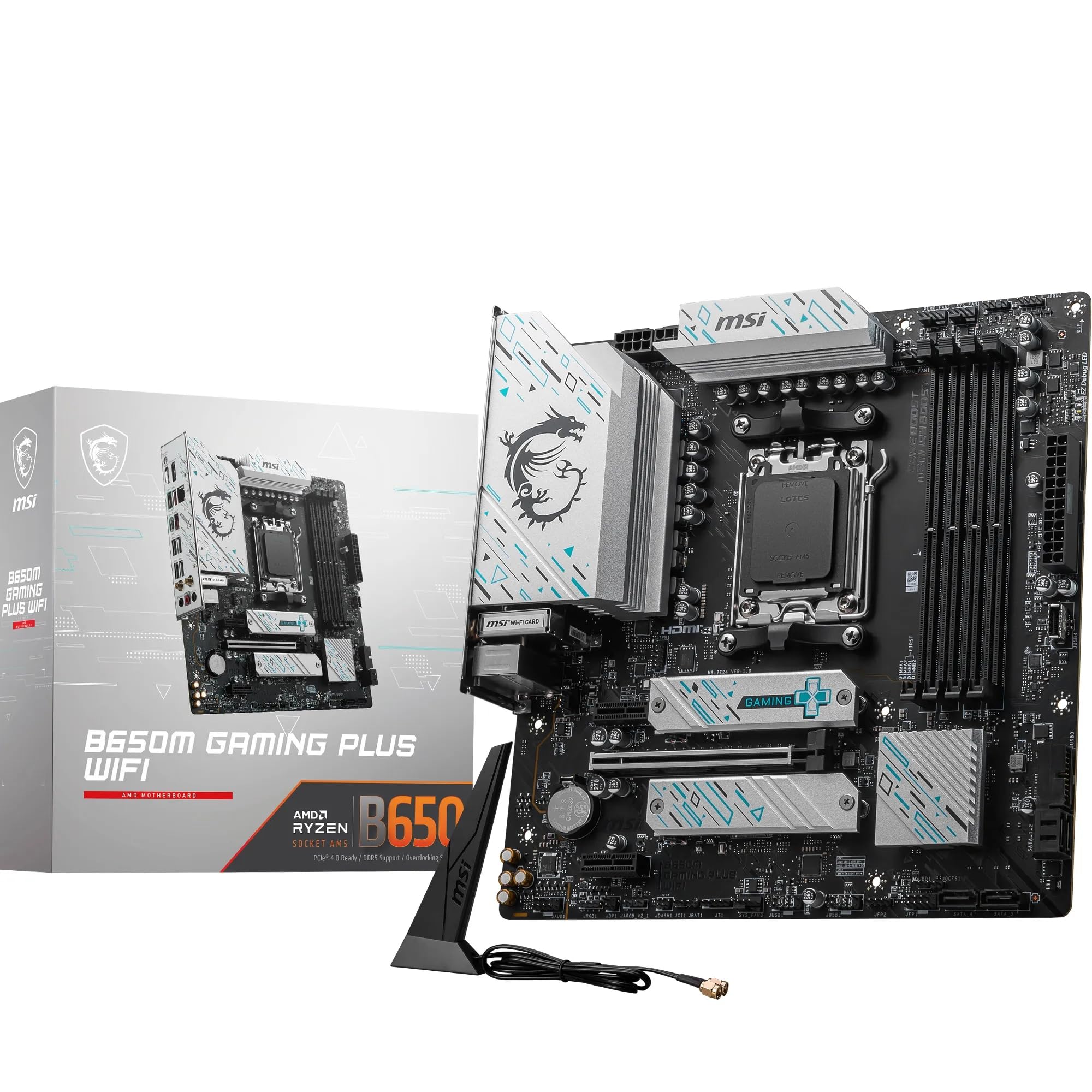
Marketing copy is easy to write. You pick the biggest numbers, slap them in bold, and hope nobody asks awkward questions. What actually tells you whether a motherboard is worth buying is the stuff manufacturers bury: real VRM phase counts, M.2 slot generations, whether the BIOS is a pleasure or a punishment. That's what I've dug into here, cross-referencing the spec sheet against what 286 owners are actually saying about the MSI PRO B650M-P Motherboard, because the gap between those two things is where the truth lives.
And here's the verdict upfront, because that's what you came for: this board solves a very specific frustration. You want AM5, you want DDR5, you want a platform that'll carry you through Ryzen 9000 series CPUs, but you don't want to spend silly money on features you'll never use. The B650M-P lands in the budget bracket and mostly delivers on that promise. It's not perfect. The VRM situation deserves honest scrutiny at this price point, and there are real trade-offs to understand before you commit. But for a budget AM5 Micro-ATX board, the 4.4-star average from real owners isn't noise. That's genuine satisfaction from people who built with it and came back to say so.
So who is this for? Primarily builders doing a sensible Ryzen 7000 or Ryzen 9000 mid-range build, people who need Micro-ATX for a smaller case, and anyone who wants to get onto the AM5 platform without paying X670E prices. It's not for enthusiasts chasing 5800MHz+ memory overclocks or running a Ryzen 9 9950X flat out. Know your use case and this board makes a lot of sense.
Core Specifications
The B650M-P is a Micro-ATX board built around AMD's B650 chipset on the AM5 socket. That means DDR5 memory, PCIe 4.0 primary slot, and compatibility with the full Ryzen 7000 and Ryzen 9000 lineup. The form factor is 244mm x 244mm, which fits the standard Micro-ATX footprint and opens up a good range of mid-tower and compact cases. For a board sitting in the budget tier, the feature list is actually pretty decent on paper, and the specs table below lays it all out cleanly.
Four DDR5 DIMM slots is a proper win at this price. Some budget boards drop to two slots to cut costs, which kills your upgrade path. Having four means you can start with 16GB or 32GB and double it later without binning your existing sticks. The two M.2 slots are both Gen 4, which is genuinely good for a budget board. You're not getting shunted onto Gen 3 for your secondary drive, which some competitors do quietly and hope you don't notice.
The rear I/O includes USB 3.2 connectivity, and the board supports HDMI output for AMD's integrated graphics on APU chips (though most Ryzen 7000 and 9000 desktop CPUs have no iGPU, so that's mainly relevant if you're running something like a Ryzen 7 8700G). It's a sensible, no-frills spec sheet. Nothing flashy, nothing obviously missing for the target use case.
| Specification | Detail |
|---|---|
| Socket | AM5 (LGA1718) |
| Chipset | AMD B650 |
| Form Factor | Micro-ATX (244mm x 244mm) |
| Memory Slots | 4 x DDR5 DIMM |
| Max Memory | 128GB DDR5 |
| PCIe x16 Slots | 1 x PCIe 4.0 x16 |
| M.2 Slots | 2 x M.2 Gen 4 x4 (NVMe) |
| SATA Ports | 4 x SATA 6Gbps |
| USB Rear (notable) | USB 3.2 Gen 1 Type-A, USB 2.0 |
| Networking | Realtek 2.5GbE LAN (no built-in Wi-Fi) |
| Audio | Realtek HD Audio |
| Video Output | HDMI (for APU use) |

Socket and CPU Compatibility
AM5 is the socket you want to be on right now if you're building AMD. It's AMD's current platform, supporting Ryzen 7000 (Zen 4), Ryzen 8000 (Zen 4 with RDNA 3 iGPU on the APU variants), and the newer Ryzen 9000 (Zen 5) series. The B650M-P is confirmed compatible with all of these, which gives you a genuinely long runway. AMD has committed to AM5 through at least 2027, so whatever you pair with this board today, there's room to drop in a faster CPU a couple of years down the line without replacing the motherboard.
One thing: if you're buying a brand new Ryzen 9000 series chip and pairing it with a B650M-P that's been sitting in a warehouse for a while, you may need a BIOS update before the system will POST. MSI's BIOS Flashback functionality (check whether this specific model includes the button on the rear I/O before assuming) can make this painless, but if it's not present, you'll need an older compatible CPU to boot and update first. before you order if you're going straight to a Ryzen 9000 chip. Many retailers will update BIOS on request if you ask nicely.
For most builders, the sweet spot pairing here is a Ryzen 5 7600 or Ryzen 7 7700, or their Ryzen 9000 equivalents. These are chips with sensible TDP figures that the B650M-P's VRM can handle without drama. Pairing a Ryzen 9 9950X with a budget B650M board would be a bit like fitting a racing engine into a family hatchback. Technically possible, but you'd be asking the VRM to do things it wasn't really designed for under sustained load.
Chipset Features
The AMD B650 chipset sits in the middle of AMD's current stack, below X670/X670E and above the entry-level A620. What that means in practice: you get PCIe 4.0 support (not Gen 5 on the primary slot, unlike X670E), and you get overclocking support for both CPU and memory. That last point matters. The A620 chipset doesn't support CPU overclocking at all. B650 does, which gives you EXPO memory profile support and the ability to push your Ryzen chip a bit if you're so inclined.
In terms of chipset-level lanes, B650 provides a reasonable allocation of USB ports, SATA connections, and PCIe lanes for expansion. The B650M-P uses these to deliver four SATA ports and two M.2 slots, which covers the storage needs of the vast majority of builds. You're not getting the lane abundance of X670E, but you're also not paying X670E prices. The trade-off is fair.
What B650 doesn't give you is PCIe Gen 5 on the primary x16 slot. For a GPU, that genuinely doesn't matter right now. No consumer graphics card saturates PCIe 4.0 bandwidth, and even PCIe 3.0 x16 barely holds anything back in real gaming scenarios. Where Gen 5 would matter is on the M.2 side, for the fastest NVMe drives, but those are expensive drives solving problems most people don't have. For a budget build, PCIe 4.0 M.2 is more than fast enough.
VRM and Power Delivery
Right, this is the section that separates honest reviews from marketing regurgitation. The VRM is the most important thing on a motherboard for long-term reliability, and budget boards are where manufacturers make their cuts. The B650M-P's VRM configuration isn't in the same league as the PRO B650-S WIFI's 12 Duet Rail Power System, and it shouldn't be expected to be at this price. What matters is whether it's adequate for the CPUs it'll realistically be paired with.
Owner feedback suggests it handles mainstream Ryzen 7000 and 9000 chips without thermal issues under normal workloads. Gaming, productivity, even light content creation with a Ryzen 5 or Ryzen 7 class chip? Fine. The VRM heatsink on budget boards is often minimal, and the B650M-P doesn't have the 7W/mK MOSFET thermal pads and extended heatsink coverage you'd find on pricier MSI boards. That's not a criticism so much as a statement of fact: you get what the price tier allows. Where owners have flagged concerns, it's usually in sustained multi-core workloads with higher-TDP chips, which is exactly what you'd expect.
The practical advice is straightforward: pair this board with a CPU that has a sensible TDP, ensure your case has decent airflow, and you'll be fine. A Ryzen 5 7600X or Ryzen 7 7700 non-X variant is the sweet spot. If you're planning to run a Ryzen 9 chip at full bore for hours on end doing video rendering, step up to a board with a beefier VRM. The B650M-P isn't trying to be that board, and it doesn't pretend to be.
Memory Support
Four DDR5 DIMM slots, up to 128GB total capacity, and EXPO support for AMD's memory overclocking profiles. That's a solid memory spec for a budget board. DDR5 is the only option here, which is correct for AM5 (the platform doesn't support DDR4, full stop), and having four slots rather than two is genuinely important for a board at this price. It means you can buy a 2x16GB kit now and add another 2x16GB later without starting over.
The rated EXPO speeds and what you'll actually achieve in practice are worth a quick conversation. AMD's EXPO profiles work similarly to Intel's XMP: the memory manufacturer sets a tested profile, you enable it in BIOS, and the system runs at the rated speed. On B650, you can push memory speeds reasonably well, though the absolute ceiling is lower than on X670E due to platform-level differences. For most people, 6000MHz DDR5 in EXPO mode is the sweet spot on AM5 anyway, and the B650M-P can handle that without drama according to owner reports.
One thing to note: running four sticks at high speeds (above 6000MHz) is harder than running two. This is an AM5 platform characteristic, not specific to this board. If you're starting with four sticks from day one and want high-speed EXPO, do your research on memory compatibility. MSI publishes a QVL (qualified vendor list) for this board. Check it before buying your RAM.
Storage Options
Two M.2 slots, both running PCIe 4.0 x4, giving you up to 64Gbps per slot. That's genuinely good for a budget board. Some competitors in this price bracket quietly give you one Gen 4 slot and one Gen 3 slot for the secondary drive. MSI has given you full-speed Gen 4 on both, which means your second NVMe drive isn't bottlenecked if you add one later. Proper job.
You also get four SATA 6Gbps ports for traditional 2.5-inch SSDs or HDDs. In 2026 most people are going all-NVMe, but having four SATA ports gives you flexibility. Maybe you're migrating from an old build and want to bring existing drives over. Maybe you need bulk storage for a media library. Four ports covers the realistic scenarios without going overboard.
RAID support is present through AMD's chipset, covering RAID 0, 1, and 10 configurations across SATA drives. NVMe RAID is technically possible on AM5 but rarely used in practice. The storage configuration on this board is one of its genuine strengths. For a budget Micro-ATX build, you're not being short-changed here. Two Gen 4 M.2 slots and four SATA ports is a storage setup that'll satisfy most builders for years.
Expansion Slots and PCIe
The primary PCIe x16 slot runs at PCIe 4.0 x16, which is where your GPU goes. At PCIe 4.0 speeds, you have 64GB/s of bandwidth available, which is more than any current consumer GPU can use. Even the fastest RTX 5090 or RX 9070 XT doesn't saturate PCIe 4.0 x16 in gaming. So don't let anyone sell you on needing PCIe 5.0 for a gaming build. You don't.
Being a Micro-ATX board, the expansion slot count is naturally more limited than a full ATX layout. The B650M-P has the primary x16 slot for your GPU and additional slots for other expansion cards. The exact count of secondary slots varies by revision, so check the MSI product page for the specific configuration, but realistically in a Micro-ATX build you're fitting a GPU and maybe a sound card or capture card. The layout accommodates that without issue.
The primary x16 slot has Steel Armor reinforcement, which is good to see even at this price. A heavy GPU can physically stress an unreinforced slot over time, especially if the board gets moved around. Steel Armor isn't just marketing fluff; it genuinely adds structural integrity and some EMI shielding. It's a small thing but it shows MSI hasn't completely stripped the build quality to hit the price point.

Connectivity and Rear I/O
The rear I/O on a budget board is where you really feel the price. The B650M-P gives you a functional set of ports: USB 3.2 Type-A connections, USB 2.0 for peripherals, HDMI for APU output, and standard audio jacks. It's not going to blow you away. There's no USB 3.2 Gen 2x2 Type-C at 20Gbps like you'd find on the PRO B650-S WIFI. But for the target user, the port selection covers the basics without embarrassing itself.
The HDMI output is specifically for anyone building with an AMD Ryzen 8000G APU (like the Ryzen 7 8700G or Ryzen 5 8600G). These chips have real integrated graphics based on RDNA 3, and the HDMI output lets you run a display without a discrete GPU. That makes this board actually quite interesting for a budget gaming PC or a home theatre build where you want decent integrated graphics without spending on a separate card.
Internal headers are the other half of connectivity that often gets ignored. The B650M-P includes the standard complement of USB headers for front-panel connectivity, fan headers for case fans and CPU cooler, and the usual front-panel connectors. Owner reviews don't flag any particular issues with header placement or accessibility, which suggests MSI has kept things sensible. One thing to check before buying: if you're using an all-in-one liquid cooler with a pump header, confirm the board has a dedicated pump fan header rather than just standard fan headers. That detail matters for proper pump speed control.
WiFi and Networking
Here's a genuine trade-off to understand clearly: the B650M-P does not include built-in Wi-Fi. You get a Realtek 2.5GbE wired LAN port, which is good (2.5Gbps is noticeably faster than 1Gbps for large file transfers and is increasingly common on modern routers), but if you need wireless connectivity you'll need to add a PCIe Wi-Fi card or a USB adapter.
Whether that matters depends entirely on your setup. Desktop builds with a router nearby on a wired connection don't need Wi-Fi at all, and not paying for a Wi-Fi module you'll never use is actually sensible cost control. But if you're building in a room without easy Ethernet access, factor in the cost of a Wi-Fi card. A decent PCIe Wi-Fi 6 card adds to the total cost, which can erode the budget advantage of the board itself.
The 2.5GbE LAN is powered by Realtek, which is the standard choice at this price point. It's reliable, well-supported by drivers across Windows and Linux, and genuinely useful if your network infrastructure supports 2.5Gbps. If your router only does 1Gbps, you won't notice the difference, but you're future-proofed for when you upgrade the network. No complaints here. 2.5GbE on a budget board is a nice touch that MSI has carried down from their pricier offerings.
BIOS and Overclocking
MSI's Click BIOS 5 interface is one of the better BIOS experiences available at this price. That's a genuine statement, not faint praise. Most budget board BIOS interfaces feel like they were designed in 2009 and never updated. MSI's Click BIOS has a proper GUI, a decent EZ Mode for beginners, and an Advanced Mode that gives you real control over memory timings, fan curves, and voltage settings without requiring a computer science degree to navigate.
Fan curve control deserves a specific mention because it's something people underestimate until they're trying to balance noise and cooling in a build. MSI's BIOS lets you set custom fan curves per header, which is proper functionality. You can set your CPU fan to ramp up aggressively under load and stay quiet at idle. The pump header (if present on this model) should have its own control. Owner reviews are generally positive about BIOS stability on the B650M-P, with the usual caveat that early firmware versions had some quirks that subsequent updates resolved. Running the latest BIOS is always good practice.
Overclocking headroom is modest but present. B650 supports EXPO memory profiles, so getting your DDR5 kit running at its rated speed is straightforward. CPU overclocking on Ryzen 7000 and 9000 is a nuanced topic anyway; AMD's Precision Boost algorithm does a good job of maximising performance within power limits automatically, so manual overclocking often yields less benefit than on older platforms. The BIOS gives you the tools if you want them, but you're not buying this board to push a Ryzen 9 9900X to its absolute limit. And you shouldn't be.
Build Quality and Aesthetics
The B650M-P is a no-nonsense board visually. There's no RGB here, which will either be a relief or a disappointment depending on your build aesthetic. Personally, I think a clean black PCB with no light show looks proper in a lot of builds, especially if you're going for a professional or understated look. RGB is easy to add via fans and strips; you can't remove it from a board that has it baked in.
The PCB quality on MSI boards at this price is generally solid. The B650M-P uses a standard layer count for the budget tier, and the component placement is sensible. The M.2 heatsink (or lack of one on one or both slots, depending on the specific revision) is. The pricier PRO B650-S WIFI has M.2 Shield Frozr on the primary slot. The B650M-P's M.2 thermal solution is more modest, which is fine for most NVMe drives that don't run particularly hot, but high-performance Gen 4 drives under sustained sequential writes can get warm. If you're running a drive that runs hot, a third-party M.2 heatsink is cheap insurance.
Owner reviews don't flag any build quality horror stories. No capacitors falling off, no warped PCBs, no slots that don't seat properly. That sounds like a low bar, but in the budget segment it genuinely isn't. The 4.4-star average from 287 suggests a product that does what it says without nasty surprises. MSI's manufacturing quality control at this price point is better than some competitors, and that shows in the review patterns.
How It Compares
The B650M-P's main competition comes from two directions: the ASUS Prime B650M-A AX (which adds Wi-Fi 6 and a slightly more generous VRM at a higher price) and the Gigabyte B650M DS3H (which undercuts on price but also cuts features more aggressively). Understanding where the B650M-P sits between these two tells you whether it's the right call for your build.
Against the ASUS Prime B650M-A AX, the MSI loses on Wi-Fi and arguably on VRM headroom, but wins on price. If you need Wi-Fi and you're running a higher-end Ryzen chip, the ASUS is worth the extra spend. If you're on wired Ethernet and running a mainstream Ryzen 5 or 7, the MSI saves you money without meaningful sacrifice. Against the Gigabyte DS3H, the MSI wins on M.2 slot quality (both Gen 4 vs the Gigabyte's mixed configuration) and generally on BIOS usability. MSI's Click BIOS is a better experience than Gigabyte's EasyTune interface at this tier.
| Feature | MSI PRO B650M-P | ASUS Prime B650M-A AX | Gigabyte B650M DS3H |
|---|---|---|---|
| Socket | AM5 | AM5 | AM5 |
| Chipset | B650 | B650 | B650 |
| Form Factor | Micro-ATX | Micro-ATX | Micro-ATX |
| Memory Slots | 4 x DDR5 | 4 x DDR5 | 4 x DDR5 |
| M.2 Slots | 2 x Gen 4 | 2 x Gen 4 | 2 x Gen 4 / Gen 3 mixed |
| LAN | 2.5GbE | 2.5GbE | 2.5GbE |
| Wi-Fi | No | Wi-Fi 6 | No |
| RGB | No | No | No |
| Price Tier | Budget | Budget to mid | Entry budget |
The comparison makes the B650M-P's value proposition clear. It sits in a sensible middle ground: better storage spec than the cheapest Gigabyte option, but cheaper than the ASUS if you don't need Wi-Fi. That's a legitimate position in the market, not just a compromise. And the MSI BIOS advantage is real. If you're new to building and you'll spend time in the BIOS setting up EXPO profiles and fan curves, you'll appreciate Click BIOS over the alternatives.

Final Verdict
The MSI PRO B650M-P Motherboard is a genuinely good budget AM5 board for the right builder. It gets the important things right: two Gen 4 M.2 slots, four DDR5 DIMM slots, EXPO support, 2.5GbE LAN, a decent BIOS, and solid build quality that 286 owners have validated with a 4.4-star average. That's not a fluke. People are building with this board, using it daily, and coming back to say it works. In the budget segment, that's what matters most.
The honest limitations: no Wi-Fi (factor in the cost of a card if you need it), a VRM that's adequate for mainstream CPUs but not designed for sustained high-TDP workloads, and no M.2 heatsink on at least one slot depending on revision. None of these are dealbreakers for the target use case. They're just things to know before you buy. A Ryzen 5 7600 or Ryzen 7 7700 paired with this board in a decent case with good airflow is a solid, reliable build that'll serve you well.
Who should skip it? Anyone running a Ryzen 9 class chip at sustained loads, anyone who needs Wi-Fi built in without adding a card, and anyone who wants full ATX for maximum expansion. If you need Wi-Fi and you're already stretching the budget, look at the ASUS Prime B650M-A AX before committing. The extra cost might be worth it for the integrated wireless and slightly more headroom in the VRM. But if you're on wired Ethernet and pairing this with a sensible mid-range Ryzen chip, the B650M-P is hard to argue with at its price in the budget bracket.
The MSI PRO B650M-P earns a solid 7.5 out of 10 from our research. It does what a budget AM5 board should do, without trying to be something it isn't. That kind of honest engineering is actually harder to find than it sounds.
What works. What doesn’t.
6 + 6What we liked6 reasons
- Both M.2 slots run PCIe 4.0 x4, giving full-speed NVMe on the primary and secondary slots without compromise
- Four DDR5 DIMM slots preserve your upgrade path, letting you add memory later without discarding existing sticks
- MSI Click BIOS 5 is notably easier to navigate than rival budget board interfaces, with proper fan curve control per header
- 2.5GbE LAN included as standard, future-proofing wired networking without paying extra
- EXPO memory profile support allows DDR5 kits to run at rated speeds with minimal BIOS effort
- Solid build quality validated by 286 owner reviews averaging 4.4 stars, with no widespread quality control complaints
Where it falls6 reasons
- No built-in Wi-Fi, meaning wireless users must budget for an additional PCIe card or USB adapter
- VRM is adequate for mainstream Ryzen 5 and 7 class CPUs but is not suited to sustained high-TDP workloads from Ryzen 9 chips
- M.2 thermal solution is modest and may be absent on one slot depending on board revision, leaving fast Gen 4 drives without heatsink coverage
- Rear I/O lacks USB 3.2 Gen 2x2 Type-C, which limits high-speed peripheral connectivity compared to pricier boards
- BIOS update may be required before a new Ryzen 9000 CPU will POST if the board has older firmware, and BIOS Flashback availability should be confirmed before purchase
- No RGB headers on the board itself, which may frustrate builders wanting integrated lighting control
Full specifications
11 attributes| Socket | AM5 |
|---|---|
| Chipset | B650 |
| Form factor | Micro-ATX |
| Bios flashback | false |
| M2 slots | 2 |
| MAX RAM GB | 192 |
| Network | 2.5GbE |
| Pcie 5 slots | 0 |
| RAM slots | 4 |
| RAM type | DDR5 |
| Usb4 | false |
Frequently asked
7 questions01Does the MSI PRO B650M-P support Ryzen 9000 series CPUs?+
Yes, the B650M-P is compatible with AMD Ryzen 9000 series processors. However, if the board was manufactured before Ryzen 9000 launched, you may need a BIOS update before the system will recognise the CPU. Check whether your specific unit supports BIOS Flashback before ordering a Ryzen 9000 chip, as without it you will need an older compatible CPU to perform the update first.
02Does the MSI PRO B650M-P have built-in Wi-Fi?+
No, the B650M-P does not include integrated Wi-Fi. It provides a Realtek 2.5GbE wired LAN port only. If you need wireless connectivity, you will need to add a PCIe Wi-Fi card or a USB wireless adapter. Factor that additional cost into your budget if wireless is a requirement for your build.
03How many M.2 slots does the MSI PRO B650M-P have, and what generation are they?+
The B650M-P has two M.2 slots, both running PCIe 4.0 x4 for NVMe drives. This gives you up to 64Gbps of bandwidth per slot. Unlike some competing budget boards that provide one Gen 4 and one Gen 3 slot, MSI has equipped both slots with full Gen 4 speeds, which is a genuine advantage at this price tier.
04Is the VRM on the MSI PRO B650M-P sufficient for a Ryzen 7 7700?+
Yes, owner feedback and the board's specification indicate the VRM handles Ryzen 5 and Ryzen 7 class CPUs without thermal issues under typical workloads including gaming and general productivity. The VRM is not designed for sustained full-load operation with high-TDP Ryzen 9 class processors, but for a Ryzen 7 7700 in a case with decent airflow it is appropriate.
05Can I use four sticks of DDR5 RAM at high EXPO speeds on the B650M-P?+
The board supports four DDR5 DIMM slots and EXPO memory profiles. Running four sticks at speeds above 6000MHz is more challenging than running two sticks, which is a characteristic of the AM5 platform generally rather than specific to this board. If you plan to populate all four slots from day one at high speeds, check MSI's qualified vendor list for compatible memory kits before purchasing.
06Does the MSI PRO B650M-P include an M.2 heatsink?+
The M.2 thermal solution on the B650M-P is more modest than on MSI's pricier boards. Depending on the board revision, one or both M.2 slots may lack a heatsink. For most NVMe drives under typical workloads this is not a problem, but high-performance Gen 4 drives running sustained sequential writes can get warm. A third-party M.2 heatsink is an inexpensive addition if you are concerned about drive temperatures.
07How does the MSI PRO B650M-P compare to the ASUS Prime B650M-A AX?+
The ASUS Prime B650M-A AX adds integrated Wi-Fi 6 and generally offers slightly more VRM headroom at a higher price. If you need wireless connectivity or plan to pair your board with a higher-end Ryzen chip, the ASUS is. If you are on wired Ethernet and building around a mainstream Ryzen 5 or Ryzen 7 processor, the MSI saves you money without meaningful sacrifice. The MSI also benefits from the Click BIOS 5 interface, which many builders find easier to use.