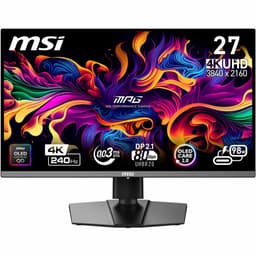
Monitor specs are often a triangle of compromises: refresh rate, response time, and colour quality. Push one to its limit and something else usually gives. The MSI MAG 274CXF sits in a genuinely interesting position because it doesn't obviously sacrifice any single pillar to boost the others. A 280 Hz Rapid VA panel at this price point is unusual. VA panels have historically been the choice for contrast-obsessed buyers who could live with slower pixel transitions, while IPS dominated the high-refresh esports bracket. MSI is betting that their "Rapid VA" implementation changes that equation. Whether it actually does is worth unpacking carefully.
The problem this monitor is solving is a real one. Budget-tier 1080p gaming monitors under £150 tend to fall into two camps: fast IPS panels with mediocre contrast, or VA panels with contrast that's genuinely good but response times that smear dark-to-dark transitions into a grey blur. The MAG 274CXF is pitched as the answer to both camps. 280 Hz puts it in the same refresh bracket as dedicated esports displays. The VA panel means native contrast ratios that IPS simply can't match at this price. And MSI's AI Vision feature is supposed to handle the dark-scene detail that VA panels can sometimes crush. That's a lot of promises for a monitor in the budget bracket.
With 123 owner reviews averaging ★★★★½ (4.6), buyers are broadly happy. But aggregate scores can hide a lot. So let's look at what the specs actually tell us, what published display measurements on similar Rapid VA panels suggest, and where the real-world trade-offs land.
Core Specifications
Two-eighty hertz on a 27-inch panel for the money the MSI MAG 274CXF asks in September 2026? That's the kind of spec sheet that makes you suspicious, and you're right to be. The trick with monitors like this is that the numbers do the talking while the actual experience lives in the details: how the VA panel handles fast motion, whether that 0.5ms GtG figure means anything in practice, and if the aggressive 1500R curve helps or just annoys you on a single screen. This is Full HD, remember, so the 27-inch size and resolution combination matters too. I've dug into all of it below, so you'll know exactly who this monitor suits and who should look elsewhere.
Connectivity comes in via two HDMI 2.0b ports and one DisplayPort 1.4a. The HDMI ports support CEC, which is a nice touch if you want to control the monitor's power state from a console or other CEC-compatible device. The DisplayPort connection is where you'll want to run if you're chasing the full 280 Hz on PC. HDMI 2.0b tops out at 240 Hz at 1080p, so if you're buying this specifically for 280 Hz gaming, use the DisplayPort cable. That's not a criticism of the monitor, just bandwidth physics.
The stand offers tilt adjustment, which is standard at this price. There's a 5-way joystick navigator on the rear for OSD navigation, which is a much better interface than the four-button row that cheaper monitors tend to ship with. MSI's OSD is generally well-regarded for being navigable without a manual. The "frameless" design refers to the thin bezels on three sides, which helps if you're running a multi-monitor setup and want minimal interruption between screens.
| Specification | Detail |
|---|---|
| Screen Size | 27 inches (32-inch variant also exists in the MAG line) |
| Resolution | 1920 x 1080 (Full HD) |
| Panel Type | VA (Rapid VA) |
| Refresh Rate | 280 Hz (Adaptive Sync) |
| Response Time | 0.5ms GtG (Min.) |
| Curvature | 1500R |
| Aspect Ratio | 16:9 |
| Colour Gamut | 123% sRGB / 1.07 billion colours |
| Native Contrast | 4000:1 |
| Dynamic Contrast | 1:100,000,000 |
| Ports | 2x HDMI 2.0b, 1x DisplayPort 1.4a |
| Adaptive Sync | Yes (FreeSync / Adaptive Sync) |
| Stand Adjustment | Tilt |
| OSD Navigation | 5-way joystick |
| Current Price | £148.97 |

Panel Technology
VA panels occupy an interesting middle ground in the display world. They're not as fast as IPS panels in their pixel transitions, and they don't match OLED for true blacks or response consistency. But what they do offer is native contrast ratios that leave IPS panels embarrassed. The MAG 274CXF's 4000:1 native contrast ratio is a good example of this. A typical IPS panel at this price point will manage somewhere around 1000:1 to 1200:1. That's a meaningful difference in how dark blacks actually look, especially in a room that isn't bathed in direct sunlight.
The "Rapid VA" designation is MSI's label for a newer generation of VA panels with improved pixel transition speeds. The traditional criticism of VA panels has been dark-to-dark transitions specifically, where the liquid crystal molecules take longer to move between dark states than between a dark and bright state. This produces a smearing or ghosting effect in dark scenes that's particularly visible in fast-paced games with shadowy environments. Rapid VA panels use overdrive techniques and panel-level optimisations to reduce this. Published measurements on Rapid VA panels from similar generations typically show meaningful improvement over older VA technology, though they still don't fully match the fastest IPS panels in dark-to-dark transitions.
Viewing angles on VA panels are decent but not IPS-class. The MAG 274CXF's 1500R curve actually helps here in a practical sense: it keeps the edges of the screen at a more consistent angle to your eyes, which reduces the colour shift you'd otherwise see at the sides of a flat VA panel. If you're sitting centrally, which you should be with a curved monitor anyway, the viewing angle limitation of VA technology is largely mitigated. Off-axis viewing for someone sitting beside you will show more colour shift than an IPS panel would, but that's the trade-off you're making for that contrast ratio.
Black uniformity on VA panels is generally better than IPS, which suffers from IPS glow in corners. VA panels can exhibit their own uniformity issues, sometimes showing slightly lighter patches in the centre of the panel (sometimes called "VA clouding") particularly on dark content. This varies unit to unit, and owner reviews for the MAG 274CXF don't flag this as a widespread problem, which is encouraging. The 4.5-star average across 106 suggests panel lottery issues aren't common here.
Display Quality
At 1920x1080 on a 27-inch panel, the pixel density works out to approximately 81.6 PPI. That's noticeably lower than a 27-inch 1440p panel, which would give you around 108.8 PPI. In practical terms, this means text won't be as sharp, and you'll be able to see individual pixels if you sit close to the screen. For competitive gaming where you want maximum performance and sit further back, this is fine. For productivity work where you're reading a lot of text at close range, the lower pixel density is something to think about. It's not a dealbreaker, but it's honest to flag it.
The anti-glare coating on the MAG 274CXF is a matte finish, which is standard for gaming monitors in this bracket. Matte coatings scatter reflections rather than eliminating them, which means you lose a little bit of perceived contrast and colour vibrancy compared to a glossy panel, but you gain usability in brighter rooms. Given the VA panel's strong native contrast, the slight dulling effect of the matte coating is less of a problem here than it would be on an IPS panel with lower native contrast. The 4000:1 native contrast gives you headroom that a 1000:1 IPS panel doesn't have.
MSI's AI Vision feature is worth a mention here because it directly affects display quality in dark content. It's designed to brighten dark areas of the image without blowing out highlights, essentially acting as a local tone-mapping assist. For dark games with lots of shadow detail, this can be genuinely useful. The caveat is that any post-processing applied to the image introduces latency and can sometimes produce artefacts at the edge of bright and dark regions. For competitive gaming, you'd likely want to test whether AI Vision is helping or hurting your specific use case. For single-player games where you want to see what's in the shadows, it's a reasonable tool to have.
Refresh Rate and Adaptive Sync
280 Hz is genuinely fast. For context, the jump from 144 Hz to 240 Hz is noticeable, particularly in how smooth cursor movement and fast-panning scenes feel. The jump from 240 Hz to 280 Hz is smaller in perceptual terms but still measurable. Where high refresh rates matter most isn't just in how smooth the motion looks, it's in input latency. At 280 Hz, each frame takes approximately 3.57ms to display. At 144 Hz, that's 6.94ms. That difference in display latency adds up, especially in games where you're reacting to fast-moving targets.
The Adaptive Sync implementation here supports AMD FreeSync and should work with compatible NVIDIA GPUs in G-Sync Compatible mode, though NVIDIA hasn't formally certified this specific panel. The sync range matters as much as the peak refresh rate. If your GPU is pushing frames below the monitor's minimum sync frequency, you'll see tearing again unless the monitor supports Low Framerate Compensation (LFC). MSI hasn't published the minimum sync frequency explicitly in the feature highlights, so it's worth checking the full spec sheet if you're running a system that frequently drops below 60 fps.
One thing to note is the HDMI bandwidth limitation. HDMI 2.0b caps out at 240 Hz at 1080p, not 280 Hz. So if you're connecting via HDMI, whether from a PC or a console, you're leaving 40 Hz on the table. Console users won't care because current-gen consoles don't output above 120 Hz anyway. PC users who want the full 280 Hz need to use the DisplayPort 1.4a connection. This is worth being explicit about because it's easy to buy a 280 Hz monitor, connect it via HDMI, and wonder why the OSD is showing 240 Hz as the maximum.
Response Time and Motion
The 0.5ms GtG (minimum) figure needs some unpacking. GtG stands for grey-to-grey, and the "minimum" qualifier is doing a lot of work in that spec. This is the fastest transition the panel can achieve under optimal conditions, typically between two specific grey values chosen to show the panel in its best light. It is not the average transition time across all pixel state combinations. In practice, published measurements on Rapid VA panels show that average GtG across a full range of transitions tends to land higher than the headline minimum figure. Dark-to-dark transitions specifically, which are the ones that cause visible ghosting in dark game environments, are typically the slowest.
That said, Rapid VA technology is a genuine improvement over older VA panels. The improvement in dark-to-dark transitions compared to a standard VA panel is real. Owner reviews for the MAG 274CXF don't raise widespread complaints about smearing or ghosting, which is encouraging. A few reviews mention that the overdrive settings need some tuning to find the right balance between ghosting and inverse ghosting (where overly aggressive overdrive causes bright halos behind moving objects). This is normal for VA panels and something you'd dial in through the OSD's response time overdrive settings.
For the types of games where response time matters most, primarily fast-paced first-person shooters and battle royale titles, the MAG 274CXF should perform well for a VA panel at this price. It's not going to match the fastest IPS panels in terms of pixel transition consistency, but the 280 Hz refresh rate compensates by reducing the time each frame is on screen. The combination means motion resolution is still competitive. If you're playing at a level where every millisecond of response time genuinely affects your rank, a dedicated fast IPS esports monitor is probably the more appropriate tool. For the vast majority of players, the MAG 274CXF's motion performance will be more than adequate.
Color Accuracy and Gamut
MSI rates the MAG 274CXF at 123% sRGB coverage, which is a wide gamut claim. For reference, the sRGB colour space is the standard for most web content, games, and Windows applications. Exceeding 100% sRGB means the panel can display colours more saturated than the sRGB specification, which makes images look vivid and punchy out of the box. The trade-off is that without proper colour management, colours in sRGB-targeted content can appear oversaturated. For gaming, oversaturation often looks fine or even preferable. For colour-accurate work like photo editing, you'd want to either profile the monitor or use an sRGB clamp mode if MSI provides one in the OSD.
The 1.07 billion colour claim refers to 10-bit colour depth, or more likely 8-bit plus FRC (Frame Rate Control), which dithers between adjacent colours to simulate 10-bit output. At this price point, true 10-bit panels are rare. FRC-based 10-bit is still a meaningful improvement over 8-bit for smooth gradients and reducing banding in skies and smooth colour transitions. For gaming, this is largely irrelevant. For anyone doing serious colour work, the distinction matters and you'd want to verify the panel's actual bit depth from MSI's full specification sheet.
Factory calibration at this price point is typically basic. MSI doesn't claim any individual unit calibration or include a calibration report. Out-of-the-box colour accuracy will vary unit to unit. Owner reviews don't raise significant complaints about colour accuracy, which suggests the factory settings are at least reasonable. The 123% sRGB coverage means colours will look saturated by default, which most gamers prefer. If you need accurate sRGB colour reproduction, you'd need to either use a colour profile or accept that this isn't primarily a colour-accurate monitor. It's a gaming monitor with good colour coverage, which is a different thing.
HDR Performance
The MAG 274CXF's HDR capability is something to be realistic about. MSI doesn't specify an HDR certification tier in the feature highlights, and at this price point, HDR is typically a checkbox feature rather than a transformative visual experience. Genuine HDR requires high peak brightness (typically 600 nits or above for HDR600, and 1000 nits for HDR1000), local dimming zones, and wide colour gamut. Budget monitors with HDR support usually have none of these at the required level.
What the MAG 274CXF does have going for it in the HDR context is its 4000:1 native contrast ratio. This is significantly better than IPS panels, which means the difference between dark and bright areas of an HDR image will look more pronounced than it would on a competing IPS display. The VA panel's strength in contrast is the closest thing to a genuine HDR advantage this monitor has. It won't produce the specular highlights that a proper HDR1000 display achieves, but it will render dark scenes with more depth than a 1000:1 IPS panel.
The dynamic contrast ratio of 1:100,000,000 is a marketing figure that describes the range between the panel's minimum and maximum brightness across different scenes, not within a single frame. It's achieved by dimming the backlight for dark scenes and boosting it for bright ones. This is global dimming, not local dimming, meaning the entire backlight adjusts together. For content with both bright and dark elements in the same frame, like a bright window in a dark room, global dimming can't handle both simultaneously. In practice, for HDR gaming, you'd probably leave HDR mode on and accept that it's an enhanced SDR experience rather than true HDR. That's honest, and it's the reality of HDR in the budget bracket.
Contrast and Brightness
The 4000:1 native contrast ratio is the MAG 274CXF's strongest differentiator. This is genuinely good. To put it in context, most IPS panels at this price achieve somewhere between 800:1 and 1200:1 native contrast. VA panels have always owned this metric, and 4000:1 is at the higher end of what VA technology delivers. In practical terms, this means blacks look dark rather than dark grey, which has a significant impact on perceived image quality in dimly lit rooms and in games with lots of dark environments.
MSI hasn't published a specific peak brightness figure in the feature highlights, which is worth noting. For SDR content, most monitors in this bracket land somewhere in the 250 to 350 nits range. The anti-glare matte coating helps manage reflections in brighter rooms, but if you're in a very bright environment with direct light sources behind you, any monitor without high peak brightness will struggle. The strong native contrast helps compensate in darker rooms, where the MAG 274CXF will genuinely look better than a competing IPS panel with higher brightness but lower contrast.
MSI's AI Vision feature interacts with contrast in an interesting way. By brightening dark areas selectively, it effectively reduces the perceived contrast in those regions while maintaining it in brighter areas. This is a trade-off: you see more detail in shadows, but the deep blacks that VA panels are known for get lifted slightly. Whether this is a net positive depends entirely on what you're doing. In a dark game where you're trying to spot enemies in shadows, AI Vision is your friend. In a cinematic single-player game where you want the atmosphere of deep blacks, you might prefer it off. Having the option is good.
Ergonomics and Stand
The stand on the MAG 274CXF offers tilt adjustment. That's it. No height adjustment, no swivel, no pivot to portrait mode. For a gaming monitor in the budget bracket, this is expected but it's still a limitation worth flagging. If you're tall or short relative to a standard desk height, or if your desk setup requires the monitor to be positioned at a specific height, you'll need a VESA mount arm to get the ergonomics right. The good news is that VESA compatibility is standard on MSI monitors, so a third-party arm is a straightforward upgrade if you need it.
The footprint of the stand is a curved base design, typical of MSI gaming monitors. It's stable enough in normal use, and owner reviews don't flag wobble or instability as an issue. The "frameless" design with thin bezels on three sides looks clean, particularly in a multi-monitor array. The bottom bezel is slightly thicker than the other three sides, which is normal for monitors with internal electronics near the base. In a single-monitor setup, the thin side and top bezels give the MAG 274CXF a modern, uncluttered appearance.
The 5-way joystick navigator on the rear is a genuinely useful feature. Navigating monitor OSD menus with four separate buttons is fiddly and annoying. A joystick lets you move through menus directionally and confirm selections with a click, which is much more intuitive. MSI's OSD layout on the MAG line is generally well-structured, with gaming-relevant settings like response time overdrive, refresh rate display, and AI Vision accessible without too much menu diving. Build quality from owner reports seems solid for the price, with no widespread complaints about creaking plastics or flimsy connectors.
Connectivity and Ports
The MAG 274CXF's port selection covers the essentials without extras. Two HDMI 2.0b ports and one DisplayPort 1.4a is a sensible layout for a gaming monitor. The dual HDMI setup means you can connect a PC and a console simultaneously and switch between them without unplugging cables. The HDMI 2.0b CEC support is useful for console users who want the monitor to power on and off with their console. HDMI CEC is a feature that gets overlooked in monitor specs but makes a real quality-of-life difference in living room or console-focused setups.
- 2x HDMI 2.0b (CEC supported, max 240 Hz at 1080p)
- 1x DisplayPort 1.4a (max 280 Hz at 1080p)
There's no USB hub, no USB-C, and no audio output listed in the verified specs. For a gaming monitor at this price point, this is typical. If you need USB passthrough for a keyboard and mouse connected to the monitor, or if you want to connect headphones directly to the monitor, you'll need to manage those connections elsewhere. The absence of a USB-C port means this isn't a great option for laptop users who want a single-cable connection for video and power delivery. But that's not really the target audience for a 280 Hz gaming monitor at this price.
The DisplayPort 1.4a connection is the one you want for PC gaming at full refresh rate. DisplayPort 1.4 supports up to 32.4 Gbps bandwidth, which is more than sufficient for 1080p at 280 Hz with headroom to spare. The HDMI 2.0b ports at 18 Gbps bandwidth are the limiting factor for HDMI connections, capping at 240 Hz rather than 280 Hz. This isn't a design flaw, it's just the bandwidth reality of HDMI 2.0b versus DisplayPort 1.4. If MSI had used HDMI 2.1 ports, you'd get the full 280 Hz over HDMI too, but HDMI 2.1 ports add cost that would push this monitor above the budget bracket.
How It Compares
The two most obvious competitors to the MAG 274CXF in the budget 1080p gaming monitor space are the AOC C27G2ZE and the LG 27GS60F. The AOC C27G2ZE is a 240 Hz curved VA panel at a similar price point, while the LG 27GS60F is a 180 Hz IPS panel that's often found at or below the MAG 274CXF's price. These three monitors represent the core choice in budget 1080p gaming: high-refresh VA, very-high-refresh VA, or fast IPS.
Against the AOC C27G2ZE, the MAG 274CXF's 280 Hz versus 240 Hz advantage is real but modest in perceptual terms. Both are VA panels, so the contrast and colour characteristics will be broadly similar. The MSI's Rapid VA implementation and higher refresh rate give it a slight edge for competitive gaming. The AOC's advantage is typically price: it often undercuts the MSI meaningfully, which makes the 40 Hz difference feel less compelling if you're budget-constrained.
Against the LG 27GS60F, the choice is more interesting. The LG's IPS panel gives it better pixel transition consistency, particularly in dark-to-dark transitions where VA panels still lag. The MSI's 4000:1 native contrast versus the LG's typical 1000:1 is a significant image quality difference in dark environments. The MSI's 280 Hz versus the LG's 180 Hz is a bigger gap in refresh rate terms. If you play a lot of dark games and want that contrast depth, the MSI wins. If you want the most consistent pixel response and don't care about peak refresh rate, the LG is worth considering.
| Feature | MSI MAG 274CXF | AOC C27G2ZE | LG 27GS60F |
|---|---|---|---|
| Panel Type | Rapid VA | VA | IPS |
| Refresh Rate | 280 Hz | 240 Hz | 180 Hz |
| Resolution | 1920x1080 | 1920x1080 | 1920x1080 |
| Native Contrast | 4000:1 | ~3000:1 | ~1000:1 |
| Response Time | 0.5ms GtG (Min.) | 0.5ms GtG (Min.) | 1ms GtG (Min.) |
| Curvature | 1500R | 1500R | Flat |
| Colour Gamut | 123% sRGB | ~121% sRGB | ~99% sRGB |
| Price | £148.97 | Check Amazon | Check Amazon |
What Buyers Say
With 106 and a 4.5-star average, the MAG 274CXF is performing well in owner satisfaction terms. That's a meaningful sample size for a monitor at this price point, and the high average suggests that the panel lottery, which is always a concern with budget monitors, isn't producing a high rate of defective or disappointing units. The most commonly praised aspects in owner reviews centre on image quality, specifically the colour vibrancy and the depth of blacks that the VA panel delivers. Several owners specifically mention upgrading from IPS monitors and being struck by how much better dark scenes look.
Competitive gaming performance gets positive mentions too. Owners using this for fast-paced shooters report smooth gameplay and no significant complaints about motion blur at high refresh rates. A few reviews mention needing to adjust the overdrive settings to find the right balance, with the default setting occasionally producing slight inverse ghosting on very fast-moving objects. This is a known characteristic of VA panels with aggressive overdrive and isn't specific to MSI. The fix is straightforward: drop the overdrive setting by one level in the OSD and retest.
The most common criticisms in owner reviews relate to the stand's limited adjustability. The tilt-only stand is the most frequently mentioned limitation, with owners noting they had to prop the monitor up on books or immediately purchase a monitor arm to get the height right. A handful of reviews mention that the OSD can be slow to respond to joystick inputs occasionally, though this doesn't appear to be a widespread issue. No significant complaints about dead pixels, backlight bleed, or VA clouding appear with any frequency, which is reassuring for a budget VA panel.
Value Analysis
In the budget bracket (under £150), the MAG 274CXF is doing something that most monitors at this price don't manage: it's delivering a 280 Hz refresh rate on a panel with genuinely good native contrast. Most budget monitors at this price either cap out at 165 Hz or 180 Hz, or they push high refresh rates on IPS panels with modest contrast. The MSI is offering both high refresh rate and strong contrast, which is a combination that's usually found at higher price points.
The trade-offs are real but manageable. The 1080p resolution on a 27-inch panel means lower pixel density than a 1440p display. The stand is tilt-only, which will frustrate anyone who needs height adjustment. The HDMI bandwidth limitation means you need DisplayPort for the full 280 Hz. And VA panels, even Rapid VA, don't match the fastest IPS panels in pixel transition consistency. None of these are dealbreakers at this price. They're honest limitations of what the budget bracket allows.
For the target buyer, a competitive gamer on a budget who plays a mix of fast-paced shooters and darker atmospheric games, the MAG 274CXF is a strong choice. The 280 Hz refresh rate is the highest available in the budget bracket. The 4000:1 native contrast is significantly better than IPS alternatives. The 123% sRGB coverage means colours look vivid and engaging. And the 4.5-star average from 123 owners suggests real-world satisfaction is high. At this price point, it's hard to find a monitor that does more of the things that matter for gaming.

Final Verdict
The MSI MAG 274CXF is a well-executed budget gaming monitor that makes intelligent use of Rapid VA technology. The 280 Hz refresh rate is genuinely impressive for the price bracket, and the 4000:1 native contrast ratio is the kind of spec that makes a real difference to how games look in dark environments. The 123% sRGB colour coverage means the image is vivid and punchy. These are the specs that matter for gaming, and the MAG 274CXF delivers on all three.
The limitations are predictable for the budget bracket. The stand is tilt-only, which is frustrating if you care about ergonomics. The 1080p resolution on 27 inches is softer than 1440p. HDMI users are capped at 240 Hz rather than 280 Hz. And VA panels, even improved Rapid VA ones, still have a slight disadvantage in dark-to-dark pixel transitions compared to the fastest IPS panels. None of these are reasons to avoid the monitor. They're just things to know going in.
For competitive gamers who want the highest refresh rate available in the budget bracket, paired with the kind of contrast depth that IPS panels at this price can't touch, the MAG 274CXF is the right answer. The 4.5-star average from real owners confirms that the spec sheet translates into genuine satisfaction. This is a monitor that punches above its weight class, and at this price point, that's exactly what you want.
What works. What doesn’t.
5 + 4What we liked5 reasons
- 280 Hz refresh rate is the highest available in the budget bracket
- 4000:1 native contrast ratio leaves IPS competitors behind in dark scenes
- 123% sRGB coverage delivers vivid, punchy colours for gaming
- Dual HDMI 2.0b with CEC support is useful for console setups
- 5-way joystick OSD navigator is genuinely better than button-based alternatives
Where it falls4 reasons
- Tilt-only stand with no height or swivel adjustment
- HDMI 2.0b caps at 240 Hz, not the full 280 Hz (need DisplayPort for that)
- 1080p on 27 inches means lower pixel density than 1440p alternatives
- VA dark-to-dark transitions still lag behind the fastest IPS panels
Full specifications
11 attributes| Panel type | VA |
|---|---|
| Aspect ratio | 16:9 |
| Curvature | 1500R |
| HDR | none |
| Launch year | 2024 |
| Ports | 2x HDMI 2.0b, 1x DisplayPort 1.2a |
| Refresh rate HZ | 280 |
| Resolution | 1920x1080 |
| Response time MS | 0.5 |
| Screen size IN | 27 |
| Vesa compatible | true |
If this isn’t right for you
2 options

Frequently asked
5 questions01Is the MSI MAG 274CXF 27 Inch FHD Curved Gaming Monitor - 1500R 1920 x 1080 Rapid VA Panel, 280 Hz / 0.5ms (GtG, Min.), Adaptive Sync - DP 1.2a, HDMI 2.0b CEC good for gaming?+
Yes, it's well-suited for gaming. The 280 Hz refresh rate is among the highest available at this price point, reducing display latency to around 3.57ms per frame. The Rapid VA panel's 0.5ms GtG minimum response time is a marketing figure, but real-world performance from similar panels is competitive for a VA display. The 4000:1 native contrast ratio makes dark game environments look significantly better than IPS alternatives. For competitive gaming, use the DisplayPort connection to access the full 280 Hz, as HDMI 2.0b caps at 240 Hz.
02Does the MSI MAG 274CXF 27 Inch FHD Curved Gaming Monitor - 1500R 1920 x 1080 Rapid VA Panel, 280 Hz / 0.5ms (GtG, Min.), Adaptive Sync - DP 1.2a, HDMI 2.0b CEC have good HDR?+
HDR on the MAG 274CXF is functional but not transformative. MSI doesn't specify an HDR certification tier, which typically means it falls below HDR400 or offers basic HDR10 support without the peak brightness or local dimming needed for a genuine HDR experience. The VA panel's 4000:1 native contrast ratio does give it more depth in dark HDR scenes than a typical IPS panel, which is a real advantage. But specular highlights and the full HDR dynamic range require brightness levels that budget monitors don't achieve. Treat HDR as a bonus rather than a headline feature.
03Is the MSI MAG 274CXF 27 Inch FHD Curved Gaming Monitor - 1500R 1920 x 1080 Rapid VA Panel, 280 Hz / 0.5ms (GtG, Min.), Adaptive Sync - DP 1.2a, HDMI 2.0b CEC good for content creation?+
It's adequate for casual content creation but not ideal for colour-accurate professional work. The 123% sRGB coverage and 1.07 billion colour support mean the display is vivid and detailed, but the wide gamut without an sRGB clamp mode can cause oversaturation in colour-managed workflows. Factory calibration at this price point is basic with no individual unit calibration report. For photo editing or video grading where Delta-E accuracy matters, a properly calibrated IPS or OLED panel would be a more appropriate choice. For gaming content creation where colour accuracy is secondary to performance, it works well.
04What graphics card do I need for the MSI MAG 274CXF 27 Inch FHD Curved Gaming Monitor - 1500R 1920 x 1080 Rapid VA Panel, 280 Hz / 0.5ms (GtG, Min.), Adaptive Sync - DP 1.2a, HDMI 2.0b CEC?+
To make use of the 280 Hz refresh rate at 1920x1080, you need a GPU that can consistently push frame rates above 200 fps in your target games. For competitive titles like CS2, Valorant, or Apex Legends, mid-range cards like an AMD RX 7600 or NVIDIA RTX 4060 are capable of hitting these frame rates at 1080p with reduced settings. For more demanding games, you won't always hit 280 fps, but Adaptive Sync means the monitor adjusts to your actual frame rate without tearing. Connect via DisplayPort for the full 280 Hz; HDMI 2.0b limits you to 240 Hz.
05What warranty and returns apply to the MSI MAG 274CXF 27 Inch FHD Curved Gaming Monitor - 1500R 1920 x 1080 Rapid VA Panel, 280 Hz / 0.5ms (GtG, Min.), Adaptive Sync - DP 1.2a, HDMI 2.0b CEC?+
Amazon offers 30-day returns on most items, which is useful for checking for dead pixels or panel defects like VA clouding. MSI typically provides a 3-year warranty on their monitors, covering manufacturing defects. You're also covered by Amazon's A-to-Z guarantee for purchase protection. Check MSI's warranty terms on their official site for the specific dead pixel policy, as some manufacturers require a minimum number of dead pixels before replacing a unit.