Best Overall
A 500Hz refresh rate on a Quantum Dot OLED panel, for less than £400. Read that again. That single line is why this MSI tops the list, and why nothing else here comes close on the specs-per-pound maths. QD-OLED means each pixel lights itself, so blacks are genuinely black rather than the grey glow you get on an IPS backlight. MSI rates it at DisplayHDR TRUE Black 500, which is the certification that actually means something on OLED because it measures contrast in near-black scenes rather than peak brightness in a white window.
The 0.03ms grey-to-grey response is an order of magnitude quicker than the 1ms MPRT figures the IPS panels here quote, and it's a real number rather than a marketing one, because OLED pixels switch almost instantly. For fast shooters that translates to smearing you simply won't see. But there's a caveat worth being straight about: 500Hz only pays off if your GPU can push 500 frames per second, which in modern AAA titles means dropping settings hard. In esports titles like CS2 or Valorant on a 4070 Super or better, though, it's fully usable.
Connectivity covers HDMI 2.1 and DP 1.4a, so you can run the full refresh from a current GPU or a PS5 at 1440p/120. FreeSync Premium Pro handles tearing and is G-Sync Compatible in practice. Owners consistently report MSI's OLED Care suite (pixel shift, panel refresh cycles) does its job at keeping burn-in risk low, and MSI backs the panel with a three-year warranty that covers burn-in, which is the single most important line in the small print for any OLED buyer.
Against the white 272QPW below it, this black model gives you the higher 500Hz refresh and a slightly lower price, but drops the USB-C power delivery. If you don't need to charge a laptop off the screen, this is the smarter buy of the two MSI OLEDs. For a deeper look, see our full MSI MAG 272QP QD-OLED review. You can read MSI's own panel notes on the MSI monitor page.
Pros
- Three-year warranty explicitly covers OLED burn-in
- HDMI 2.1 handles PS5 at 1440p/120
- OLED Care pixel-shift and refresh cycles built in
- Cheaper than the 280Hz white sibling
Cons
- No USB-C power delivery (the QPW has it)
- 500Hz wasted unless your GPU is very strong
- OLED peak brightness trails IPS in a bright room
Buy on AmazonRead full review
Best QD-OLED with USB-C
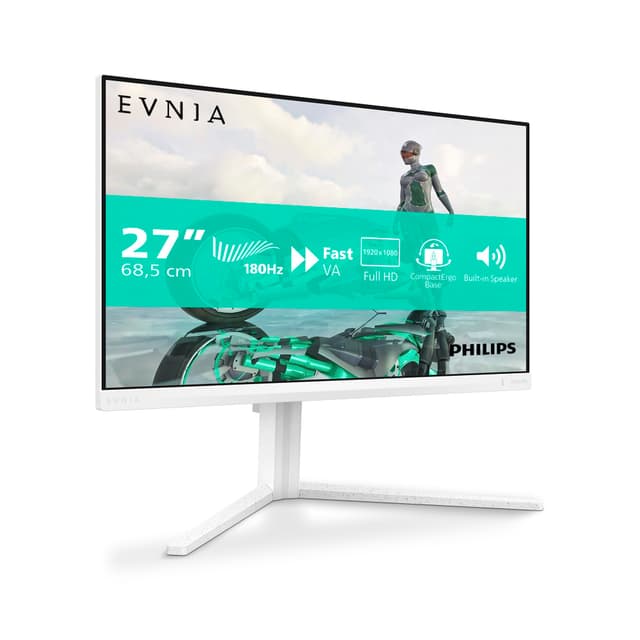
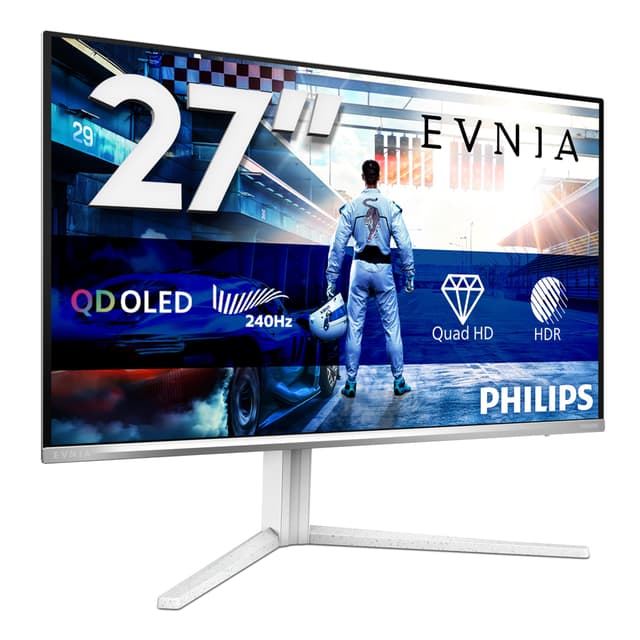
Same QD-OLED panel technology as the number one pick, dressed in white and built for a different buyer. The headline difference is refresh: 280Hz here versus 500Hz on the black X50. For anyone not chasing competitive esports frame rates, that gap barely matters, because a 4070-class card will comfortably feed 280fps in plenty of titles while it would struggle to hit 500.
What you gain is USB-C with 15W power delivery, which the X50 skips. That's enough to keep a phone topped up or run a single-cable setup for a lightweight laptop, though 15W won't fast-charge a gaming laptop. The white chassis is a genuine selling point if you're building a light-themed desk; it's one of the few OLED panels here that isn't matte black. Owners note the coating handles reflections well for an OLED.
HDR sits at TRUE Black 400 rather than the X50's 500, a small step down in certified contrast performance but still a real OLED HDR experience. It costs more than the black 500Hz model, so you're paying a premium for the colour and the USB-C. Worth it only if those two things matter to you. Full detail lives in our MSI MAG 272QPW review.
Pros
- USB-C with 15W power delivery for single-cable tidiness
- White chassis, rare among OLED gaming panels
- Same instant 0.03ms OLED response
- Burn-in covered under MSI's warranty
Cons
- Costs more than the faster 500Hz X50
- 280Hz not 500Hz
- 15W USB-C too weak for gaming laptops
Buy on Amazon£378.95Read full review
Best Value
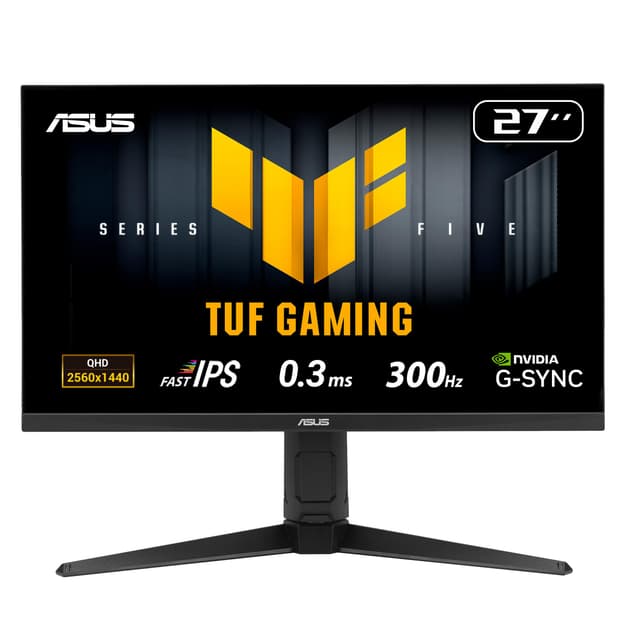
£239 for a 300Hz 1440p panel is the value story of this whole list. The ASUS undercuts every OLED here by a wide margin and still delivers a refresh rate high enough for serious competitive play. It's a fast IPS panel, so you trade OLED's perfect blacks for something that stays punchy and bright in a sunlit room, which for a lot of buyers is the more sensible compromise.
300Hz needs feeding, and that's the honest catch: in demanding AAA titles you'll be nowhere near 300fps even on strong hardware, so the headroom mostly benefits esports players running lighter games. IPS response times are quoted around 1ms MPRT, which is fine but not the near-instant switching of the MSI OLEDs, so expect a touch more motion blur in the very fastest scenes.
Against the Z-Edge 240Hz below, the ASUS costs a bit more but adds 60Hz of refresh and carries the more trusted brand name for panel QC. Against the £367 KTC, it's cheaper and faster but gives up some of the KTC's colour-accuracy credentials. For a pure value fast-IPS gaming buy, this is the pick. More in our ASUS 27-inch 300Hz review.
Pros
- 300Hz for well under £250
- Stays bright in daylight where OLED dims
- No burn-in risk to worry about long term
Cons
- IPS blacks look grey next to any OLED here
- 300fps unrealistic in AAA games
- 1ms MPRT trails OLED's real 0.03ms
Buy on AmazonRead full review
Best for Immersion
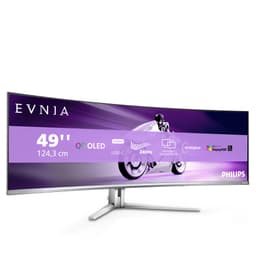
This is the one you buy to replace two monitors with one enormous curved wall of QD-OLED. 5120x1440 is a 32:9 super-ultrawide, which technically doubles a 1440p panel side by side, and on a 49-inch curve it wraps around your field of view for sim racing, flight sims and space games in a way no 27-inch screen manages.
240Hz across that many pixels is demanding, and you'll want a 4080-class GPU to make the most of it in AAA titles. The QD-OLED panel brings the same perfect blacks and instant response as the MSI 27-inch models, just stretched across a far bigger canvas. Owners report the width transforms productivity too: three documents side by side without a bezel in sight.
At £869 it's the most expensive display here by a distance. Against the KOORUI S4941XO, which is also a 49-inch ultrawide for far less, the Philips justifies its premium purely on the QD-OLED panel; the KOORUI can't match the contrast. Desk depth matters, as this needs a proper amount of space. See our Philips Evnia 49-inch review for the full picture.
Pros
- 32:9 QD-OLED replaces a dual-monitor setup
- 240Hz across 5120x1440 is genuinely fast for the format
- Curve suits sim racing and flight perfectly
Cons
- Most expensive display here by a wide margin
- Needs a very deep desk
- Demands a top-tier GPU to feed it
Buy on Amazon£869.99Read full review
Best Ultrawide Value
Want the width of an ultrawide without the £800-plus outlay? The MSI MPG 346CQRF is a 34-inch 21:9 curved panel at around £299, which brings extra horizontal real estate for racing games and productivity at roughly a third the Philips Evnia's price. It's the sensible middle ground for anyone tempted by ultrawide but not ready to remortgage.
The 34-inch 21:9 format shows more of the road or the battlefield either side of centre, and the curve keeps the edges at a consistent viewing distance. It's not OLED, so blacks won't match the MSI QD-OLED panels, but the trade buys you a much friendlier price and no burn-in worry. Against the HKC CG345U, another 34-inch curved ultrawide that's cheaper again, the MSI leans on the stronger brand reputation and MSI's gaming OSD features.
If your desk can take a 34-inch panel and you'd rather have width than the fastest refresh, this beats squeezing onto a 27-inch screen.
Pros
- 34-inch 21:9 ultrawide for around £299
- Curve suits racing and cockpit games
- MSI gaming OSD and preset library
Cons
- IPS-class blacks, not OLED contrast
- Pricier than the HKC 34-inch alternative
- 21:9 needs game support to look right
Buy on Amazon£299.99
Best 240Hz IPS Under £200
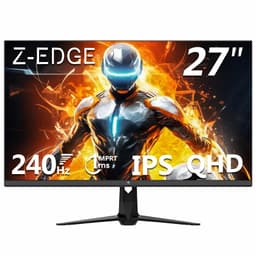
240Hz at 1440p for £199 is a proper bargain, and the Z-Edge earns its place on price-to-refresh alone. It's a fast IPS panel rated at 400cd/m² brightness, enough to stay legible in a normally lit room where OLED would dim itself. The dual DisplayPort and dual HDMI layout is unusually generous at this price, giving you four inputs to juggle a PC, console and laptop.
One thing to watch in that port list: the HDMI ports cap at 144Hz, so you only get the full 240Hz over DisplayPort. Plan your cabling accordingly. Against the ASUS 300Hz above, the Z-Edge is cheaper but 60Hz slower and comes from a less established brand for QC. Against the KOORUI G2721P at the bottom, it's dearer but adds a big chunk of refresh and brightness.
It's VESA mountable, so an arm is an easy addition. A strong choice for a first fast-IPS gaming panel on a tight budget. More in our Z-Edge 27-inch 240Hz review.
Pros
- 240Hz at 1440p for under £200
- Four inputs (2x DP, 2x HDMI)
- 400cd/m² stays usable in daylight
- VESA mountable
Cons
- HDMI ports limited to 144Hz
- Lesser-known brand for panel QC
- HDR10 is basic, not a real HDR experience
Buy on Amazon£179.99Read full review
Best for Colour Work
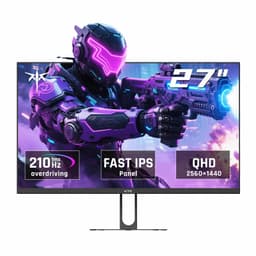
The KTC is the pick for anyone who games and also edits photos or video, because its colour credentials are the strongest of the IPS panels here. 101% DCI-P3 coverage and a factory Delta-E under 2 mean it's close to colour-accurate out of the box, which is rare on a gaming panel and something none of the KOORUI screens claim.
210Hz via overclock keeps it fast enough for most players, and at 450cd/m² it's the brightest IPS panel on this list, useful for HDR400 content and sunny rooms alike. Built-in speakers save a bit of desk clutter, though as ever with monitor speakers they're a convenience rather than a reason to skip proper audio.
At around £367 it costs more than the faster ASUS 300Hz but buys you the colour accuracy that gamers who also create will value. If you only game, the ASUS is the better spend; if you split time with creative work, the KTC earns the difference.
Pros
- 101% DCI-P3 and Delta-E under 2 out of the box
- 450cd/m², brightest IPS panel here
- Built-in speakers
Cons
- 210Hz OC trails the ASUS 300Hz
- Dearer than faster pure-gaming rivals
- Speakers are basic
Buy on Amazon
Best Mid-Budget Contrast
At £399 the KOORUI S2721XO sits in awkward company, because that's the same money as the white MSI QD-OLED sibling territory once you shop around. Its appeal is contrast on a 27-inch 1440p panel for buyers loyal to the KOORUI range or catching it on offer. It's a competent gaming display, but the value maths is tighter than the cheaper KOORUI screens further down.
Against the ASUS 300Hz, which costs £160 less, the KOORUI struggles to justify the gap on refresh alone. Where it makes more sense is if you specifically want the deeper contrast KOORUI's higher panels offer over a standard fast IPS, and you're not chasing the highest frame rates. Owners rate the build and stand favourably.
A solid panel, but priced into a corner by better-value rivals on this very list.
Pros
- Stronger contrast than basic IPS
- Well-regarded build and stand
- 27-inch 1440p sweet spot
Cons
- £399 buys close to MSI OLED territory
- Undercut heavily by the ASUS 300Hz
- Refresh not a headline strength
Buy on Amazon£399.99
Best Budget Super-Ultrawide
The KOORUI S4941XO is the budget alternative to the Philips Evnia: a 49-inch 32:9 super-ultrawide at £799 rather than £869. That's not a huge saving on paper, but the KOORUI aims at buyers who want the sheer scale of a 49-inch curve without a top-tier QD-OLED price tag climbing further.
You get the same immersive width for sim racing and multi-window productivity, wrapping across your peripheral vision. The trade against the Philips is panel technology: the KOORUI can't match QD-OLED's perfect blacks and instant response, so dark scenes look greyer and fast motion isn't as crisp. For the price gap here, most buyers should stretch to the Philips if OLED contrast matters; the KOORUI makes sense only if you find it discounted well below the Evnia.
Desk depth is the same practical concern as any 49-inch panel. Big screen, big footprint.
Pros
- 49-inch 32:9 immersion below Evnia money
- Replaces a dual-monitor layout
- Wide curve suits racing and sims
Cons
- Can't match the Philips QD-OLED contrast
- Only modestly cheaper than the far better Evnia
- Needs a very deep desk
Buy on Amazon£799.99
Best Curved Under £250
A 34-inch curved ultrawide for £229 is the HKC's whole pitch, and it's a decent one. That's cheaper than the MSI MPG 346CQRF for a similar 21:9 format, so it's the budget route into ultrawide gaming. You give up MSI's brand pedigree and OSD polish, and the panel won't match OLED contrast, but for width on a strict budget it delivers.
Pros
- Cheapest 34-inch ultrawide here
- Curve aids racing and immersion
Cons
- Lesser-known brand for QC
- Basic OSD versus the MSI ultrawide
Buy on Amazon£229.99
Best for Bundled Extras
The KOORUI S2721BO is the hardest sell here at £499, because that money buys a QD-OLED MSI in the same size class. It's a 27-inch 1440p panel that leans on bundle and build rather than a standout spec. Unless you catch a heavy discount, the value isn't there against the OLED options above it and the cheaper KOORUI panels below.
Pros
- Solid KOORUI build quality
- 27-inch 1440p standard size
Cons
- £499 overlaps with far better OLED panels
- No headline spec to justify the price
Buy on Amazon£499.99
Best Under £120
At £119 the KOORUI G2721P is the cheapest way onto a 1440p high-refresh panel on this list, and that alone earns it a place. It skips the OLED contrast, the USB-C and the sky-high refresh of the pricier models, but for a first proper gaming monitor it's hard to fault the price. Against the £199 Z-Edge, you lose refresh and brightness but save £80.
Pros
- Cheapest 1440p gaming panel here
- Great first-monitor value
Cons
- Basic panel, no OLED or high brightness
- Lower refresh than dearer rivals
Buy on Amazon£119.99