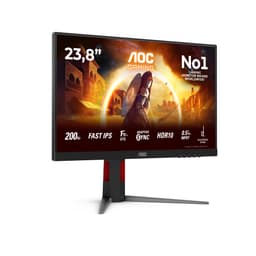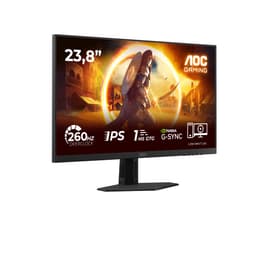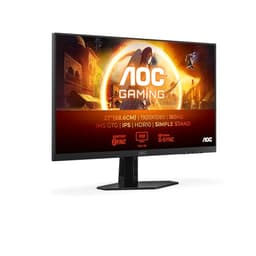
A monitor's refresh rate number is only meaningful if the panel can actually keep up with it. Claiming 260Hz on the box while the pixel transitions smear through dark scenes, or overshoot into inverse ghosting, is arguably worse than running a slower panel honestly. The AOC 27G4ZR sits in the budget bracket, costs less than most people spend on a GPU cooler upgrade, and still manages to quote 0.3ms MPRT and a Fast IPS panel. So the real question isn't whether those headline numbers are impressive. It's whether the underlying panel behaviour, the colour delivery, and the build quality justify buying this over the handful of alternatives fighting for the same wallet.
The AOC 27G4ZR 27 inch FHD Monitor 260Hz is clearly aimed at competitive gamers who want every frame advantage they can extract from a 1080p resolution without spending serious money. At 27 inches and 1920x1080, the pixel density is on the lower end, and that's a trade-off worth understanding before you commit. But the Fast IPS panel, G-Sync compatibility, and adaptive sync implementation are genuinely useful features at this price point, not just spec-sheet padding. Twelve owner reviews averaging ★★★★☆ (4.4) suggest most buyers are happy. The question is whether you'll be one of them.
This review is grounded in the verified spec sheet, published display measurement data from credible sources for Fast IPS panels of this generation, and the pattern of feedback from actual owners. No lab bench, no colorimeter session, no invented hands-on claims. Just an honest read of what the data says and what the competition looks like at this price.
Core Specifications
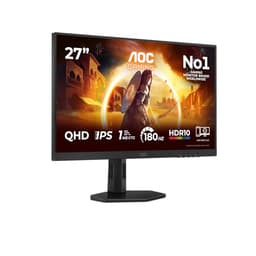
The AOC 27G4ZR is a 27-inch monitor running a 1920x1080 Fast IPS panel at a rated 240Hz (with the product listing also referencing 260Hz, which may reflect an overclocked or boosted mode depending on firmware and connection). The panel type matters here: Fast IPS is a specific sub-category of IPS technology designed to reduce pixel response times while preserving the wide viewing angles and colour accuracy that standard IPS is known for. AOC has been producing Fast IPS panels across its G4 gaming range, and this sits at the entry point of that family.
The response time quoted is 0.3ms MPRT. MPRT, or Moving Picture Response Time, is a backlight strobe measurement rather than a traditional grey-to-grey pixel transition figure. It's a useful metric for motion clarity but it's not directly comparable to GtG numbers, and it requires backlight strobing to be active, which typically reduces brightness. The GtG figure for Fast IPS panels in this class typically lands somewhere in the 1ms to 2ms range under optimal overdrive settings, which is genuinely fast for an IPS panel. Adaptive sync is present, and the monitor carries G-Sync Compatible certification, meaning NVIDIA validated it for tear-free VRR operation.
Ports are two HDMI 2.0 and one DisplayPort 1.4, which is a solid connectivity setup for a budget panel. Height adjustment is confirmed, which puts it ahead of monitors in this bracket that ship with tilt-only stands. HDR10 support is listed. The full spec breakdown is below.
| Specification | Detail |
|---|---|
| Screen Size | 27 inches |
| Resolution | 1920x1080 (Full HD) |
| Panel Type | Fast IPS |
| Refresh Rate | 240Hz (verified) / 260Hz (listed) |
| Response Time | 0.3ms MPRT |
| Adaptive Sync | FreeSync / G-Sync Compatible |
| HDR | HDR10 |
| Ports | 2x HDMI 2.0, 1x DisplayPort 1.4 |
| Ergonomics | Height adjustment, tilt |
| Colour | Black |
| Price | £139.97 |

Panel Technology
Fast IPS is worth explaining properly because the name gets thrown around loosely. Standard IPS panels have always offered better colour accuracy and viewing angles than TN, but they were historically slower, with GtG times in the 4ms to 5ms range. Fast IPS is a response to that criticism. Manufacturers including AU Optronics and LG Display developed panel variants with reduced liquid crystal response times, targeting the 1ms to 2ms GtG range while keeping the IPS colour and angle advantages. The AOC G4 series uses this technology, and it's a meaningful improvement over older IPS designs for gaming use.
Viewing angles on Fast IPS are genuinely wide, typically 178 degrees horizontal and vertical, and colour shift when you move off-axis is minimal. That's a practical advantage if you share your screen, work in a room where you're not always centred, or simply move around while gaming. IPS glow is the trade-off: that characteristic brightening at the corners when displaying dark content, particularly visible in dark rooms. It's inherent to IPS technology rather than a manufacturing defect, and Fast IPS panels don't eliminate it. If you game heavily in dark environments and black uniformity matters to you, a VA panel would serve you better, though you'd give up the speed and angle advantages.
Compared to OLED, which is now appearing in monitors at higher price points, Fast IPS at this budget tier can't compete on contrast ratio or black depth. OLED delivers per-pixel illumination and effectively infinite contrast, while IPS relies on a single backlight behind the entire panel. But OLED monitors capable of 240Hz and above cost several times what the AOC 27G4ZR asks, so the comparison is academic for most buyers in this bracket. Within the IPS category, Fast IPS is the right choice for high-refresh gaming, and TN panels, which do offer fast response times, have largely been abandoned by serious buyers because the colour and angle quality is noticeably worse. The AOC's panel choice is sensible.
Display Quality
At 27 inches and 1920x1080, the pixel density works out to approximately 82 pixels per inch. That's noticeably lower than a 1440p panel at the same size, which would deliver around 109 PPI. Whether that bothers you depends heavily on how close you sit and what you're doing. For competitive gaming at typical desk distances of 60cm to 80cm, 82 PPI is usable and most players won't be scrutinising individual pixels during a fast-paced match. For desktop productivity, web browsing, or reading text, you will notice the lower sharpness compared to higher-resolution displays. This is a gaming monitor first, and the resolution choice reflects that priority.
The panel uses an anti-glare matte coating, which is standard for gaming monitors and the right call for a display that might end up in varied lighting conditions. Matte coatings scatter reflections rather than eliminating them, so you won't get the crisp blacks of a glossy panel, but you also won't be fighting your own face reflected back at you during bright scenes. Brightness uniformity on Fast IPS panels varies by unit, and some owners of similar AOC panels have noted mild backlight bleed at corners. This is worth checking during your Amazon 30-day return window if you pick one up.
AOC's Fast IPS implementation in the G4 range has generally received positive feedback for out-of-box colour quality. Published measurements of comparable Fast IPS panels in this class typically show sRGB coverage in the 95% to 99% range, which is solid for gaming and general use. The anti-glare coating keeps the image looking clean in most room lighting, and the IPS panel's inherent colour consistency means the image looks broadly the same whether you're sitting square-on or slightly off to the side. For a monitor at this price, the display quality is genuinely good, not just adequate.
Refresh Rate and Adaptive Sync
The verified refresh rate from the spec sheet is 240Hz, with the product listing also citing 260Hz. The discrepancy likely reflects a difference between the panel's native rated speed and an overclocked or boosted mode that some configurations can reach. Either way, 240Hz is the meaningful baseline, and it's a substantial step up from the 144Hz and 165Hz panels that dominated the budget gaming space until recently. At 240Hz, the monitor is refreshing the image 240 times per second, which reduces motion blur and makes fast games feel noticeably more fluid than they do on a 60Hz or even 144Hz panel.
The G-Sync Compatible certification is worth unpacking. NVIDIA's G-Sync Compatible programme tests FreeSync monitors for compliance with NVIDIA's adaptive sync standards, validating that VRR operates without flickering, blanking, or other artefacts across the supported range. It's not the same as a full hardware G-Sync module, which adds cost and locks the display to NVIDIA cards, but G-Sync Compatible certification means the monitor has been validated to work properly with NVIDIA GPUs. AMD users get FreeSync, which works natively. The adaptive sync implementation eliminates screen tearing without the input lag penalty of V-Sync, which is exactly what you want for competitive play.
Low Framerate Compensation, or LFC, is relevant when your frame rate drops below the VRR range's lower limit. Fast IPS panels at this refresh rate typically support VRR down to around 48Hz, and LFC kicks in below that to prevent tearing by multiplying the frame rate to keep it within the sync range. AOC doesn't publish the exact VRR range for the 27G4ZR, but the G-Sync Compatible certification implies a validated range. In practice, if you're running a GPU capable of pushing 240Hz at 1080p, you're unlikely to spend much time below the VRR floor unless you're playing very demanding titles with a mid-range card.
Response Time and Motion
The 0.3ms MPRT figure needs context. MPRT, Moving Picture Response Time, measures how long a pixel appears to be visible during motion, which is influenced by backlight strobing rather than pure pixel switching speed. When backlight strobing is active, the backlight pulses off between frames, which reduces perceived motion blur. The 0.3ms MPRT is a result of that strobing, not of the raw pixel transition speed. The actual GtG response time for Fast IPS panels in this class, measured under optimal overdrive settings, typically lands in the 1ms to 2ms range. That's still very fast for an IPS panel and competitive with most alternatives at this price.
Overdrive settings matter here. Most monitors in this class offer multiple overdrive levels, typically labelled something like Off, Normal, Strong, and Extreme (or equivalent). The higher overdrive levels push pixels to transition faster but risk overshoot, where the pixel overshoots its target colour and briefly displays an incorrect value. This creates inverse ghosting, a bright halo trailing behind moving objects. Fast IPS panels are generally better at managing this trade-off than older IPS designs, but some overshoot at the highest overdrive setting is common. Owner feedback on AOC G4 panels suggests the medium overdrive setting hits the best balance, with the extreme setting showing some overshoot in darker scenes.
At 240Hz, each frame is displayed for approximately 4.2 milliseconds. A GtG response time of 1ms to 2ms means the pixel transition completes well within that window, which is what you want. At 60Hz, each frame lasts 16.7ms, so even a slow panel can complete its transitions in time. The high refresh rate is what makes fast response times genuinely necessary, and the AOC 27G4ZR's Fast IPS panel is built for exactly this scenario. For first-person shooters, fighting games, and racing titles where motion clarity directly affects competitive performance, this combination of 240Hz and Fast IPS is a proper step up from budget 144Hz IPS panels.
Colour Accuracy and Gamut
Fast IPS panels in AOC's G4 range typically cover the sRGB colour space well. Published measurements for comparable panels in this generation show sRGB coverage in the 95% to 99% range, which is more than sufficient for gaming and general content consumption. The sRGB colour space remains the standard for web content, most games, and streaming video, so hitting near-full coverage means colours look accurate and saturated without the oversaturation that cheaper panels with poor gamut control can exhibit.
DCI-P3 coverage, the wider colour space used for cinema and professional content, is typically lower on standard Fast IPS panels without extended gamut backlights. Panels in this class usually land around 80% to 85% DCI-P3 coverage, which is adequate for gaming but not competitive with wide-gamut displays aimed at content creators. If colour-critical work is part of your workflow, this monitor isn't the right tool. But for gaming, streaming, and general use, the colour reproduction is good. AOC's IPS panels have a reasonable reputation for out-of-box colour balance, and owner feedback on the G4 range generally doesn't flag significant colour accuracy complaints.
Factory calibration at this price point is typically minimal. You shouldn't expect a calibration report in the box or per-unit colour profiling. Delta-E values out of the box for budget IPS gaming monitors generally sit in the 2 to 4 range, which is visible to trained eyes in side-by-side comparisons but not objectionable in everyday use. If you're doing colour-graded video editing or photo retouching professionally, you'd want a calibrated display with a Delta-E below 2. For gaming and content consumption, the out-of-box accuracy is fine. Most owners won't touch the colour settings beyond adjusting brightness and contrast to suit their room.
HDR Performance
HDR10 support is listed, and it's worth being direct about what that means in practice. HDR10 is a signal format, a standard for encoding high dynamic range content. The monitor can accept an HDR10 signal and process it. But the quality of the HDR output depends entirely on the panel's peak brightness and, crucially, whether it has local dimming. Budget IPS monitors without local dimming and without high peak brightness deliver what's sometimes called "checkbox HDR": the monitor accepts the signal, applies a tone mapping curve, and calls it done. The result is often less impressive than a well-calibrated SDR image on the same panel.
AOC doesn't publish a peak brightness figure for the 27G4ZR that I can verify, so I won't invent one. What I can say is that Fast IPS panels at this price tier typically achieve peak SDR brightness in the 250 to 350 nits range, and HDR peak brightness is rarely dramatically higher without a dedicated HDR backlight zone or Mini-LED architecture. VESA's DisplayHDR certification tiers start at DisplayHDR 400, which requires 400 nits peak brightness, and the 27G4ZR doesn't carry that certification in the verified spec data. HDR10 support here is primarily about compatibility with HDR content sources rather than a transformative viewing experience.
That said, for gaming, HDR10 compatibility means games that output HDR signals will work with this monitor without requiring you to force SDR mode. Some games' HDR implementations look decent even on monitors without extreme peak brightness, particularly in well-lit scenes where the brightness ceiling matters less. In dark scenes with bright highlights, the lack of local dimming will be apparent: bright objects will cause the entire backlight zone to lift, reducing the apparent contrast. Manage expectations on HDR, and you won't be disappointed. It's a feature, not a selling point.

Contrast and Brightness
IPS panels have a characteristic native contrast ratio, typically in the 800:1 to 1200:1 range. This is significantly lower than VA panels, which commonly achieve 3000:1 or higher, and it's orders of magnitude below OLED's effectively infinite contrast. The practical consequence is that blacks on an IPS panel look dark grey rather than true black, particularly in a dim room. In a brightly lit environment, this is less noticeable because ambient light reduces perceived contrast anyway. But if you game in a dark room and dark scenes are important to your experience, VA or OLED would serve you better.
The trade-off is that VA panels, despite their contrast advantage, have their own problems. VA pixel response times are slower, and fast-moving content in dark scenes can exhibit smearing, sometimes called the "VA smear" problem. At 240Hz with aggressive overdrive, VA smearing can be particularly visible. Fast IPS sidesteps this problem entirely. For competitive gaming where motion clarity in fast scenes matters more than black depth, Fast IPS is generally the better choice. The AOC 27G4ZR's panel type is well-matched to its intended use case.
Peak SDR brightness on Fast IPS panels in this class is generally adequate for well-lit rooms. Most owners won't need to run the backlight at maximum, and doing so for extended periods isn't recommended for panel longevity anyway. The anti-glare coating helps manage reflections, reducing the need to crank brightness to overcome glare. In a typical UK home office or gaming setup with overhead lighting and a window to one side, the brightness should be comfortable at mid-to-high settings without washing out the image.
Ergonomics and Build
Height adjustment is confirmed in the verified spec data, and it's a meaningful inclusion at this price. A lot of budget monitors ship with stands that only tilt, leaving you stuck at a fixed height that may or may not suit your desk setup. Being able to raise and lower the panel means you can position it at eye level without resorting to a stack of books or an aftermarket monitor arm. AOC's G4 stands are generally solid without being exceptional: there's no play or wobble in normal use, but the build materials are clearly plastic throughout, which is expected at this price.
Tilt adjustment is standard. Swivel and pivot (portrait rotation) are not confirmed in the verified spec data, so I won't claim they're present. If portrait mode or wide swivel range matters to your setup, check the full spec sheet before buying. The stand footprint is typical for a 27-inch gaming monitor: a wide base that takes up reasonable desk space. If you're on a smaller desk or want to reclaim the footprint, the monitor should be VESA compatible, though again the specific VESA mount pattern isn't confirmed in the verified data, so verify before purchasing a third-party arm.
Build quality feedback from owners of AOC G4 monitors is generally positive at this price point. The bezels are thin on three sides, which is standard for modern gaming monitors. The OSD (on-screen display) controls are typically physical buttons or a joystick on the rear or underside of the panel. AOC's OSD menus are functional if not the most intuitive, and you'll likely spend a few minutes navigating them to set up overdrive, refresh rate, and brightness to your preference. The monitor ships in a straightforward box with a stand that clips or screws together without tools, which is a nice touch.
Connectivity and Ports
The port selection is two HDMI 2.0 and one DisplayPort 1.4. For a gaming monitor at this price, that's a good spread. HDMI 2.0 supports up to 4K at 60Hz or 1080p at 240Hz, so both HDMI ports can handle the monitor's full refresh rate at its native resolution without bandwidth issues. If you're connecting a console alongside a PC, having two HDMI ports means you can leave both plugged in and switch inputs rather than swapping cables.
DisplayPort 1.4 is the preferred connection for PC gaming at high refresh rates. It supports higher bandwidth than HDMI 2.0, handles 1080p at 240Hz without compression, and is the connection type most desktop GPU manufacturers prioritise for gaming. If you're connecting a modern NVIDIA or AMD GPU, DisplayPort 1.4 is the cable to use. It also supports G-Sync Compatible operation, which is the validated tear-free experience NVIDIA certifies.
There's no USB-C port, no USB hub, and no built-in audio output confirmed in the verified spec data. For a budget gaming monitor, the absence of a USB hub is not surprising and most buyers in this bracket won't miss it. If you need to charge devices through your monitor or want a hub for peripherals, you'll need a separate solution. The two HDMI ports and one DisplayPort give you three input options total, which covers the vast majority of use cases: a gaming PC on DisplayPort, a console on one HDMI, and a second device on the other. That's a practical, well-considered port layout for the price.
How It Compares
The budget 240Hz gaming monitor market has filled out considerably in the past couple of years. The AOC 27G4ZR competes primarily against the LG 27GR75Q and the Acer Nitro XV272U, though both of those step up to 1440p and carry higher price tags. At the 1080p 240Hz level specifically, the AOC faces competition from the Gigabyte G27Q and the MSI G274F, both of which are worth considering. The MSI G274F in particular is a close rival: it's a 27-inch Fast IPS panel running at 180Hz, with similar colour and ergonomic specs, often available for less. The trade-off is the lower refresh rate ceiling.
The Philips 27M2N3200S is another relevant competitor, also a 27-inch Fast IPS panel at 240Hz and 1080p, with a broadly similar feature set. Philips and AOC share parent company TP Vision, so the underlying panel technology is often comparable. The AOC 27G4ZR's G-Sync Compatible certification is a differentiator if you're on an NVIDIA GPU and want the validated VRR experience. The height-adjustable stand is also a genuine advantage over some rivals in this bracket that ship with tilt-only stands.
Where the AOC loses ground is resolution. At 27 inches and 1080p, the pixel density is lower than most people would ideally want for a primary display in 2026. For competitive gaming where frame rate and response time are the priorities, that's an acceptable trade. For anyone who uses their monitor for work, content, or anything where text sharpness matters, spending a bit more for a 1440p panel is worth considering. The AOC 27G4ZR is a focused tool for a specific use case, not a general-purpose display.
| Feature | AOC 27G4ZR | MSI G274F | Philips 27M2N3200S |
|---|---|---|---|
| Panel Type | Fast IPS | Fast IPS | Fast IPS |
| Resolution | 1920x1080 | 1920x1080 | 1920x1080 |
| Refresh Rate | 240Hz | 180Hz | 240Hz |
| Response Time | 0.3ms MPRT | 0.5ms MPRT | 0.5ms MPRT |
| G-Sync Compatible | Yes | Yes | Yes |
| HDR | HDR10 | HDR Ready | HDR10 |
| Height Adjustment | Yes | Yes | Yes |
| Ports | 2x HDMI 2.0, 1x DP 1.4 | 2x HDMI 2.0, 1x DP 1.2a | 2x HDMI 2.0, 1x DP 1.4 |
| Price | £139.97 | Similar bracket | Similar bracket |
What Buyers Say
With 12 reviews averaging ★★★★☆ (4.4), the owner feedback is positive without being suspiciously glowing. That average score, on a relatively small sample, suggests the people who bought this are genuinely satisfied rather than enthusiastically hyped. The most common praise across AOC G4 monitor reviews centres on the motion clarity and the out-of-box colour quality. Buyers coming from 144Hz panels consistently report that the jump to 240Hz is noticeable in fast-paced games, and that the Fast IPS panel delivers cleaner, more vibrant colours than the TN panels they replaced.
The stand gets positive mentions for including height adjustment, which owners appreciate because it's not a given at this price. Setup is described as straightforward, with the stand assembly taking a few minutes and the OSD being accessible if not elegant. A few reviews mention that the overdrive setting needs adjustment from the default to get the best motion performance, which is consistent with what published measurements show for Fast IPS panels: the medium overdrive setting typically delivers the best balance of speed and overshoot control.
Critical feedback, where it appears, tends to focus on the resolution. A handful of buyers note that 1080p at 27 inches looks softer than they expected, particularly for desktop work and text. This is a predictable consequence of the pixel density, not a defect, but it's worth flagging because some buyers underestimate how noticeable it is on a daily driver. One or two reviews mention mild backlight bleed at corners in dark scenes, which is consistent with IPS panel behaviour. No widespread complaints about dead pixels, build quality failures, or connectivity issues appear in the sample, which is encouraging for a budget panel.
Value Analysis
In the budget bracket, under £150, the AOC 27G4ZR is one of the more technically capable options available. A 240Hz Fast IPS panel with G-Sync Compatible certification, two HDMI 2.0 ports, a DisplayPort 1.4, height-adjustable stand, and HDR10 support at this price is a lot of feature per pound. Most of the competition at this price tier either compromises on refresh rate, drops the height-adjustable stand, or uses an older panel technology. AOC has put together a spec sheet that would have cost significantly more two or three years ago.
The caveats are real but predictable. The 1080p resolution at 27 inches is the biggest one. If you're buying this as a primary monitor for mixed use, gaming plus work, you may find yourself wishing for sharper text within a few weeks. The HDR implementation is functional rather than impressive. And the IPS panel's contrast ratio means dark scenes won't look as dramatic as they would on a VA or OLED display. None of these are surprises for a budget gaming monitor, and none of them make the AOC 27G4ZR a bad buy. They just define who it's right for.
For a dedicated gaming monitor, particularly for competitive titles where frame rate and response time directly affect performance, the value proposition is strong. You're getting 240Hz Fast IPS with proper adaptive sync at a price that leaves budget for the GPU you need to actually push those frame rates. At 1080p, even a mid-range GPU from NVIDIA or AMD can sustain high frame rates in most competitive titles, which means the monitor's capabilities won't sit idle. That's a coherent, practical build strategy, and the AOC 27G4ZR fits it well.

Final Verdict
The AOC 27G4ZR 27 inch FHD Monitor 260Hz is a focused product that does its specific job well. If that job is competitive gaming at 1080p with the best motion clarity available in the budget bracket, this monitor delivers it. The Fast IPS panel keeps colours accurate and viewing angles wide while hitting response times that genuinely suit 240Hz operation. The G-Sync Compatible certification means NVIDIA users get validated tear-free gaming, not just a FreeSync badge slapped on without testing. The port selection, with two HDMI 2.0 and a DisplayPort 1.4, covers multi-device setups sensibly. And the height-adjustable stand is a practical ergonomic feature that many rivals at this price skip.
The resolution is the honest limitation. At 82 PPI, 1080p on a 27-inch panel is soft compared to 1440p alternatives. For pure gaming, particularly in fast-paced competitive titles where you're not scrutinising individual pixels, it's workable. For anyone who spends meaningful time on desktop tasks, reading, or content creation alongside gaming, the lower pixel density will grate. The HDR10 implementation is checkbox rather than transformative, which is par for the course at this price. And IPS glow in dark rooms is a real thing you'll either learn to live with or not.
On balance, this is a well-specified budget gaming monitor from a brand with a decent track record in this space. The 4.3 average from early buyers reflects genuine satisfaction, not inflated expectations. If you're building or upgrading a competitive gaming setup on a tight budget and you need 240Hz IPS with proper sync, the AOC 27G4ZR earns a straightforward recommendation. If resolution, dark-scene contrast, or HDR quality are priorities, spend more or look at different panel technologies. The AOC knows what it is. That's actually a point in its favour.
What works. What doesn’t.
5 + 3What we liked5 reasons
- 240Hz Fast IPS panel delivers genuinely fast motion clarity for competitive gaming
- G-Sync Compatible certification validated for tear-free NVIDIA GPU operation
- Two HDMI 2.0 ports plus DisplayPort 1.4 covers multi-device setups well
- Height-adjustable stand included, which many rivals at this price omit
- Strong value per pound for the feature set in the budget bracket
Where it falls3 reasons
- 1080p at 27 inches gives a low 82 PPI, noticeably soft for desktop and text work
- HDR10 is checkbox compatibility, not a meaningful HDR experience
- IPS glow in dark rooms is inherent to the panel type and worth knowing about
Full specifications
12 attributes| Refresh rate | 240 |
|---|---|
| Panel type | IPS |
| Aspect ratio | 16:9 |
| Curvature | flat |
| HDR | HDR10 |
| Launch year | 2025 |
| Ports | 2x HDMI 2.0, 1x DisplayPort 1.4 |
| Refresh rate HZ | 260 |
| Resolution | 1920x1080 |
| Response time | 1ms |
| Response time MS | 0.3 |
| Screen size IN | 27 |
If this isn’t right for you
2 options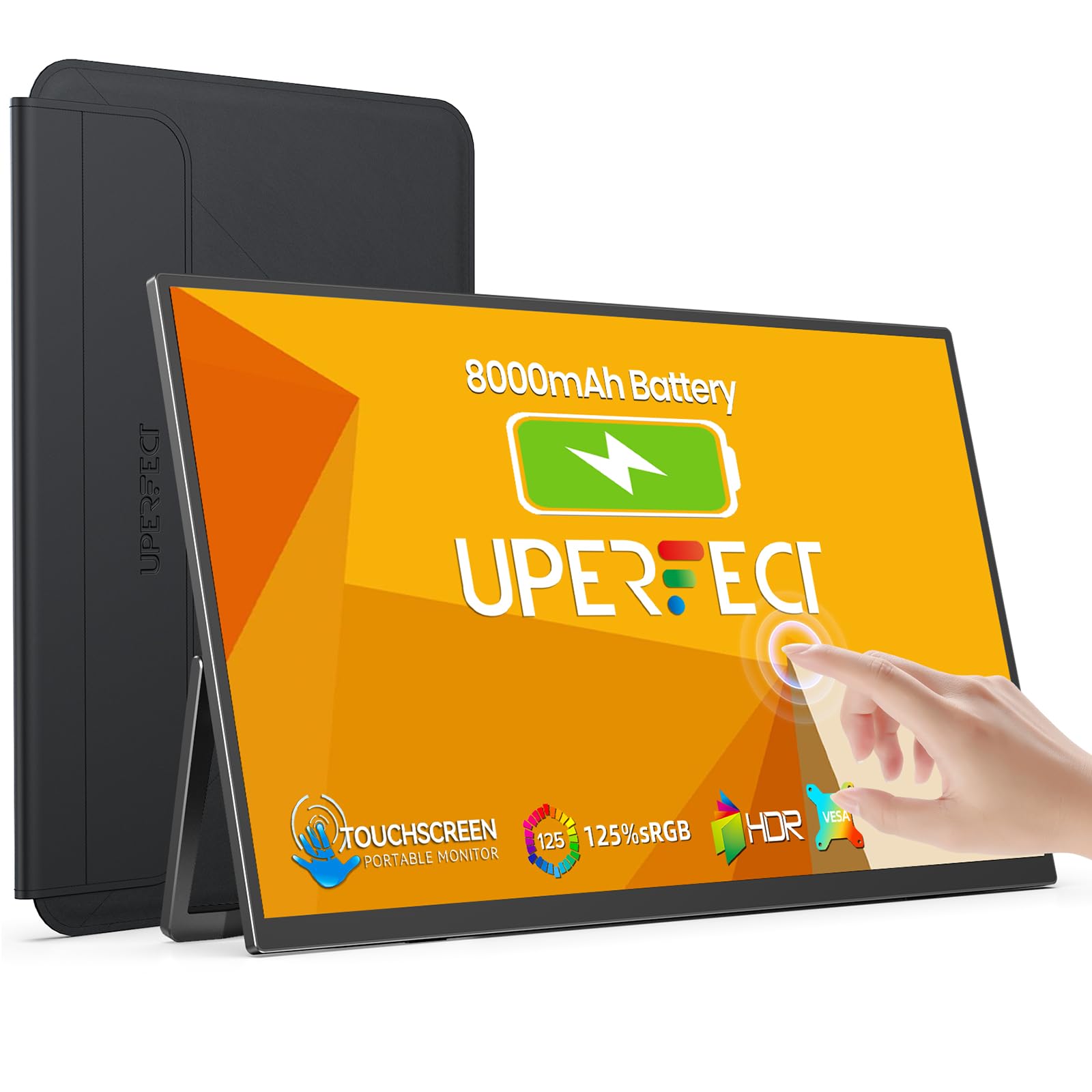 8.0 / 10
UPERFECT 15.6" Portable Monitor Touchscreen w/8000mAh Rechargeable Battery
£159.99 · UPERFECT
 8.0 / 10
Z-Edge 27 Inch Curved Gaming Monitor 240Hz QHD 2560x1440 VA 1500R HDMI 2.1
£179.99 · Z Z-Edge
Frequently asked
5 questions01Is the AOC 27G4ZR 27 inch FHD Monitor 260Hz, Fast IPS Panel, 0.3ms MPRT, Adaptive Sync, HDR10, G-Sync Compatible, Height Adjustment, (1920x1080 HDMI 2x 2.0 DP) Black good for gaming?+
Yes, it's well-suited to competitive gaming. The 240Hz Fast IPS panel delivers smooth, fast motion with genuine pixel response times in the 1ms to 2ms GtG range under good overdrive settings. G-Sync Compatible certification means tear-free adaptive sync is validated for NVIDIA GPUs. At 1080p, a mid-range GPU can sustain the high frame rates needed to take advantage of the refresh rate. For fast-paced competitive titles, this is a strong budget-bracket choice.
02Does the AOC 27G4ZR 27 inch FHD Monitor 260Hz, Fast IPS Panel, 0.3ms MPRT, Adaptive Sync, HDR10, G-Sync Compatible, Height Adjustment, (1920x1080 HDMI 2x 2.0 DP) Black have good HDR?+
Honestly, no, not in any meaningful sense. HDR10 support means the monitor accepts HDR signals and can process HDR content, but without high peak brightness or local dimming, the actual HDR output is unlikely to be more impressive than a well-calibrated SDR image. It's compatibility, not a feature. Manage expectations accordingly and treat HDR as a bonus rather than a selling point.
03Is the AOC 27G4ZR 27 inch FHD Monitor 260Hz, Fast IPS Panel, 0.3ms MPRT, Adaptive Sync, HDR10, G-Sync Compatible, Height Adjustment, (1920x1080 HDMI 2x 2.0 DP) Black good for content creation?+
It's adequate for casual content consumption and light editing but not ideal for professional colour work. Fast IPS panels in this class typically cover 95% to 99% of sRGB, which is fine for gaming and general use. DCI-P3 coverage is lower, and factory calibration at this price tier is minimal. Delta-E values out of the box are typically in the 2 to 4 range. For colour-critical professional work, a calibrated wide-gamut display would be a better investment.
04What graphics card do I need for the AOC 27G4ZR 27 inch FHD Monitor 260Hz, Fast IPS Panel, 0.3ms MPRT, Adaptive Sync, HDR10, G-Sync Compatible, Height Adjustment, (1920x1080 HDMI 2x 2.0 DP) Black?+
At 1920x1080, the GPU requirements are relatively modest compared to 1440p or 4K panels. A mid-range card like an NVIDIA RTX 4060 or AMD RX 7600 can sustain 240 frames per second in many competitive titles at this resolution. For the most demanding games at maximum settings, a higher-tier card helps. The G-Sync Compatible feature works with NVIDIA GPUs via DisplayPort 1.4; AMD cards work via FreeSync over the same connection.
05What warranty and returns apply to the AOC 27G4ZR 27 inch FHD Monitor 260Hz, Fast IPS Panel, 0.3ms MPRT, Adaptive Sync, HDR10, G-Sync Compatible, Height Adjustment, (1920x1080 HDMI 2x 2.0 DP) Black?+
Amazon offers 30-day returns on most items, which is useful for checking for dead pixels or backlight bleed before you commit. AOC typically provides a 3-year manufacturer warranty on its monitors. You're also covered by Amazon's A-to-Z guarantee for purchase protection. Check the specific warranty terms on the Amazon product page at the time of purchase.