
Specs on paper and specs in practice are two different things. A monitor can look brilliant in a bullet-point list and be genuinely frustrating to sit in front of every day. So the question with the Gawfolk 32 Inch 4K UHD Curved 1500R Computer Monitor isn't just whether the numbers add up. It's whether those numbers translate into something you'd actually want on your desk.
The short answer is: mostly yes, with some real caveats. This is a 32-inch VA panel at 4K, 60Hz, with a tight 1500R curve, 100% sRGB coverage, and a port selection that's genuinely useful. At the mid-range price point it sits in, it's competing against some decent IPS alternatives. For the right buyer, it's a solid deal. For others, it's the wrong tool entirely. We'll get into exactly which is which.
Owner feedback sits at ★★★½☆ (3.6) across 9 reviews on Amazon, which is a low enough sample to take with a pinch of salt but honest enough to flag some patterns worth discussing. Picture quality gets genuine praise. The 60Hz ceiling and some stand limitations come up more than once. None of that is surprising once you look at the spec sheet properly.
Core Specifications: Gawfolk 32 Inch 4K UHD Curved 1500R Computer Monitor
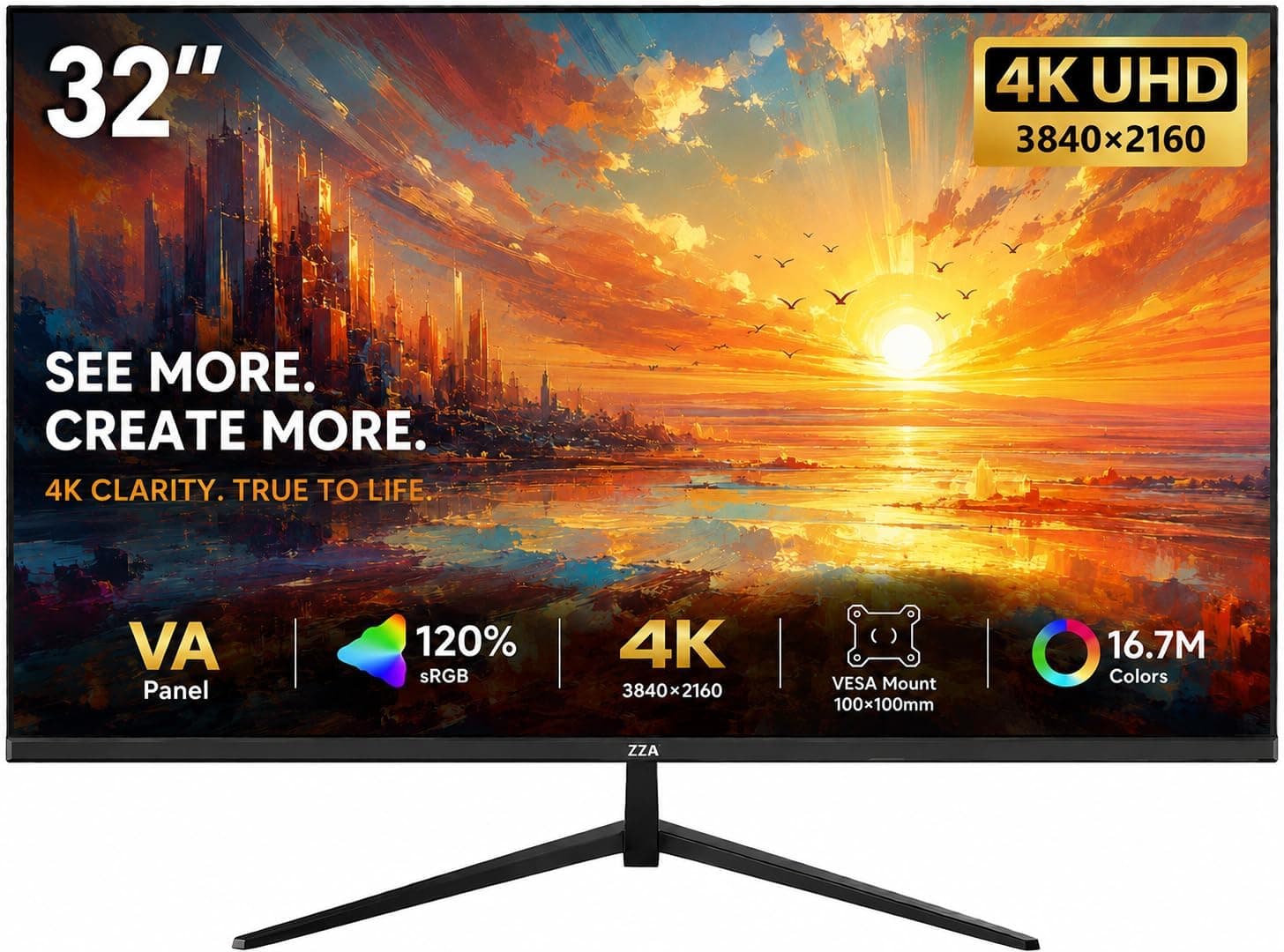
The headline specs are straightforward. You get a 32-inch VA panel running at 3840x2160 (4K UHD), with a 60Hz refresh rate. The curve is 1500R, which is one of the tighter curves you'll find on a 32-inch screen. Pixel density lands at 138 PPI, which is genuinely sharp for a monitor of this size. Text rendering at native resolution is crisp without any scaling tricks needed.
Connectivity is properly sorted for a monitor in this bracket. Dual HDMI and dual DisplayPort means you can have four devices plugged in simultaneously without ever touching a cable. That's a practical advantage that a lot of budget monitors skip. The listing specifies HDMI 2.0 and DisplayPort 1.4, which are the right versions for 4K at 60Hz without any compression or bandwidth headaches. Brightness is rated at 330 cd/m squared, contrast at 3000:1, and colour depth at 8-bit with 16.7 million colours.
VESA compatibility is confirmed at 100x100mm, so wall mounting is straightforward if the included stand doesn't suit you. The 1500R curve is marketed as matching the natural field of view, and while that's partly marketing language, it does mean the edges of the screen sit closer to your eyes than a flatter panel would at the same size, which genuinely reduces the need to swivel your head at the extremes.
| Specification | Detail |
|---|---|
| Screen Size | 32 inches |
| Panel Type | VA (Vertical Alignment) |
| Resolution | 3840x2160 (4K UHD) |
| Refresh Rate | 60Hz |
| Curvature | 1500R |
| Pixel Density | 138 PPI |
| Brightness | 330 cd/m² |
| Contrast Ratio | 3000:1 (native) |
| Colour Depth | 8-bit, 16.7 million colours |
| Colour Gamut | 100% sRGB |
| Viewing Angle | 178° horizontal and vertical |
| Ports | 2x HDMI 2.0, 2x DisplayPort 1.4 |
| VESA Mount | 100x100mm |
| Eye Care | Low blue light, DC dimming flicker-free |
| Price | Check price |

Panel Technology: Why VA Matters Here
VA panels sit between IPS and TN in almost every meaningful way, except contrast. Native contrast of 3000:1 is where VA earns its place. IPS panels typically land around 1000:1 to 1200:1 at best. That gap is visible in dark scenes, night-time desktop use, and anything with deep shadows. Black looks genuinely dark on a VA panel rather than the grey-ish wash you get on IPS. For film watching and immersive gaming, this matters more than most people realise until they switch.
The trade-off is viewing angles and something called black smearing or dark-scene ghosting. VA panels have a slower pixel response in dark-to-dark transitions compared to IPS. At 60Hz this is less catastrophic than it would be on a 144Hz VA, because the frame time is long enough to partially mask it. But in very dark scenes with fast motion, you may see some trailing. Owner reviews on this unit don't raise it as a major complaint, which is consistent with the 60Hz spec keeping things manageable. Still, so check it before you buy.
Viewing angles are rated at 178 degrees both horizontally and vertically. VA panels technically hit this figure, but there's a nuance: colours shift slightly when viewed from extreme off-axis positions in a way IPS doesn't. At normal desktop distances and head positions, you won't notice. If you're planning to use this for group viewing or have a wide multi-seat setup, IPS would serve you better. For a single-person desk, the VA trade-off is worth it for that contrast advantage. The 1500R curve also helps here, because it keeps more of the screen at a consistent viewing angle relative to your eyes than a flat panel would.
Display Quality: 4K on 32 Inches is a Good Match
138 PPI at 32 inches is a genuinely good pixel density. It's the sweet spot where you don't need scaling to read text comfortably, but you also get noticeably sharper detail than 1440p at the same size (which lands around 92 PPI). The difference between 4K and 1440p on a 32-inch screen is visible in fine text, small UI elements, and detailed imagery. It's not the dramatic leap you get going from 1080p to 1440p, but it's real and it's consistent across the whole display surface.
The 100% sRGB coverage means colours are accurately reproduced for standard content, web browsing, photography edited for web output, and video streaming. At 330 cd/m squared rated brightness, the panel should hold up reasonably well in a normally lit room. It's not going to punch through direct sunlight, but for an indoor office or living room setup it's adequate. The anti-glare coating, which is standard on VA panels, helps manage reflections without the haziness that very aggressive matte coatings sometimes introduce.
The 3000:1 contrast ratio is where the image quality story gets genuinely interesting. Combined with 330 nits brightness, the dynamic range of the SDR image is impressive for a panel at this price. Bright highlights look clean and dark areas retain detail rather than crushing to solid black. Several owners specifically mention picture quality as the standout positive, and that's consistent with what a well-implemented VA panel at this spec level should deliver. It's not an OLED, but it's a meaningful step above the IPS alternatives at the same price.
Refresh Rate and Adaptive Sync
Sixty hertz. That's the ceiling, and there's no way around it. For gaming, this is the most significant limitation of the Gawfolk 32 Inch 4K UHD Curved 1500R Computer Monitor. If you play fast-paced shooters, racing games, or anything where frame rate and motion clarity matter, 60Hz will feel noticeably less smooth than a 144Hz or 165Hz alternative. This isn't a subtle difference once you've spent time on a high-refresh panel. It's one of those things that's hard to unsee.
For the use cases this monitor actually suits, 60Hz is fine. Document editing, video editing, web browsing, film watching, and slower-paced or turn-based games all look perfectly good at 60fps. The 4K resolution at 60Hz is also significantly easier on your GPU than 4K at 144Hz. If your graphics card is mid-range, 60Hz at 4K is a more realistic target than trying to hit high frame rates at this resolution anyway. There's a practical logic to the spec combination even if it frustrates gamers.
Adaptive sync support isn't explicitly detailed in the verified product data, so we won't claim it's present or absent. What we can say is that at 60Hz, the benefit of adaptive sync is reduced compared to higher refresh panels. Screen tearing at 60Hz is less visually disruptive than at 144Hz, and most modern games can be capped at 60fps without much difficulty. If adaptive sync is important to you, verify this directly with the seller before purchasing. The DisplayPort standard does support adaptive sync natively over DP 1.4, but implementation depends on the monitor's scaler firmware.
Response Time and Motion: The VA Reality Check
No response time figure is listed in the verified product data. That's actually telling. Monitors with genuinely fast pixel transitions tend to advertise them prominently. The absence of a specific GtG number here suggests it's not a selling point, which is consistent with what VA panels typically deliver at 60Hz. Most VA panels at this refresh rate measure somewhere between 8ms and 16ms GtG in real-world conditions, depending on the overdrive setting and the specific transition being measured.
Dark-to-dark transitions are the traditional weak point of VA technology. This is the black smearing effect mentioned earlier. At 60Hz the frame time is 16.7ms, which means even a relatively slow pixel transition completes within the frame window for most transitions. The problem is most visible in very dark scenes with fast lateral movement, where shadow detail can appear to smear or trail behind moving objects. For cinematic content at moderate pace, it's rarely an issue. For competitive gaming in dark environments, it can be genuinely distracting.
Owner reviews don't specifically flag motion as a major problem, which suggests the implementation is at least competent. But it's worth being realistic: this is not a monitor designed for fast gaming. The combination of 60Hz and VA panel technology means motion performance is firmly in the "good enough for everything except competitive gaming" category. If you're playing Elden Ring, watching films, or working in Premiere Pro, you won't be bothered. If you're grinding ranked matches in a fast shooter, look elsewhere. Something like a 144Hz IPS panel at 1440p would serve that use case far better.
Color Accuracy and Gamut
The 100% sRGB coverage claim is the headline for colour work, and it's a meaningful spec for the target audience. sRGB is the standard colour space for web content, most photography workflows, and standard video production. Hitting 100% coverage means colours in sRGB content are reproduced fully without clipping or undersaturation. For someone editing photos for web output, designing graphics, or doing general creative work, this is exactly the spec you want confirmed.
The 8-bit colour depth delivering 16.7 million colours is standard for this price bracket. It's not 10-bit, which would give you over a billion colours and smoother gradients, but for sRGB work it's adequate. Banding in smooth gradients can occasionally appear on 8-bit panels with certain content, particularly in skies or subtle colour ramps, but it's not typically a dealbreaker for non-professional work. Professional photographers and videographers who need DCI-P3 coverage or 10-bit output should be looking at significantly more expensive panels.
No factory calibration report or Delta-E figures are published for this monitor. That's common at this price point. Factory calibration on budget and mid-range monitors is rarely tight, and the 100% sRGB claim is a coverage figure rather than an accuracy figure. Coverage tells you the panel can reproduce the colours in the sRGB gamut; accuracy tells you how precisely it does so. Without published Delta-E measurements from an independent source, the honest answer is that colour accuracy is probably decent rather than exceptional. For casual creative work, that's fine. For colour-critical professional work, a panel with published calibration data and a lower Delta-E guarantee would be the right choice.

HDR Performance: Temper Your Expectations
HDR isn't explicitly certified to a specific VESA DisplayHDR tier in the verified product data. The brightness ceiling of 330 cd/m squared is the key figure here. VESA's DisplayHDR 400 certification requires a minimum of 400 nits peak brightness, which this panel doesn't reach. That puts any HDR mode in the category of basic or checkbox HDR rather than a meaningful HDR implementation.
This isn't unique to the Gawfolk. Most monitors under £300 that claim HDR support are in the same position. The HDR specification requires not just high peak brightness but also local dimming zones to create genuine contrast between bright highlights and dark shadows simultaneously. Without local dimming, an HDR signal is processed by the panel but the result is often no better than a good SDR image, and sometimes worse if the tone mapping is poorly implemented. The 3000:1 native contrast of the VA panel is actually a bigger contributor to perceived HDR-like quality than any HDR mode is likely to be.
For HDR gaming and HDR film watching, the practical advice is to keep HDR mode off on this monitor and use a good SDR calibration instead. The native VA contrast will give you better dark-scene performance than a mediocre HDR tone map will. If genuine HDR is important to you, you're looking at a different class of product entirely, something like a mini-LED panel with hundreds of local dimming zones and 600-plus nits peak brightness. That's a significantly higher price bracket. Within the mid-range, no monitor delivers genuinely impressive HDR, so this isn't a specific weakness of the Gawfolk so much as a category-wide reality.
Contrast and Brightness: Where VA Earns Its Keep
The 3000:1 native contrast ratio is the standout spec on this monitor. To put that in context, a typical IPS panel at this price delivers around 1000:1 to 1200:1. That means the VA panel's blacks are roughly two to three times darker relative to peak white. In a dim room, the difference is immediately visible. Dark scenes in films have genuine depth. The desktop background looks properly black rather than dark grey. Shadow detail in games is preserved without being washed out.
At 330 cd/m squared peak brightness, the panel is adequately bright for indoor use. It's not going to fight direct sunlight coming through a window, but for a typical office or living room environment it's enough. The anti-glare surface helps manage ambient light reflections. In a normally lit room, the combination of 330 nits brightness and 3000:1 contrast produces an image that looks punchy and detailed without being fatiguing. The DC dimming flicker-free implementation also matters. PWM dimming at low brightness levels causes flicker that some people find causes eye strain over long sessions. DC dimming avoids this entirely, which is a genuine quality-of-life feature for anyone who spends hours in front of a screen.
Brightness uniformity across the panel is harder to verify without published measurements, and it's an area where budget and mid-range VA panels can vary. Some owners report consistent brightness across the screen; others notice slight variation towards the edges. This is a manufacturing lottery to some extent. The 1500R curve does help by keeping the panel surface at a more consistent angle relative to the viewer, which can mask some non-uniformity that would be more obvious on a flat panel. If you receive a unit with visible clouding or hotspots, Amazon's standard returns process applies.
Ergonomics and Stand
The stand situation on monitors in this price bracket is almost always a compromise, and the Gawfolk is no exception based on owner feedback. The listing confirms VESA 100x100mm compatibility, which is the important escape hatch. If the included stand doesn't offer the height, tilt, or swivel adjustment you need, a third-party VESA arm solves it cleanly. A decent monitor arm in the £30 to £60 range transforms the ergonomics of any VESA-compatible monitor.
Owners mention the stand as functional but limited in adjustment range. Tilt is typically present on monitors like this, but height adjustment and swivel are less common at this price. For a 32-inch curved panel, pivot (portrait rotation) isn't really applicable anyway since the curve makes portrait orientation impractical. If you're planning to use the included stand long-term, check that your desk height and monitor distance work with whatever fixed height the stand provides. A few owners note the stand feels a bit plasticky, which is expected at this price point.
The physical build of the panel itself is reported as solid enough. The bezels are slim on three sides, which is standard for modern monitors and helps with the immersive feel the 1500R curve is trying to create. The 32-inch footprint is substantial on a desk, so measure your space before committing. At this size, you want at least 60cm of desk depth to sit at a comfortable distance from the screen. The 1500R curve means you'll naturally sit a bit closer than you might with a flat panel, which is part of the design intent but if desk space is tight.
Connectivity and Ports
The port selection on the Gawfolk 32 Inch 4K UHD Curved 1500R Computer Monitor is genuinely one of its strongest practical features. Two HDMI 2.0 ports and two DisplayPort 1.4 ports give you four simultaneous connections. That's useful in a multi-device setup: a gaming console on one HDMI, a PC on DisplayPort, a laptop on the second HDMI or DP. Switching between sources without touching cables is a real convenience that cheaper monitors with a single input don't offer.
- 2x HDMI 2.0 (supports 4K at 60Hz)
- 2x DisplayPort 1.4 (supports 4K at 60Hz, higher bandwidth headroom)
- VESA 100x100mm for wall or arm mounting
HDMI 2.0 handles 4K at 60Hz comfortably with bandwidth to spare for HDR signalling. DisplayPort 1.4 offers even more bandwidth, supporting 4K at 60Hz with 10-bit colour and HDR without compression. Both are the right versions for this resolution and refresh rate combination. You won't hit bandwidth limitations connecting a modern PC or console to this monitor through either interface.
USB hub functionality and audio output aren't listed in the verified product data, so we won't make claims either way on those. If a built-in USB hub or headphone jack matters to you, confirm with the seller or Amazon listing before purchasing. The absence of USB-C is for laptop users who want a single-cable connection. USB-C with DisplayPort Alt Mode and power delivery is increasingly common on mid-range monitors, and its absence here means laptop users will need a separate cable for video and a separate charger. Not a dealbreaker, but worth factoring in if your workflow involves a laptop as the primary source.
How It Compares to the Competition
The main competition in the mid-range 32-inch 4K space comes from established brands with more track record. The LG 32UN650-W is a well-regarded 32-inch 4K IPS panel that sits in a similar price bracket. It trades the VA contrast advantage for better viewing angles, faster pixel response, and the reassurance of LG's display manufacturing heritage. If you prioritise colour accuracy for creative work and viewing angles over deep blacks, the LG is the safer choice. The Gawfolk's VA panel wins on contrast, which matters more for film and dark-scene gaming.
The AOC U32P2 is another 32-inch 4K IPS alternative that frequently appears in this price range. Like the LG, it offers IPS viewing angles and a more established brand warranty. AOC has a long history in the budget-to-mid-range monitor space, and their quality control is generally more consistent than a newer, less-established brand. The Gawfolk's dual DP plus dual HDMI port layout is actually more generous than some competitors, which is a point in its favour for multi-device users.
The honest comparison point is brand confidence. Gawfolk isn't a household name, and with only 9 reviews on Amazon there's limited owner data to draw from. That 3.6 average suggests the product works as described for most buyers, but the sample is too small to be statistically reliable. LG and AOC have thousands of reviews and established support channels. If post-purchase support and return experience matter to you, the established brands carry less risk. If you're comfortable with Amazon's own A-to-Z guarantee as your safety net, the Gawfolk's spec-to-price ratio is competitive.
| Feature | Gawfolk 32" 4K VA | LG 32UN650-W | AOC U32P2 |
|---|---|---|---|
| Panel Type | VA | IPS | IPS |
| Resolution | 3840x2160 | 3840x2160 | 3840x2160 |
| Refresh Rate | 60Hz | 60Hz | 60Hz |
| Native Contrast | 3000:1 | ~1000:1 | ~1000:1 |
| Colour Gamut | 100% sRGB | 95% DCI-P3 | 100% sRGB |
| Curvature | 1500R | Flat | Flat |
| Ports | 2x HDMI, 2x DP | 2x HDMI, 1x DP | 1x HDMI, 1x DP |
| Brand Track Record | Unknown/New | Established | Established |
| Price | Check price | ~£230 to £280 | ~£200 to £250 |

Final Verdict: Solid Spec Sheet, Unknown Quantity Brand
The Gawfolk 32 Inch 4K UHD Curved 1500R Computer Monitor gets a lot of the fundamentals right. A 32-inch VA panel at 4K with 3000:1 contrast, 100% sRGB, and four video inputs is a genuinely useful specification for the right buyer. The picture quality, particularly in dark scenes and for film watching, should be noticeably better than a same-price IPS alternative. The port layout is more generous than most competitors. The DC dimming flicker-free implementation is a proper quality-of-life feature, not just a checkbox.
The limitations are equally clear. Sixty hertz is the ceiling, and that's a firm no for anyone who plays fast-paced games. The VA panel's dark-scene response time won't match IPS in motion clarity. No factory calibration data means colour accuracy is an unknown quantity beyond the coverage claim. And Gawfolk as a brand carries more uncertainty than LG or AOC. Nine Amazon reviews is not enough to draw strong conclusions about long-term reliability or customer service responsiveness. You're taking a slightly larger leap of faith than you would with an established name.
Who should buy this? Someone who wants a large, sharp, high-contrast screen primarily for films, productivity, and slower-paced or strategy gaming. A home office worker who needs to connect multiple devices without cable swapping. Someone who's priced out of the LG or AOC equivalents but still wants 4K at 32 inches. The value proposition is real if those use cases fit. Who should skip it? Gamers who care about refresh rate and motion clarity. Anyone who needs colour-critical accuracy with published Delta-E data. Anyone who values brand warranty and support over raw specs per pound.
If you genuinely don't need the 4K resolution and primarily want a large curved screen for gaming, a 1440p 144Hz curved monitor at a similar or lower price will serve you better. The extra refresh rate and faster panel response of a 1440p gaming-focused option is a more meaningful upgrade for gaming than 4K at 60Hz. The Gawfolk makes sense specifically when 4K sharpness for non-gaming use is the priority. Get that use case right, and it's a reasonable buy at the mid-range price point. Get it wrong, and you'll be frustrated within a week.
What works. What doesn’t.
5 + 4What we liked5 reasons
- 3000:1 native contrast is excellent for a mid-range panel
- Four video inputs (2x HDMI 2.0 + 2x DP 1.4) is genuinely generous
- 138 PPI at 32 inches gives sharp 4K detail without scaling
- DC dimming flicker-free reduces eye strain for long sessions
- 100% sRGB coverage suits standard photography and design workflows
Where it falls4 reasons
- 60Hz ceiling rules it out for fast-paced gaming
- No published Delta-E or factory calibration data
- Gawfolk is an unknown brand with only 9 reviews and limited track record
- No USB-C input limits single-cable laptop connectivity
Full specifications
12 attributes| Refresh rate | 60 |
|---|---|
| Screen size | 32 |
| Panel type | VA |
| Adaptive sync | FreeSync |
| Aspect ratio | 16:9 |
| Curvature | 1500R |
| HDR | none |
| Launch year | 2024 |
| Ports | 2x HDMI, 2x DisplayPort |
| Refresh rate HZ | 60 |
| Resolution | 3840x2160 |
| Screen size IN | 32 |
If this isn’t right for you
2 options
Frequently asked
5 questions01Is the Gawfolk 32 Inch 4K UHD Curved 1500R Computer Monitor, Ultra-Clear (3840×2160p) Screen, 100% sRGB, 178° Viewing Angle, DisplayPort 1.4, HDMI 2.0, Compatible with Wall Mounting 100 * 100MM - Black good for gaming?+
It depends entirely on what you play. At 60Hz, this monitor is fine for slower-paced games, strategy titles, RPGs, and anything where frame rate isn't critical. The 3000:1 VA contrast makes dark-scene games look genuinely good. But for fast-paced shooters, racing games, or any competitive gaming where motion clarity matters, 60Hz is a real limitation. The VA panel also has slower dark-to-dark pixel transitions than IPS, which can cause some trailing in very dark fast-motion scenes. If gaming performance is your priority, a 144Hz IPS panel at 1440p would be a better fit.
02Does the Gawfolk 32 Inch 4K UHD Curved 1500R Computer Monitor, Ultra-Clear (3840×2160p) Screen, 100% sRGB, 178° Viewing Angle, DisplayPort 1.4, HDMI 2.0, Compatible with Wall Mounting 100 * 100MM - Black have good HDR?+
Honest answer: not really. The panel is rated at 330 cd/m squared brightness, which falls below the 400 nits threshold required for VESA DisplayHDR 400 certification. Without high peak brightness and local dimming zones, HDR mode on this monitor is unlikely to deliver a meaningful improvement over a well-configured SDR image. The VA panel's native 3000:1 contrast actually does more for perceived image depth than any HDR processing will. If you want genuine HDR performance, you need a mini-LED panel with hundreds of local dimming zones and 600-plus nits peak brightness, which is a significantly higher price bracket.
03Is the Gawfolk 32 Inch 4K UHD Curved 1500R Computer Monitor, Ultra-Clear (3840×2160p) Screen, 100% sRGB, 178° Viewing Angle, DisplayPort 1.4, HDMI 2.0, Compatible with Wall Mounting 100 * 100MM - Black good for content creation?+
For standard sRGB workflows it's a reasonable option. The 100% sRGB coverage means web-destined photography, graphic design, and standard video editing will see accurate colour reproduction within the sRGB colour space. The 8-bit colour depth is adequate for most non-professional work. The limitation is the absence of published Delta-E accuracy figures and factory calibration data, so you don't know exactly how accurate the colours are out of the box. For professional colour-critical work requiring DCI-P3 coverage or verified Delta-E below 2, a panel with published calibration data would be the right choice.
04What graphics card do I need for the Gawfolk 32 Inch 4K UHD Curved 1500R Computer Monitor, Ultra-Clear (3840×2160p) Screen, 100% sRGB, 178° Viewing Angle, DisplayPort 1.4, HDMI 2.0, Compatible with Wall Mounting 100 * 100MM - Black?+
For 4K at 60Hz, you need a GPU capable of driving that resolution at a stable 60 frames per second in your target games or applications. For gaming, an Nvidia RTX 3070 or AMD RX 6700 XT is a reasonable starting point for 4K at 60fps in most titles at medium to high settings. More demanding games will need an RTX 4070 or RX 7800 XT or better. For productivity and video editing, any modern mid-range GPU with a DisplayPort 1.4 or HDMI 2.0 output will handle 4K at 60Hz without issues. The 60Hz ceiling actually makes the GPU requirement more manageable than a 4K 144Hz panel would.
05What warranty and returns apply to the Gawfolk 32 Inch 4K UHD Curved 1500R Computer Monitor, Ultra-Clear (3840×2160p) Screen, 100% sRGB, 178° Viewing Angle, DisplayPort 1.4, HDMI 2.0, Compatible with Wall Mounting 100 * 100MM - Black?+
No specific manufacturer warranty terms appear in the verified product data for this monitor. When purchasing through Amazon UK, you're covered by Amazon's standard 30-day returns policy and the Amazon A-to-Z Guarantee, which provides a baseline of buyer protection. For warranty details beyond Amazon's standard terms, check the current product listing or contact the seller directly before purchasing.