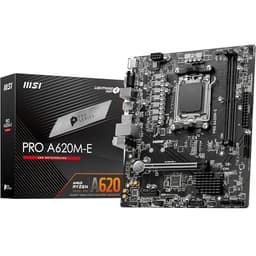
MSI has long been one of the most trusted names in PC building, and in 2025 the brand's sub-£150 motherboard lineup is stronger than ever. Whether you are building a budget AMD Ryzen system on AM4, stepping up to the newer AM5 platform, or going the Intel LGA1700 route, MSI offers a board to match. This guide is aimed at first-time builders, upgraders on a tight budget, and anyone who wants a reliable, feature-packed motherboard without spending big. Compared to last year, MSI has refreshed several lines with better VRM configurations, added WiFi 6E to more entry-level boards, and introduced back-connect PCB designs that were previously only seen on premium models. Prices have also shifted slightly downward as competition from ASUS and Gigabyte has intensified. The six picks below cover a range of form factors, sockets, and chipsets, all priced under £150 at time of writing.
Quick Verdict
Best Overall: MSI B760 Gaming Plus WiFi, which delivers a well-rounded Intel LGA1700 experience with WiFi 6E, solid VRMs, and broad CPU support at a very competitive price point.
Best Value: MSI PRO H610M-E DDR4, a no-nonsense Micro-ATX board that keeps costs low while still offering everything a budget Intel build actually needs.
The MSI B840 Gaming Plus WiFi is one of the newest boards in this roundup, representing MSI's push to bring AMD's latest B840 chipset to market at an accessible price. The B840 chipset is AMD's updated mid-range option for AM5, positioned to replace B650 as the mainstream choice for Ryzen 7000, 8000, and 9000 series builds. It offers a slightly streamlined feature set compared to B650 in exchange for a lower manufacturing cost, which is passed on to the consumer.
At under £100, the B840 Gaming Plus WiFi is the most affordable ATX board with WiFi in this roundup, and it punches well above its price in terms of specification. The board supports DDR5 memory up to 192 GB across four slots, which is the highest maximum capacity in this roundup and future-proofs the board for memory-intensive workloads. Three M.2 slots are present, all PCIe 4.0, which is a generous allocation at this price point.
The VRM is a 10+2+1 phase design, which is adequate for Ryzen 5 and Ryzen 7 processors but may limit sustained performance on Ryzen 9 chips with high TDP. For most gaming and productivity builds, this will not be a practical concern, but it is worth noting if you plan to pair the board with a flagship CPU. Memory overclocking via EXPO is supported, and the BIOS has received regular updates since launch.
Connectivity includes WiFi 6E, 2.5 GbE, USB 3.2 Gen 2 on the rear panel, and the standard complement of USB-A ports. The rear I/O shield is pre-installed, and the board includes MSI's Steel Armor on the primary PCIe slot. The overall build quality is consistent with MSI's Gaming Plus line, with solid heatsinks and a clean PCB layout that makes cable routing straightforward.
This board is the right choice for budget-conscious AMD builders who want a modern AM5 platform with WiFi and ample storage options without spending B650 money. It is particularly good value for Ryzen 5 and Ryzen 7 builds where the VRM headroom is more than sufficient and the feature set covers every practical need.
Pros
- Supports up to 192 GB DDR5 across four slots, the highest capacity in this roundup
- Three PCIe 4.0 M.2 slots at under £100 is exceptional value for AM5
- WiFi 6E included, making it the most affordable WiFi-equipped ATX AM5 board here
Cons
- VRM may throttle under sustained load with high-TDP Ryzen 9 processors
- B840 chipset offers fewer PCIe lanes than B650, limiting multi-device configurations
Buying Guide
Socket and Chipset: Get This Right First
The single most important decision when buying a motherboard is matching the socket to your CPU. Intel's current mainstream socket is LGA1700, used by 12th, 13th, and 14th generation Core processors. AMD's current platform is AM5, used by Ryzen 7000, 8000, and 9000 series chips. These sockets are not interchangeable. If you already own a CPU, check its socket before buying a board. If you are buying both together, consider platform longevity: AMD has committed to AM5 support through at least 2027, while Intel is expected to move to a new socket with its next major architecture.
The chipset determines what features are available on the board. For Intel, H610 is entry-level with no overclocking, B760 is mid-range with memory overclocking and more connectivity, and Z790 is the enthusiast tier with full CPU overclocking. For AMD, A620 is entry-level, B650 and B840 are mid-range, and X670E is the enthusiast option with PCIe 5.0 and full overclocking support. Paying for a higher chipset only makes sense if you will actually use the additional features.
DDR4 vs DDR5
Most new boards in 2025 use DDR5, but DDR4 boards like the MSI PRO H610M-E DDR4 are still available and can save significant money if you have existing DDR4 kits. DDR5 offers higher bandwidth and is the future-facing choice, but for everyday gaming and productivity the real-world difference is modest. If you are building from scratch with no existing memory, DDR5 is the better long-term investment. If you are upgrading and already own DDR4, a DDR4-compatible board can save £50 to £80 on memory costs.
Form Factor
ATX boards are the standard full-size option, fitting most mid-tower and full-tower cases. They offer more expansion slots, better VRM heatsink coverage, and more M.2 slots. Micro-ATX boards are smaller and suit compact cases, but they typically have fewer slots and a smaller VRM area. Choose the form factor that fits your case and matches your expansion needs. If you only need one GPU and two or three storage drives, Micro-ATX is perfectly adequate.
Connectivity Checklist
Before buying, confirm the board has everything your build needs. Key items to check include: the number of M.2 slots and whether they support PCIe 4.0 or 5.0, the presence of WiFi and its standard (WiFi 5, 6, or 6E), the LAN speed (1 GbE or 2.5 GbE), the number and type of rear USB ports, and the number of fan headers for your cooling setup. Boards without WiFi are not necessarily worse, but adding a USB adapter later is less elegant than having it built in.
Is MSI a Good Brand?
MSI is one of the three dominant motherboard manufacturers alongside ASUS and Gigabyte, and it has a strong reputation for build quality, BIOS support, and value for money. The brand's Gaming Plus and PRO lines are particularly well-regarded in the budget and mid-range segments. Compared to ASUS, MSI tends to offer slightly more features per pound at the budget end, while ASUS has an edge in premium build quality at the top of the market. Neither brand is objectively better: both produce excellent boards, and the best choice depends on the specific model and your requirements rather than brand loyalty alone.
The MSI B760 Gaming Plus WiFi is the overall winner of this roundup. It combines broad Intel CPU compatibility, three PCIe 4.0 M.2 slots, WiFi 6E, 2.5 GbE, and a solid VRM into a full ATX package at a price that undercuts many competitors with fewer features. It suits the widest range of builders, from budget Core i5 systems to high-performance Core i9 non-K builds, and its BIOS maturity and long-term driver support make it a reliable foundation for a multi-year build. For AMD builders who want the best platform under £150, the MSI X670E Gaming Plus WiFi is the standout choice, bringing X670E features including PCIe 5.0 and full overclocking support to a price point that was unthinkable twelve months ago.