Competitive FPS gaming demands a mouse that can keep up with split-second flick shots, precise tracking, and the kind of low-latency response that separates a headshot from a miss. Whether you play Valorant, CS2, or Apex Legends, the mouse in your hand matters more than almost any other peripheral. Since last year, the market has shifted noticeably: wireless polling rates have climbed to 8,000 Hz, ultralight designs have gone mainstream rather than niche, and budget options have improved enough to genuinely threaten mid-range picks. This roundup is aimed at PC players who want a competitive edge, from those on a tight student budget to seasoned ranked grinders willing to spend over £100 for marginal gains. We have tested and evaluated five mice from the catalogue that are genuinely suited to fast-paced FPS play, cutting anything designed primarily for productivity or ergonomic office use.
Quick Verdict
Best Overall: Logitech G PRO X SUPERLIGHT. Its 61 g weight, HERO 25K sensor, and near-zero wireless latency make it the benchmark for competitive play. Best Value: Razer Basilisk V3, which delivers a flagship-class optical sensor and satisfying click feel at a price that undercuts most rivals significantly.
The Rapoo VT2 MAX is the most technically ambitious mouse in this roundup and arguably the most forward-looking option for competitive FPS players who want cutting-edge specs without paying a flagship premium. At 53 g, it sits firmly in ultralight territory, and its 8,000 Hz wireless polling rate is a genuine differentiator, a feature that until recently was reserved for wired mice or cost several times more to obtain wirelessly.
The sensor is the PixArt PAW3395, which is one of the most trusted optical sensors in esports right now, offering up to 26,000 DPI, zero hardware acceleration, and consistent tracking on virtually every surface. At 8,000 Hz polling, the cursor position is updated eight times more frequently than a standard 1,000 Hz mouse, which translates to smoother micro-adjustments during flick shots and reduced perceived input lag. For players competing at high frame rates on 240 Hz or 360 Hz monitors, this matters.
The shape is a symmetrical design that suits both palm and claw grips, and the main buttons use optical switches rated for 100 million clicks. The honeycomb-free shell keeps the exterior clean while the internal structure sheds weight, and PTFE feet ensure smooth gliding on hard pads and cloth alike. Battery life is quoted at up to 70 hours at 1,000 Hz polling, though expect that to drop noticeably at 8,000 Hz. The USB-C charging port is a welcome modern touch.
Who is this for? Players who are already running a high-refresh-rate monitor and want their mouse hardware to match, or anyone who has read about 8K polling and wants to experience it without spending over £100. It is also a strong pick for claw-grip players who find heavier mice tiring during long sessions.
The main caveat is that Rapoo is a newer name in the competitive space compared to Logitech or Razer, so software support and long-term firmware updates are less proven. The scroll wheel also lacks the premium feel of more expensive options. That said, for the price, the hardware specification is genuinely exceptional.
Verdict: The best value 8K polling wireless mouse available right now, and a serious option for any competitive FPS player who wants tomorrow's specs today.
Pros
- 8,000 Hz wireless polling rate at a mid-range price point
- PAW3395 sensor with zero hardware acceleration and 26,000 DPI ceiling
- 53 g ultralight build with USB-C charging
Cons
- Rapoo's software ecosystem and long-term firmware support are less established than rivals
- Scroll wheel feel is noticeably cheaper than premium competitors
The Logitech G PRO X SUPERLIGHT has been the benchmark wireless gaming mouse for competitive FPS players since its launch, and it continues to hold that position in 2025 despite newer challengers. At 61 g, it was the mouse that proved ultralight wireless was achievable without sacrificing sensor quality or battery life, and it remains one of the most-used mice on the professional esports circuit across CS2, Valorant, and Apex Legends.
The HERO 25K sensor is Logitech's own design and is widely regarded as one of the most accurate and consistent optical sensors ever produced. It tracks at up to 25,600 DPI with no smoothing, no acceleration, and exceptional lift-off distance consistency. At 1,000 Hz polling over LIGHTSPEED wireless, the latency is indistinguishable from a wired connection in real-world play. Logitech quotes up to 70 hours of battery life, and in practice most users report comfortably exceeding 50 hours between charges.
The shape is an ambidextrous design with a subtle right-hand bias, making it comfortable for palm, claw, and fingertip grips. The side buttons are positioned cleanly and click with a satisfying, short actuation. The main left and right buttons use Logitech's own mechanical switches, which feel crisp and consistent. The PTFE feet are among the best stock feet on any mouse at this price point.
The G PRO X SUPERLIGHT is the right choice for players who want a proven, tournament-grade mouse with a long track record of reliability. It is particularly well suited to players who have spent time with heavier mice and want to make the switch to ultralight without the uncertainty of a newer brand. The G HUB software is mature, feature-rich, and stable on Windows and Mac.
The main criticism is that at this price, you are not getting 8K polling, which newer competitors offer. The scroll wheel is also minimal and lacks the tactile richness of the Basilisk V3. However, for pure competitive FPS use, neither of those things materially affects performance.
Verdict: The safest, most proven choice for competitive FPS gaming. If you want the mouse that professionals trust, this is it.
Pros
- HERO 25K sensor with zero acceleration and industry-leading consistency
- 61 g weight in a comfortable ambidextrous shape suitable for multiple grip styles
- Up to 70 hours battery life with LIGHTSPEED wireless latency matching wired performance
Cons
- Capped at 1,000 Hz polling when newer rivals offer 8,000 Hz at lower prices
- Premium price is harder to justify now that the SUPERLIGHT 2 exists at a similar cost
The Razer Basilisk V3 is the wired option in this roundup that punches well above its price bracket. It uses Razer's Focus+ optical sensor, which is capable of up to 26,000 DPI and features Razer's own intelligent tracking and lift-off adjustment. While it is heavier than the ultralight options here at 101 g, it makes up for that with a feature set that would have cost considerably more just two years ago.
The headline feature is Razer's HyperScroll Tilt Wheel, which offers both free-spinning and tactile scroll modes switchable on the fly with a button beneath the scroll wheel. For FPS gaming specifically, the tactile mode provides reliable, clicky scroll steps that are useful for weapon switching, while free-spin is handy in other game genres. The mouse also includes 11 programmable buttons, a sniper button on the thumb rest, and Razer Chroma RGB lighting across 11 zones, though RGB is irrelevant to performance.
The optical switches in the main buttons are rated for 70 million clicks and offer an actuation time of 0.2 ms, which is faster than most mechanical switches. This means no pre-travel, no debounce delay, and near-instant registration of clicks, which is genuinely useful in fast-paced FPS scenarios where double-tapping or rapid fire is common.
Who is this for? The Basilisk V3 is ideal for players who prefer a heavier, more stable mouse that does not shift during aggressive swipes, or those who grip their mouse firmly and find ultralight designs feel insubstantial. It is also an excellent choice for players transitioning from office mice who want flagship sensor quality at a budget-friendly price. The wired connection removes any wireless latency concern entirely.
The weight is the obvious trade-off. At 101 g, it is nearly double the Rapoo VT2 MAX, and players who have made the switch to sub-60 g mice will feel the difference immediately. The cable, while braided and reasonably flexible, is still a cable. Razer Synapse software is also occasionally reported as resource-heavy.
Verdict: The best value wired FPS mouse in this comparison. Flagship sensor, optical switches, and a premium feel at a price that undercuts most of the competition.
Pros
- Focus+ 26,000 DPI optical sensor with no hardware acceleration
- Optical switches with 0.2 ms actuation and 70 million click rating
- HyperScroll tilt wheel with switchable free-spin and tactile modes
Cons
- 101 g weight is significantly heavier than ultralight competitors
- Razer Synapse software can be resource-intensive and requires an account for full features
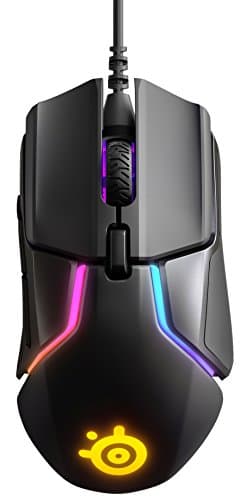
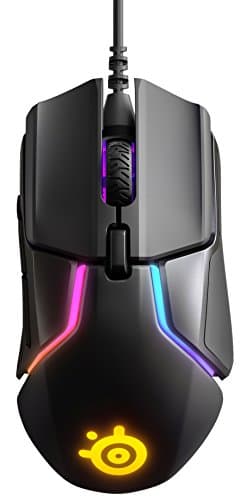
The SteelSeries Rival 600 is an older design that has aged surprisingly well for competitive FPS use, and it occupies a unique position in the market thanks to its dual-sensor system and adjustable weight mechanism. It uses the TrueMove3+ dual optical sensor array, combining a primary tracking sensor with a secondary depth sensor that measures the exact lift-off distance to 0.1 mm precision. The result is one of the most consistent lift-off behaviours of any mouse ever made, which is particularly valuable for low-sensitivity FPS players who frequently lift and reposition.
The weight system allows players to add or remove eight individual 4 g weights from compartments in the base, giving a range from roughly 96 g up to 128 g. This is the opposite philosophy to the ultralight trend, but it has a loyal following among players who prefer a heavier, more anchored feel during precise tracking. The split-trigger button design separates the left and right click buttons from the main shell, which reduces the force required to actuate and eliminates the slight flex found in many competing designs.
The main buttons use mechanical switches rated for 60 million clicks, and the side buttons are positioned well for a right-handed claw or palm grip. The textured rubber side grips provide excellent purchase even during sweaty gaming sessions. At 12,000 CPI maximum, the sensor ceiling is lower than newer options, but for competitive FPS play the vast majority of players operate between 400 and 3,200 DPI, making the cap largely irrelevant in practice.
Who is this for? The Rival 600 suits players who have tried ultralight mice and found them too skittish, or those who want the most consistent lift-off behaviour available. It is also a strong choice for players who like to tune their mouse weight to match their play style, and for those who play on a low sensitivity with large arm movements where the extra mass provides a sense of control.
The age of the design is starting to show. At 1,000 Hz polling and without wireless capability, it lacks the headline specs of newer options. The software, SteelSeries GG, is solid but the mouse does not support newer features like 4K or 8K polling. The price has dropped considerably over time, which makes it excellent value, but buyers should be aware they are purchasing a mature product.
Verdict: A niche but genuinely useful pick for low-sensitivity FPS players who value lift-off precision and adjustable weight above all else.
Pros
- TrueMove3+ dual sensor system delivers industry-leading lift-off distance consistency
- Adjustable weight system with eight 4 g weights for personalised feel
- Split-trigger button design reduces actuation force and eliminates flex
Cons
- 12,000 CPI sensor ceiling and 1,000 Hz polling are behind current-generation rivals
- No wireless option and an ageing design that lacks modern features
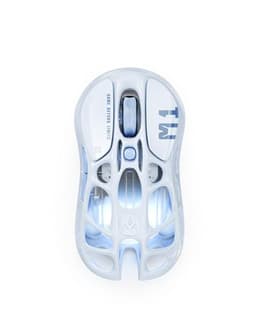
The GravaStar Mercury M1 Pro is the most visually distinctive mouse in this roundup by a considerable margin. Made from magnesium alloy rather than the ABS plastic used by most competitors, it weighs just 49 g, making it the lightest mouse in this comparison. The metal construction gives it a premium, almost industrial feel that is unlike anything else at this price point, and the exposed internal structure is a deliberate aesthetic choice that also contributes to the weight reduction.
The sensor is the PixArt PAW3395, identical to the one found in the Rapoo VT2 MAX, offering 26,000 DPI, zero acceleration, and consistent tracking across surfaces. The wireless connection uses 2.4 GHz at 1,000 Hz polling, which is standard for this class of mouse. Battery life is quoted at up to 80 hours, which is among the best in this roundup, and the USB-C charging port is a practical modern touch. The mouse also supports Bluetooth connectivity for multi-device use, though Bluetooth is not recommended for competitive play due to higher latency.
The shape is a symmetrical ambidextrous design with a relatively flat profile that suits fingertip and claw grips particularly well. The main buttons use optical switches, and the side buttons are responsive with a clean, short actuation. PTFE feet are included as standard and feel smooth on both hard and cloth surfaces. The scroll wheel is tactile and well-defined, though it lacks a free-spin mode.
Who is this for? The Mercury M1 Pro is aimed at players who want the lightest possible mouse for high-sensitivity fingertip play, and who appreciate hardware that looks as distinctive as it performs. It is also a strong pick for players who have wrist or arm fatigue issues and want to reduce the physical effort of large swipe movements. The magnesium alloy construction feels more durable than honeycomb plastic alternatives.
GravaStar is a smaller brand with less established software support compared to Logitech or Razer, and the companion app is functional but basic. At 49 g, the mouse may feel insubstantial to players accustomed to heavier designs. The polling rate is capped at 1,000 Hz, which is behind the Rapoo VT2 MAX despite a higher price tag.
Verdict: A genuinely impressive ultralight mouse with premium materials and a flagship sensor, let down only by basic software and a polling rate that trails its closest rival.
Pros
- 49 g magnesium alloy construction is the lightest and most premium-feeling build in this roundup
- PAW3395 sensor with 26,000 DPI and zero hardware acceleration
- Up to 80 hours battery life with USB-C charging and Bluetooth support
Cons
- Companion software is basic and less feature-rich than Logitech G HUB or Razer Synapse
- 1,000 Hz polling rate is behind the Rapoo VT2 MAX despite a higher asking price
Buying Guide
Sensor Quality
The optical sensor is the most important component in any competitive FPS mouse. Modern flagship sensors such as the PixArt PAW3395 and Logitech HERO 25K track with zero hardware acceleration, zero smoothing, and consistent lift-off behaviour across virtually every surface. These properties matter because any deviation from true 1:1 tracking introduces unpredictability into your aim. Avoid mice that advertise very high DPI figures as a headline feature without specifying the sensor model, as DPI alone tells you nothing about tracking quality. For competitive play, 3,200 DPI is more than sufficient for most players, and the sensor's accuracy at your chosen sensitivity is what actually matters.
Weight and Shape
The trend towards ultralight mice, those under 70 g, is well established in competitive FPS circles. Lighter mice reduce fatigue during long sessions and allow faster flick movements with less physical effort. However, weight preference is genuinely personal: some players find very light mice feel imprecise or difficult to control, particularly at low sensitivities with large arm movements. Shape matters equally. Ambidextrous designs suit a wider range of grip styles, while right-hand ergonomic shapes often provide better thumb support for palm grip players. Before committing to any mouse, consider your grip style: palm, claw, or fingertip, and check whether the mouse dimensions match your hand size.
Wired vs Wireless
Modern 2.4 GHz wireless mice from reputable brands offer latency that is genuinely indistinguishable from wired in controlled tests. Logitech LIGHTSPEED and Razer HyperSpeed are the two most proven wireless technologies in competitive gaming. The practical advantage of wireless is the absence of cable drag, which can subtly affect mouse movement during fast swipes. Battery life is a consideration: most competitive wireless mice offer 40 to 80 hours per charge, which is sufficient for most players. If you compete in LAN events, a wired mouse eliminates any concern about battery management, but for home play, wireless is no longer a performance compromise.
Polling Rate
Standard gaming mice poll at 1,000 Hz, meaning the cursor position is reported to the PC 1,000 times per second. Newer mice now offer 4,000 Hz or 8,000 Hz polling, which theoretically reduces input lag and smooths micro-movements at very high frame rates. In practice, the benefit of 8,000 Hz is most noticeable on 240 Hz or higher monitors and at high in-game frame rates. At 144 Hz, the difference between 1,000 Hz and 8,000 Hz polling is minimal for most players. Higher polling rates also increase CPU usage slightly, so ensure your system can handle it before prioritising this specification.
Click Feel and Switches
Mechanical switches are the traditional choice and offer a satisfying tactile click with good durability ratings, typically 50 to 60 million actuations. Optical switches, used in the Razer Basilisk V3 and GravaStar Mercury M1 Pro, use a light beam rather than physical contact, which eliminates debounce delay and reduces actuation time to as little as 0.2 ms. This can provide a marginal advantage in rapid-fire scenarios. The trade-off is that optical switches feel different to mechanical ones, with a lighter actuation that some players find less satisfying. Both technologies are reliable for competitive use.
For the majority of competitive FPS players, the Logitech G PRO X SUPERLIGHT remains the overall winner. Its combination of the HERO 25K sensor, 61 g weight, proven LIGHTSPEED wireless reliability, and extensive use at the professional level makes it the most trustworthy option in this roundup. It is not the cheapest, and it does not offer 8K polling, but it delivers consistent, tournament-grade performance with mature software support and a long track record. If budget is the primary concern, the Razer Basilisk V3 offers a flagship-class sensor and optical switches at a fraction of the price, making it the best value pick for players who do not mind a wired connection and a heavier build. For those who want the most cutting-edge specification at a mid-range price, the Rapoo VT2 MAX is the one to watch, with its 8K wireless polling rate and PAW3395 sensor representing genuine value for money.