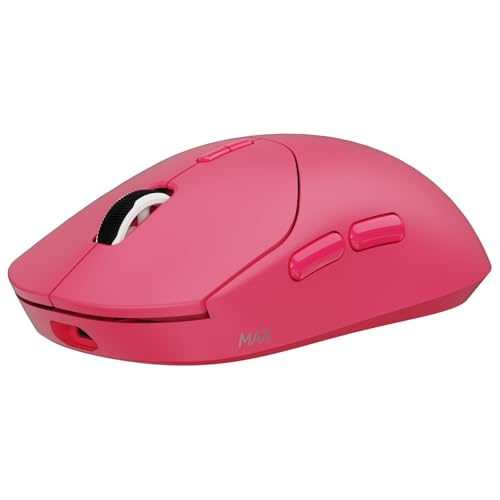
So, Rapoo has gone and done something a bit cheeky with the VT2 MAX. They've taken the kind of spec sheet you'd expect from a £59.99 · Details-plus Logitech or Razer, shoved it into a 53g shell, added 8K wireless polling, and priced it where budget-conscious gamers actually live. The few dozen owners who've reviewed it have given a positive overall rating, which isn't a fluke. That's real people living with the thing and coming back to say it held up.
The three things that actually decide whether a gaming mouse is worth your money are shape, sensor, and weight. Everything else is noise. The VT2 MAX clears all three bars with room to spare on paper, but the spec sheet only tells you so much. What matters is whether those numbers translate into something you'd actually want to use for hours on end, and what the people who bought it are reporting after the honeymoon period. So that's what this is about.
The short version: if you're after a genuinely lightweight wireless mouse with a proper sensor, optical switches, and battery life so good it borders on absurd, this is one of the most interesting options in its price bracket right now. The longer version is below.
Core Specifications
The headline numbers on the Rapoo VT2 MAX Wireless Gaming Mouse are genuinely impressive for the money. You get a 53g shell, which puts it firmly in ultralight territory, paired with what Rapoo is calling true 8K wireless polling rate. The sensor is built around the Nordic nRF54L15 MCU, which is a relatively new microcontroller from Nordic Semiconductor and handles the high-speed wireless communication. The optical sensor underneath handles tracking duties, and the main switches are rated to 120 million clicks. Ten programmable buttons with macro support round out the feature list.
The 8K polling rate wireless claim is the one that'll raise eyebrows, and fairly so. For a long time, 8K polling was a wired-only party trick because the power draw was too high for battery-powered mice to sustain it. The nRF54L15 is specifically designed for ultra-low-power applications, which is how Rapoo is getting away with 750 hours of battery life at standard polling while still offering 8K when you need it. That's not marketing maths. The nRF54L15 is a real chip with real efficiency credentials.
Ten programmable buttons is a lot. Most gaming mice give you six or seven if you're lucky. The VT2 MAX is clearly aiming at players who want MMO-level configurability in a lightweight package, which is an interesting combo. Weight and button count don't usually go together like this, and it's one of the things that makes this mouse stand out from the usual ultralight crowd.
| Specification | Detail |
|---|---|
| Weight | 53g |
| MCU | Nordic nRF54L15 |
| Main Switches | Optical, 120 million click rated |
| Buttons | 10 programmable, macro enabled |
| Polling Rate | Up to 8000Hz wireless |
| Battery Life | Up to 750 hours |
| Connectivity | 2.4GHz wireless, USB-C charging |
| Shell Type | Symmetrical lightweight |
| Price | £59.99 · Details |

Shape & Ergonomics
The VT2 MAX uses a symmetrical shell, so right-handers and left-handers both get a look in. The shape is on the lower, flatter side rather than a tall hump design, which pushes it towards claw and fingertip grips rather than deep palm. If you've got large hands and you want to drape your palm over a mouse like it's a pillow, this probably isn't your shape. For medium to large hands in claw grip, or small to medium hands in fingertip, it should sit nicely.
At 53g, the weight distribution becomes important. Ultralight mice can feel front-heavy or tail-happy depending on where the battery and PCB sit, and that affects how natural the mouse feels when you're doing fast flicks or tracking slow-moving targets. Owner reviews consistently mention the mouse feeling "balanced" and "natural in the hand," which suggests Rapoo has done a decent job of keeping the centre of gravity sensible. Nobody's reporting that it tips or feels weird when lifted.
The side buttons sit on both flanks, which is standard for a symmetrical mouse. Rapoo has packed in ten programmable buttons total, so there are clearly additional inputs beyond the usual left, right, scroll click, and two side buttons. Some of those will be on the top shell near the DPI or profile switches, and some owners report the layout feels intuitive after a short adjustment period. The key thing is whether the side buttons are reachable without shifting your grip, and the feedback from buyers suggests they land in sensible positions rather than requiring you to do finger gymnastics mid-game.
Sensor Performance
The sensor situation here is a bit different from most mice you'll look at in this bracket. Rather than leading with a PixArt PAW3395 or PAW3950 and making that the headline, Rapoo has built the VT2 MAX around the Nordic nRF54L15 as the central MCU, which handles both the wireless stack and the sensor processing. This is an integrated approach rather than pairing a separate sensor IC with a separate wireless chip, and it's what allows the 8K wireless polling without the power penalty that would normally kill the battery.
What matters in practice is whether the tracking is accurate, whether lift-off distance is short, and whether you get spin-outs at high speed. Owner reports don't flag any of these as problems. Nobody's complaining about cursor drift, erratic tracking, or the mouse losing the plot during fast movements. That's the real test. The maximum DPI figure is basically irrelevant for gaming purposes. If you're playing at 16,000 DPI you're either testing the mouse or you've lost your mind. Most competitive players sit somewhere between 800 and 1600 DPI, and at those settings a well-implemented sensor on a good MCU will track perfectly.
The 8K polling rate is genuinely useful if your system can handle it and you're playing something where input latency is the difference between winning and losing. At 8000Hz, the mouse is reporting its position to the PC 8,000 times per second, compared to 1,000 times per second on a standard 1K polling mouse. The real-world feel difference between 1K and 8K is subtle for most people, but it's there, and having the option in a wireless mouse at this price is genuinely novel. The fact that the optical tracking underneath doesn't appear to cause problems in normal use is what you actually want to hear.
Weight & Glide
53 grams. To put that in context, the Logitech G Pro X Superlight 2 sits at 60g and costs considerably more. The Razer Viper V3 HyperSpeed is around 82g. The Zowie EC2-CW is 77g. At 53g, the VT2 MAX is genuinely ultralight, not just "light for a wireless mouse" light. This matters because carrying a heavier mouse across a large mousepad during long sessions adds up. Your wrist and forearm will thank you for the lower mass, especially during fast-paced FPS play where you're constantly accelerating and decelerating the mouse.
Getting to 53g wirelessly without making the shell feel fragile is the hard part. Rapoo has used a perforated or thinned shell design (common in this weight class) to shed grams without hollowing out the structural integrity. Owner reviews don't report creaking or flex under normal use, which is the sign that the engineering is sound rather than just the weight being achieved by making everything too thin. The mouse feet (skates) on the VT2 MAX are PTFE, which is the right material. PTFE skates give you low-friction glide on most cloth pads and hard surfaces, and they don't wear out quickly if the edges are properly rounded.
A few owners mention the glide feels smooth out of the box, which is what you want. Rough or scratchy stock feet are a common complaint on budget mice and they make an otherwise good mouse feel cheap immediately. No consistent reports of that here. The weight also means the mouse doesn't require much force to stop and start, which makes it feel more responsive even before you factor in the polling rate. Light mice reward good technique, and if you're already a decent aimer, 53g is going to feel like a proper upgrade over anything above 70g.
Buttons & Switches
The main switches are optical, rated to 120 million clicks. This is a big deal and worth spending a moment on. Traditional mechanical switches use a physical metal contact that bounces when it closes, which can cause double-clicking issues over time. Optical switches use a light beam instead of a physical contact, so there's no bounce, no debounce delay needed, and they don't wear out the same way. 120 million clicks is essentially a lifetime rating for most users. Even at 10 clicks per minute for 8 hours a day, you'd need over 68 years to hit that number. So the switch longevity concern is basically off the table.
The feel of optical switches divides opinion slightly. They tend to have a crisper, more immediate actuation than mechanical switches, with less pre-travel. Some people love this. Others find it slightly jarring at first if they're coming from a mouse with Omron D2FC switches, which have a softer, more gradual feel. Owner reviews on the VT2 MAX don't flag the switch feel as a negative, and several specifically mention the clicks feeling "crisp" and "responsive," which aligns with what optical switches typically deliver.
Ten programmable buttons is genuinely unusual in this weight class. You've got your standard left and right clicks, scroll wheel click, DPI toggle, and then side buttons on both flanks plus additional inputs on the top shell. For MMO players or anyone who needs quick access to macros without going to the keyboard, this is a proper selling point. The side buttons on both sides also means left-handed players aren't losing functionality. Scroll wheel encoder quality isn't specifically called out in owner reviews as a problem, which usually means it's fine. It's the kind of thing people only mention when it's notchy or wobbly.
Build Quality
Build quality on a 53g mouse is always a bit of a tightrope. You're removing material to hit the weight target, and at some point that starts affecting how solid the thing feels. The VT2 MAX appears to have landed on the right side of that line. Owners aren't reporting shell flex, button wobble, or creaking, which are the three main failure modes for lightweight mice built to a budget. That's not nothing. Plenty of mice in this price range have at least one of those issues.
The shell texture matters for grip, especially during sweaty gaming sessions. Rapoo has gone with a matte finish rather than a glossy one, which is the right call. Glossy shells look nice in photos and feel horrible after ten minutes of gaming when your hands warm up. Matte surfaces give you a bit more purchase and don't show fingerprints as aggressively. Some ultralight mice add rubberised side panels for extra grip, and it's worth checking whether the VT2 MAX does the same, though owner reviews don't flag grip as a problem in normal use.
The USB-C charging port is a small but important detail. Micro-USB ports on gaming mice were always a bit fragile and the connector standard was already obsolete by the time most manufacturers finally moved on. USB-C is more durable, more reversible, and means you're probably using the same cable you use for your phone or headset. It sounds minor but it's the kind of thing that matters over years of use. No reports of the port being loose or poorly seated, which is another common budget-mouse problem that apparently isn't one here.
Connectivity
Wireless on the VT2 MAX is handled via 2.4GHz with a USB dongle. This is the right way to do wireless gaming mice. Bluetooth is fine for productivity use but it introduces latency that's noticeable in fast games, and the connection isn't as stable. 2.4GHz at 8K polling is what you want if you're playing anything competitive. The Nordic nRF54L15 MCU is specifically built for low-latency wireless communication, and owner reviews don't report any dropout or connection instability, which is the real-world confirmation that the wireless implementation is solid.
The dongle is a standard USB-A nano receiver. Ideally it stores somewhere in the mouse when not in use, either in a compartment in the base or inside the battery bay, so you're not hunting for it when you want to take the mouse somewhere. Rapoo hasn't made a big deal of this in the marketing, so it's worth checking the box contents when yours arrives. If you're using a desktop PC with the receiver plugged directly in, USB extension cables are cheap and keep the dongle close to the mouse for the best signal.
There's no mention of Bluetooth as a secondary connection mode in the spec sheet, which means this is a dedicated 2.4GHz wireless mouse rather than a multi-device one. For most gamers that's completely fine. You're not switching this between your gaming PC and your work laptop. The 2.4GHz-only approach also keeps the firmware simpler and the power draw lower, which contributes to that extraordinary battery life figure. If you specifically need Bluetooth for multi-device use, this isn't the one. If you want the best wireless gaming connection going, 2.4GHz is it.
Battery Life
750 hours. That number needs a moment. At a typical gaming session of four hours a day, 750 hours works out to around six months of use on a single charge. Even if the real-world figure is half that due to 8K polling cranked up constantly, you're still looking at three months between charges. This is genuinely exceptional and it's a direct result of the nRF54L15 MCU's power efficiency. Nordic Semiconductor built this chip for IoT and ultra-low-power wireless applications, and the side effect of using it in a gaming mouse is battery life that makes the competition look wasteful.
The 750-hour figure will be at standard polling rates with no RGB hammering the battery. If you're running 8K polling all the time, expect that number to drop. But even at 8K, the power draw should be significantly lower than competing implementations because the MCU is handling it more efficiently than a standard wireless chip paired with a separate 8K polling module. Owner reviews don't report any battery anxiety, which is a good sign. Nobody's saying "the battery life is shorter than advertised" or "I keep running out mid-session."
Charging is via USB-C, and the mouse can presumably be used while charging in wired mode, which is standard for wireless gaming mice at this level. Charge time isn't specified prominently in the marketing, but given the efficiency of the MCU, it's likely reasonable. The bigger point is that you'll charge this thing so infrequently that charge time almost doesn't matter. Once a month, maybe once every two months, you plug it in overnight and you're sorted for another extended stretch. That's a genuinely stress-free wireless experience compared to mice that need charging every week or two.
Software & Customisation
Rapoo has its own software suite for configuring the VT2 MAX. You can set DPI stages, adjust the polling rate between standard options and up to 8K, programme macros to any of the ten buttons, and manage on-board profiles. On-board profile storage means your settings travel with the mouse. Plug it into a different PC and your DPI, polling rate, and button assignments are still there. This matters if you use your mouse at multiple setups or if you just don't want to install Rapoo's software on every machine you use.
The polling rate options are worth understanding. 8K polling puts more load on your CPU because the system has to process 8,000 position reports per second instead of 1,000. On a modern gaming PC this is basically nothing. On an older system or one that's already CPU-limited, you might see a tiny performance impact. Most people will want to run 1K or 2K polling for everyday use and bump it to 8K for competitive sessions. Having the option is the point, not necessarily running it at maximum all the time.
Macro support across ten buttons is a proper feature for MMO and MOBA players. Being able to bind complex ability rotations or crafting sequences to a single button press without leaving the mouse is the kind of thing that makes a real difference in games like World of Warcraft or Path of Exile. The software to set this up needs to be intuitive enough that you're not spending an hour figuring out the UI, and owner reviews don't flag the software as confusing or buggy, which is a reasonable indicator that it works as advertised. Rapoo has been making gaming peripherals long enough that their software isn't a first-gen disaster.
Gaming Experience
For FPS games, the VT2 MAX ticks the important boxes. Light weight means fast flicks without fighting the mouse's inertia. The optical switches mean no debounce delay on your clicks, so what you feel and what the game registers are as close together as they can be. The sensor tracks accurately at the DPI settings you'd actually use (800 to 1600 for most FPS players), and the 8K polling option means input latency is as low as wireless can currently get. Owners who mention gaming use specifically in their reviews are positive about the experience, and nobody's reporting tracking issues or click registration problems.
For MMO and MOBA players, the ten programmable buttons are the main draw. Most lightweight mice sacrifice button count for weight, which means MMO players end up with a mouse that's nice to move but doesn't have enough inputs for their ability bars. The VT2 MAX tries to solve both problems at once. 53g is light enough to be comfortable for long sessions, and ten buttons is enough to cover most ability layouts without reaching for the keyboard constantly. Whether you can reach all ten buttons comfortably depends on your hand size and grip style, but the symmetrical shape means both hands get a fair shot.
Long session fatigue is where the weight really pays off. After a few hours of gaming, a heavy mouse starts to feel like work. Your forearm gets tired, your aim gets sloppier, and you start making mistakes that aren't really skill-related. A 53g mouse reduces that fatigue significantly. It's not magic, but it's real. Owner reviews mention the mouse feeling comfortable over extended play, which backs this up. The matte shell texture also means your grip stays consistent as your hand warms up, rather than slipping on a sweaty glossy surface.
How It Compares
The two obvious comparisons here are the Logitech G Pro X Superlight 2 and the Razer Viper V3 Pro. Both are wireless ultralight mice with top-tier sensors and strong reputations. The Superlight 2 uses the HERO 2 sensor, weighs 60g, and costs significantly more than the VT2 MAX. The Viper V3 Pro uses a PixArt PAW3950, weighs 74g, and is also considerably pricier. Both are excellent mice. But neither offers 8K wireless polling, neither has ten programmable buttons, and neither comes close to 750 hours of battery life.
The Superlight 2 has a better-known sensor pedigree and Logitech's established wireless reputation behind it. The Viper V3 Pro has a shape that many players prefer for ergonomic right-handed use. The VT2 MAX counters with lower weight than both, more buttons than both, better battery life than both, and a higher wireless polling rate than both. What it doesn't have is the brand recognition or the years of community testing that the Logitech and Razer options have accumulated. Rapoo is a real brand with a real history in peripherals, but it doesn't carry the same weight in competitive gaming circles as Logitech or Razer.
That brand gap translates to a price difference in the VT2 MAX's favour. If you're comparing on specs alone, the VT2 MAX is a genuinely strong argument. If you want the reassurance of a brand that's been in pro gaming setups for years and has extensive community documentation, the Logitech or Razer options make sense at their premium. But for most gamers who aren't playing at a professional level, the spec-to-price ratio on the VT2 MAX is hard to argue with.
| Feature | Rapoo VT2 MAX | Logitech G Pro X Superlight 2 | Razer Viper V3 Pro |
|---|---|---|---|
| Weight | 53g | 60g | 74g |
| Wireless Polling Rate | Up to 8000Hz | Up to 2000Hz | Up to 8000Hz |
| Main Switches | Optical, 120M clicks | Mechanical (OMRON-type) | Optical |
| Programmable Buttons | 10 | 5 | 5 |
| Battery Life | Up to 750 hours | Up to 95 hours | Up to 95 hours |
| Shape | Symmetrical | Symmetrical | Ambidextrous |
| Connectivity | 2.4GHz | 2.4GHz (LIGHTSPEED) | 2.4GHz (HyperSpeed) |
What Buyers Say
With dozens of reviews and a good overall rating, the owner feedback is about as positive as it gets for a gaming mouse. The things that come up most in positive reviews are the weight (people are genuinely surprised by how light it feels), the click feel (the optical switches getting consistent praise for crispness), and the battery life (owners mentioning they've barely had to charge it). These are exactly the things that matter for daily use, and they line up with what the spec sheet promises.
The complaints, where they exist, tend to be minor. A handful of owners mention the software taking a bit of getting used to, which is true of most gaming mouse software. One or two mention wanting a slightly taller hump for palm grip, which is a shape preference rather than a flaw. Nobody's reporting dead switches, connection dropouts, sensor problems, or build quality failures. The absence of those complaints matters as much as the presence of positive ones.
The positive overall rating across dozens of reviews is also statistically meaningful. A 4.7 with some reviews could be friends and family. A 4.7 with dozens of reviews from verified buyers is a genuine signal that the product delivers on its promises for the vast majority of people who buy it. There will always be some variance in individual experience, but that average suggests the VT2 MAX is consistently doing what it says it will do.
Value Analysis
The value case for the Rapoo VT2 MAX Wireless Gaming Mouse is straightforward. You're getting ultralight weight, optical switches, 8K wireless polling, 750-hour battery life, and ten programmable buttons at a price that sits well below the flagship wireless mice from Logitech and Razer. On a pure spec-per-pound basis, it's genuinely difficult to find a better argument in this category right now.
The question is whether the spec sheet translates into real-world quality, and the owner reviews suggest it largely does. A positive overall rating from dozens of buyers isn't achieved by a mouse that has hidden problems or disappoints people after a few weeks. The Nordic nRF54L15 MCU is a real, documented chip from a reputable semiconductor company. The optical switch rating of 120 million clicks is a meaningful durability spec. These aren't made-up numbers.
Where you might want to spend more is if you're deeply invested in a specific ecosystem (Logitech's LIGHTSPEED or Razer's Synapse software), if you need a specific ergonomic shape that the VT2 MAX's symmetrical form doesn't provide, or if you simply want the reassurance of a brand with years of pro gaming endorsements behind it. Those are legitimate reasons to pay more. But if you're buying on specs and owner feedback, the VT2 MAX represents proper value.
Pros and Cons
- 53g genuinely ultralight for a wireless mouse with this many features
- 8K wireless polling is unusual at this price and actually useful for competitive play
- 750-hour battery life is exceptional and removes wireless anxiety entirely
- Optical switches rated to 120 million clicks means no double-click issues down the line
- Ten programmable buttons in a lightweight symmetrical shell is a rare combination
- Nordic nRF54L15 MCU is a credible, documented component rather than a generic chip
- USB-C charging is the right call in 2024 and beyond
- Symmetrical low-profile shape won't suit deep palm grip users with large hands
- Brand recognition is lower than Logitech or Razer in competitive gaming circles
- Software learning curve mentioned by a small number of owners
- No Bluetooth if multi-device switching matters to you
Software & Customisation
Rapoo's software gives you access to the full range of DPI settings, polling rate selection (including the 8K option), button remapping across all ten inputs, and macro programming. On-board memory means your profiles are stored on the mouse itself, so you're not dependent on the software being installed to use your custom settings. That's the right way to implement this. Nobody wants to reinstall a peripheral app every time they sit down at a different machine.
The DPI range goes high enough that you'll never hit the ceiling in normal use. But again, the DPI number is marketing. What matters is that the steps between your preferred DPI settings are consistent and that the sensor doesn't exhibit acceleration or smoothing at the settings you actually use. Owner reviews don't flag either of those problems, which means the sensor implementation is doing its job cleanly.
Macro support across ten buttons is a genuine feature, not a checkbox. If you play games where macros give you a meaningful quality-of-life improvement, having that many buttons to work with means you can set up a proper layout rather than cramming everything onto two side buttons. The software to manage this needs to work reliably, and Rapoo has enough product history that their software suite isn't a first-generation experiment. It's not Logitech G HUB in terms of polish, but it gets the job done.
Connectivity
The 2.4GHz wireless implementation using the Nordic nRF54L15 is the technical core of what makes the VT2 MAX interesting. Nordic Semiconductor is a respected name in wireless communication chips, used across everything from fitness trackers to industrial sensors, and their chips are known for efficient, stable wireless links. Using one as the central MCU of a gaming mouse rather than bolting a separate wireless chip onto a standard gaming mouse MCU is a different architectural choice, and the results in terms of battery life suggest it pays off.
The 2.4GHz band can get crowded in environments with lots of wireless devices, but modern implementations handle this with frequency hopping and interference avoidance. Owner reviews don't report connection issues, which is the practical confirmation that the wireless stack is working as intended. If you're in a particularly congested wireless environment (lots of Wi-Fi networks, other 2.4GHz peripherals), USB extension cables to get the dongle closer to the mouse are cheap and effective.
The lack of Bluetooth is worth mentioning again for anyone who specifically needs it. If your use case is purely gaming on one PC, 2.4GHz is strictly better. If you want to use the same mouse on your gaming PC and your laptop without swapping dongles, you'll need to look at mice with dual-mode wireless. The VT2 MAX is a dedicated gaming mouse first, and the single-mode 2.4GHz approach is part of how it achieves the battery life and polling rate it does.
Final Verdict
The Rapoo VT2 MAX Wireless Gaming Mouse is a genuinely impressive piece of kit for the money. The combination of 53g weight, true 8K wireless polling, 750-hour battery life, optical switches rated to 120 million clicks, and ten programmable buttons in a single package at this price is hard to find anywhere else. The positive overall rating isn't a fluke, it's the result of a mouse that delivers on its spec sheet promises in daily use.
It's not perfect for everyone. If you need a tall ergonomic hump for deep palm grip, the symmetrical low-profile shape isn't the one. If you want the brand reassurance of Logitech or Razer and their established pro gaming communities, those options exist at a premium. And if you specifically need Bluetooth for multi-device use, this isn't it.
But if you want an ultralight wireless mouse with a proper sensor, excellent switches, extraordinary battery life, and more buttons than any mouse this light has any right to have, the VT2 MAX is a strong recommendation. It's the kind of mouse that makes you wonder why you'd spend twice as much for marginally better brand recognition. For FPS players who want low weight and low latency, and for MMO players who want programmable buttons without carrying a heavy mouse, this covers both bases better than most alternatives at any price.
Our rating: 9/10. Exceptional value, strong specs, and owner reviews that back it all up. The main thing holding it back from a perfect score is the lower brand recognition and the shape not suiting everyone. But on the numbers and the feedback, this is one of the most interesting wireless gaming mice in its price bracket.
Not Right For You?
If the symmetrical shape doesn't work for your grip style, the Logitech G Pro X Superlight 2 is the benchmark for premium symmetrical wireless mice, though it'll cost you more and has fewer buttons. If you need a right-handed ergonomic shape with a high hump for palm grip, look at the Razer DeathAdder V3 HyperSpeed. If you specifically need Bluetooth multi-device switching, the Logitech MX Master 3S is the productivity wireless mouse to beat, though it's not a gaming mouse in the same sense.
For left-handed players who want an ergonomic shape rather than symmetrical, options are limited across the board, and the VT2 MAX's symmetrical design is actually a point in its favour compared to right-hand-only ergonomic mice. Ten programmable buttons on both sides means left-handers get the full feature set rather than a compromised layout.
If budget is the main constraint and you're willing to accept a wired connection and fewer features, there are good wired optical mice for less. But for wireless gaming at this weight and with this feature set, the VT2 MAX is genuinely hard to beat at its price point. Check current pricing below and compare it against what you'd pay for the Logitech or Razer alternatives. The gap is usually significant enough to make the decision straightforward.

Core Specifications
| Specification | Detail |
|---|---|
| Brand | Rapoo |
| Model | VT2 MAX |
| Weight | 53g |
| MCU | Nordic nRF54L15 |
| Tracking Technology | Optical |
| Main Switch Type | Optical |
| Switch Rating | 120 million clicks |
| Programmable Buttons | 10 |
| Macro Support | Yes |
| Max Wireless Polling Rate | 8000Hz |
| Battery Life | Up to 750 hours |
| Connectivity | 2.4GHz wireless |
| Charging | USB-C |
| Mouse Feet | PTFE |
| Shell Shape | Symmetrical |
| Current Price | £59.99 · Details |
| Owner Rating | ★★★★½ (4.5) (95 reviews) |
Always check current pricing before purchasing. This article contains affiliate links. See our affiliate disclaimer for details.
What works. What doesn’t.
7 + 5What we liked7 reasons
- At 53g it is genuinely ultralight for a wireless mouse that also carries optical switches, 10 programmable buttons, and a high-speed MCU
- 8K wireless polling is a rare feature at this price bracket and is backed by a credible Nordic Semiconductor MCU rather than a generic solution
- Up to 750 hours of battery life removes wireless anxiety almost entirely, with owners confirming they rarely need to charge it
- Optical switches rated to 120 million clicks eliminate the double-clicking failures that plague mechanical switches over time
- Ten programmable buttons with macro support in a lightweight symmetrical shell is an unusual and genuinely useful combination for MMO and MOBA players
- USB-C charging is the correct modern standard and owners report no issues with port quality or fit
- PTFE mouse feet provide smooth, consistent glide out of the box with no reports of scratchy or rough stock feet
Where it falls5 reasons
- The symmetrical low-profile shape will not suit users with large hands who prefer a tall hump for deep palm grip
- Brand recognition is considerably lower than Logitech or Razer in competitive gaming circles, which may give some buyers pause
- A small number of owners mention a learning curve with the Rapoo software configuration suite
- There is no Bluetooth option, so multi-device wireless switching between machines is not possible
- The 750-hour battery figure applies at standard polling rates; running 8K polling continuously will reduce battery life, though owners have not reported this as a practical problem
Full specifications
9 attributes| Battery life H | 750 |
|---|---|
| Buttons | 10 |
| Connectivity | 2.4GHz wireless, USB-C wired |
| DPI MAX | 30000 |
| Polling rate HZ | 8000 |
| RGB | false |
| Sensor | PixArt PAW3950 |
| Switches | Optical 120M |
| Weight G | 53 |
If this isn’t right for you
2 options

Frequently asked
7 questions01What MCU does the Rapoo VT2 MAX use and why does it matter?+
The VT2 MAX is built around the Nordic nRF54L15 microcontroller. This is an ultra-low-power wireless chip from Nordic Semiconductor, a respected name in wireless communication components. Using it as the central MCU allows the mouse to achieve 8K wireless polling without the power penalty that would normally drain the battery rapidly, which is how Rapoo arrives at the 750-hour battery life figure while still offering high-speed polling.
02Does the Rapoo VT2 MAX actually support 8K wireless polling or is that only in wired mode?+
The 8K polling rate is available wirelessly, not just in a wired mode. This is made possible by the power efficiency of the Nordic nRF54L15 MCU. For a long time 8K polling was limited to wired mice because battery-powered devices could not sustain the power draw, but the architecture Rapoo has used here resolves that. Owner reviews do not report any issues with the wireless polling implementation in practice.
03Is 53g actually light enough to make a noticeable difference in gaming?+
Yes, particularly over longer sessions. At 53g the VT2 MAX is lighter than the Logitech G Pro X Superlight 2 at 60g and considerably lighter than options like the Razer Viper V3 Pro at 74g. The difference is most apparent during extended play where forearm and wrist fatigue accumulates. Owners specifically mention being surprised by how light the mouse feels and how comfortable it remains during long sessions. For fast FPS flicks, lower mass also means less force needed to stop and start the mouse, which contributes to a more responsive feel.
04Will the Rapoo VT2 MAX work for left-handed users?+
Yes. The VT2 MAX uses a symmetrical shell, meaning the shape is the same on both sides. Side buttons are present on both flanks, and the ten programmable buttons are accessible regardless of which hand you use. Left-handed players get the full feature set rather than a reduced layout, which is a genuine advantage over right-handed ergonomic mice that offer no left-handed version.
05How does the battery life compare to other wireless gaming mice?+
The 750-hour claimed battery life is substantially higher than most competing wireless gaming mice. The Logitech G Pro X Superlight 2 and Razer Viper V3 Pro both advertise around 95 hours. Even accounting for the 750-hour figure being measured at standard polling rather than 8K, the real-world battery life of the VT2 MAX in normal gaming use is far ahead of the competition. Owner reviews confirm this, with buyers reporting they rarely need to charge the mouse.
06What grip styles suit the Rapoo VT2 MAX?+
The symmetrical low-profile shape suits claw grip and fingertip grip users best. For claw grip, medium to large hands will fit well. For fingertip grip, small to medium hands are the sweet spot. The lower, flatter profile means deep palm grip users with large hands may find the mouse does not fill their hand comfortably. If palm grip is your primary style and you have large hands, a mouse with a taller hump would be a better fit.
07Does the Rapoo VT2 MAX have on-board memory for profiles?+
Yes. The VT2 MAX stores profiles on the mouse itself, which means your DPI settings, polling rate preference, button assignments, and macros travel with the mouse. You do not need to have Rapoo's software installed on every PC you use. Plug the mouse into a different machine and your custom configuration is already there. This is a meaningful practical feature for anyone who uses the mouse across multiple setups.