Casual PC gaming has never been more accessible, but picking the right desktop in 2025 still requires some thought. Whether you want to play the latest titles at 1080p without breaking the bank, or you fancy a compact machine that sits quietly on a desk without looking like a spaceship, the market has expanded considerably since last year. The arrival of Nvidia's RTX 50-series cards at more affordable price points has pushed older RTX 30-series and even RTX 40-series hardware into better value territory, while AMD's integrated graphics have improved enough to handle lighter games entirely on their own. This article is aimed squarely at players who game a few evenings a week, are not chasing ultra-competitive frame rates, and want a reliable, ready-to-use machine rather than a self-build project. We have chosen five desktops that cover the realistic spending range for this audience, from a budget refurbished option through to a capable mid-range tower that will handle most titles comfortably for years to come.
Quick Verdict
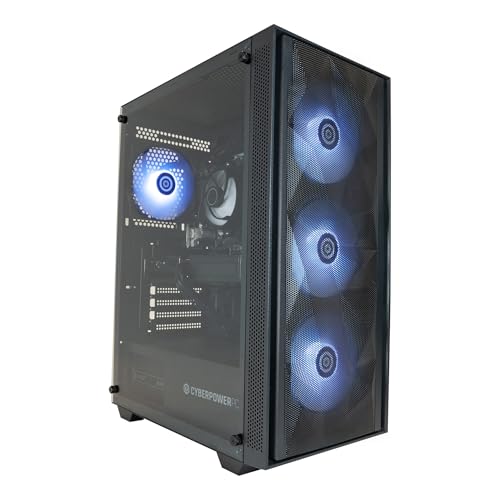
Best Overall: CyberPowerPC Wyvern Gaming PC (RTX 5060, Ryzen 5 8400F), a modern GPU, a recent CPU, and a sensible price for anyone who wants genuine 1080p gaming performance out of the box.
Best Value: Vibox I-7 Gaming PC, for light gaming on a tight budget, the Ryzen 3 3200G with Vega 8 integrated graphics handles older and less demanding titles without requiring a separate graphics card purchase.
The Vibox I-7 is aimed at the casual gamer who is either just starting out or working with a strict budget. It is built around the AMD Ryzen 3 3200G, a processor that combines a quad-core CPU running up to 4.0 GHz with Radeon Vega 8 integrated graphics. That combination will not run the latest AAA titles at high settings, but it handles a surprisingly wide range of games, including older titles, indie games, esports titles such as Rocket League and CS2 on lower settings, and strategy games that are not particularly GPU-hungry. If your gaming library consists largely of games from the last five to eight years rather than brand-new releases, this machine can cover a lot of ground.
The 16 GB of RAM is genuinely generous at this price point and means the system will not feel cramped when running a game alongside a browser, Discord, and a music streaming service simultaneously. The 500 GB SATA SSD keeps load times quick, though a handful of large modern games will fill it, so expect to add storage if your library grows. Windows 11 comes pre-installed, so there is no operating system headache on first boot.
The integrated Vega 8 graphics are the obvious ceiling here. You will need to keep resolution at 1080p and settings at medium or below for most modern games, and some titles from 2023 onwards will simply not run at acceptable frame rates. There is no discrete GPU, which means upgrading later is possible but requires opening the case and purchasing a card separately, which somewhat undermines the appeal of a pre-built machine.
Vibox builds are assembled in the UK and come with a warranty, which is reassuring for buyers who are not confident troubleshooting hardware issues themselves. The tower form factor means there is room for future upgrades if you eventually want to add a dedicated graphics card, extra storage, or more RAM.
Verdict: The best-value entry point for casual gaming on a budget, provided your game library skews towards older or less demanding titles.
Pros
- 16 GB RAM is unusually generous for this price bracket
- 500 GB SATA SSD gives fast load times
- Tower form factor allows future GPU upgrade if needed
Cons
- Integrated Vega 8 graphics cannot handle modern AAA titles at acceptable settings
- Ryzen 3 3200G is several generations old and will show its age in CPU-intensive games
Buying Guide
Do you actually need a discrete GPU?
The first question to ask is what you actually play. If your library consists of Minecraft, older strategy games, indie titles, and esports games such as Rocket League or Valorant, a modern integrated GPU such as the AMD Radeon 780M (found in the GMKtec K8 Plus) or even the Radeon Vega 8 (Vibox I-7) can handle these games at 1080p on reasonable settings. If you want to play recent AAA releases such as Cyberpunk 2077, Hogwarts Legacy, or the latest Call of Duty at acceptable settings, a discrete GPU is essential. The RTX 5060 and RTX 3060 options in this selection are the minimum recommended for that kind of library.
How much RAM do you need?
For casual gaming in 2025, 16 GB is the practical minimum and will serve most players well for the next three to four years. Games are increasingly using 12 to 16 GB of system RAM in addition to GPU VRAM, so 8 GB systems (such as the Dell Optiplex, which was not selected for this reason) are already struggling with modern titles. If you also use your PC for video editing, running virtual machines, or keeping many browser tabs open alongside a game, 32 GB is worth the investment. The GMKtec K8 Plus is the only machine in this selection that ships with 32 GB as standard.
SSD versus HDD
Every machine in this selection uses an NVMe SSD as its primary drive, which is the correct choice for 2025. NVMe SSDs dramatically reduce game load times compared to traditional hard drives and make the overall system feel responsive. A 1 TB drive is adequate for most casual gamers who maintain a library of ten to twenty installed games at a time, but if you tend to keep a large number of large games installed simultaneously, plan for external USB storage from the outset.
Form factor: tower versus mini PC
Traditional towers offer better cooling, more upgrade options, and generally better sustained performance under load. Mini PCs are quieter, take up far less space, and can be moved easily, but they sacrifice upgrade potential and can throttle under sustained gaming loads. For most casual gamers, a compact tower is the best compromise. If desk space is genuinely at a premium or portability matters, the mini PC route is viable provided gaming expectations are realistic.
Pre-built versus self-build
All five machines in this selection are pre-built and ready to use. For casual gamers who do not want to research component compatibility, source parts individually, and assemble a PC themselves, pre-built is the sensible choice. The price premium over a self-build is real but has narrowed considerably, and the warranty and support that come with a pre-built machine have genuine value for buyers who are not confident troubleshooting hardware faults independently.
Operating system
Most machines in this selection ship with Windows 11 Home, which is the current standard and the recommended OS for gaming in 2025. The MSI Aegis R ships with Windows 10 Home, which still works but is approaching end-of-support and will require a manual upgrade. Ensure any machine you buy ships with a licensed copy of Windows rather than requiring a separate purchase.
For the majority of casual PC gamers in the UK in 2025, the CyberPowerPC Wyvern Gaming PC with the RTX 5060 and Ryzen 5 8400F is the clear overall winner. It combines a genuinely modern GPU based on Nvidia's latest Blackwell architecture with a capable six-core CPU, 16 GB of RAM, and a 1 TB NVMe SSD, all at a price that is firmly within reach for this audience. It handles virtually every current game at 1080p high settings, supports DLSS 4 for future performance headroom, and requires no additional investment to be gaming-ready. For buyers on a tighter budget who play lighter or older titles, the Vibox I-7 remains the best-value entry point. For those who want a minimal desk footprint and play a mix of lighter games and productivity tasks, the GMKtec K8 Plus is the most distinctive alternative. The step-up Wyvern with the Ryzen 7 8700F earns its place for dual-use buyers who work and game on the same machine, while the MSI Aegis R suits brand-conscious buyers who value MSI's build quality and are comfortable with a slightly older platform.