AMD's Ryzen lineup has never been more varied, spanning budget-friendly AM4 chips that still punch well above their price, through to the latest AM5 processors built on Zen 5 architecture. Whether you are building a new PC from scratch, upgrading an existing AM4 board, or stepping up to the AM5 platform for the long haul, there is a Ryzen processor to suit every budget and use case. Since last year, AMD has launched the Ryzen 9000 series on AM5, bringing meaningful IPC gains over Ryzen 7000, while the Ryzen 7 9800X3D has cemented itself as the single best gaming CPU money can buy. Meanwhile, older AM4 chips like the Ryzen 5 5600X remain compelling value as prices have continued to fall. This comparison covers eight of the most worthwhile AMD processors available in the UK right now, from the entry-level Ryzen 5 3600 to the flagship Ryzen 7 9800X3D, helping you find the right chip for your needs and budget.
Quick Verdict
Best Overall: AMD Ryzen 7 9800X3D. No other consumer CPU matches its gaming performance, and it is strong in productivity too. Best Value: AMD Ryzen 5 5600X. Still a brilliant six-core chip at a price that makes it one of the most cost-effective AM4 upgrades available in 2025.
The Ryzen 7 9800X3D is AMD's current flagship gaming processor, and it is genuinely difficult to overstate how dominant it is in that role. Built on the Zen 5 architecture and paired with AMD's second-generation 3D V-Cache technology, it stacks 64 MB of additional L3 cache on top of the standard 40 MB, bringing the total to 104 MB. That enormous cache pool dramatically reduces latency for game workloads, keeping the CPU fed with data and preventing the bottlenecks that typically limit frame rates in demanding titles.
Who is it for? Primarily serious PC gamers who want the absolute best frame rates available, particularly in CPU-limited scenarios at 1080p and 1440p. It is also a strong all-rounder for content creators, performing admirably in multi-threaded workloads like video rendering and 3D modelling, though a Ryzen 9 9900X may edge it out in heavily threaded tasks where raw core count matters more than cache.
The chip sits on the AM5 platform, meaning you will need a compatible X670, B650, or X870 motherboard and DDR5 memory. That is a meaningful investment if you are building from scratch, but AM5 is AMD's platform for the foreseeable future, so it is a sensible long-term choice. The 9800X3D has a TDP of 120W, though real-world power consumption is often lower than its predecessor, the 7800X3D, thanks to Zen 5 efficiency improvements. Cooling requirements are modest by high-end standards, and a quality 240mm AIO or a large air cooler will serve it well.
Clock speeds reach up to 5.7 GHz boost, and the chip handles everything from competitive esports titles to open-world games with enormous draw distances. In games like Cyberpunk 2077, Baldur's Gate 3, and Microsoft Flight Simulator, it consistently delivers the highest frame rates of any consumer processor tested. The price is a premium one, but for a dedicated gaming rig where performance is the priority, nothing else in the AMD catalogue comes close.
Verdict: The best gaming CPU AMD has ever made, and arguably the best gaming CPU available from any manufacturer right now. The price is steep, but justified for enthusiasts.
Pros
- Highest gaming frame rates of any consumer CPU currently available
- 104 MB total cache dramatically reduces in-game CPU bottlenecks
- Surprisingly efficient for a 120W chip thanks to Zen 5 architecture
Cons
- Premium price requires a full AM5 platform investment if upgrading from AM4
- Multi-threaded productivity advantage over Ryzen 9 9900X is minimal given the price gap
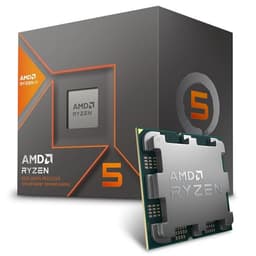
The Ryzen 5 5600X launched in 2020 as one of the best mainstream processors AMD had ever produced, and years later it remains a genuinely excellent choice, particularly given how far its price has fallen. Built on the Zen 3 architecture, it brought a significant IPC uplift over its Zen 2 predecessors and established AMD's dominance in the mid-range CPU market. In 2025, it sits in a sweet spot: mature, well-supported, and cheap enough to represent outstanding value for AM4 platform builds.
This chip is ideal for gamers and general users who already own an AM4 motherboard and want a meaningful upgrade without spending on a new platform. It is also a strong choice for first-time builders on a budget who are happy to pair it with an affordable B550 or X570 board. The six cores and twelve threads handle modern games, streaming, light video editing, and everyday productivity without breaking a sweat.
The 65W TDP means it runs cool and quiet under most workloads, and AMD includes a Wraith Stealth cooler in the box, though a budget aftermarket cooler will yield noticeably lower temperatures. Boost clocks reach 4.6 GHz across the six cores, and the 35 MB of combined cache keeps latency low for gaming workloads. PCIe 4.0 support ensures compatibility with modern NVMe SSDs and mid-range graphics cards without bandwidth constraints.
It does not have integrated graphics, so a discrete GPU is required. In heavily threaded workloads such as 4K video encoding or large-scale 3D rendering, it will fall behind eight-core and twelve-core chips. However, for the vast majority of gaming and everyday computing tasks, the 5600X delivers performance that remains competitive with chips costing considerably more. The AM4 ecosystem is also extremely mature, with a huge selection of compatible motherboards available at every price point.
Verdict: The best value AMD CPU available. If you are on AM4 or building a budget gaming PC, the 5600X is the chip to beat at this price point.
Pros
- Exceptional price-to-performance ratio for AM4 gaming builds
- Low 65W TDP keeps temperatures and noise levels manageable
- Mature AM4 platform means affordable, well-featured motherboard options abound
Cons
- No integrated graphics, so a discrete GPU is mandatory
- Six cores show strain in heavily multi-threaded professional workloads
- AM4 is a maturing platform with no future AMD CPU support beyond existing models
The Ryzen 7 9700X represents AMD's mainstream eight-core offering on the AM5 platform, built on the Zen 5 architecture. It is positioned as the sensible step up from the Ryzen 5 9600X for users who need more multi-threaded headroom, whether that is for content creation, software development, game streaming, or simply future-proofing a new build. What makes the 9700X particularly interesting is its 65W TDP, which is unusually low for an eight-core chip and makes it an excellent choice for small form factor builds or systems where noise and heat are a concern.
The chip boosts up to 5.5 GHz and offers 40 MB of combined L3 and L2 cache. In gaming, it performs very well, though it sits clearly behind the 9800X3D due to the absence of 3D V-Cache. For productivity workloads, the eight cores and sixteen threads handle video editing in DaVinci Resolve, compiling code, and running virtual machines with ease. It is a well-rounded chip that suits professionals who game as a secondary use case, rather than dedicated gaming enthusiasts who would be better served by the 9800X3D.
The AM5 platform requirement means DDR5 memory and a compatible motherboard are necessary, adding to the overall build cost. However, AM5 supports PCIe 5.0 for both GPU and M.2 slots on appropriate boards, and the platform is expected to receive CPU support through at least 2027, making it a solid long-term investment. The 9700X does not include integrated graphics, so a discrete GPU is required, which is worth noting for those planning a temporary iGPU-only setup during a build.
Compared to the Ryzen 7 7700X it replaces, the 9700X offers roughly 10 to 16 per cent better IPC performance depending on the workload, which is a meaningful generational improvement. Power efficiency is also notably better, making it one of the most thermally friendly eight-core desktop processors available.
Verdict: A polished, efficient eight-core chip that suits creators and power users building on AM5. Not the gaming king, but a superb all-rounder.
Pros
- 65W TDP is remarkably low for an eight-core processor, enabling quiet, cool operation
- Strong IPC gains over Zen 4 make it noticeably faster than the Ryzen 7 7700X
- AM5 platform longevity ensures upgrade paths remain open for several years
Cons
- No integrated graphics limits flexibility during builds or in case of GPU failure
- Gaming performance falls noticeably short of the 9800X3D for the price difference
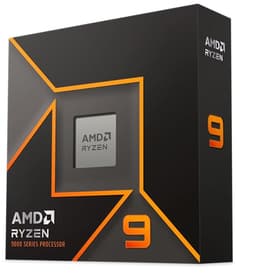
The Ryzen 9 9900X is AMD's twelve-core powerhouse on the AM5 platform, designed for users whose workloads genuinely benefit from a high core count. With twelve cores, twenty-four threads, and boost clocks reaching 5.6 GHz, it is one of the fastest multi-threaded processors in AMD's consumer lineup. It is built for video editors, 3D artists, software developers running parallel build systems, and anyone else who regularly pushes CPU utilisation to its limits across many simultaneous tasks.
In benchmarks like Cinebench R23 and Blender, the 9900X delivers performance that comfortably outpaces eight-core chips and closes the gap on the flagship Ryzen 9 9950X at a lower price. For gaming, it performs excellently in absolute terms, though the Ryzen 7 9800X3D still leads in most titles due to its 3D V-Cache advantage. If your primary use case is productivity with gaming as a secondary activity, the 9900X is arguably the more sensible choice than the 9800X3D.
The 120W TDP means you will want a quality cooler, and AMD does not include one in the box. A 280mm AIO or a high-end tower cooler is recommended to keep temperatures in check during sustained workloads. The chip supports PCIe 5.0 and DDR5 memory, and the AM5 platform provides plenty of bandwidth for demanding storage and GPU configurations.
One consideration is that the Ryzen 9 9900X sits in a slightly awkward position between the 9700X and the 9950X. For pure gaming, the 9800X3D is the better buy. For maximum multi-threaded throughput, the 9950X offers more cores. However, the 9900X hits a sweet spot for users who want strong multi-threaded performance without paying the premium for the 9950X, and it is a genuinely fast chip in virtually every scenario.
There is no integrated graphics on the 9900X, so a discrete GPU is required. For professional workstation users who occasionally render on the CPU while also needing GPU compute, this is worth factoring into your build planning.
Verdict: The best AMD CPU for multi-threaded productivity at a price below the flagship 9950X. A serious chip for serious workloads.
Pros
- Twelve cores deliver excellent performance in video rendering, compilation, and 3D work
- 5.6 GHz boost clock is among the highest in AMD's current consumer lineup
- Competitive pricing relative to the sixteen-core Ryzen 9 9950X
Cons
- 120W TDP demands a quality aftermarket cooler, which adds to build cost
- Gaming performance is strong but cannot match the 9800X3D's 3D V-Cache advantage
- No integrated graphics included
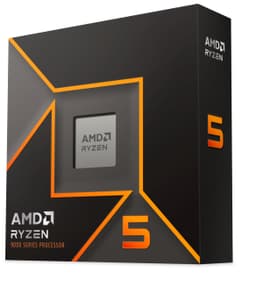
The Ryzen 5 9600X is AMD's entry point into the Zen 5 architecture on AM5, and it makes a compelling case for users who want a modern, future-proof platform without spending on an eight-core chip. Six cores and twelve threads may sound modest in 2025, but the Zen 5 IPC improvements mean the 9600X is noticeably faster than the Ryzen 5 7600 it succeeds, and it trades blows with eight-core Zen 4 chips in many gaming scenarios.
Boost clocks reach 5.4 GHz, which is impressive for a 65W six-core processor, and the chip includes Radeon integrated graphics. This is a practical bonus: it means you can get a system up and running without a discrete GPU, test your build, or use the machine for light tasks while waiting for a graphics card. The iGPU is not powerful enough for serious gaming, but it handles desktop tasks, 4K video playback, and light workloads without issue.
For gamers building on AM5 for the first time, the 9600X offers an affordable entry point with a clear upgrade path. When you are ready to step up, you can drop in a 9700X, 9800X3D, or future AM5 chip without changing your motherboard or memory. The 65W TDP also keeps cooling requirements minimal, and the chip will run comfortably on a mid-range air cooler.
In multi-threaded workloads, the six cores do show their limits compared to eight-core and twelve-core options. Sustained video encoding, large compilation jobs, and complex 3D rendering will all benefit from more cores. However, for gaming, web browsing, office productivity, and light creative work, the 9600X is more than sufficient and represents a sensible, modern foundation for a new AM5 build.
The combination of Zen 5 performance, integrated graphics, low power draw, and AM5 platform longevity makes the 9600X one of the most practical mainstream AMD chips available right now.
Verdict: The smartest entry point to AM5. Fast, efficient, and practical thanks to integrated graphics. Ideal for first-time AM5 builders on a moderate budget.
Pros
- Integrated Radeon graphics allow system operation without a discrete GPU
- Zen 5 IPC improvements make it faster than its Zen 4 predecessor in most workloads
- 65W TDP suits compact and quiet builds with modest cooling requirements
Cons
- Six cores limit performance in heavily multi-threaded professional applications
- AM5 platform cost (DDR5, compatible motherboard) raises the total build price
The Ryzen 5 8600G is AMD's mainstream APU for AM5, combining a Zen 4 CPU with a Radeon 760M integrated GPU. It is designed for users who want a capable, complete computing solution without a discrete graphics card, whether that is for a budget gaming PC, a home theatre build, a compact office machine, or a system where a GPU will be added later. The 760M iGPU is based on RDNA 3 architecture and is genuinely capable of light gaming at 1080p with settings turned down.
Six CPU cores boost to 5.0 GHz, and the chip handles everyday productivity, streaming, and office workloads without difficulty. The Zen 4 architecture is a step behind the Zen 5 chips in the lineup, but for the tasks this processor is designed for, the difference is largely academic. AMD also integrates Ryzen AI capabilities into the 8600G, enabling on-device AI processing for supported applications, which is an increasingly relevant feature as AI-accelerated software becomes more common.
The 22 MB of total cache is lower than the dedicated gaming chips in this list, which does mean the 8600G is not the best choice for CPU-limited gaming scenarios. However, when paired with a discrete GPU, it performs well and the integrated graphics serve as a useful fallback. The 65W TDP keeps the chip cool and quiet, and it is compatible with AM5 boards including the more affordable A620 platform, which helps keep total build costs down.
For small form factor enthusiasts, the 8600G is particularly appealing. Its low power draw, integrated graphics, and compact footprint make it ideal for mini-ITX builds where space and thermal headroom are at a premium. It is also worth considering for anyone building a secondary PC or a living room gaming machine where a full discrete GPU is not practical.
The 8600G does not match the raw CPU performance of the 9600X or 9700X, but it is not trying to. It occupies a distinct niche as an all-in-one solution, and within that niche it is very good indeed.
Verdict: The best AMD APU for AM5. Ideal for GPU-free builds, small form factor systems, and budget gaming setups where integrated graphics matter.
Pros
- Radeon 760M iGPU is capable of 1080p gaming at low to medium settings in many titles
- Compatible with budget AM5 A620 motherboards, keeping total build costs accessible
- Ryzen AI integration adds on-device AI processing for supported software
Cons
- Zen 4 architecture means it trails Zen 5 chips in IPC performance
- Lower cache total compared to dedicated gaming CPUs limits performance in CPU-heavy games
Buying Guide
AM4 vs AM5: Which Platform Should You Choose?
This is the most important decision you will make when choosing an AMD CPU in 2025. AM4 is AMD's mature platform, supporting processors from the original Ryzen 1000 series through to the Ryzen 5000 series. It uses DDR4 memory, which is cheaper than DDR5, and motherboards are available at very low prices. The downside is that AM4 has no future: AMD has confirmed it will not release new processors for the socket beyond the existing Ryzen 5000 lineup. If you are buying an AM4 chip today, you are investing in a platform with a fixed ceiling.
AM5 is AMD's current and future platform, supporting Ryzen 7000 and Ryzen 9000 series processors. It uses DDR5 memory and requires a newer motherboard, which increases the cost of entry. However, AMD has committed to AM5 support through at least 2027, meaning there are future upgrade paths available. If you are building a new PC from scratch, AM5 is generally the better long-term investment.
Core Count: How Many Do You Actually Need?
For gaming, six cores are sufficient for the vast majority of current titles, and the single-threaded performance and cache size of the processor matter more than raw core count. Eight cores provide additional headroom for background tasks and future-proofing. Twelve or more cores are primarily beneficial for content creators, software developers, and professionals running multi-threaded workloads. Buying a twelve-core chip purely for gaming is unlikely to yield a noticeable improvement over a well-chosen eight-core or six-core processor.
Integrated Graphics: Do You Need Them?
Most AMD Ryzen processors do not include integrated graphics, which means a discrete GPU is required for display output. The exceptions in this list are the Ryzen 5 9600X, Ryzen 5 8600G, and Ryzen 5 5600GT. If you are building a system without a dedicated graphics card, or want a fallback in case your GPU fails, choosing a chip with integrated graphics is a practical decision. The 8600G's Radeon 760M is the most capable iGPU in this list and is capable of light gaming.
TDP and Cooling Requirements
A chip's TDP rating gives a rough indication of its heat output and cooling requirements. The 65W chips in this list, including the 5600X, 9600X, 9700X, and 8600G, can be cooled adequately with a quality budget air cooler. The 120W chips, including the 9800X3D and 9900X, benefit from a 240mm AIO or a high-end tower cooler for sustained workloads. Always factor cooler cost into your budget, particularly for the higher-TDP chips where AMD does not include a cooler in the box.
Cache Size and Gaming Performance
AMD's 3D V-Cache technology, featured on the 9800X3D, dramatically increases the L3 cache available to the CPU. This has a significant positive effect on gaming performance by reducing the frequency with which the processor must fetch data from slower system memory. If gaming is your primary use case and budget allows, a 3D V-Cache chip is worth prioritising over a higher core count chip at a similar price.
The AMD Ryzen 7 9800X3D is the clear overall winner. It combines Zen 5's improved IPC with 3D V-Cache technology to deliver gaming performance that no other consumer processor can match, and it is more than capable in productivity workloads too. The AM5 platform investment is worthwhile given AMD's commitment to the socket through 2027 and beyond.
For buyers who cannot justify the 9800X3D's price or who are working within an existing AM4 system, the Ryzen 5 5600X remains the best value AMD CPU available. It is fast, efficient, affordable, and supported by a mature ecosystem of affordable motherboards. It will not win any benchmarks against newer Zen 5 chips, but for the money it is exceptionally difficult to fault. Between these two chips, virtually every AMD CPU buyer will find their answer.