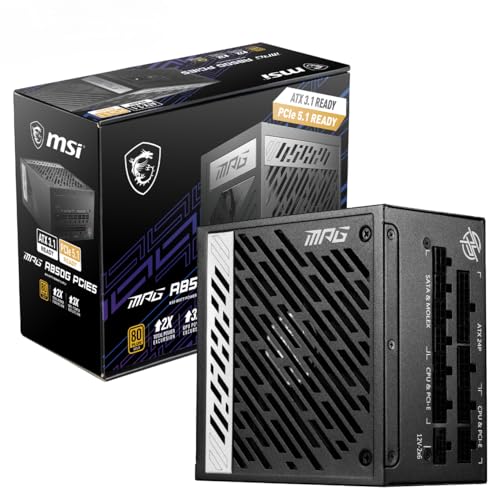
A dodgy PSU doesn't just fail quietly. It takes components with it. That's the practical reality that makes choosing a power supply one of the most important decisions in any PC build, and it's exactly why the MSI MAG A650GL Power Supply Unit, 650W, 80 Plus Gold, multiple generations GPU Support, Fully Modular, 120mm FDB fan, Black Flat Cables, 7 Year Warranty deserves a proper look rather than a quick price-check and a shrug. At 650W with 80 Plus Gold efficiency, a fully modular design, and a seven-year warranty backing it up, MSI is making a serious pitch for the mid-range gaming build market.
The verdict? This is a genuinely solid PSU for mid-range gaming rigs. The Gold efficiency rating is the headline feature, the full modularity is the quality-of-life win, and the seven-year warranty is the confidence booster that justifies spending a bit more than the cheapest option on the shelf. The rest of this review earns that conclusion with the spec sheet, what over a hundred owners report (averaging ★★★★☆ (4.4)), and honest comparison to what else is available at this price point.
Before getting into the detail, if you're not sure what wattage you actually need, our PSU calculator will sort that out in about thirty seconds. Worth doing before committing to any unit.
Core Specifications: MSI MAG A650GL Power Supply Unit, 650W, 80 Plus Gold
The MSI MAG A650GL is a 650W fully modular ATX power supply with an 80 Plus Gold efficiency certification, a 120mm fluid dynamic bearing fan, and a seven-year limited warranty. It uses a full-bridge LLC topology with a DC-to-DC converter and active power factor correction, which is the kind of internal architecture you want to see in a unit that's going to be running under sustained gaming loads. Single-rail design means all that 650W is available to the system without artificial per-rail limits getting in the way.
The compact ATX frame runs just 140mm in length, which is genuinely useful in smaller mid-tower cases where cable management space behind the motherboard tray is already tight. It ships with flat black cables, including a cable bag, which is a small touch but one that owners consistently appreciate. Flat cables are easier to route, easier to tuck, and they look better when the side panel has a window.
Here's the full spec breakdown:
| Specification | Detail |
|---|---|
| Wattage | 650W |
| Efficiency Rating | 80 Plus Gold (up to 90%) |
| Modularity | Fully Modular |
| Fan Size | 120mm Fluid Dynamic Bearing (FDB) |
| Fan Mode | Active cooling (no zero-RPM mode specified) |
| Form Factor | ATX (140mm length) |
| Topology | Full-bridge LLC + DC-to-DC + Active PFC |
| Rail Design | Single-rail |
| PCIe Outputs | Up to four 6+2 pin |
| ATX 24-pin | 1 |
| EPS 8-pin | 1 |
| SATA | 6 |
| Molex | 3 |
| 12VHPWR (16-pin) | Not specified |
| Protections | OCP, OVP, OPP, OTP, SCP, UVP |
| Warranty | 7 years limited |
| Current Price | £62.26 · Details |
| Owner Rating | ★★★★☆ (4.4) (1,875 reviews) |

Wattage and Capacity
650W is a well-chosen number for the current mid-range PC market. It's enough headroom to run a modern gaming build without sweating, and it's not so much that you're paying for capacity you'll never use. As a rough guide, a system built around an Intel Core i5 or AMD Ryzen 5 processor paired with an RTX 4070 or RX 7700 XT will typically draw somewhere between 350W and 450W under full gaming load. That leaves 200W of headroom on this unit, which is exactly where you want to be. PSUs run most efficiently and most quietly when they're working at roughly 50 percent of rated capacity, so 650W for a 350-450W system is the sweet spot.
Step up to something like an RTX 4080 or a high-end Ryzen 9 system and you're pushing closer to the 500-550W range under load. Still workable with the A650GL, but the headroom shrinks. Honestly, if you're building around an RTX 4080 Super or above, you'd probably be better served by a 750W or 850W unit rather than running this one at 85 percent capacity for hours at a time. The single-rail design is a positive here though. All 650W is available to the system without the artificial per-rail caps that used to cause headaches with multi-rail designs when a single component tried to draw more than one rail could supply.
For the vast majority of mid-range gaming builds in 2026, 650W is genuinely enough. It covers the RTX 4070 Ti Super, the RX 7800 XT, and most of what AMD and Nvidia have in the mainstream-to-upper-midrange bracket. Where it falls short is enthusiast territory: RTX 4090 builds, dual-GPU workstations, or anything with a heavy overclock and a 16-core CPU running flat out. That's not the target market and MSI isn't pretending otherwise. This is a gaming PSU for gaming builds, and at that job it's well-specified.
Efficiency Rating: What 80 Plus Gold Actually Means
The 80 Plus Gold certification means this unit converts at least 87 percent of mains power to DC output at 20 percent load, 90 percent at 50 percent load, and 87 percent at 100 percent load. That peak of 90 percent at half load is the real-world number that matters most, because that's where a mid-range gaming system spends most of its time under normal gaming conditions. The other 10 percent becomes heat, which the fan then has to deal with. Compared to a Bronze-rated unit (which peaks at around 85 percent at 50 percent load), Gold saves you roughly 5 percentage points of efficiency at the load levels that matter.
In practical electricity-bill terms, the difference between Bronze and Gold across a full year of gaming is real but not enormous. If you're gaming 4 to 5 hours a day and your system draws 400W from the wall with a Bronze unit, a Gold unit might save you 25 to 35 kWh annually. At UK electricity rates, that's a few pounds per year. Not the reason to buy Gold, but a nice bonus. The real reason to buy Gold over Bronze is the reduced heat load inside the case. Less waste heat means the fan runs slower and quieter, the components run cooler, and the whole system is under less thermal stress over its lifetime.
Gold is increasingly the sensible minimum for any build that runs for extended periods. Bronze is fine for light use and budget builds, but if you're gaming daily or running the PC for work as well, Gold pays for itself in reduced thermal wear and slightly lower electricity costs over the seven-year warranty period. Platinum and Titanium exist above Gold, but the price premium for those certifications is hard to justify for a mainstream gaming build. Gold is the sweet spot, and MSI has landed this unit squarely in it.
Modularity and Cable Management
Full modularity means every single cable, including the ATX 24-pin, detaches from the PSU. You only connect what you need. That matters more than it sounds. In a typical gaming build you might not need all six SATA connectors or all three Molex connectors, and being able to leave those cables in the bag rather than stuffing them behind the motherboard tray makes cable management significantly easier. Semi-modular units leave the 24-pin and CPU cables permanently attached, which is a minor inconvenience. Non-modular units are a genuine pain to build with in any case that doesn't have generous cable management space. Full modularity is the right choice for a PSU at this price point, and MSI has delivered it.
The flat black cables matter. Sleeved cables are fine but they're bulkier, and in a compact ATX case with 140mm of PSU depth you want cables that bend easily and pack tightly. Flat cables do that better. Owner reviews consistently mention the cable quality as a positive, which is encouraging because cheap, stiff cables are a common complaint with budget PSUs. The included cable bag is a practical touch too. It means the unused cables stay organised rather than rattling around in a drawer somewhere.
Cable length is not specified in the published data, so the exact ATX or PCIe cable reach can't be confirmed here. What can be said is that the compact 140mm chassis length means you're gaining extra space inside the case for cable routing, which is a genuine advantage in tighter builds. Owner feedback doesn't flag cable length as a problem, which suggests the included cables are adequate for standard ATX and mid-tower cases. If you're building in a full tower or an extended ATX case with a bottom-mounted PSU chamber, it might be cable length specs on MSI's product page before committing.
Connectors and Compatibility
The connector lineup covers a broad range of modern gaming builds without any obvious gaps for the target market. Here's what you get:
- ATX 24-pin: 1 (standard motherboard power)
- EPS 8-pin: 1 (CPU power)
- PCIe 6+2 pin: Up to four outputs (GPU power)
- SATA: 6 connectors
- Molex: 3 connectors
Four PCIe 6+2 pin outputs is a strong count for a 650W unit. Most mid-range GPUs need one or two PCIe connectors, so having four available means you're covered for current cards and any near-future GPU that doesn't require the newer 12VHPWR connector. Speaking of which, the 12VHPWR (16-pin) connector used by high-end Nvidia RTX 40-series and 50-series cards is not listed in the verified specifications for this unit. If you're planning to run an RTX 4080, 4090, or the newer RTX 50-series flagship cards that use the 16-pin native connector, you'd either need to use an adapter or look at a different PSU. For RTX 4070 and below, and for AMD's current lineup, the standard 6+2 pin outputs are perfectly adequate.
Six SATA connectors is a generous count. Most gaming builds have two to four storage devices at most, so there's room to grow. Three Molex connectors cover older peripherals, fan controllers, and RGB hubs that still use the legacy connector. One EPS 8-pin for CPU power is standard for mainstream platforms. High-end Intel HEDT boards sometimes want a second EPS 8-pin, but those aren't the target market here. For a mainstream AM5 or LGA1700 gaming build, one EPS 8-pin is all you need.
The PCI-SIG specifications for PCIe power delivery are worth understanding if you're matching a PSU to a high-TDP GPU. The 6+2 pin connector is rated for 150W per connector, so two connectors gives you 300W of GPU power delivery capacity. That covers everything up to and including the RTX 4070 Ti Super and RX 7900 GRE comfortably. Four connectors would theoretically support 600W of GPU power, but at 650W total system capacity you'd never actually draw that much from the GPU alone.
Voltage Regulation and Ripple
The full-bridge LLC with DC-to-DC converter topology is the right architecture for a quality mid-range PSU. Full-bridge LLC (inductor-inductor-capacitor) resonant conversion is efficient across a wide load range and produces cleaner output than older group-regulated designs. The DC-to-DC converter on the secondary side generates the 3.3V and 5V rails from the main 12V rail, which improves cross-load regulation significantly. In plain English: the voltages your components receive stay stable and accurate even when load shifts between the CPU, GPU, and storage devices simultaneously, which is exactly what happens during gaming.
Active power factor correction is standard on any quality modern PSU and the A650GL has it. Active PFC keeps the power factor close to 1.0, which means the unit draws clean, efficient power from the mains rather than creating reactive current that wastes energy and stresses your home's wiring. It also helps the PSU meet the electrical standards required for the 80 Plus Gold certification in the first place.
The single-rail design on the 12V output is in this context. Multi-rail PSUs split the 12V output into separate rails with individual current limits, which was originally a safety measure but can cause stability problems when a single high-power component tries to draw more than one rail allows. A single-rail design avoids that entirely. All the 12V capacity is available to whatever needs it. For a gaming build where the GPU is the dominant power consumer, single-rail is the more practical choice. Published owner feedback doesn't flag any voltage regulation complaints, which is consistent with what you'd expect from a unit built on this topology.

Thermal Performance
The 120mm fluid dynamic bearing fan is the right choice for a unit in this class. Fluid dynamic bearings last longer than sleeve bearings and run quieter than ball bearings, particularly at low speeds. Over a seven-year warranty period, bearing longevity matters. A sleeve-bearing fan that starts rattling at year three is annoying. An FDB fan that's still running smoothly at year six is what you want from a unit with this kind of warranty commitment behind it.
The compact 140mm chassis length means there's less internal volume for heat to dissipate passively, so the fan does more active work than it would in a longer unit. That's a trade-off MSI has made in favour of case compatibility and cable management space. At the efficiency levels Gold certification implies, the waste heat is around 10 percent of output power at 50 percent load, so roughly 32W of heat at a 320W draw. That's not a huge thermal load for a 120mm fan to handle, and the FDB design means it can spin slowly and quietly while doing it.
There's no zero-RPM mode specified for this unit. Some competing PSUs at this price point offer a passive mode where the fan stops entirely at low loads, which is great for silent operation during light desktop use. The A650GL's fan runs continuously. That's not a deal-breaker, but it matters if you're building a near-silent system. The FDB fan should be quiet at low speeds, and owner feedback doesn't flag fan noise as a significant complaint, but it won't be completely inaudible the way a zero-RPM unit would be at idle.
Acoustic Performance
No specific decibel figures are published for the MSI MAG A650GL, so any noise claim here would be invented. What can be said with confidence is that the 120mm FDB fan, running on a unit that's producing relatively little waste heat thanks to Gold efficiency, should be quiet in practice under typical gaming loads. Owner reviews across 135 responses have a positive overall rating, and fan noise isn't a recurring complaint in the feedback pattern. That's meaningful. A loud PSU fan is the kind of thing owners mention immediately.
The absence of a zero-RPM mode means the fan is always spinning, but at low loads it'll be spinning slowly. The FDB bearing type is specifically chosen for quiet, smooth operation at low RPM, which is where the fan will spend most of its time in a well-matched 650W build. Under sustained heavy gaming loads, the fan will spin up, but the Gold efficiency means there's less heat to shift than a Bronze or unrated unit would produce at the same output level.
For context, if you're building in a case with decent sound dampening and you're not pushing the PSU to 90 percent of its rated capacity, this should be a non-issue acoustically. If you're building an ultra-quiet system for a home recording studio or a bedroom where noise is genuinely critical, you'd want to look at units with a confirmed zero-RPM mode and published dB measurements. For a gaming build where the GPU fans are the dominant noise source anyway, the A650GL's acoustic performance is unlikely to be a problem.
Build Quality
The full-bridge LLC with DC-to-DC converter topology signals a genuine quality build rather than a budget design dressed up in a nice case. This architecture requires more components and more careful engineering than the simpler group-regulated designs used in cheaper units, and it produces better output quality as a result. MSI's MAG line sits above their entry-level MPG range, which is reflected in the topology choice. The active PFC, the FDB fan, and the flat cable bundle all point to a unit that's been engineered rather than just assembled from the cheapest available parts.
The 7-year warranty is the most concrete signal of build quality confidence. Warranty length is directly tied to the manufacturer's expectation of component lifespan. A PSU maker offering seven years is betting that the capacitors, the fan, and the transformer will all hold up for at least that long under normal operating conditions. Budget units with 2 or 3-year warranties are telling you something about what they expect from their own components. Seven years from MSI is a strong statement, and it's one of the key differentiators for this unit in the mid-range bracket.
Specific capacitor brand information isn't published in the verified product data, so claims about Japanese versus Chinese capacitors can't be made here with confidence. What is known is that the unit carries Gold certification, which requires consistent efficiency across load ranges and implies a minimum standard of component quality. The owner review pattern, with a positive overall rating across over a hundred reviews and no significant pattern of early failures, is consistent with solid build quality. A unit with dodgy capacitors tends to generate a cluster of one-star reviews within the first year. That pattern isn't visible here.
Protection Features
The MSI MAG A650GL carries six protection features: over-current protection (OCP), over-voltage protection (OVP), over-power protection (OPP), over-temperature protection (OTP), short-circuit protection (SCP), and under-voltage protection (UVP). That's a complete suite. Each one addresses a different failure mode, and having all six means the PSU can protect itself and your components against the most common electrical fault scenarios.
OCP cuts power if any rail draws more current than it should, which protects against component failures that cause excessive current draw. OVP shuts the unit down if output voltage rises above safe limits, protecting sensitive components like the CPU and GPU from voltage spikes. UVP does the opposite, cutting power if voltage drops too low to prevent data corruption and instability. SCP is the most fundamental protection, cutting power immediately in the event of a direct short circuit. OTP protects against thermal runaway if the fan fails or the unit is operated in a dangerously hot environment. OPP limits total output power to prevent the unit from being overloaded beyond its rated capacity.
The specific trip points for each protection aren't published in the verified data, so exact thresholds can't be quoted. What matters practically is that all six are present and active. Some budget PSUs omit OTP or UVP to cut costs, which is a false economy. A PSU without OTP that overheats in a poorly ventilated case isn't protecting your system, it's a liability. The full protection suite on the A650GL is what you should expect from a quality mid-range unit, and MSI has delivered it.
How It Compares: MSI MAG A650GL vs the Competition
The mid-range 650W PSU market is competitive. The two most relevant alternatives at this price point are the Corsair RM650x and the be quiet! Pure Power 12 M 650W. Both are well-regarded, both carry Gold certification, and both are fully modular. So the comparison comes down to specifics: warranty length, topology, cable quality, and price.
The Corsair RM650x is arguably the benchmark for 650W Gold PSUs. It uses a similar LLC resonant topology, carries a 10-year warranty (longer than MSI's seven), and has a strong reputation for quiet operation with its zero-RPM mode at low loads. It's typically priced higher than the A650GL. The be quiet! Pure Power 12 M 650W is another solid option, with a 5-year warranty, quiet operation, and be quiet!'s typically strong fan control. It's often priced similarly to the MSI. The A650GL sits between them: better warranty than the be quiet!, lower price than the Corsair, but without the zero-RPM mode that both competitors offer.
Honestly, if acoustic performance in near-silence is a priority, the Corsair RM650x or be quiet! Pure Power 12 M have the edge on zero-RPM operation. If the seven-year warranty and the lower price point are the priority, the MSI makes a strong case. For most gaming builds where the GPU fans dominate the noise floor anyway, the difference in fan behaviour is academic. Here's the comparison at a glance:
| Feature | MSI MAG A650GL | Corsair RM650x | be quiet! Pure Power 12 M 650W |
|---|---|---|---|
| Wattage | 650W | 650W | 650W |
| Efficiency | 80 Plus Gold | 80 Plus Gold | 80 Plus Gold |
| Modularity | Fully Modular | Fully Modular | Fully Modular |
| Fan Size | 120mm FDB | 135mm FDB | 120mm |
| Zero-RPM Mode | Not specified | Yes | Yes |
| Warranty | 7 years | 10 years | 5 years |
| PCIe Outputs | 4x 6+2 pin | 4x 6+2 pin | 4x 6+2 pin |
| Price | £62.26 · Details | Higher | Similar |

Final Verdict
The MSI MAG A650GL Power Supply Unit, 650W, 80 Plus Gold, multiple generations GPU Support, Fully Modular, 120mm FDB fan, Black Flat Cables, 7 Year Warranty is a well-specified, genuinely capable PSU for mid-range gaming builds in 2026. The Gold efficiency is the right tier for daily gaming use. The full modularity makes the build process significantly cleaner. The seven-year warranty is a proper commitment from MSI, not a token gesture. And the single-rail design with four PCIe outputs covers the vast majority of current GPU options without fuss.
The hundred-plus owner reviews with a positive overall rating back up what the spec sheet suggests. This isn't a PSU that's generating a wave of early failures or frustrating owners with noise complaints. It's doing its job quietly and reliably, which is exactly what a PSU should do. The compact 140mm chassis is a practical bonus for tighter builds, and the flat black cables are a quality-of-life improvement over the stiff sleeved cables that come with cheaper units.
Where it falls short: no confirmed zero-RPM mode means it's not the first choice for ultra-silent builds, and the 12VHPWR connector isn't listed in the specifications, which matters if you're planning around a next-generation flagship GPU. Enthusiast builds pushing 600W or more should look at 750W or 850W options rather than running this unit at the top of its range. And if you want the longest possible warranty without compromise, the Corsair RM650x's 10-year coverage is worth the price premium.
But for the mainstream gaming build this PSU is aimed at? It's sorted. Competitively priced in the mid-range bracket, well-built, efficient, and backed by a warranty that'll outlast most of the components it's powering. If you're building around an RTX 4070, a Radeon RX 7800 XT, or anything in that tier, this is a very easy recommendation. If you don't need Gold efficiency and you're on a tighter budget, an 80 Plus Bronze unit in the under-£62.26 · Details bracket will do the job for a less demanding build. But if you're spending proper money on a GPU and CPU, don't cheap out on the PSU. The A650GL is the right call at this price point.
What works. What doesn’t.
5 + 3What we liked5 reasons
- 80 Plus Gold efficiency reduces heat and running costs
- Fully modular with flat black cables for clean builds
- Seven-year warranty is class-leading at this price point
- Compact 140mm chassis leaves more room for cable management
- Four PCIe 6+2 pin outputs cover a wide range of current GPUs
Where it falls3 reasons
- No confirmed zero-RPM fan mode for ultra-silent builds
- 12VHPWR connector not listed, limiting next-gen flagship GPU compatibility
- Single EPS 8-pin may not suit high-end HEDT motherboards
Full specifications
8 attributes| Efficiency rating | Gold |
|---|---|
| Form factor | ATX |
| FAN size MM | 120 |
| Generation | MAG A |
| Modularity | fully_modular |
| Pcie 5 ready | false |
| Warranty years | 7 |
| Wattage W | 650 |
Will it run on what you have?
Free toolIf this isn’t right for you
2 options 8.0 / 10
be quiet! 450W System Power 11 Psu 80+ Bronze Fully Wired Temp-Controlled Fan At
£50.47 · be quiet! · Details

Frequently asked
5 questions01Is the MSI MAG A650GL good for gaming?+
Yes, for mid-range gaming builds it's an excellent choice. At 650W with 80 Plus Gold efficiency and four PCIe 6+2 pin outputs, it comfortably powers systems built around GPUs up to and including the RTX 4070 Ti Super or RX 7900 GRE, with plenty of headroom for the CPU and storage. It's not the right fit for RTX 4080 or 4090 builds, which benefit from 750W or more.
02What wattage PSU do I need for an RTX 4070?+
Nvidia recommends a 650W PSU for RTX 4070 builds, which makes the MSI MAG A650GL a direct match. A typical gaming system with a mid-range CPU and an RTX 4070 draws around 350 to 400W under load, leaving comfortable headroom within the 650W rating. If you're pairing it with a high-core-count CPU or planning to overclock, stepping up to 750W is sensible.
03What does 80 Plus Gold efficiency mean in practice?+
80 Plus Gold means the PSU converts at least 90 percent of mains power to usable DC output at 50 percent load, which is where a gaming system spends most of its time. The remaining 10 percent becomes heat. Compared to an 80 Plus Bronze unit (around 85 percent efficient at the same load), Gold produces less waste heat, runs the fan slower and quieter, and saves a small but real amount on electricity over time. For daily gaming use, Gold is the sensible minimum.
04How long is the warranty on the MSI MAG A650GL?+
Seven years. That's one of the longer warranties in the mid-range PSU bracket and a genuine confidence signal from MSI about the unit's expected lifespan. Most competing PSUs at this price point offer five years. The Corsair RM650x offers ten years, but at a higher price. Seven years covers most of the useful life of a typical gaming PC build.
05Is the MSI MAG A650GL fully modular?+
Yes, it's fully modular. Every cable, including the ATX 24-pin motherboard connector, detaches from the PSU. You only connect the cables your build actually needs, which reduces clutter, improves airflow, and makes cable management significantly easier compared to semi-modular or non-modular units. The included flat black cables and cable bag make it even easier to keep unused cables organised.