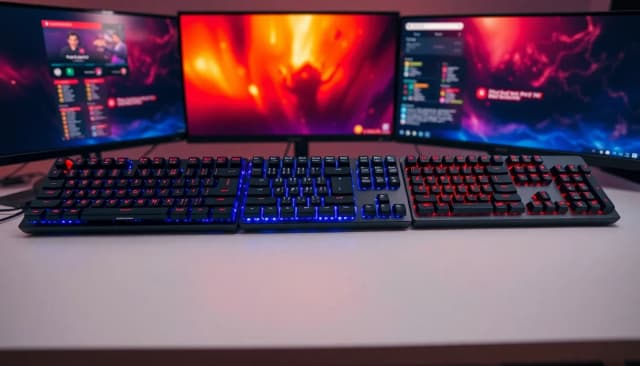
Esports players demand more from a keyboard than any casual gamer: sub-millisecond actuation, zero input lag, rock-solid build quality and a layout that keeps hands in the optimal position during long tournament sessions. This year the market has shifted noticeably, with Hall Effect magnetic switches moving from niche curiosity to mainstream contender, analogue optical technology maturing significantly, and wireless latency finally reaching a point where it is genuinely competitive-grade. Whether you are grinding ranked matches, attending LAN events or streaming from home, the keyboard you choose can shave precious milliseconds off your reaction time and reduce fatigue over extended play. This roundup focuses on keyboards that are actually available in the UK, spanning a range of budgets from under £50 to nearly £280, so whether you are a student on a tight budget or a professional looking for the best money can buy, there is a pick here for you.
Quick Verdict
Best Overall: Razer Huntsman V3 Pro. Its analogue optical switches deliver the most refined competitive experience available right now, with adjustable actuation and genuine tournament-grade performance.
Best Value: AULA WIN60 HE. Hall Effect switches at under £50 is remarkable, and the adjustable actuation point makes it punch well above its price class for esports use.
The Razer Huntsman V3 Pro is aimed squarely at professional and semi-professional esports players who want the most technologically advanced switch mechanism currently on the market. Razer's second-generation Analog Optical switches sit at the heart of this keyboard, and they represent a genuine leap forward from the first Huntsman generation. Where traditional mechanical switches are binary, registering either pressed or not pressed, the analogue optical system reads the precise position of each key along its travel, allowing you to set custom actuation points anywhere from 0.1 mm to 4.0 mm. For esports titles like Counter-Strike 2, Valorant or Apex Legends, this means you can set an extremely shallow actuation point for faster inputs, or a deeper one to avoid accidental keypresses during tense moments.
The keyboard supports a polling rate of up to 8,000 Hz when paired with Razer's HyperPolling technology, which means the PC receives position data from the keyboard eight thousand times per second. In practical terms, the difference between 1,000 Hz and 8,000 Hz is measurable in competitive scenarios, particularly for movement inputs where timing is critical. The build quality is excellent: an aluminium top plate gives the keyboard rigidity without excessive flex, and the stabilisers on larger keys are pre-lubed from the factory, resulting in a smooth, rattle-free experience straight out of the box.
The Huntsman V3 Pro is a full-size keyboard, which some esports players may find takes up too much desk space. However, Razer does offer a TKL version if you prefer a more compact layout. The Razer Synapse software is required to unlock the full potential of the adjustable actuation system, and while it is feature-rich, it is also resource-heavy and requires an account to access cloud-saved profiles. At close to £250, this is not a budget purchase, but for players who want every competitive advantage and are willing to pay for it, the Huntsman V3 Pro is the most capable esports keyboard in this roundup.
The per-key RGB lighting is vibrant and customisable, and the USB-C braided cable is detachable, making transport to LAN events straightforward. Keycap legends are clear and durable, and the font is clean enough to remain legible even at lower lighting levels. The wrist rest is sold separately, which is a minor frustration at this price point, but the keyboard itself is wide enough that most players will not miss it during shorter sessions.
Verdict: The Huntsman V3 Pro is the most technically accomplished esports keyboard in this comparison. If you are serious about competitive play and want cutting-edge switch technology, this is the one to get.
Pros
- Analog Optical switches with fully adjustable actuation from 0.1 mm to 4.0 mm
- Up to 8,000 Hz polling rate for the lowest possible input latency
- Aluminium top plate with factory-lubed stabilisers for a premium feel
Cons
- Full-size layout takes up significant desk space compared to TKL or 75% alternatives
- Razer Synapse software is required for advanced features and is resource-intensive
The AULA WIN60 HE is the most exciting budget offering in this roundup, and arguably one of the most significant value propositions in the entire UK gaming keyboard market right now. Hall Effect magnetic switches, which were until recently found only on keyboards costing well over £100, are here available for under £50. This matters enormously for esports players on a budget, because Hall Effect switches offer two key advantages over traditional mechanical switches: they have no physical contact points, so they do not wear out or develop inconsistency over time, and they allow fully adjustable actuation points, letting you tune the keyboard's response to your exact preference.
The WIN60 HE uses a 60% layout, which is the most compact form factor in mainstream use. This removes the function row, arrow keys and navigation cluster, leaving only the alphanumeric keys and modifiers. For many esports players, particularly those who play first-person shooters or battle royale titles, this is ideal: the mouse can sit closer to the keyboard, reducing shoulder strain, and the smaller footprint means more room for wide mouse sweeps. Function layer access covers the missing keys, and most players adapt to this within a few sessions.
The adjustable actuation system on the WIN60 HE allows you to set the actuation point anywhere within the switch travel, and some Hall Effect implementations also support rapid trigger, a feature that resets the actuation point immediately upon key release rather than waiting for the key to return to a fixed reset point. Rapid trigger is particularly valued in games like Counter-Strike 2, where the ability to stop and start movement inputs as quickly as possible is a genuine competitive advantage.
Build quality is solid for the price. The case has a slight flex to it, as is common at this price point, but the switches feel consistent and the stabilisers are acceptable without modification. The USB-C connection is wired only, which is a limitation compared to more expensive options, but for a keyboard at this price, wired is entirely appropriate. RGB lighting is per-key and reasonably vibrant, with basic customisation available via software.
For a student, a younger player or anyone who wants to experience Hall Effect technology without a significant financial commitment, the WIN60 HE is an outstanding choice. It is not perfect, but at this price, its shortcomings are very easy to forgive.
Verdict: The AULA WIN60 HE is the best value esports keyboard in this comparison. Hall Effect switches and adjustable actuation at under £50 is genuinely remarkable.
Pros
- Hall Effect magnetic switches with adjustable actuation at a sub-£50 price point
- 60% layout maximises desk space for wide mouse movement, ideal for FPS players
- No physical contact points mean switches maintain consistency over millions of keypresses
Cons
- Wired only, with no wireless option for players who prefer cable-free setups
- 60% layout requires function layer access for arrow keys, which takes adjustment time
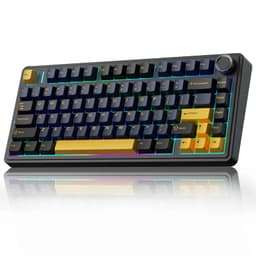
The EPOMAKER X AULA F75 MAX is a collaboration between two brands that have built strong reputations in the enthusiast keyboard community, and the result is one of the most feature-rich mid-range gaming keyboards available in the UK. The 75% layout is arguably the sweet spot for esports players who want a compact board without giving up arrow keys and a small navigation cluster, which are genuinely useful outside of gaming for productivity tasks and in-game chat navigation.
The headline feature that sets the F75 MAX apart from most keyboards at this price is the TFT display screen built into the keyboard body. This small screen can display system information, custom animations, GIFs or clock data, and while it is primarily an aesthetic feature, it does add a level of personalisation that enthusiasts will appreciate. The rotary knob for volume control is a practical addition that esports players use constantly, allowing quick audio adjustments without alt-tabbing or reaching for a separate controller.
Connectivity is tri-mode: 2.4 GHz wireless via a USB dongle, Bluetooth 5.0 for up to three paired devices, and USB-C wired. For esports play, the 2.4 GHz wireless mode is the recommended option, as it delivers the lowest latency of the wireless options. The keyboard is hot-swap compatible, meaning you can change the switches without soldering, which is a significant advantage for players who want to experiment with different switch feels or upgrade to Hall Effect switches in the future.
The gasket mount design provides a softer, more cushioned typing feel compared to the tray-mount designs common in budget keyboards. This reduces typing fatigue during long sessions and gives the keyboard a more premium sound profile. The pre-installed linear switches are smooth and consistent, suitable for esports use, though the hot-swap capability means you are not locked in if you prefer a different switch type.
Software support is provided via EPOMAKER's own driver suite, which covers RGB customisation, macro programming and the TFT screen content. It is functional if not the most polished interface available. At under £80, the F75 MAX offers a remarkable combination of features, build quality and flexibility that would cost significantly more from established brands.
Verdict: The EPOMAKER X AULA F75 MAX is the best all-rounder for players who want a feature-rich keyboard with wireless flexibility and the option to customise switches without soldering.
Pros
- Tri-mode connectivity (2.4 GHz, Bluetooth 5.0, USB-C) for maximum flexibility
- Hot-swap switch sockets allow switch changes without soldering tools
- Gasket mount design reduces typing fatigue and improves sound profile
Cons
- TFT screen and knob add weight and complexity that pure esports players may not need
- EPOMAKER software is functional but less polished than Logitech or Razer equivalents
The AULA F75 Wireless is the more straightforward sibling to the EPOMAKER X AULA F75 MAX, sharing the same 75% layout and tri-mode wireless connectivity but stripping back some of the premium features to hit a slightly lower price point. For esports players who want a wireless 75% keyboard with hot-swap capability and do not need a TFT screen or rotary knob, the F75 Wireless is an excellent, focused option.
The 75% layout retains the arrow keys and a condensed navigation cluster, which makes it more versatile than a 60% board for players who also use their keyboard for work or study. The layout is compact enough to allow comfortable mouse positioning without the full-size footprint that can push the mouse uncomfortably far to the right. Many professional esports players have moved to 75% or TKL layouts for exactly this reason.
The tri-mode connectivity mirrors the F75 MAX: 2.4 GHz wireless for gaming, Bluetooth 5.0 for connecting to additional devices such as a laptop or tablet, and USB-C wired for charging or wired play. The 2.4 GHz connection operates at a 1,000 Hz polling rate, which is the standard for competitive gaming and more than sufficient for the vast majority of players. Battery life is rated at several weeks on Bluetooth and around 40-50 hours on 2.4 GHz with backlighting active.
Hot-swap PCB support means you can install your preferred switches with no soldering required. The keyboard ships with linear switches pre-installed, which are suitable for esports, but the ability to swap to tactile, clicky or even Hall Effect switches (if compatible) gives the keyboard a longevity that fixed-switch boards cannot match. The gasket mount provides a softer sound and feel compared to budget tray-mount alternatives.
RGB lighting is per-key and covers a wide spectrum, with customisation available through AULA's software. The keycaps are double-shot ABS, which is adequate but will develop shine over time with heavy use. Upgrading to aftermarket PBT keycaps is straightforward given the standard layout and switch compatibility.
At under £70, the AULA F75 Wireless represents strong value for a wireless hot-swap mechanical keyboard with a layout that suits both gaming and everyday use. It is not quite as feature-packed as the F75 MAX, but for players who prioritise simplicity and value, it is the more sensible choice.
Verdict: The AULA F75 Wireless is a focused, well-priced wireless keyboard for esports players who want hot-swap flexibility and tri-mode connectivity without paying for features they will never use.
Pros
- Tri-mode wireless with 2.4 GHz at 1,000 Hz polling rate for competitive-grade latency
- Hot-swap PCB allows switch changes without soldering, extending the keyboard's lifespan
- 75% layout retains arrow keys, making it practical for both gaming and productivity
Cons
- Double-shot ABS keycaps will develop shine with prolonged heavy use
- No TFT screen or rotary knob compared to the F75 MAX at a similar price bracket
Buying Guide
Switch Technology: Why It Matters More Than Ever
The switch is the single most important component in any esports keyboard, and in 2025 the landscape has changed significantly. Traditional mechanical switches, which use a physical contact mechanism to register keypresses, remain perfectly viable for competitive play, but two newer technologies have raised the bar considerably.
Hall Effect magnetic switches use magnets rather than physical contacts to detect key position. Because there is no metal-on-metal contact, they do not wear out in the same way, and they allow the actuation point to be adjusted via software. More importantly, many Hall Effect keyboards support rapid trigger, a feature that resets the actuation point the moment a key begins to rise rather than waiting for it to return to a fixed position. In games like Counter-Strike 2, rapid trigger allows faster stop-start movement inputs, which is a measurable competitive advantage.
Analogue optical switches, as found in the Razer Huntsman V3 Pro, take this further by reading the precise position of the key along its entire travel using light. This enables not just adjustable actuation but also analogue input values, meaning the keyboard can theoretically send different values depending on how far a key is pressed, similar to an analogue thumbstick on a controller.
Layout: Choosing the Right Size
For esports, smaller is generally better. A full-size keyboard with a numpad pushes the mouse further to the right, increasing the distance your arm must travel and potentially causing shoulder strain over long sessions. The most popular layouts among competitive players are:
- 60%: Removes the function row, arrow keys and navigation cluster. Maximum compactness, minimum desk footprint. Requires function layer access for missing keys. For a premium option here, consider an aluminium 60% board like the HyperX Alloy Origins 60.
- 75%: Retains arrow keys and a small navigation cluster while remaining significantly more compact than a full-size board. The best compromise for players who also use their keyboard for work.
- TKL (80%): Removes only the numpad. Retains all other keys. A comfortable choice for players transitioning from full-size boards.
Wireless vs Wired
Modern 2.4 GHz wireless keyboards operating at 1,000 Hz polling rate are genuinely competitive-grade. The latency difference between a quality wireless keyboard and a wired one is, in practice, imperceptible to human reaction times. However, wired connections remain the standard at most official tournaments, so if you plan to compete at LAN events, ensure your keyboard can operate in wired mode as well.
Polling Rate
1,000 Hz means the keyboard sends its state to the PC 1,000 times per second, or once every millisecond. This is the standard for competitive gaming. Some keyboards, including the Razer Huntsman V3 Pro, support up to 8,000 Hz, which reduces the maximum latency from 1 ms to 0.125 ms. Whether this is perceptible in practice is debated, but for the most latency-sensitive players, higher polling rates are a meaningful consideration.
Keycaps
PBT keycaps are more durable than ABS, resisting the shine that develops with prolonged use. Double-shot legends, where the character is moulded from a second layer of plastic rather than printed, will never fade. For a keyboard you intend to use heavily for competitive gaming, PBT double-shot keycaps are the preferred option.
Budget Guidance
Under £25: Entry-level wired keyboards. Suitable for beginners testing compact layouts. Under £80: Mid-range mechanical or Hall Effect keyboards with wireless options. The sweet spot for most players. Over £150: Premium keyboards with advanced switch technology, superior build quality and professional-grade wireless. Worth the investment for serious competitors.
The Razer Huntsman V3 Pro is the overall winner of this comparison. Its analogue optical switches with adjustable actuation from 0.1 mm to 4.0 mm, combined with an 8,000 Hz polling rate, represent the most advanced competitive keyboard technology available in the UK market right now. The aluminium build, factory-lubed stabilisers and detachable USB-C cable make it a complete package for serious esports players. Yes, it is expensive, and the full-size layout will not suit everyone, but for players who want the absolute best and are prepared to invest accordingly, nothing else in this roundup comes close.
For players who cannot justify the Huntsman V3 Pro's price, the AULA WIN60 HE is the standout value pick. Hall Effect switches with adjustable actuation at under £50 was unthinkable two years ago, and the fact that it is now a reality makes the WIN60 HE one of the most significant budget gaming keyboards released in recent memory. Players who want wireless freedom should look at the Logitech G PRO X TKL LIGHTSPEED or the EPOMAKER X AULA F75 MAX, both of which offer genuinely competitive wireless performance at very different price points.