Finding a capable processor under £150 has never been more straightforward. Budget-conscious builders and everyday users now have access to processors that deliver solid multi-threaded performance, energy efficiency, and in many cases, integrated graphics that eliminate the need for a dedicated GPU. This year's crop of sub-£150 CPUs represents a significant shift from 2024, with newer generations offering better power efficiency, improved AI-ready instruction sets, and faster memory support on the AM5 socket. Whether you're building a home office PC, a light gaming rig, or a media server, this buying guide covers the best options that deliver genuine value without compromise.
Quick Verdict
Best Overall: AMD Ryzen 5 9600X, newest architecture, integrated graphics, and 65W efficiency.
Best Value: AMD Ryzen 5 4500, six cores, twelve threads, rock-bottom price, perfect for basic workloads and office use.
The Ryzen 5 8400F occupies a sweet spot for builders who want modern AM5 architecture at a keen price. Six cores and twelve threads paired with a 65W TDP make this processor efficient and affordable to run. The lack of integrated graphics keeps the price low, but requires a discrete GPU for any visual output, a reasonable trade-off if you're planning a gaming or graphics workstation anyway. Clock speeds reach 5.0 GHz, ensuring responsive performance in single-threaded workloads. The 22MB cache supports smooth operation in productivity software and development environments. DDR5 memory support via AM5 gives you access to faster system RAM, though DDR4 boards remain compatible at lower speeds.
This processor suits anyone building a gaming PC, video editing workstation, or development machine who already plans to buy a GPU. The F-series designation signals no integrated graphics, but the 8400F remains an excellent choice for balanced mid-range gaming builds where a modest graphics card handles the visual load. Productivity work, software compilation, and multitasking with many browser tabs run smoothly. The modern Zen 4c architecture ensures good power efficiency compared to older budget CPUs, reducing electricity costs over time. This CPU pairs well with graphics cards in the £100, £300 range, offering good value without bottleneck concerns.
Verdict: A no-nonsense AM5 processor offering modern performance and low power consumption at a genuine budget price, ideal for GPU-accelerated builds where integrated graphics aren't needed.
Pros
- Modern Zen 4c architecture on affordable AM5 socket
- 5.0 GHz boost clock delivers snappy performance across tasks
- 65W TDP keeps cooling simple and power bills low
- Keenly priced for AM5 platform entry
Cons
- No integrated graphics, requires a dedicated GPU for any display output
- Limited upgrade path if you later want more cores on AM5
The Ryzen 5 5600X remains a capable choice for builders seeking Zen 3 architecture at under £150. Six cores and twelve threads with a 65W TDP provide reliable performance for everyday tasks, gaming, and light productivity work. No integrated graphics means a discrete GPU is essential, but the absence of iGPU overhead keeps temperatures and power consumption low. Clock speeds reach 4.6 GHz, providing adequate single-threaded performance for most workloads. The 35MB cache is generous for the price, supporting smooth operation in demanding applications. Compatibility with both DDR4 and AM4 boards makes this CPU a sensible choice for budget-focused platform upgrades or secondary system builds.
This processor suits builders who already have a GPU or plan to add one, and who favour proven Zen 3 architecture over newer generations. The 5600X has matured significantly in the secondhand and clearance markets, making it a bargain for those comfortable with older silicon. Gaming performance remains solid at 1080p and 1440p with a modest GPU, and the six cores handle streaming, content creation, and development tasks admirably. System builders on tight budgets appreciate the AM4 compatibility and low power consumption, which simplifies power supply sizing and cooling selection. This CPU represents good value in 2025 for users unwilling to pay a premium for the latest architecture.
Verdict: A mature Zen 3 processor offering proven performance and reliability at a bargain price, best suited to GPU-accelerated builds and users unconcerned with the latest architecture.
Pros
- Proven Zen 3 architecture with excellent gaming performance
- 65W TDP allows efficient operation and simple cooling
- Generous 35MB cache benefits productivity and gaming workloads
- Clearance pricing makes this excellent value for money
Cons
- No integrated graphics, requires a dedicated GPU
- Older AM4 socket limits future upgrade options
The Ryzen 5 8600G combines Zen 4c cores with integrated Vega graphics, offering a modern AM5 platform processor with graphics built-in at a price slightly above £150. Six cores and twelve threads with a 65W TDP deliver efficient performance, whilst the Vega iGPU handles everyday graphics tasks and light gaming. The inclusion of DDR5 support via the AM5 socket provides a path to faster system memory, though DDR4 compatibility remains available. Clock speeds reach 5.0 GHz, ensuring responsive performance across workloads. The 16MB cache is modest but sufficient for typical office and gaming applications. This CPU occupies a unique position between the efficient 5600GT and the newer 9600X.
This processor suits builders wanting modern AM5 architecture with integrated graphics, positioned between budget and performance tiers. Office work, media consumption, and casual gaming run smoothly with the Vega iGPU providing modest graphical capability. The 65W TDP keeps thermal requirements reasonable, and AM5 compatibility ensures an upgrade path to faster processors if needed later. Compared to the 5600GT, the 8600G offers superior single-threaded performance and access to DDR5; compared to the 9600X, it trades newer architecture for a lower price. Budget-conscious builders wanting a future-proof AM5 platform with integrated graphics benefit from this processor's balanced approach.
Verdict: A capable AM5 integrated processor bridging budget and modern architecture, suited to office work, media consumption, and casual gaming with DDR5 support for future upgrades.
Pros
- Modern AM5 socket with DDR5 support for platform longevity
- Integrated Vega graphics handle everyday tasks and light gaming
- Zen 4c architecture provides strong single-threaded performance
- 5.0 GHz boost clock ensures responsive operation
Cons
- Vega iGPU less capable than newer RDNA variants
- 16MB cache is modest compared to other budget options
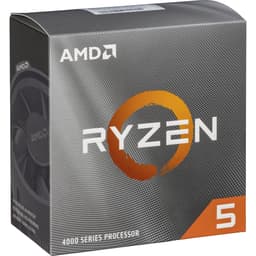
The Ryzen 5 4500 represents the entry point to the budget CPU market, delivering six cores and twelve threads at a rock-bottom price that undercuts all other options in this guide. The 65W TDP keeps power consumption minimal, and AM4 compatibility ensures broad motherboard support. No integrated graphics means a discrete GPU is required, but the absence of iGPU overhead keeps the CPU cool and efficient. Clock speeds reach 3.6 GHz with a boost to 4.1 GHz, adequate for office work and everyday computing but noticeably slower than newer budget options. The 11MB cache is sufficient for basic productivity tasks and light multitasking.
This processor suits users building the most affordable possible PC or upgrading ageing systems with a new CPU and motherboard. Office work, web browsing, document editing, and everyday media consumption run without issue. The 4500 is not designed for gaming or demanding productivity tasks, but rather for users whose needs centre on productivity software, communication tools, and content consumption. The incredibly low price makes this CPU attractive for secondary systems, media servers, or test builds. Older than other options here, the 4500 lacks modern optimisations and instruction sets, but its simplicity and bargain pricing appeal to budget-conscious users unconcerned with the latest features. This remains an excellent choice for office PCs and home server applications.
Verdict: The most affordable CPU under £150, ideal for office work and everyday computing where the lowest possible cost outweighs the need for modern architecture or performance.
Pros
- Lowest price of any option, delivering exceptional value
- Six cores and twelve threads handle office and productivity work easily
- 65W TDP keeps power consumption and cooling simple
- Proven AM4 platform with excellent motherboard compatibility
Cons
- No integrated graphics, requires a dedicated GPU
- Older Zen 2 architecture with slower clock speeds than newer budget options
Buying Guide
Selecting a budget CPU requires balancing several key considerations. First, determine whether integrated graphics are essential to your build. Processors with integrated graphics, such as the 9600X, 7600, 5600GT, and 8600G, eliminate the expense of a discrete GPU and suit office users, media consumers, and casual gamers. F-series and non-GT processors like the 4500, 5600X, and 8400F require a dedicated graphics card but cost less, making them ideal for GPU-heavy gaming builds where funds are better spent on graphics hardware.
Socket choice represents your second major decision. The AM5 socket (9600X, 8400F, 7600, 8600G) is newer and future-proof, offering a clearer upgrade path to faster processors in coming years. The older AM4 socket (4500, 5600X, 5600GT) remains widely supported with abundant motherboard options, but future upgrades become increasingly limited. If you plan to keep the system for several years, AM5 justifies a modest price premium. For immediate needs and budget-conscious builds, AM4 remains capable.
Power efficiency matters more in budget builds, where every pound spent on power supplies and cooling affects total project cost. The 5600GT's ultra-low 35W TDP suits silent or fanless builds and reduces running costs in systems left on continuously. The 65W options balance efficiency with performance. Look for cooling solutions matching your CPU's TDP, as budget coolers may struggle with higher-power processors in cramped cases.
Performance requirements define realistic expectations. The 4500 excels at office and everyday tasks but struggles with gaming or demanding software. Mid-tier options like the 5600GT, 8400F, and 7600 suit balanced builds, casual gaming, and productivity. The newest 9600X and mature 5600X deliver the strongest performance but still remain budget-conscious compared to higher-tier processors.
Finally, consider your upgrade timeline. If building a system for three to five years of active use, investing in modern architecture and the AM5 platform provides security against obsolescence. For immediate needs, budget platforms like the AM4 represent sensible compromises if prices are significantly lower.
The AMD Ryzen 5 9600X emerges as the overall winner, combining the latest Zen 5 architecture, integrated RDNA 3.5 graphics, efficient 65W operation, and AM5 platform compatibility at a price under £150. This processor delivers modern performance for gaming, productivity, and everyday tasks whilst eliminating the need for a discrete GPU in many scenarios. The architecture's future-readiness and integrated graphics capability ensure value for money over the system's lifespan.
However, the best CPU for you depends on your specific needs. Builders planning substantial GPU investments should choose the AM5 8400F or mature Ryzen 5 5600X for maximum cost-effectiveness. Those prioritising silence and minimal power consumption benefit from the exceptional 5600GT. Office workers and budget-conscious users unwilling to stretch beyond office tasks gain excellent value from the rock-bottom Ryzen 5 4500. The diversity of options below £150 ensures every user type finds a capable processor matching their priorities and budget constraints.