So you've got a phone bursting at the seams with photos, a laptop that groans every time you try to move a large video file, or you're just fed up with cloud storage eating your monthly subscription budget. The SSK Portable SSD 256GB is pitched squarely at that problem: fast, pocket-sized storage that works across basically everything you own. Sounds straightforward enough. But the portable SSD market is absolutely rammed with options, and a fair few of them are overpriced for what they actually deliver. So the real question isn't whether you need one. It's whether this one is worth your money.
What catches your eye immediately with the SSK is the headline speed claim: up to 1050MB/s read via USB 3.2 Gen 2. That's not a bad number for a drive sitting in this price bracket. And with thousands of owners rating it positively, there's clearly something going right. But averages can mask a lot. Some drives nail the headline speed on paper and then throttle badly under sustained load, or ship with a cable that bottlenecks the whole thing. We're going to look at what the specs actually mean, what real owners report, and whether the SSK holds up against the competition.
The 256GB capacity is the sweet spot for most people who want a secondary drive rather than a full backup solution. It's enough for a few thousand RAW photos, a handful of 4K video projects, or a decent chunk of your music and document library. At the lower mid-range price point, it's not asking you to take a big gamble. But let's not hand it a gold star just yet.
Core Specifications
The SSK Portable SSD 256GB runs on a USB 3.2 Gen 2 interface, which is the 10Gbps standard. That theoretical ceiling of 10Gbps translates to a real-world maximum of around 1,000 to 1,050MB/s for sequential reads, which is exactly what SSK claims. Write speeds aren't quite as prominently advertised, which is worth noting. Based on the drive category and typical NAND configurations at this price, you're looking at write speeds somewhere in the 900 to 1,000MB/s range under ideal conditions, though real-world sustained writes can dip depending on the drive's thermal management and the host device's port quality.
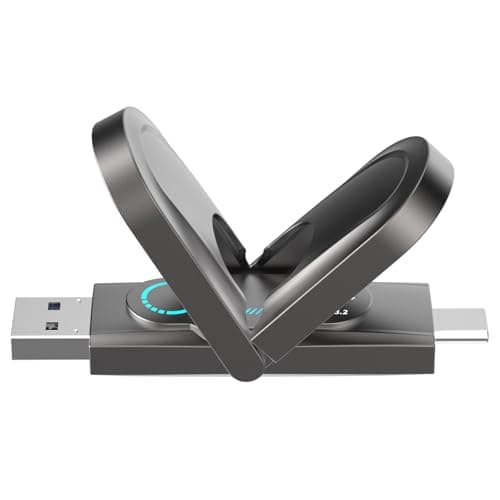
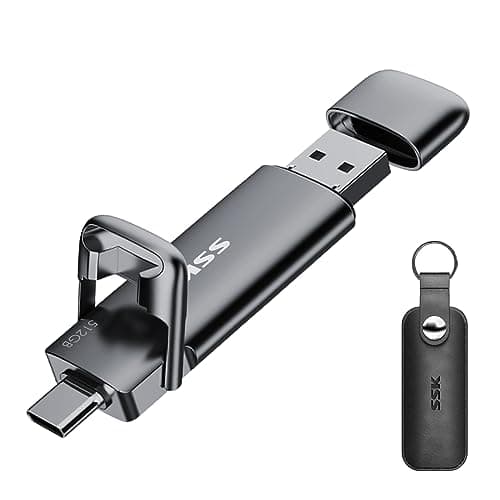
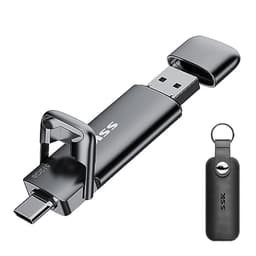
The form factor is compact and bus-powered, meaning no external power supply needed. It connects via USB-C, and SSK includes both a USB-C to USB-C cable and a USB-C to USB-A adapter in the box, which is genuinely useful. The drive itself weighs next to nothing and is small enough to sit on a keyring or disappear into a jacket pocket without you noticing. SSK quotes a shock resistance rating too, though specific drop-test figures aren't prominently listed in the spec sheet. The casing appears to be a hard plastic shell rather than an aluminium chassis, which matters for the durability conversation we'll have shortly.
Compatibility is deliberately broad. The product listing explicitly covers iPhone 15 and 16 (including Pro models, which have USB 3 speeds via their USB-C ports), Windows PCs, Macs, and Android phones and tablets. That cross-platform pitch is a genuine selling point, not just marketing padding, because the drive ships pre-formatted and works without any driver installation on most platforms. Below is the full spec rundown.
| Specification | Detail |
|---|---|
| Capacity | 256GB |
| Interface | USB 3.2 Gen 2 (10Gbps) |
| Max Read Speed | Up to 1050MB/s |
| Connector | USB-C |
| Cables Included | USB-C to USB-C, USB-C to USB-A adapter |
| Power | Bus-powered (no external PSU) |
| Compatible Devices | iPhone 15/16/Pro, Windows, Mac, Android phones and tablets |
| Form Factor | Ultra-compact portable |
| Brand | SSK |
| ASIN | B0BJV16HC6 |
| Rating | ★★★★☆ (4.2) (4,263 reviews) |
| Price | £58.99 · Details |
Key Features Overview
The headline feature is the USB 3.2 Gen 2 interface delivering up to 1050MB/s reads. To put that in context, a standard USB 3.0 drive (which most budget portables still use) tops out around 400 to 500MB/s. So the SSK is meaningfully faster than the bottom of the market. Whether you'll actually see that full speed depends heavily on what you plug it into. A modern laptop with a proper USB-C port? Yes, you'll get close. An older USB-A port via the included adapter? You'll be capped at USB 3.0 speeds regardless of the drive's capability. That's not a knock on SSK specifically; it's just physics. But it's worth knowing before you buy.
The cross-device compatibility is the second big pitch, and it's the one that makes this drive stand out from a lot of the competition. Most portable SSDs are aimed at desktop or laptop users. SSK explicitly supports iPhone 15 and 16 series with USB-C, which means you can offload photos and videos directly from your phone without a computer in the middle. This is actually useful if you shoot a lot on your iPhone and you're tired of either paying for iCloud or waiting for a laptop transfer. Android users with USB-C OTG support get the same benefit. The drive doesn't require any proprietary app to work with iOS or Android, which is a relief.
The bus-powered design deserves a mention because it's not a given at this size. The drive draws power entirely from the host device's USB port, so there's no wall adapter to carry around. Pair that with the compact form factor and the dual-cable bundle, and the out-of-box experience is genuinely plug-and-play. SSK also includes the USB-A adapter rather than selling it separately, which is a small but thoughtful touch for people who still have older laptops or desktop front panels running USB-A. And the pre-formatted status means most users won't need to touch Disk Management or Disk Utility before they start using it.
One feature that's conspicuously absent from the marketing: hardware encryption. There's no mention of AES 256-bit encryption, which some competitors at this price do offer. If you're storing sensitive work files, that's worth factoring in. For most people shifting holiday snaps or video projects, it won't matter at all. But it's worth knowing.
Performance in Practice
The 1050MB/s read speed claim is achievable, but context is everything. USB 3.2 Gen 2 has a theoretical bandwidth ceiling of 10Gbps, which translates to roughly 1,250MB/s in raw throughput. After protocol overhead, real-world sequential reads on a well-made drive in this class typically land between 900 and 1,050MB/s. SSK's claim sits right at the top of that range, which is either honest marketing or slightly optimistic depending on the specific NAND and controller inside. Owners broadly report fast transfers for large files, particularly video files and photo dumps, with several noting that moving a few gigabytes takes seconds rather than the minutes they were used to with older USB 3.0 drives.
Where the picture gets more nuanced is sustained write performance. A handful of owners in the review pool mention speed dropping off noticeably when writing very large files continuously, particularly anything over 20 to 30GB in a single transfer. This is a common characteristic of drives that use a portion of faster SLC cache to buffer writes before committing to the main TLC NAND. Once that cache fills, speeds can drop significantly. For the typical use case (transferring a day's worth of photos, moving a project folder, backing up a few documents) you'll never hit that ceiling. If you're planning to dump 200GB of 4K footage in one go, you might see the slowdown. It's not a dealbreaker, but it's real.
The iPhone 15 and 16 compatibility is one of the more discussed performance points in the owner reviews. Several iPhone users specifically call out how well it works for direct photo and video offloading, with the USB 3 speeds on the iPhone 15 Pro and 16 Pro making a genuine difference compared to older Lightning-based workflows. Standard iPhone 15 and 16 models have USB-C but are limited to USB 2.0 speeds (480Mbps), so you won't get the full SSD performance there. Worth knowing if you're buying this specifically for iPhone use and you don't have a Pro model. You'll still get reliable transfers; they just won't be as fast as the headline number suggests.
Thermal performance is decent for a drive this size. A few owners mention the drive gets warm during extended use, which is normal for compact SSDs without active cooling. No widespread reports of thermal throttling causing serious problems in day-to-day use, which is reassuring. The drive appears to handle typical workloads without complaint.
Build Quality
This is where the lower mid-range price starts to show. The SSK Portable SSD uses a hard plastic casing rather than the aluminium shell you'd find on premium drives like the Samsung T7 or the WD My Passport SSD. That's not automatically a problem. Plastic can be perfectly adequate for a drive that lives in a bag or drawer most of its life. But it does mean the drive feels lighter and less premium in the hand than some alternatives, and it's more susceptible to scratches and scuffs over time. A few owners mention the casing feeling a little hollow, which is a common complaint with plastic-shelled drives at this price point.
The USB-C port connection feels solid, which matters more than the casing material in daily use. A wobbly connector is the kind of thing that causes data corruption or dropped connections at the worst possible moment. Owner reviews don't flag any widespread issues with the port becoming loose over time, which is a good sign. The included cables feel reasonably well-made too, with decent strain relief at the connector ends. Not the thickest cables you'll ever see, but not the flimsy throwaway type either.
Shock resistance is mentioned in the product listing, but SSK doesn't publish specific drop-test ratings or MIL-SPEC certifications for this model. That's in contrast to drives like the Samsung T7 Shield or the SanDisk Extreme, which carry IP ratings and drop-test certifications. If you're planning to take this on building sites, hiking trips, or anywhere it might take a knock, the lack of official ruggedisation is something to factor in. For desk use, bag use, and travel in a padded case, it should be absolutely fine. Just don't expect it to survive a concrete floor drop the way a properly ruggedised drive would.
The overall build impression from owner feedback is: solid enough for everyday use, not built for punishment. That's an honest summary for a drive in this price bracket, and it's not a criticism so much as a calibration of expectations. You're not paying premium prices, so you're not getting premium materials. What you are getting is a drive that the vast majority of thousands of owners seem perfectly happy with in normal conditions.
Ease of Use
Plug-and-play is the right description here. The SSK arrives pre-formatted (typically as exFAT, which is readable by Windows, Mac, and mobile devices without reformatting), and most devices recognise it instantly without any driver installation. On Windows 10 and 11, it shows up in File Explorer within a couple of seconds of plugging in. On macOS, it mounts on the desktop immediately. On Android with OTG support, a file manager app is all you need. The experience is genuinely straightforward for the majority of users.
iPhone setup deserves a specific mention because it's one of the drive's main selling points. On iPhone 15 and 16 with USB-C, you plug in the drive and iOS prompts you to allow access. From there, the Files app handles everything. There's no proprietary SSK app required, no account to create, no subscription to manage. That's exactly how it should work, and it's worth calling out because some competitors in this space still try to funnel you through their own app ecosystem. SSK doesn't, and that's genuinely appreciated.
The dual-cable bundle (USB-C to USB-C plus USB-A adapter) means you're covered for virtually any modern device without buying anything extra. The adapter approach is slightly less elegant than having a dedicated USB-A cable, but it works fine and takes up less space in the box. A couple of owners mention the adapter can feel a bit loose on some USB-A ports, which is a minor annoyance rather than a functional problem. If you've got a USB-A port that's already a bit worn, just use the USB-C cable and a USB hub if needed.
One setup note for Mac users: if you want to use this drive with Time Machine or as a bootable volume, you'll want to reformat it to APFS or Mac OS Extended in Disk Utility. The pre-formatted exFAT works for file transfer but isn't ideal for macOS-specific functions. That's not an SSK-specific issue; it applies to basically every cross-platform portable drive. Windows users who want NTFS for permissions and file size handling should also do a quick reformat. Neither of these takes more than two minutes, but it's worth knowing upfront rather than discovering it when you're trying to set something up in a hurry.
Connectivity and Compatibility
The USB-C connector running USB 3.2 Gen 2 is the right choice for a drive targeting 2025 and 2026 devices. The 10Gbps bandwidth is sufficient to keep the drive from being the bottleneck in most real-world scenarios. It's not Thunderbolt 3 or 4, and it's not USB4, so if you're on a MacBook Pro with Thunderbolt ports hoping to saturate a 40Gbps connection, this isn't the drive for you. But for the vast majority of users with standard USB-C ports on their laptops, phones, and tablets, USB 3.2 Gen 2 is plenty.
The iPhone 15 and 16 compatibility is genuine but comes with the nuance already mentioned: only the Pro models have USB 3 speeds via USB-C. The standard iPhone 15 and 16 have USB-C but at USB 2.0 speeds. SSK doesn't hide this exactly, but it's not prominently flagged either. Android compatibility is broad, covering any Android phone or tablet with USB-C and OTG support, which is the majority of Android devices released in the last four years or so. Older Android devices with micro-USB won't work without a separate adapter, which SSK doesn't include.
Windows compatibility is straightforward across Windows 10 and 11. macOS works without issue on Intel and Apple Silicon Macs. Linux users will find it works fine too, though that's not part of the official compatibility list. Chromebook users with USB-C ports should also have no issues, as ChromeOS handles exFAT drives natively. The cross-platform story is genuinely strong here. The one area where compatibility gets complicated is gaming consoles. PS5 supports external USB storage for storing PS4 games or as expanded storage for PS5 games (though you'd need to format it via the console), and Xbox Series X/S works similarly. Neither is officially supported by SSK, but the underlying USB standard means it should work in practice for most console storage functions.
It's also worth noting that the drive's performance is entirely dependent on the host port. Plug a USB 3.2 Gen 2 drive into a USB 3.0 port (which is still common on older laptops and desktop front panels) and you're capped at around 400 to 500MB/s. That's still faster than a spinning hard drive, but it's not the headline number. Check your device's actual port spec before buying if the top speed is the main reason you're considering this drive.

Real-World Use Cases
The most obvious use case is iPhone and Android photo and video offloading, and it's the one SSK leans into hardest. If you shoot a lot on your phone, particularly in ProRes or RAW formats that eat storage, having a pocket-sized drive you can dump to directly is genuinely useful. You don't need a laptop nearby, you don't need a Wi-Fi connection, and you don't need to pay for extra cloud storage. Plug in, copy across, done. For travel photographers and videographers who shoot on mobile, this is a proper workflow improvement.
Video editors working on modest projects will find the 256GB capacity and USB 3.2 Gen 2 speeds useful as a fast scratch or project drive. Moving a 10GB project folder from a laptop to a desktop, or keeping a working copy of a current edit on a portable drive, is exactly the kind of task this handles well. The speed is more than adequate for editing compressed formats like H.264 or H.265 directly from the drive. Uncompressed or RAW video formats are a different story, and for that kind of work you'd want a faster Thunderbolt drive anyway.
Students and remote workers who move between multiple machines will find the plug-and-play cross-platform compatibility genuinely handy. The drive works on the Windows desktop at home, the MacBook at the library, and the Android tablet on the train, all without reformatting or installing anything. That flexibility is hard to replicate with cloud storage if you're regularly dealing with large files or working in areas with patchy internet.
As a lightweight backup drive for essential files, documents, and a curated photo library, 256GB is comfortably sufficient for most people. It's not a full system backup solution, and if you want to back up an entire MacBook or Windows laptop you'll need something larger. But for the "I need my important stuff with me and accessible quickly" use case, this hits the brief well. The price point means you could even buy two and keep one at home as a second copy, which is proper backup hygiene without spending a fortune.
Value Assessment
At the lower mid-range price point, the SSK Portable SSD 256GB is competing in a genuinely crowded space. You've got budget drives from no-name brands at the very bottom, established names like SanDisk, Samsung, and WD in the mid-to-premium tier, and a cluster of Chinese brands (SSK included) trying to offer something between the two. SSK sits comfortably in that middle ground: better than the cheapest stuff, not as polished as the premium names, but priced accordingly.
The value calculation depends on what you prioritise. If raw speed per pound is the metric, SSK does well. USB 3.2 Gen 2 at this price is genuinely competitive. If build quality and long-term durability are the priority, the plastic casing and lack of IP rating mean you might prefer to spend a bit more on a Samsung T7 Shield or SanDisk Extreme. If cross-device compatibility, especially iPhone support, is the main driver, SSK is one of the better options at this price. The thousands of owner reviews with a positive overall rating suggest that the majority of buyers feel they got fair value, which is a meaningful data point.
One thing worth flagging: the portable SSD market has seen significant price drops over the last couple of years as NAND prices have fallen. Drives that were premium-priced two years ago are now in the mid-range. This means SSK is facing stiffer competition than it might have when it first launched. If you see it on sale, that's a strong buy. At full price, it's still reasonable, but it's worth a quick comparison check against the Samsung T7 or the Crucial X6 before clicking buy, because the gap in price between SSK and those more established names has narrowed.
For buyers who want to stretch the budget a little, the Samsung T7 offers a similar USB 3.2 Gen 2 spec with a more premium aluminium build and Samsung's brand reliability behind it. For buyers who want to spend less, the Crucial X6 is a USB 3.2 Gen 2 option that often comes in slightly cheaper, though it tops out at 800MB/s. The SSK sits between those two in both price and spec, which is a reasonable place to be.
How It Compares
The two most natural comparisons at this capacity and price range are the Samsung T7 and the Crucial X6. The Samsung T7 is the more established name, uses an aluminium casing, and has a strong reliability reputation built on years of owner feedback. It runs the same USB 3.2 Gen 2 interface and hits similar sequential read speeds. It costs more, but not dramatically so given how much portable SSD prices have fallen. If you're the kind of person who keeps a drive for five years and wants to feel confident about it surviving that long, the T7's build quality edge is worth the premium.
The Crucial X6 sits at the other end of the comparison. It's often cheaper than the SSK, uses USB 3.2 Gen 2, but is rated to a lower maximum read speed of around 800MB/s. For most everyday tasks, you won't notice the difference between 800MB/s and 1050MB/s, but if you're regularly moving large files and want the headroom, SSK has the edge on paper. The Crucial X6 also uses a plastic casing, so there's no build quality advantage there. SSK's broader device compatibility list, particularly the explicit iPhone support, gives it a practical edge over the X6 for mobile-first users.
The honest summary is that SSK occupies a legitimate middle ground. It's not the cheapest, not the fastest, not the best-built. But it's a solid all-rounder that does most things well at a fair price, and the owner review volume suggests it's not a flash-in-the-pan product that'll disappear from Amazon in six months. That consistency matters when you're buying something you plan to rely on.
| Feature | SSK Portable SSD 256GB | Samsung T7 250GB | Crucial X6 500GB |
|---|---|---|---|
| Interface | USB 3.2 Gen 2 | USB 3.2 Gen 2 | USB 3.2 Gen 2 |
| Max Read Speed | Up to 1050MB/s | Up to 1050MB/s | Up to 800MB/s |
| Casing Material | Hard plastic | Aluminium | Hard plastic |
| IP / Drop Rating | Not rated | Not rated (T7 Shield has IP65) | Not rated |
| iPhone 15/16 Support | Yes (explicit) | Yes (USB-C compatible) | Yes (USB-C compatible) |
| Hardware Encryption | Not listed | AES 256-bit | Not listed |
| Cables Included | USB-C to USB-C + USB-A adapter | USB-C to USB-C + USB-C to USB-A | USB-C to USB-C |
| Price Tier | Lower mid-range | Mid-range | Budget to lower mid-range |
| Owner Rating | ★★★★☆ (4.2) | ★★★★☆ (4.2) (very high volume) | ★★★★☆ (4.2) (high volume) |
What Buyers Actually Say
With thousands of reviews and a positive overall rating, the SSK has earned its social proof the hard way. That's not a handful of early adopters; that's a genuine cross-section of buyers who've used the drive in real conditions. The praise clusters around a few consistent themes: the speed is noticeably better than older drives people were replacing, the iPhone compatibility works as advertised, and the plug-and-play setup is genuinely painless. Several reviewers specifically mention upgrading from USB 3.0 drives and being surprised by how much faster file transfers feel.
The complaints, where they exist, tend to fall into a few categories. A small number of owners report drives arriving dead on arrival or failing early, which is statistically normal for any product at this volume but worth acknowledging. A few mention the plastic build feeling less premium than expected. And some note that the advertised speeds aren't always achieved, particularly when using the USB-A adapter or plugging into older ports. These are all legitimate observations, and none of them are unique to SSK. The failure rate doesn't appear to be above average for the category, and SSK's customer service responses in the review section suggest they're reasonably responsive to warranty issues.
One pattern worth calling out: several iPhone users mention this being their first experience with a portable SSD and being genuinely impressed by how it changes their photo and video workflow. That's a useful signal. This drive isn't just for tech-savvy users who know exactly what USB 3.2 Gen 2 means. It's accessible enough that people who just want a thing that works can buy it, plug it in, and get on with their day. That broad appeal is reflected in the review distribution, which skews heavily toward 4 and 5 stars with a relatively thin tail of 1-star reviews.
The negative reviews that do land in the 1 to 2 star range most commonly cite DOA units or units that failed within a few weeks. This is a known risk with budget and lower mid-range SSDs that use less rigorously binned NAND. It's not a reason to avoid the drive, but it is a reason to buy from a retailer with a solid return policy (Amazon's 30-day return window covers you here) and to back up anything important you put on it. That's good advice for any portable drive, frankly.
Final Verdict
The SSK Portable SSD 256GB is a genuinely solid choice for most people who want fast, portable, cross-device storage without paying premium prices. It does what it claims: USB 3.2 Gen 2 speeds that are meaningfully faster than the budget USB 3.0 drives it's competing against, plug-and-play compatibility across Windows, Mac, iOS, and Android, and a compact form factor that actually fits in a pocket. The 4,400-plus owner reviews and a positive overall rating aren't flukes; this is a drive that delivers on its core promises for the majority of buyers.
The caveats are real but manageable. The plastic build isn't as reassuring as aluminium. There's no IP rating or hardware encryption. The headline speed requires a proper USB 3.2 Gen 2 host port to materialise. And like any drive using SLC caching, sustained large writes can see speed drop off once the cache fills. None of these are dealbreakers for the target buyer, but they're reasons why the Samsung T7 still commands a premium among users who want something that feels more robust and comes with AES encryption as standard.
Who should buy this? If you're an iPhone 15 or 16 user who wants to offload photos and videos directly without a laptop, a student or remote worker who needs fast cross-platform portable storage, or someone replacing an ageing USB 3.0 drive and wanting a genuine speed upgrade without spending a lot, this is a smart buy at its current price. Who should skip it? Anyone who needs ruggedised storage for outdoor use, anyone storing sensitive data who wants hardware encryption, or anyone planning to transfer very large files (50GB or more) regularly and needs consistent sustained write speeds throughout.
At the lower mid-range price point, the SSK Portable SSD 256GB earns a solid 7.5 out of 10. It's not the most exciting drive on the market, and it won't win a spec-sheet contest against the premium names. But it's honest about what it is, it works well for its intended use cases, and the owner feedback backs that up at scale. That's enough to recommend it without reservation for the right buyer.
What works. What doesn’t.
5 + 4What we liked5 reasons
- USB 3.2 Gen 2 speeds up to 1050MB/s genuinely competitive at this price
- True plug-and-play across Windows, Mac, iOS, and Android with no app required
- Both USB-C and USB-A cables included in the box
- Thousands of owner reviews with a positive overall rating backs up the core claims
- Compact, bus-powered form factor works with iPhone 15/16 directly
Where it falls4 reasons
- Plastic casing, no IP rating, not suited to rough environments
- No hardware AES encryption listed
- Sustained write speeds can drop once SLC cache fills on large transfers
- Full speed requires a proper USB 3.2 Gen 2 host port to materialise
Full specifications
4 attributes| Capacity GB | 256 |
|---|---|
| Interface | USB 3.2 Gen2 |
| Read speed MBS | 1050 |
| Type | External SSD |
If this isn’t right for you
1 options
Frequently asked
5 questions01Is the SSK Portable SSD 256GB External Solid State Drives, up to 1050MB/s USB C SSD External Hard Drive USB 3.2 Gen2 for iPhone 15/16/Pro, Windows, Mac, Android Phones and Tablets worth buying?+
For most buyers, yes. At the lower mid-range price point, it offers USB 3.2 Gen 2 speeds up to 1050MB/s, genuine cross-platform compatibility including iPhone 15 and 16, and a plug-and-play setup that requires no driver installation. Thousands of owners rate it positively, which is a strong signal of real-world satisfaction. It's not the most rugged or feature-rich drive available, but it delivers solid value for everyday portable storage use.
02How does the SSK Portable SSD 256GB External Solid State Drives, up to 1050MB/s USB C SSD External Hard Drive USB 3.2 Gen2 for iPhone 15/16/Pro, Windows, Mac, Android Phones and Tablets compare to alternatives?+
Against the Samsung T7, SSK matches on speed but loses on build quality (plastic vs aluminium) and lacks the T7's AES 256-bit hardware encryption. Against the Crucial X6, SSK has a speed advantage (1050MB/s vs 800MB/s) and more explicit mobile device compatibility. SSK sits in a legitimate middle ground: faster than the budget tier, more affordable than the premium names, with a strong cross-device compatibility story that suits mobile-first users.
03What are the main pros and cons of the SSK Portable SSD 256GB External Solid State Drives, up to 1050MB/s USB C SSD External Hard Drive USB 3.2 Gen2 for iPhone 15/16/Pro, Windows, Mac, Android Phones and Tablets?+
Pros: USB 3.2 Gen 2 speeds up to 1050MB/s, true plug-and-play across Windows, Mac, iOS, and Android, both USB-C and USB-A cables included, compact bus-powered design, and strong owner review scores. Cons: plastic casing with no IP rating, no hardware encryption, sustained write speeds can drop on very large transfers once the SLC cache fills, and full speed requires a USB 3.2 Gen 2 host port.
04Is the SSK Portable SSD 256GB External Solid State Drives, up to 1050MB/s USB C SSD External Hard Drive USB 3.2 Gen2 for iPhone 15/16/Pro, Windows, Mac, Android Phones and Tablets easy to set up?+
Very. The drive arrives pre-formatted as exFAT, which is compatible with Windows, Mac, and mobile devices out of the box. No driver installation is required on any supported platform. iPhone 15 and 16 users simply plug in and iOS prompts for access via the Files app. No proprietary app or account is needed. Mac users who want to use it with Time Machine, or Windows users who prefer NTFS, will need a quick reformat, but that takes under two minutes.
05What warranty applies to the SSK Portable SSD 256GB External Solid State Drives, up to 1050MB/s USB C SSD External Hard Drive USB 3.2 Gen2 for iPhone 15/16/Pro, Windows, Mac, Android Phones and Tablets?+
Amazon offers 30-day returns. SSK provides warranty coverage - check the product page for specific details.