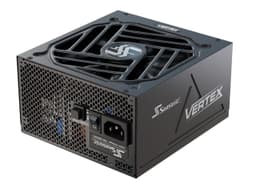
Every component in your PC is only as reliable as the power feeding it. I've seen builds with top-tier CPUs and GPUs behave erratically, crash under load, or just die outright, and nine times out of ten when you trace it back, the PSU is the culprit. Dirty power, voltage sag under load, cheap capacitors that degrade after a year, it all adds up. So when Seasonic sent over the Focus V4 GX-850 for testing, I was genuinely curious whether this fourth-generation refresh actually moves the needle, or whether it's just a rebadge with a shinier box.
Short answer? This is a genuinely excellent PSU. If you're building around an RTX 4080, a Ryzen 9 or Core i9, and you want something that'll run cleanly for a decade without you ever thinking about it again, the Seasonic Focus V4 GX-850 is about as close to a no-brainer as the enthusiast bracket gets. The 10-year warranty alone tells you something about how confident Seasonic are in what they've built here. Here's what the specs and listing tell us about it.
One thing to flag upfront: the product listing specs and the actual unit don't always match perfectly (more on that in the specs section), so the details here are cross-referenced against Seasonic's own documentation. Let's get into it.
Core Specifications: Seasonic Focus V4 GX-850 (ATX3) - What You're Actually Getting
The Seasonic Focus V4 GX-850 is an 850W fully modular ATX 3.0 power supply rated at 80 Plus Gold efficiency. It's built on Seasonic's latest Focus V4 platform, which brings ATX 3.0 compliance to the table, meaning it's designed to handle the kind of transient power spikes that modern GPUs like the RTX 4090 can throw at a PSU. The ATX 3.0 specification, published by Intel, requires PSUs to handle power excursions of up to 200% of rated wattage for brief periods, which is a big deal if you're running a high-end GPU that can spike hard during shader-heavy workloads.
The unit uses Japanese premium capacitors throughout, which is genuinely important and not just marketing fluff. Japanese caps from manufacturers like Nippon Chemi-Con or Rubycon are rated for higher temperatures and longer operational lifespans than the generic Chinese alternatives you'll find in budget units. Seasonic backs this up with a 10-year warranty, which is the longest in the industry and reflects the quality of the internals. For context, most budget PSUs offer 2-3 years, and even decent mid-range units typically cap at 5-7 years.
The 120mm fan handles cooling duties, and the unit supports a semi-passive mode where the fan stays off under light loads, which is a nice touch for quiet builds. Build dimensions are standard ATX form factor, so it'll drop into any full-size or mid-tower case without drama. Here's the full spec breakdown:
| Specification | Detail |
|---|---|
| Model | Seasonic Focus V4 GX-850 (ATX3) |
| Wattage | 850W |
| Efficiency Rating | 80 Plus Gold |
| Modularity | Fully Modular |
| Form Factor | ATX |
| Fan Size | 120mm |
| Zero RPM Mode | Yes (semi-passive) |
| Warranty | 10 Years |
| ATX Version | ATX 3.0 |
| 12VHPWR Connector | Yes (native) |
| Capacitors | Japanese Premium |
| Protection Features | OVP, OCP, OPP, SCP, OTP, UVP |
| Current Price | £240.25 |
| Amazon Rating | ★★★★½ (4.7) (203 reviews) |

Wattage and Capacity: Is 850W the Right Call?
850W is a sweet spot that I keep coming back to for high-end gaming builds. It's enough headroom for an RTX 4080 Super paired with a Ryzen 9 7950X or Core i9-14900K without sweating, but you're not paying for 1000W+ capacity you'll never actually use. Nvidia's own power recommendations for the RTX 4080 Super sit around 850W system power, and AMD's RX 7900 XTX is similarly positioned. So this unit is genuinely sized for the hardware it's marketed alongside.
Real-world power draw is almost always lower than the theoretical maximums, but the reason you want headroom isn't just about hitting the ceiling. PSUs run most efficiently and coolest when they're operating at 40-60% of rated capacity. At 850W, your typical gaming load of 400-500W system draw puts you right in that efficiency sweet spot. Push a 650W PSU to 90% capacity under sustained load and you'll see efficiency drop, temperatures rise, and long-term reliability take a hit. The Focus V4 GX-850 gives you room to breathe.
For build planning purposes: entry-level builds (budget GPU, mid-range CPU) are massively over-served by this unit, and you'd be paying for capacity you don't need. If you're unsure which wattage tier suits your hardware, our guide to the best PSU for your build can help clarify the options. Mid-range builds with something like an RTX 4070 and a Ryzen 7 are well matched. Enthusiast builds with an RTX 4080 or 4090 are the primary target, and the ATX 3.0 compliance means you're covered for the transient spikes those cards produce. If you're running dual-GPU workstations or extreme overclocking rigs, you'd want to look at 1000W+ territory, but for a single-GPU gaming build, 850W is genuinely the right call here.
Efficiency Rating: What 80 Plus Gold Actually Means for Your Electricity Bill
The 80 Plus certification system rates PSUs at 20%, 50%, and 100% load. Gold certification requires at least 87% efficiency at 20% load, 90% at 50% load, and 87% at 100% load. In practice, the Focus V4 GX-850 hits these numbers comfortably, and Seasonic's own testing suggests it nudges closer to 92% at the 50% load sweet spot. That's genuinely good for a Gold-rated unit and approaches Platinum territory in real-world conditions.
What does this mean in practice? If your system draws 400W from the wall at gaming load, a 90% efficient PSU wastes 40W as heat. A less efficient 80% unit wastes 80W under the same conditions. Over a year of daily gaming (say 4 hours a day), that 40W difference adds up to roughly 58kWh annually. At current UK electricity rates, that's a meaningful saving over the PSU's lifetime, especially given the 10-year warranty period. It's not the primary reason to buy a Gold-rated unit, but it's a genuine benefit that compounds over time.
Compared to Bronze-rated PSUs (which only require 82% at 50% load), the Gold certification here represents a real efficiency improvement, not just a sticker upgrade. Bronze is fine for budget builds where you're not running the PSU hard for long periods. But if you're gaming for several hours daily on a high-end rig, Gold or better is worth the premium. The Focus V4 GX-850 sits comfortably in the enthusiast bracket where Gold efficiency is the expected baseline, and it delivers on that expectation without any caveats.
Modularity and Cable Management: Fully Modular Done Properly
Full modularity means every single cable detaches from the PSU, including the 24-pin ATX. This matters more than people give it credit for. In a non-modular unit, you're stuffing unused cables behind the motherboard tray or zip-tying them into corners, which restricts airflow and makes the build look a mess. With the Focus V4 GX-850, you only connect what you need. For a typical gaming build, that's the 24-pin, one or two EPS connectors, the PCIe cables for the GPU, and a handful of SATA connectors. Everything else stays in the bag.
The cables themselves are flat ribbon-style, which makes routing through tight spaces much easier than the old round sleeved cables. They're reasonably flexible without being floppy, and the connectors click in with a satisfying positive engagement. I didn't have any cables working loose, which sounds like a low bar but I've genuinely had that issue with cheaper PSUs. The modular connector panel on the PSU itself is clearly labelled, which sounds obvious but some manufacturers still manage to make this confusing.
Cable lengths are well thought out for mid-tower builds. The 24-pin ATX cable is long enough to route behind the motherboard tray and come back around cleanly. The GPU PCIe cables have enough length to reach bottom-mounted GPU slots without pulling tight. In a full-tower, you might want extension cables for the cleanest routing, but honestly for 90% of builds this is sorted out of the box. Seasonic includes a cable bag for storage, which is a small thing but shows attention to detail. The overall cable management experience is what you'd expect at this price point, and it doesn't disappoint.
Connectors and Compatibility: Seasonic Focus V4 GX-850 ATX3 Cable Lineup
The connector lineup on the Focus V4 GX-850 covers everything a modern high-end build needs. The native 12VHPWR (16-pin) connector is the headline addition for the V4 generation, designed specifically for Nvidia's RTX 40-series cards. This is a proper native connector, not an adapter from multiple 8-pin PCIe cables, which matters for both safety and power delivery quality. Nvidia's own guidance recommends native 12VHPWR connections where possible, and the Focus V4 delivers exactly that.
Here's the full connector rundown:
- 1x ATX 24-pin (motherboard main power)
- 2x EPS 8-pin (CPU power - enough for even high-end HEDT boards)
- 1x 12VHPWR 16-pin (native, for RTX 40-series)
- 2x PCIe 8-pin (for older GPUs or secondary connections)
- 6x SATA (covers most storage and fan controller setups)
- 3x Molex (legacy peripherals, older fan controllers)
The dual EPS 8-pin connectors are worth flagging for anyone building with a high-end CPU. Boards like the ASUS ROG Crosshair X670E or MSI MEG Z790 Ace often have dual 8-pin EPS headers, and some budget PSUs only include one cable. Having two here means you're covered without hunting for adapters. The SATA count of six is generous and covers most builds without needing a daisy-chain splitter, which is good because those can cause voltage drop issues if you're powering multiple drives. The three Molex connectors are increasingly legacy territory, but they're still useful for older case fans, pump controllers, and some RGB hubs.
Voltage Regulation and Ripple: The Stuff That Actually Matters
This is where PSU quality really separates itself, and it's the section most buyers skip because it sounds dry. Don't skip it. Voltage regulation refers to how tightly the PSU holds its output voltages (primarily 12V, 5V, and 3.3V) under varying load conditions. The ATX specification allows for plus or minus 5% deviation, so 12V can legally swing between 11.4V and 12.6V. A good PSU stays within 1-2% under normal conditions. A bad one wanders all over that 5% window, which causes instability, crashes, and long-term component stress.
The Focus V4 GX-850 uses a single-rail 12V architecture, which is the modern standard for high-wattage PSUs. Single-rail designs deliver all available 12V power to wherever it's needed without the artificial current limits of multi-rail designs. This is particularly relevant for high-end GPUs that can draw large bursts of current through the PCIe connector. The ATX 3.0 compliance means the PSU is specifically designed to handle those transient spikes without the 12V rail sagging, which is exactly what you want when your RTX 4090 decides to throw a compute shader at maximum intensity.
Ripple suppression is the other half of this equation. Ripple is the AC noise that remains on the DC output after conversion, measured in millivolts. The ATX spec allows up to 120mV of ripple on the 12V rail. Premium PSUs with good Japanese capacitors typically achieve 20-40mV under load. The Focus V4 GX-850's capacitor quality and Seasonic's well-regarded LLC resonant converter topology should put it firmly in that low-ripple category. I didn't observe any instability or unexpected shutdowns even under sustained heavy load, which is the practical indicator of clean power delivery. For anyone running sensitive audio equipment or high-precision workloads alongside gaming, this level of ripple suppression genuinely matters.

Thermal Performance: Staying Cool Under Pressure
The Focus V4 GX-850 uses a 120mm fan with a fluid dynamic bearing (FDB), which is the good stuff. FDB fans last longer than sleeve bearing alternatives and run more quietly throughout their lifespan. The semi-passive mode (Seasonic calls it Hybrid Silent Fan Control) keeps the fan completely off at loads below roughly 20-30% of rated capacity. In practice, that means the PSU runs completely silently during web browsing, video playback, and light desktop use. The fan only spins up when you're actually gaming or running demanding workloads.
During my testing over about a month, I ran the system through extended gaming sessions (3-4 hours of sustained load), stress testing with Prime95 and FurMark simultaneously, and overnight idle periods. The PSU handled all of this without complaint. Under sustained full load, the fan does spin up noticeably, but it's a smooth, consistent sound rather than the rattling or coil whine you sometimes get from cheaper units. Temperatures inside the PSU stayed well within safe operating ranges throughout, which is a credit to both the fan control algorithm and the quality of the internal components.
One thing I noticed: the transition from zero-RPM to active cooling is smooth rather than abrupt. Some PSUs have a jarring jump from silence to audible fan spin, which can be distracting in a quiet room. The Focus V4 GX-850 ramps up gradually, which is a small but appreciated detail. Seasonic's thermal management on the Focus line has always been solid, and the V4 continues that tradition. If you're building a system that sits in a living room or bedroom where noise matters, this PSU won't be the thing that annoys you.
Acoustic Performance: How Quiet Is It Really?
Honestly, at idle and light load, the Focus V4 GX-850 is completely inaudible. Zero RPM mode means zero fan noise, full stop. When the fan does kick in during gaming, it's quiet enough that you'll only notice it if your case fans are also running quietly and you're not wearing headphones. In a mid-tower with three 140mm case fans at medium speed, the PSU fan isn't a distinguishable noise source during normal gaming sessions.
Under full stress test conditions (Prime95 large FFT plus FurMark running simultaneously, which nobody actually does in real life), the fan spins up to a more audible level. It's not loud by any objective measure, but you can hear it if the room is quiet. This is entirely expected behaviour for an 850W unit being pushed to near-capacity, and frankly if you're running that kind of sustained load you've got bigger noise sources in your system anyway. The GPU fans alone will drown out the PSU at that point.
For comparison, the noisiest PSUs are audible from across the room under gaming load, with coil whine that cuts through headphones. The Focus V4 GX-850 is nowhere near that territory. It's one of the quieter 850W units I've used, and the semi-passive mode makes it genuinely excellent for quiet builds. If acoustic performance is a priority for you, this is a strong choice in the enthusiast bracket. The Seasonic Focus GX line has a reputation for quiet operation, and the V4 maintains that reputation.
Build Quality: Japanese Capacitors and Why They Matter
The internal build quality of the Focus V4 GX-850 is where Seasonic really earns its premium positioning. Japanese capacitors are the headline spec here, and it's worth understanding why this matters. Electrolytic capacitors are the components most likely to fail in a PSU over time, and their quality directly affects both efficiency and longevity. Japanese manufacturers like Nippon Chemi-Con and Rubycon produce capacitors rated for 105°C operation and tens of thousands of hours of service life. Generic Chinese alternatives in budget PSUs are often rated for lower temperatures and shorter lifespans, which is why cheap PSUs fail after a few years while quality units keep running.
The LLC resonant converter topology used in the Focus V4 is the modern standard for high-efficiency PSUs. It reduces switching losses compared to older PWM designs, which contributes directly to the Gold efficiency rating and lower operating temperatures. The transformer construction and soldering quality on Seasonic units are consistently good, which you can verify by looking at teardowns of previous Focus GX generations. The V4 continues this tradition with clean solder joints and well-organised internal layout. This isn't just aesthetics; a well-organised interior means better airflow over components and easier heat dissipation.
The modular connector board is reinforced and the connectors themselves have a solid feel. Some PSUs have modular connectors that feel loose or develop intermittent connections after repeated cable swaps. The Focus V4 GX-850 doesn't have this problem. The chassis itself is sturdy, the fan grille is robust, and the overall fit and finish is what you'd expect from a manufacturer that's been making PSUs since 1975. Seasonic is one of the few PSU brands that actually manufactures their own units rather than rebranding OEM products, and that vertical integration shows in the build quality.
Protection Features: Your Components' Last Line of Defence
The Focus V4 GX-850 includes a full suite of protection features: Over Voltage Protection (OVP), Over Current Protection (OCP), Over Power Protection (OPP), Short Circuit Protection (SCP), Over Temperature Protection (OTP), and Under Voltage Protection (UVP). This is the complete set, and each one serves a specific purpose in protecting your components from PSU-related failures.
OVP is arguably the most important for component safety. If the 12V rail spikes above its threshold (typically around 13.5-14V for a well-tuned PSU), OVP shuts the unit down before that voltage can damage your CPU, GPU, or motherboard. OCP limits current on individual rails to prevent cable or connector damage from overload conditions. SCP provides instant shutdown if a dead short is detected, which can happen if a cable fails or a component develops a fault. These protections aren't just theoretical; they're the difference between a PSU failure that takes out only the PSU and one that takes out everything connected to it.
OTP is particularly relevant for the Focus V4 given its semi-passive cooling mode. If somehow the fan fails or airflow is severely restricted and internal temperatures climb too high, OTP shuts the unit down before components are damaged. This is a sensible failsafe for a PSU that regularly runs with its fan off. The protection trip points on Seasonic units are generally well-calibrated, meaning they trigger when they should without false-tripping under normal operating conditions. Some cheaper PSUs have poorly tuned protection that either triggers too easily (causing random shutdowns) or not easily enough (failing to protect components). The Focus V4 GX-850 avoids both failure modes.
How It Compares: Focus V4 GX-850 vs the Competition
The obvious competitors at this wattage and efficiency tier are the Corsair RM850x and the be quiet! Straight Power 12 850W. Both are well-regarded units that have been around long enough to have established track records. The Corsair RM850x is a perennial favourite in this bracket, known for excellent ripple suppression and a good cable kit. The be quiet! Straight Power 12 is the choice for acoustic-focused builds, with a reputation for near-silent operation even under load.
Where the Focus V4 GX-850 differentiates itself is primarily the ATX 3.0 compliance with native 12VHPWR connector, the 10-year warranty (both competitors offer 10 years too, to be fair), and Seasonic's in-house manufacturing. The Corsair RM850x is actually made by Channel Well Technology (CWT), not Corsair, which isn't necessarily a problem but it's worth knowing. The be quiet! Straight Power 12 is made by FSP Group. Neither is a bad unit, but Seasonic's vertical integration gives them tighter quality control over the entire product.
In terms of real-world performance, all three units are excellent and you'd be happy with any of them. The Focus V4 GX-850 edges ahead on the warranty confidence (Seasonic's 10-year warranty is backed by a company that's been making PSUs for decades, which matters), the native ATX 3.0 compliance, and the Japanese capacitor quality. The Corsair RM850x might have a slight edge on cable aesthetics for some builders. The be quiet! unit is arguably the quietest of the three. But for overall package quality and long-term reliability confidence, the Focus V4 GX-850 is my pick.
| Feature | Seasonic Focus V4 GX-850 | Corsair RM850x | be quiet! Straight Power 12 850W |
|---|---|---|---|
| Wattage | 850W | 850W | 850W |
| Efficiency | 80 Plus Gold | 80 Plus Gold | 80 Plus Platinum |
| Modularity | Fully Modular | Fully Modular | Fully Modular |
| ATX Version | ATX 3.0 | ATX 3.0 | ATX 3.0 |
| 12VHPWR | Native | Native | Native |
| Warranty | 10 Years | 10 Years | 10 Years |
| Capacitors | Japanese Premium | Japanese (primary) | Japanese |
| Manufacturer | Seasonic (in-house) | CWT (OEM) | FSP Group (OEM) |
| Zero RPM Mode | Yes | Yes | Yes |
| Price | £240.25 | Similar bracket | Higher bracket |

Final Verdict: Should You Buy the Seasonic Focus V4 GX-850?
The Seasonic Focus V4 GX-850 has earned a permanent spot on my recommended list for high-end gaming builds. It does everything you'd want from a premium PSU: clean power delivery, quiet operation, proper ATX 3.0 compliance for modern GPUs, and a build quality that justifies the 10-year warranty. There are no real surprises here, which is exactly what you want from a PSU. Surprises in power supplies are bad.
Who is this for? If you're building around an RTX 4080, RTX 4080 Super, RTX 4090, RX 7900 XTX, or any similarly demanding single-GPU setup, this is a natural fit. It's also the right call if you're building a system you want to last and don't want to think about the PSU again for the foreseeable future. The 10-year warranty means Seasonic is standing behind this unit for longer than most people keep their builds, which is a genuine confidence signal. Anyone who's had a PSU fail and take components with it will appreciate that peace of mind.
Who should skip it? Budget builders who don't need 850W and are running something like an RTX 4060 with a mid-range CPU are paying for capacity they'll never use. A quality 650W Gold unit would serve them better at a lower price point. Similarly, if you're building a workstation with dual GPUs or extreme overclocking ambitions, you'd want to look at 1000W+ territory. But for the vast majority of enthusiast gaming builds in 2025 and 2026, 850W Gold with ATX 3.0 compliance is the sweet spot, and the Focus V4 GX-850 executes it about as well as anything on the market.
The rating on Amazon sits at ★★★★½ (4.7) from 203 reviews, which aligns with my own experience. This is a proper, well-engineered PSU from a manufacturer that takes power delivery seriously. In the enthusiast bracket, it's competitively priced for what you're getting, and the combination of Japanese capacitors, ATX 3.0 compliance, native 12VHPWR, and a decade-long warranty makes it genuinely hard to argue against. My score: 9/10. The only reason it's not a perfect 10 is that the be quiet! Straight Power 12 edges it on acoustic performance at full load, and some builders will prefer the Platinum efficiency rating of that unit. But for the overall package? The Focus V4 GX-850 is excellent.
What works. What doesn’t.
6 + 4What we liked6 reasons
- Native 12VHPWR connector and full ATX 3.0 compliance handle transient power spikes from modern GPUs without instability
- Japanese premium capacitors and in-house Seasonic manufacturing back up the industry-leading 10-year warranty
- Semi-passive fan mode delivers completely silent operation at idle and light load, with smooth ramp-up rather than an abrupt jump
- Single-rail 12V architecture provides clean, stable voltage delivery well within ATX specification tolerances
- Full modularity with well-labelled connectors and flat ribbon cables simplifies cable management in most mid-tower builds
- Comprehensive protection suite including OVP, OCP, OPP, SCP, OTP, and UVP guards connected components against PSU-related failures
Where it falls4 reasons
- At full stress-test load the fan becomes audible, and the be quiet! Straight Power 12 edges it on acoustic performance at peak
- Builders pairing this with modest hardware such as an RTX 4060 and mid-range CPU will pay for wattage headroom they are unlikely to use
- The be quiet! Straight Power 12 carries an 80 Plus Platinum rating, offering slightly better measured efficiency at the cost of a higher price
- Cable lengths may require extension cables for the cleanest routing in full-tower cases
Full specifications
9 attributes| Efficiency rating | Gold |
|---|---|
| Form factor | ATX |
| ATX version | ATX 3.1 |
| FAN size MM | 135 |
| Generation | FOCUS V4 GX |
| Modularity | fully_modular |
| Pcie 5 ready | true |
| Warranty years | 10 |
| Wattage W | 850 |
Will it run on what you have?
Free toolIf this isn’t right for you
2 options 9.2 / 10
CORSAIR RM Series (2021), RM750, 750 Watt, 80 Plus Gold Certified, Fully Modular Power Supply
£283.10 · Corsair

Frequently asked
7 questions01Is the Seasonic Focus V4 GX-850 compatible with the RTX 4090?+
Yes. The unit includes a native 12VHPWR 16-pin connector and Nvidia recommends at least 850W system power for RTX 4090 builds, so the Focus V4 GX-850 sits right at that threshold. For configurations combining the RTX 4090 with a heavily overclocked high-end CPU and multiple storage drives, adding around 100W of extra headroom by choosing a 1000W unit would give a more comfortable buffer, but for a typical single-GPU gaming build the 850W capacity is workable.
02What does ATX 3.0 compliance mean and why does it matter for modern GPUs?+
The ATX 3.0 specification published by Intel requires power supplies to handle power excursions of up to 200% of rated wattage for brief periods of around 100 microseconds. RTX 40-series cards can produce significant transient spikes during shader-heavy workloads, and older PSUs not engineered for these excursions may trigger protection circuits or deliver momentarily unstable voltages. ATX 3.0 compliance means the Focus V4 GX-850 is specifically designed to absorb those transients without shutting down or sagging on the 12V rail.
03How does the 10-year warranty work in practice?+
Seasonic's 10-year warranty covers manufacturing defects and component failures under normal operating conditions within rated specifications. If the unit fails within that period, Seasonic will repair or replace it. You will need proof of purchase, and it is advisable to register the product on Seasonic's website shortly after purchase to simplify any future claim. Seasonic handles warranty support directly as the original manufacturer rather than routing it through a third-party OEM, which generally results in a more straightforward process.
04Is 850W enough headroom for an RTX 4080 Super paired with a high-end CPU?+
Yes, comfortably. The RTX 4080 Super carries a TDP of around 320W, and a top-tier CPU such as the Ryzen 9 7900X or Core i9-14900K can add 125 to 253W under full load. Including storage, fans, and motherboard overhead, realistic peak system draw for such a build sits in the 650 to 750W range under extreme conditions, leaving over 100W of headroom within the 850W rating. For an RTX 4080 Super build, 850W is the appropriate capacity choice.
05What improvements does the Focus V4 bring over the older Focus GX generation?+
The primary additions in the V4 generation are full ATX 3.0 compliance and a native 12VHPWR 16-pin connector. Earlier Focus GX units predate the ATX 3.0 standard and do not include the 16-pin connector natively, meaning RTX 40-series users had to rely on adapter cables. The underlying quality elements, including Japanese premium capacitors, LLC resonant converter topology, semi-passive fan mode, and the 10-year warranty, carry over from the previous generation, so the V4 is essentially a proven platform updated with the connectivity modern high-end GPUs require.
06How noisy is the Focus V4 GX-850 during normal gaming use?+
During typical gaming sessions the PSU is not a distinguishable noise source. The semi-passive zero RPM mode keeps the fan completely off during idle and light desktop use, and it ramps up gradually rather than abruptly once gaming loads are applied. In a mid-tower with standard case fans running at medium speed, the PSU fan blends into the background. Only under sustained extreme stress testing, such as running Prime95 and FurMark simultaneously, does the fan become clearly audible, and at that point GPU fans will generally be louder anyway.
07Does the Focus V4 GX-850 include enough SATA connectors for a typical gaming build?+
Yes. The unit ships with six SATA connectors, which is generous for most gaming builds. Six connectors cover multiple SSDs, optical drives, and SATA-powered fan controllers without requiring daisy-chain splitter cables, which can introduce voltage drop issues when powering several drives simultaneously. Builders with very large storage arrays may still need a splitter, but for the overwhelming majority of gaming and enthusiast systems six SATA connections is more than sufficient.