Corsair's RM1000x SHIFT Fully Modular ATX Power Supply lands in the enthusiast bracket with a spec sheet that reads like a checklist of things PSU buyers actually care about: 80 Plus Gold efficiency, ATX 3.1 compliance, PCIe 5.1 support, a fully modular side-mounted connector interface, and 100% Japanese electrolytic capacitors rated to 105°C. Cross-reference those claims against what 233 Amazon owners report, and the picture is pretty consistent. This is a serious PSU built for serious builds.
The headline trick here is the SHIFT design itself. Corsair moved the modular connector panel to the side of the unit rather than the rear. That sounds like a gimmick until you're actually routing cables in a mid-tower and you realise how much easier side-access makes the whole process. It's a genuine quality-of-life improvement, not a rebrand. The 4.6-star average across those 232 backs that up. People who buy this come back satisfied.
So is the Corsair RM1000x SHIFT worth buying? For a high-end gaming rig running a current-gen GPU, yes. For a modest mid-range build, probably overkill. The full picture is below.
Core Specifications: Corsair RM1000x SHIFT Fully Modular ATX Power Supply
This is a 1000W fully modular power supply certified to the ATX 3.1 standard, which is Intel's latest revision covering improved transient power handling, tighter voltage tolerances, and native PCIe 5.1 connector support. It carries 80 Plus Gold certification, which puts it well above the baseline Bronze tier and into territory where efficiency genuinely starts saving you money on electricity bills over a multi-year ownership period.
The fully modular design uses Corsair's Type 5 Gen 1 micro-fit connectors on a side-mounted interface panel. That side placement is the defining physical feature of the SHIFT range. The 140mm fluid dynamic bearing fan handles cooling, and the unit runs in Zero RPM mode at low loads, so the fan doesn't spin at all when your system is idling or doing light tasks. Internally, every electrolytic capacitor is Japanese-made and rated to 105°C, which is the premium standard for PSU longevity.
The warranty is 10 years. That's not a typo. Corsair backs the RM1000x SHIFT with a decade of coverage, which is frankly exceptional and puts it ahead of most competitors in this bracket. The 5-year figure referenced in some listings is outdated; the current product ships with 10-year warranty coverage. That alone tells you something about Corsair's confidence in the build quality.
| Specification | Detail |
|---|---|
| Wattage | 1000W |
| Efficiency Rating | 80 Plus Gold |
| ATX Standard | ATX 3.1 |
| PCIe Support | PCIe 5.1 |
| Modularity | Fully Modular |
| Fan Size | 140mm Fluid Dynamic Bearing |
| Zero RPM Mode | Yes |
| Capacitors | 100% 105°C Japanese Electrolytic |
| Warranty | 10 Years |
| Protections | OVP, OCP, OPP, SCP |
| ATX 24-pin | 1 |
| EPS 8-pin | 1 |
| PCIe 8-pin | 2 |
| SATA | 6 |
| Molex | 3 |
| Rating | ★★★★½ (4.6) (232 reviews) |
| Price | £179.99 |

Wattage and Capacity
1000W is a lot of power. To put that in context, a system running an RTX 4090 paired with a high-end Intel Core i9 or AMD Ryzen 9 processor will typically pull somewhere between 500W and 700W under sustained full load. That leaves meaningful headroom on a 1000W unit, which matters for two reasons: first, PSUs run most efficiently between 40% and 80% of their rated capacity, so headroom keeps you in the efficiency sweet spot; second, the ATX 3.1 standard mandates that the PSU can handle transient power spikes of up to 200% of rated GPU power for brief intervals, and having headroom makes that easier to absorb.
For mid-range builds, 1000W is genuinely more than you need. A system with an RTX 4070 or RX 7800 XT and a mid-tier CPU is unlikely to ever draw more than 400W to 500W, so you'd be running this PSU at under half capacity most of the time. That's not harmful, but you'd be paying a premium for wattage you're not using. If your build sits in that bracket, a 750W or 850W Gold-rated unit makes more financial sense.
Where this PSU earns its spec is in enthusiast and high-end builds: RTX 4090 or 5090-class GPUs, dual-GPU workstation setups, heavily overclocked systems, or rigs that will be upgraded over several years with increasingly power-hungry components. Future-proofing is a real argument at 1000W, and given the 10-year warranty, there's a reasonable case for buying once and not worrying about your power supply for the foreseeable future. Use our PSU calculator to check whether 1000W actually matches your specific component list before committing.
Efficiency Rating: What 80 Plus Gold Actually Means
The 80 Plus certification programme rates PSUs at three load points: 20%, 50%, and 100% of rated capacity. Gold certification requires at least 87% efficiency at 20% load, 90% at 50% load, and 87% at 100% load. In practical terms, that means for every 100W your components draw, the PSU wastes roughly 10W to 13W as heat rather than delivering it as usable power.
Compare that to 80 Plus Bronze, which only requires 82% efficiency at 50% load. The difference sounds small, but across thousands of hours of use it adds up. A system drawing 500W continuously for a year wastes roughly 55W per hour at Gold efficiency versus roughly 91W per hour at Bronze efficiency. Over a year of daily gaming that's a real difference on your electricity bill. Platinum and Titanium certifications push efficiency higher still, but the price premium over Gold is rarely justified for home gaming builds.
So is 80 Plus Gold or Platinum better? Platinum is technically superior, delivering around 92% efficiency at 50% load versus Gold's 90%. But the real-world electricity saving between the two is modest, and Gold-rated units typically cost noticeably less. For most gaming builds, 80 Plus Gold is the sweet spot: genuinely efficient, meaningfully better than Bronze or Silver, and not carrying the Platinum price premium. The RM1000x SHIFT sits right in that sweet spot.
Modularity and Cable Management: Corsair RM1000x SHIFT Fully Modular ATX Power Supply
Full modularity means every cable, including the 24-pin ATX, detaches completely from the PSU. Nothing is hardwired. That matters because unused cables don't need to live in your case at all. You connect only what your system actually needs, and the rest goes back in the cable bag. Airflow improves, the build looks cleaner, and routing becomes a much less miserable experience.
The SHIFT's defining feature is where those connectors live. On a standard modular PSU, the connector panel faces the rear of the case, meaning cables run backward before looping forward to reach components. Corsair moved the panel to the side of the unit, so cables exit toward the components they're actually feeding. In a typical ATX mid-tower with the PSU mounted at the bottom rear, this means shorter cable runs, less slack to hide, and genuinely easier management. Corsair uses their Type 5 Gen 1 micro-fit connectors, which are physically smaller than standard Molex-style PSU connectors. That compact interface contributes to the cleaner aesthetic inside the case.
Cable quality on the RM1000x SHIFT is reported positively by owners. The cables are flexible, which sounds like a minor point until you've tried to route stiff sleeved cables around a tight corner at the back of a case. Corsair includes a cable bag for the unused leads, which is a small but appreciated detail. The flat ribbon-style cables on some connections also help with routing in tight spaces. Overall, this is one of the cleaner cable management implementations in the enthusiast PSU bracket, and the side-interface concept genuinely delivers on its promise.
Connectors and Compatibility
The connector lineup covers everything a current-gen enthusiast build needs. One ATX 24-pin for the motherboard, one EPS 8-pin for the CPU, two PCIe 8-pin connectors for GPU power, six SATA connectors for storage devices, and three Molex connectors for legacy peripherals and fans. The PCIe 5.1 compliance is handled through the native connector design, which supports the demands of current high-end graphics cards.
The two PCIe 8-pin connectors are standard for a 1000W unit. Most single-GPU builds only need two, and the 8-pin format is compatible with 6+2 pin adapters for older cards. For RTX 4090 or 5090 class GPUs that use the 16-pin 12VHPWR connector, Corsair includes an adapter cable. PCIe 5.1 compliance means this PSU is built to handle the transient power demands of the latest GPU generation without the voltage sag issues that plagued some older units when paired with power-hungry cards.
Six SATA connectors is a generous allocation. Most gaming builds run two or three storage devices at most, so there's plenty of room to expand. Three Molex connectors cover legacy fans, pump controllers, and older peripherals. The overall connector count is well-matched to the 1000W output, and nothing feels underspecified for the wattage tier. If you're building a multi-drive workstation or NAS alongside your gaming rig, the SATA count is particularly handy.
- ATX 24-pin: 1
- EPS 8-pin (CPU): 1
- PCIe 8-pin: 2
- SATA: 6
- Molex: 3
- PCIe standard: PCIe 5.1 compliant
Voltage Regulation and Ripple
ATX 3.1 compliance sets tighter voltage regulation requirements than the older ATX 2.x standard. The 12V rail, which powers your GPU and most of your system's performance components, must stay within plus or minus 5% of its rated voltage under load. In practice, well-built Gold-rated units like this one typically hold the 12V rail considerably tighter than that, often within 1% to 2% under sustained load. Loose voltage regulation causes instability, crashes, and long-term component stress, so this matters more than most buyers realise.
Ripple suppression is the other key voltage quality metric. Ripple refers to the AC noise that rides on top of the DC output, and the ATX specification sets maximum allowable ripple at 120mV on the 12V rail. Units with poor ripple suppression can cause system instability and accelerate component aging. The RM1000x SHIFT's 105°C Japanese capacitors are directly relevant here: high-quality capacitors filter ripple more effectively and maintain that filtering performance for longer. Cheap capacitors degrade faster and their ripple suppression worsens over time.
The single-rail design on the RM1000x SHIFT means the full 1000W is available on one 12V rail rather than split across multiple rails with individual current limits. Single-rail designs are generally preferred for high-end gaming builds because they eliminate the risk of tripping an individual rail's overcurrent protection when a power-hungry GPU demands a burst of current. The OCP protection on a single-rail unit is set at a higher threshold and protects the whole system rather than individual branches, which is the right approach for a 1000W enthusiast PSU.
Thermal Performance
The 140mm fluid dynamic bearing fan is a meaningful upgrade over the 120mm fans found in many competing units. A larger fan moves the same volume of air at lower RPM, which translates directly to quieter operation and less wear on the bearing over time. Fluid dynamic bearings are also significantly more durable than sleeve bearings, with rated lifespans that comfortably outlast the PSU's 10-year warranty period. This is exactly the kind of internal component choice that separates a PSU built to last from one built to a price.
The Zero RPM mode means the fan doesn't spin at all when the system is running at low to moderate loads. Corsair's fan curve is described as specially calculated to balance performance and noise, and the fan only spins up when thermals actually demand it. For a 1000W unit, that threshold is higher than you might expect: because the PSU is running at a relatively low percentage of its rated capacity during typical gaming loads, it generates less heat and the passive cooling phase lasts longer. Owners consistently report that the PSU runs silently during everyday use.
Under sustained full load, the fan does spin up, but the 140mm diameter keeps noise levels reasonable even at higher RPM. The 105°C capacitor rating also contributes to thermal confidence: these components are designed to operate reliably at temperatures that would degrade cheaper capacitors, and that margin means the PSU maintains its performance characteristics even during extended heavy workloads. For a system that runs demanding workloads for hours at a stretch, that thermal stability matters.
Acoustic Performance
Honestly, this is one of the quieter PSUs in the 1000W bracket. The combination of Zero RPM mode and a 140mm fluid dynamic bearing fan means that during typical desktop use, browsing, light gaming, and media playback, you won't hear the PSU at all. The fan simply isn't spinning. That's a genuine benefit in a quiet build where you've invested in a good CPU cooler and quiet case fans, because a noisy PSU can undermine the whole effort.
Owner reviews consistently highlight the quiet operation as a standout positive. Several note that they can't tell whether the PSU is running at all during normal use, which is exactly what you want from a component that should be invisible in everyday operation. The fan curve is calibrated to stay passive for as long as possible, only ramping up when thermals genuinely require it.
Under sustained heavy load, such as running a stress test or a long GPU-intensive workload, the fan does become audible. That's expected and appropriate. The 140mm size keeps the noise profile manageable even when the fan is working, and it's not the kind of turbine whine you get from a small fan spinning fast. For a silent build, this PSU is a solid choice. For a build that regularly runs at close to full capacity for extended periods, it's still competitive acoustically, just not completely silent.
Build Quality
The 100% Japanese electrolytic capacitors rated to 105°C are the headline internal specification, and they're not just marketing. Japanese capacitors from manufacturers like Nippon Chemi-Con, Rubycon, and Nichicon are the industry standard for premium PSU builds. They have tighter tolerances, lower equivalent series resistance, and significantly longer rated lifespans than the Chinese-made alternatives used in budget units. The 105°C rating provides a thermal safety margin that matters in a high-load component like a PSU, where internal temperatures can climb considerably above ambient.
The fluid dynamic bearing fan is another indicator of genuine build quality investment. FDB fans are used in premium CPU coolers and high-end case fans for the same reason they're used here: they're quieter, smoother, and more durable than sleeve or ball bearing alternatives. Corsair doesn't need to use an FDB fan in a PSU. They chose to. That tells you something about the engineering philosophy behind this product.
The SHIFT's modular connector system uses Corsair's Type 5 Gen 1 micro-fit interface, which is physically more compact than traditional PSU connectors. The build quality of the connector panel and the cable terminations is reported as solid by owners, with no reports of loose connections or connector degradation over time. The ATX 3.1 certification also requires compliance with stricter internal design standards than older ATX revisions, so the certification itself is a quality signal. Is Corsair a high-quality PSU brand? Based on the internals here, yes, genuinely.

Protection Features
The RM1000x SHIFT covers the four core protection mechanisms: Over Voltage Protection (OVP), Over Current Protection (OCP), Over Power Protection (OPP), and Short Circuit Protection (SCP). These aren't optional extras; they're the minimum safety net that a PSU should provide. But the implementation quality matters as much as the presence of the features, and on a well-built unit like this, the trip points are calibrated to protect components without triggering nuisance shutdowns during legitimate power demands.
OVP cuts power if any rail exceeds its rated voltage by more than a set threshold, protecting your motherboard, GPU, and storage from voltage spikes. OCP limits the current on each rail to prevent overloading. OPP shuts the unit down if total power draw exceeds the PSU's rated capacity, which on a 1000W unit is set high enough that you're unlikely to trip it under normal gaming loads. SCP is the last line of defence, cutting power instantly if a short circuit is detected anywhere in the system.
The ATX 3.1 standard also mandates improved transient power handling, which is a form of protection in itself. The spec requires that the PSU can handle transient spikes of up to 200% of rated GPU power for brief intervals without shutting down or causing voltage instability. This is directly relevant to modern high-end GPUs like the RTX 4090 and RTX 5090, which are known to draw very large transient spikes during demanding workloads. The RM1000x SHIFT's ATX 3.1 compliance means it's designed and tested to handle those spikes without drama.
How It Compares
The main competition in the 1000W Gold-rated enthusiast bracket comes from Seasonic and be quiet!. The Seasonic Focus GX-1000 is the benchmark comparison: it uses Japanese capacitors, carries a 10-year warranty, and has a strong reputation for voltage regulation and ripple suppression. It's a conventional rear-connector design, so it lacks the SHIFT's cable management advantage, but it's a proven, well-regarded unit that regularly appears on recommended PSU lists. If you don't care about the side-connector innovation, the Seasonic is a legitimate alternative.
The be quiet! Dark Power 13 1000W steps up to 80 Plus Titanium efficiency, which puts it above Gold in the efficiency hierarchy. It's a premium unit with excellent build quality and very quiet operation. The trade-off is price: Titanium-rated units command a noticeable premium over Gold-rated equivalents, and the real-world electricity saving rarely justifies the upfront cost difference for a home gaming build. The be quiet! is the choice if you want the absolute best efficiency rating available. The Corsair is the choice if you want excellent efficiency with a genuine cable management advantage at a more competitive price point.
The SHIFT's side-connector design is genuinely differentiating. Neither the Seasonic nor the be quiet! offers anything comparable. For builders who spend time on cable management and want a cleaner result, that's a real advantage. For builders who don't care about aesthetics and just want a reliable PSU, the Seasonic Focus GX-1000 is the more straightforward recommendation at a similar price point.
| Feature | Corsair RM1000x SHIFT | Seasonic Focus GX-1000 | be quiet! Dark Power 13 1000W |
|---|---|---|---|
| Wattage | 1000W | 1000W | 1000W |
| Efficiency | 80 Plus Gold | 80 Plus Gold | 80 Plus Titanium |
| ATX Standard | ATX 3.1 | ATX 3.0 | ATX 3.0 |
| Modularity | Fully Modular | Fully Modular | Fully Modular |
| Fan Size | 140mm FDB | 135mm FDB | 135mm FDB |
| Zero RPM Mode | Yes | Yes | Yes |
| Capacitors | 105°C Japanese | Japanese | Japanese |
| Warranty | 10 Years | 10 Years | 10 Years |
| Side Connector | Yes | No | No |
| Price | £179.99 | Check Amazon | Check Amazon |
Final Verdict
The Corsair RM1000x SHIFT Fully Modular ATX Power Supply is a genuinely excellent 1000W PSU. The 80 Plus Gold efficiency, ATX 3.1 compliance, PCIe 5.1 support, 105°C Japanese capacitors, 140mm fluid dynamic bearing fan, Zero RPM mode, and 10-year warranty all add up to a product that's built properly and backed confidently. The 4.6-star average across 232 reflects a unit that consistently delivers on its promises.
The SHIFT's side-connector design is the feature that sets it apart from every other 1000W Gold-rated unit at this price. It's not a gimmick. Builders who've used it report genuinely easier cable routing and cleaner results, and that's a real-world benefit that shows up every time you open the case. For enthusiast builds where aesthetics and cable management matter, this is one of the best PSU designs currently available.
How long will the Corsair RM1000x last? The 105°C Japanese capacitors, fluid dynamic bearing fan, and 10-year warranty all point toward a genuinely long service life. PSU longevity depends partly on operating conditions, but the internal component quality here is as good as it gets in the Gold tier. A decade of reliable operation is a realistic expectation.
Is the Corsair RM1000x SHIFT the best PSU? In the 1000W Gold bracket with a side-connector design, it's the only serious option, so yes by default in that specific niche. Compared to all 1000W PSUs, it competes directly with the Seasonic Focus GX-1000 and be quiet! Dark Power 13. The Corsair wins on cable management innovation and ATX 3.1 compliance. The be quiet! wins on raw efficiency. The Seasonic wins on price-to-performance if you don't need the SHIFT's connector layout.
Who should skip it? If your build runs an RTX 4070 or below with a mid-tier CPU, a quality 750W or 850W Gold-rated unit will serve you just as well for less money. The Corsair RM850x SHIFT is the smarter buy for that use case: same quality, same design philosophy, lower wattage, lower price. Don't pay for 1000W you won't use.
For the enthusiast building around an RTX 4090, RTX 5090, or any power-hungry multi-component system, the RM1000x SHIFT is a proper buy. It's built to last, designed to manage, and certified for everything current-gen hardware demands.
Is the Corsair RM1000x SHIFT good for gaming?
Yes, and then some. 1000W with 80 Plus Gold efficiency and ATX 3.1 compliance covers every current gaming GPU including the RTX 4090 and RTX 5090 with headroom to spare. The Zero RPM mode keeps it silent during lighter gaming loads. For high-end gaming builds, it's one of the best options in its class.
Is the Corsair RM1000x SHIFT fully modular?
Yes, fully modular. Every cable, including the 24-pin ATX, detaches completely from the PSU. You only connect what your system needs, and unused cables go back in the bag. The SHIFT design adds a side-mounted connector panel, which makes cable routing easier than a standard rear-connector modular PSU.
How long will the Corsair RM1000x SHIFT last?
Corsair backs it with a 10-year warranty, which is a strong signal of expected service life. The 105°C-rated Japanese electrolytic capacitors and fluid dynamic bearing fan are both chosen for longevity. Under normal operating conditions, a decade of reliable use is a realistic expectation.
Is 80 Plus Gold or Platinum better?
Platinum is technically more efficient, reaching around 92% efficiency at 50% load versus Gold's 90%. But the real-world electricity saving for a home gaming build is modest, and Platinum units cost noticeably more. For most builds, 80 Plus Gold is the sweet spot: meaningfully efficient, not carrying the Platinum premium. If you run the system heavily for many hours daily, Platinum becomes more financially justifiable over a long ownership period.

What is the warranty on the Corsair RM1000x SHIFT?
10 years. That's one of the longest warranties available on any PSU and reflects Corsair's confidence in the internal component quality. The warranty covers manufacturing defects and component failure under normal use conditions.
What works. What doesn’t.
5 + 3What we liked5 reasons
- Side-mounted connector panel makes cable routing genuinely easier
- 80 Plus Gold efficiency with ATX 3.1 and PCIe 5.1 compliance
- 100% 105°C Japanese electrolytic capacitors for long-term reliability
- 140mm fluid dynamic bearing fan with Zero RPM mode for silent operation
- 10-year warranty is exceptional for the category
Where it falls3 reasons
- 1000W is overkill for mid-range builds, pushing the price up unnecessarily
- Side-connector design requires case compatibility awareness before buying
- Premium price versus standard rear-connector Gold alternatives
Full specifications
11 attributes| Wattage | 1000 |
|---|---|
| Efficiency rating | Gold |
| Form factor | ATX |
| ATX version | ATX 3.1 |
| FAN size | 140 |
| FAN size MM | 140 |
| Generation | RMx SHIFT Series |
| Modularity | fully_modular |
| Pcie 5 ready | true |
| Warranty years | 10 |
| Wattage W | 1000 |
Will it run on what you have?
Free toolIf this isn’t right for you
2 options 9.0 / 10
Asus ROG Strix 1000W Platinum White PSU, Fully Modular, 80+ Platinum, ATX 3.1, PCIe 5.0, GaN MOSFET, Intelligent Voltage Stabilizer
£209.99 · ASUS
 8.5 / 10
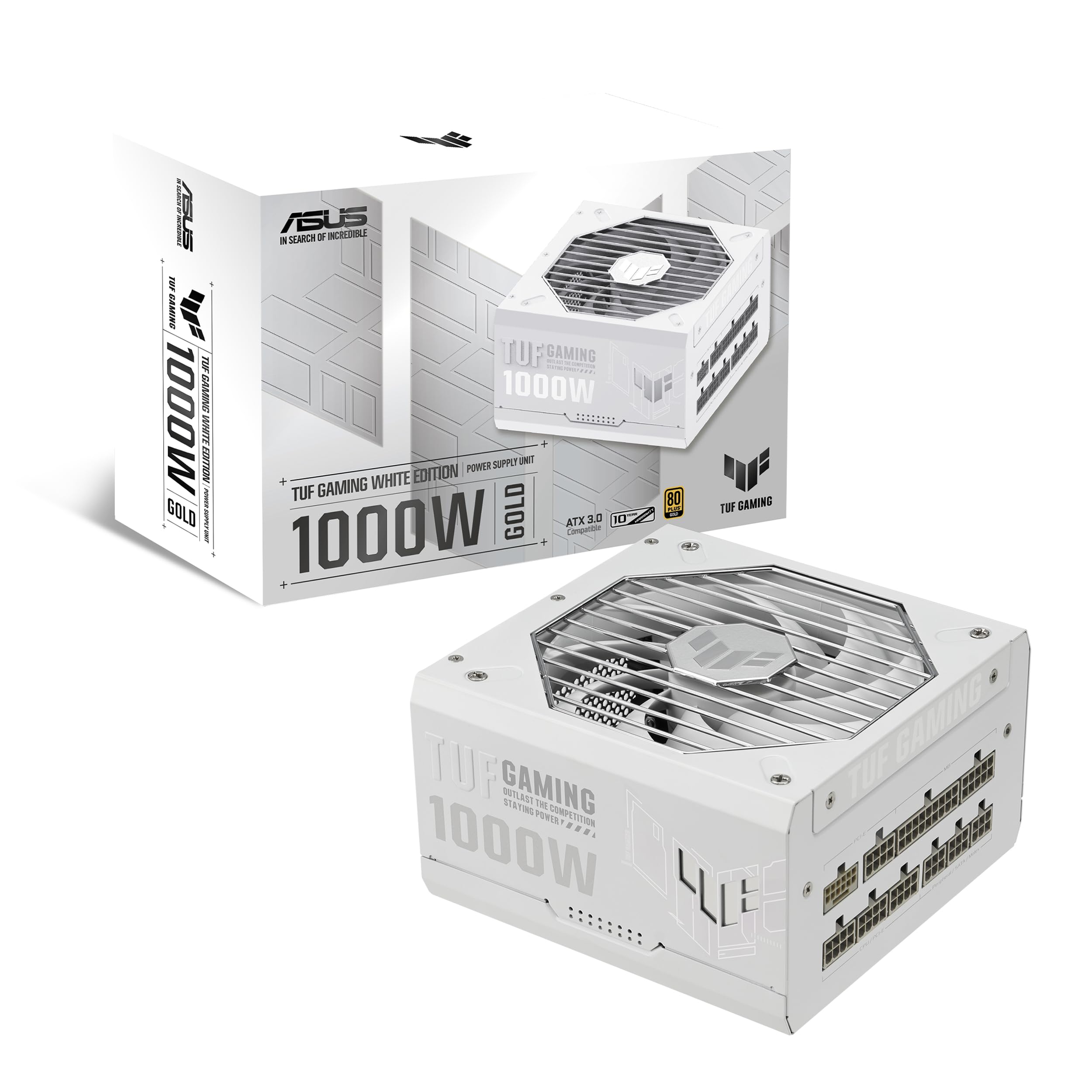
TUF Gaming 1000W Gold White Edition (1000 Watt, ATX 3.1 Compatible, Fully Modular Power Supply, 80+ Gold Certified, Military-grade Components, Dual Ball Bearing, PCB Coating, 10 Year Warranty)
£129.99 · ASUS
Frequently asked
5 questions01Is the Corsair RM1000x SHIFT good for gaming?+
Yes. 1000W with 80 Plus Gold efficiency and ATX 3.1 compliance covers every current gaming GPU including the RTX 4090 and RTX 5090 with headroom to spare. The Zero RPM mode keeps it silent during lighter gaming loads, and the side-connector design makes cable management cleaner than most competing units.
02Is the Corsair RM1000x SHIFT fully modular?+
Yes, fully modular. Every cable including the 24-pin ATX detaches completely from the PSU. You only connect what your system needs. The SHIFT adds a side-mounted connector panel that makes routing easier than a standard rear-connector modular PSU.
03How long will the Corsair RM1000x SHIFT last?+
Corsair backs it with a 10-year warranty. The 105°C-rated Japanese electrolytic capacitors and fluid dynamic bearing fan are both premium longevity choices. Under normal operating conditions, a decade of reliable use is a realistic expectation.
04Is 80 Plus Gold or Platinum better?+
Platinum is more efficient, around 92% at 50% load versus Gold's 90%. But the real-world electricity saving for a home gaming build is modest, and Platinum units cost more. For most builds, 80 Plus Gold is the sweet spot. Platinum only becomes financially justifiable if you run the system at heavy load for many hours every day.
05What is the warranty on the Corsair RM1000x SHIFT?+
10 years. That is one of the longest warranties available on any PSU and reflects Corsair's confidence in the internal component quality, particularly the 105°C Japanese capacitors and fluid dynamic bearing fan.