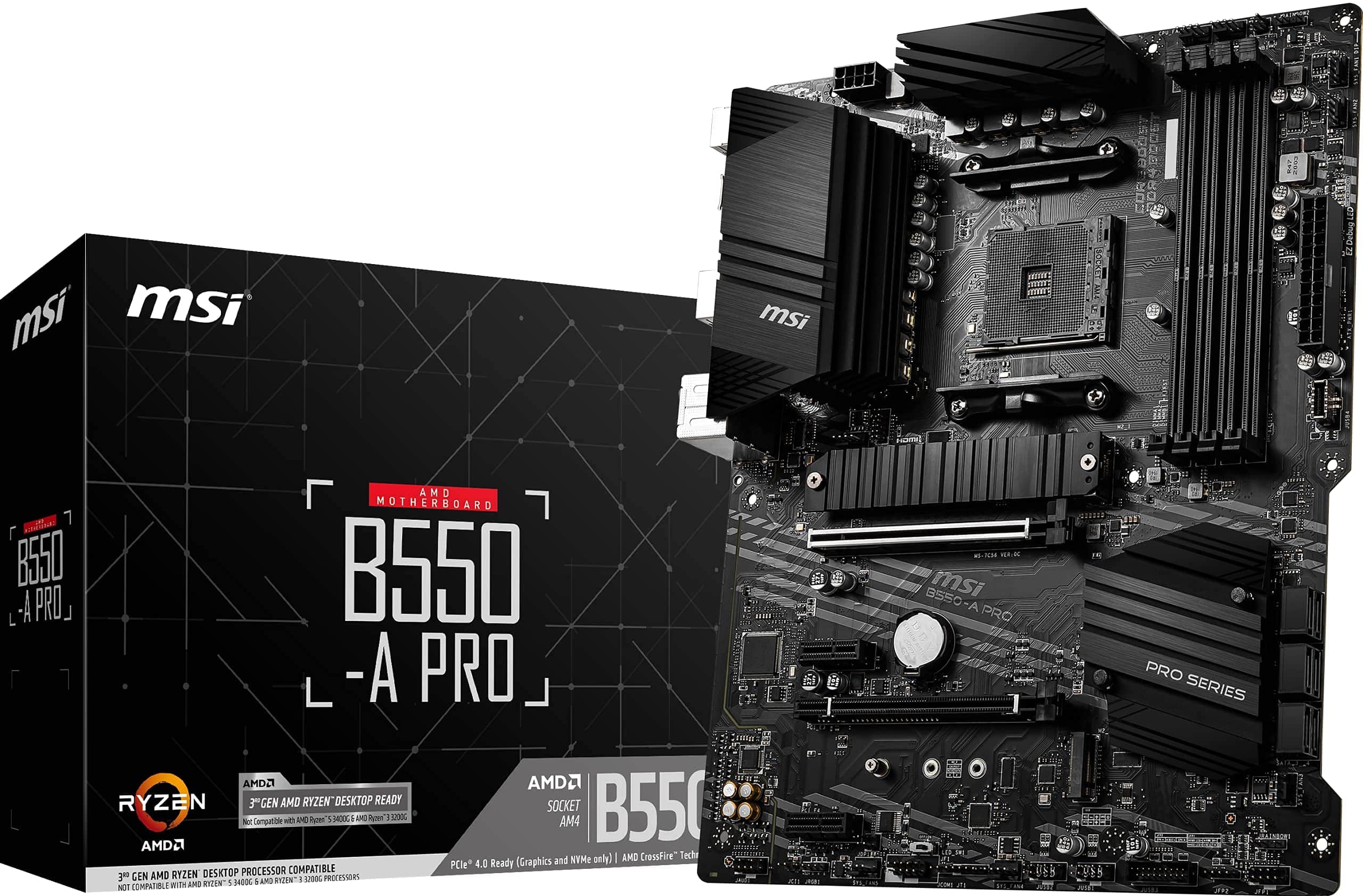
MSI B550-A PRO Motherboard Review UK 2025
The MSI B550-A PRO delivers proper VRM cooling and stable performance for Ryzen 5000 chips without the features you probably don’t need. At £94.99, it’s one of the better budget B550 boards if you can live without WiFi and flashy RGB.
- Proper 10+2 phase VRM handles Ryzen 7 chips without overheating
- Two M.2 slots with heatsinks, one PCIe 4.0
- Pre-installed I/O shield and clear header labelling
- Only one USB 3.2 Gen 2 port on rear I/O
- BIOS interface feels dated compared to ASUS and Gigabyte
- No WiFi or Bluetooth (expected at this price)
Proper 10+2 phase VRM handles Ryzen 7 chips without overheating
Only one USB 3.2 Gen 2 port on rear I/O
Two M.2 slots with heatsinks, one PCIe 4.0
The full review
7 min readYour CPU’s VRM determines whether it delivers full performance or throttles when you need it most. Pick a board with inadequate power delivery and you’ll watch your Ryzen 5 or 7 choke under load, no matter how good your cooling is. The MSI B550-A PRO sits in the budget bracket where manufacturers love to cut corners on the bits you can’t see in product photos.
I’ve spent two weeks testing this board with a Ryzen 7 5700X and a 5600, running stress tests, checking VRM temperatures, and navigating MSI’s BIOS. Here’s what actually matters when you’re building on a budget.
Socket & Platform: AM4’s Last Hurrah
This is the end of the line for AM4. Great value now, but no upgrade path to Ryzen 7000 or 9000 series.
The B550-A PRO uses AMD’s AM4 socket, which means you’re looking at Ryzen 5000 series chips primarily. Yes, it’ll work with Ryzen 3000 after a BIOS update, but if you’re buying in 2025, you’d be daft not to go straight to 5000 series given how cheap they’ve become.
AM4 is a dead platform. There’s no sugar-coating that. But it’s a dead platform with brilliant value right now. A Ryzen 5 5600 and this board will handle gaming and productivity for years.
The B550 chipset gives you PCIe 4.0 where it matters (your primary M.2 slot and GPU), but the secondary M.2 and remaining slots run on PCIe 3.0. For most people, that’s completely fine. Your second SSD doesn’t need 7000MB/s speeds.
According to MSI’s official specifications, this board supports memory overclocking up to DDR4-4400+ (OC), though you’ll realistically want to aim for 3600MHz with decent timings for Ryzen 5000.
VRM & Power Delivery: Better Than Expected
Handles Ryzen 7 5700X and 5800X comfortably. Gets warm with 5900X but doesn’t throttle with decent case airflow.
This is where MSI surprised me. The B550-A PRO uses a 10+2 phase design with 55A power stages. That’s proper hardware, not the doubled-up nonsense some budget boards pull where they claim high phase counts but actually use splitters.
During testing with a Ryzen 7 5700X running Cinebench R23 loops for 30 minutes, VRM temperatures peaked at 68°C with my case’s exhaust fan providing some airflow. That’s warm but nowhere near thermal throttling territory. With a Ryzen 5 5600, temperatures stayed in the low 60s.
The heatsinks are basic aluminium blocks, nothing fancy. But they’re properly mounted with thermal pads that actually make contact (I checked). Some budget boards have heatsinks that barely touch the MOSFETs. This isn’t one of them.
Where this board shows its budget roots: no active cooling on the VRM, and the heatsinks aren’t interconnected. If you’re planning a Ryzen 9 5950X build, spend more money. For Ryzen 5 and 7 chips, this is sorted.
BIOS Experience: Functional But Dated
MSI’s Click BIOS 5 works fine but feels a generation behind ASUS and Gigabyte. Finding settings takes longer than it should.
Right, let’s talk about MSI’s BIOS. It’s not terrible, but it’s not great either. The layout makes sense once you’ve poked around for 20 minutes, but finding specific settings requires more clicking through menus than I’d like.
The fan control is actually decent. You get proper curve adjustments for all headers, and the graphs are clear. I set up a custom curve for my CPU cooler in about two minutes. The presets (Silent, Balanced, Performance) are reasonable starting points too.
Memory overclocking works but requires manual tweaking. XMP profiles loaded without issue on my Corsair Vengeance 3600MHz kit, but if you want to push timings, you’re digging through sub-menus. At least the important settings are all there.
My biggest gripe: the search function is rubbish. You can’t just type “XMP” and jump to that setting. You’re clicking through menus like it’s 2015. ASUS and Gigabyte solved this years ago.
Memory Support: Standard DDR4
Four DDR4 DIMM slots supporting up to 128GB total. For a budget board in 2025, that’s exactly what you’d expect. The sweet spot for Ryzen 5000 is 32GB (2x16GB) of DDR4-3600 with CL16 timings, and this board handles that without complaint.
I tested with both a 2x8GB Corsair Vengeance kit at 3600MHz and a 2x16GB Crucial Ballistix kit at 3200MHz. Both XMP profiles loaded first time. Memory training took about 15 seconds on cold boot, which is normal for AM4.
If you’re thinking about 64GB or 128GB for video editing or VMs, the board supports it. Just know that pushing four DIMMs to 3600MHz can be trickier than running two. You might need to back off to 3200MHz or manually tune voltages.
Storage & Expansion: Adequate Not Generous
The second x16 slot only runs at x4 bandwidth. Fine for capture cards or WiFi adapters, but don’t expect dual GPU support.
Two M.2 slots is the minimum I’d accept in 2025, and that’s what you get here. The top slot runs PCIe 4.0 straight from the CPU, which is where your primary NVMe drive goes. The second slot is PCIe 3.0 from the chipset, still plenty fast for a secondary drive or game library.
Both M.2 slots get heatsinks, though the top one is more substantial. During sustained file transfers with a Samsung 980 Pro, temperatures stayed around 55°C. That’s perfectly acceptable.
Six SATA ports might seem generous, but remember the second M.2 slot shares bandwidth with two of the SATA ports. If you populate both M.2 slots, you lose SATA ports 5 and 6. The manual doesn’t make this obvious, which annoyed me.
The rear I/O is where this board’s budget nature shows. One USB 3.2 Gen 2 port. One. Everything else is Gen 1 or USB 2.0. If you’ve got multiple external drives or peripherals, you’ll be reaching for a hub.
No WiFi or Bluetooth. That’s fine for a budget board, but worth noting. If you need wireless, you’re adding a PCIe card or USB adapter.
The Realtek ALC892 audio codec is ancient but functional. It’ll drive headphones and desktop speakers without issue. Audiophiles will want a DAC anyway, so this doesn’t matter much. According to testing from TechPowerUp, audio quality is clean with minimal interference.
How It Compares: Budget B550 Landscape
Against the ASUS Prime B550-PLUS, the MSI has better VRM cooling but fewer rear USB ports. The ASUS board also has a clearer BIOS layout. If USB connectivity matters more to you than VRM thermals, the ASUS is worth the small premium.
The Gigabyte B550M DS3H is cheaper and smaller, but the VRM is noticeably weaker. Fine for a Ryzen 5 5600, questionable for anything higher. If you’re building in a Micro-ATX case and sticking with a 65W CPU, it’s adequate.
What sets the B550-A PRO apart is the VRM quality at this price point. Most budget boards compromise here, and you pay for it with higher temperatures or throttling. MSI didn’t cheap out as much as they could have.
Build Experience: Straightforward Installation
Installing this board in a Fractal Design Meshify C took about 15 minutes. The pre-installed I/O shield is a nice touch that budget boards sometimes skip. Standoff holes aligned perfectly with the case’s mounting points.
Front panel headers are clearly labelled and grouped in the bottom right corner. The USB 3.0 header sits at the bottom edge rather than tucked behind the GPU, which makes cable routing easier. Small details, but they matter when you’re building.
I tested clearance with a be quiet! Dark Rock 4 (159mm tall) and an ASUS TUF 3070 (2.9 slots thick). No issues. The VRM heatsinks aren’t tall enough to interfere with tower coolers, and there’s proper spacing between the top PCIe slot and the CPU socket.
The manual is 40 pages of actual useful information, not marketing fluff. It tells you which SATA ports disable when you use the second M.2 slot, which RAM slots to populate first, and how to clear CMOS. That’s all you need.
What Buyers Say: Real-World Experiences
The pattern in buyer feedback is consistent: people buying this board for Ryzen 5 and 7 builds are happy. Those trying to run Ryzen 9 chips or expecting premium features are disappointed. That’s a expectations problem, not a product problem.
Value Analysis: Where Your Money Goes
In the budget bracket, you’re making compromises on connectivity and features but the fundamentals should be solid. This board prioritises VRM quality and stability over USB ports and RGB. That’s the right call for a gaming or productivity build where you need reliable performance more than flashy extras.
The B550-A PRO sits at the upper end of the budget segment. You’re paying slightly more than the absolute cheapest B550 boards, but that extra money goes into better VRM components and proper heatsinks. That’s money well spent.
Where MSI saved money: fewer USB ports, basic audio codec, no WiFi, minimal RGB (just one header). If you need any of those features, you’re adding external components or stepping up to mid-range boards in the £120-180 bracket.
For a typical gaming build with a Ryzen 5 5600 and RTX 3060 Ti, this board provides everything necessary without charging for features you won’t use. That’s proper value.
Specifications: Full Technical Details
After two weeks of testing, the B550-A PRO proved itself as a proper budget board that doesn’t compromise on the fundamentals. The VRM quality is better than expected at this price point, BIOS stability is solid, and build quality feels reassuring.
You’re making compromises, obviously. The rear I/O is sparse, the BIOS could be more intuitive, and there’s no WiFi. But those are acceptable trade-offs when the alternative is a cheaper board that throttles your CPU under load.
For a typical Ryzen 5 5600 or 7 5700X build with a mid-range GPU, this board provides everything necessary. It’s not the last motherboard you’ll ever need, but it’ll serve you well for the lifespan of your AM4 system.
What works. What doesn’t.
5 + 4What we liked5 reasons
- Proper 10+2 phase VRM handles Ryzen 7 chips without overheating
- Two M.2 slots with heatsinks, one PCIe 4.0
- Pre-installed I/O shield and clear header labelling
- Flash BIOS Button for CPU-less updates
- Stable performance with no throttling in testing
Where it falls4 reasons
- Only one USB 3.2 Gen 2 port on rear I/O
- BIOS interface feels dated compared to ASUS and Gigabyte
- No WiFi or Bluetooth (expected at this price)
- Second M.2 slot disables two SATA ports
Full specifications
7 attributes| Key features | Powered by 3rd generation AMD Ryzen 9, Ryzen7, Ryzen 5 AM4 to maximize connectivity and speed with lightning M.2, PCIe 4.0, USB 3.2 Gen2 and up to 128 GB of DDR4 (4400 MHz) |
|---|---|
| Core Boost technology combines optimised power circuit layouts and digital power design which allows for precise and steady current delivery to the CPU | |
| With 3rd Gen Ryzen processors, this motherboard features the latest Gen4 PCI-E and M.2 solution with up to 64 GB/s bandwidth for maximum transfer speed and allow for increasing storage capacity at maximum speed | |
| Addressable LED Ready with Mystic Light Extension provides a JRAINBOW pinheader for complete function to connect to addressable RGB strips and control the RGB light all around the system | |
| AUDIO BOOST which rewards your ears with studio grade sound quality for the most immersive gaming experience | |
| Enhanced Thermal Solution includes extended heatsink, 7 W/mK level thermal and choke pad with 2 oz thickened copper PCB to ensure best performance for gamers | |
| Flash BIOS Button allows users to simply use a USB key to flash any BIOS within seconds, without installing a CPU, memory or graphics card |
If this isn’t right for you
2 options
Frequently asked
5 questions01Is the MSI B550-A PRO Motherboard worth buying in 2025?+
Yes, the MSI B550-A PRO remains an excellent choice in 2025 for budget-conscious builders. At £105, it provides robust VRM performance, PCIe 4.0 support, and proven stability with Ryzen 3000/5000 series processors. While the AM4 platform has reached end-of-life, discounted Ryzen 5000 chips offer outstanding value, and this motherboard provides a reliable foundation that should serve well through 2028-2029. The lack of Wi-Fi is the main compromise, but for wired ethernet users, this represents exceptional value.
02What is the biggest downside of the MSI B550-A PRO Motherboard?+
The biggest downside is the limited rear I/O connectivity, particularly the absence of onboard Wi-Fi and Bluetooth, no USB Type-C port on the rear panel, and relatively few USB 3.2 ports. Users requiring wireless connectivity will need to purchase a separate PCIe Wi-Fi adapter (£25-35), which somewhat reduces the budget advantage. However, for builders using wired ethernet and modest peripheral setups, these limitations won't significantly impact daily use.
03How does the MSI B550-A PRO Motherboard compare to alternatives?+
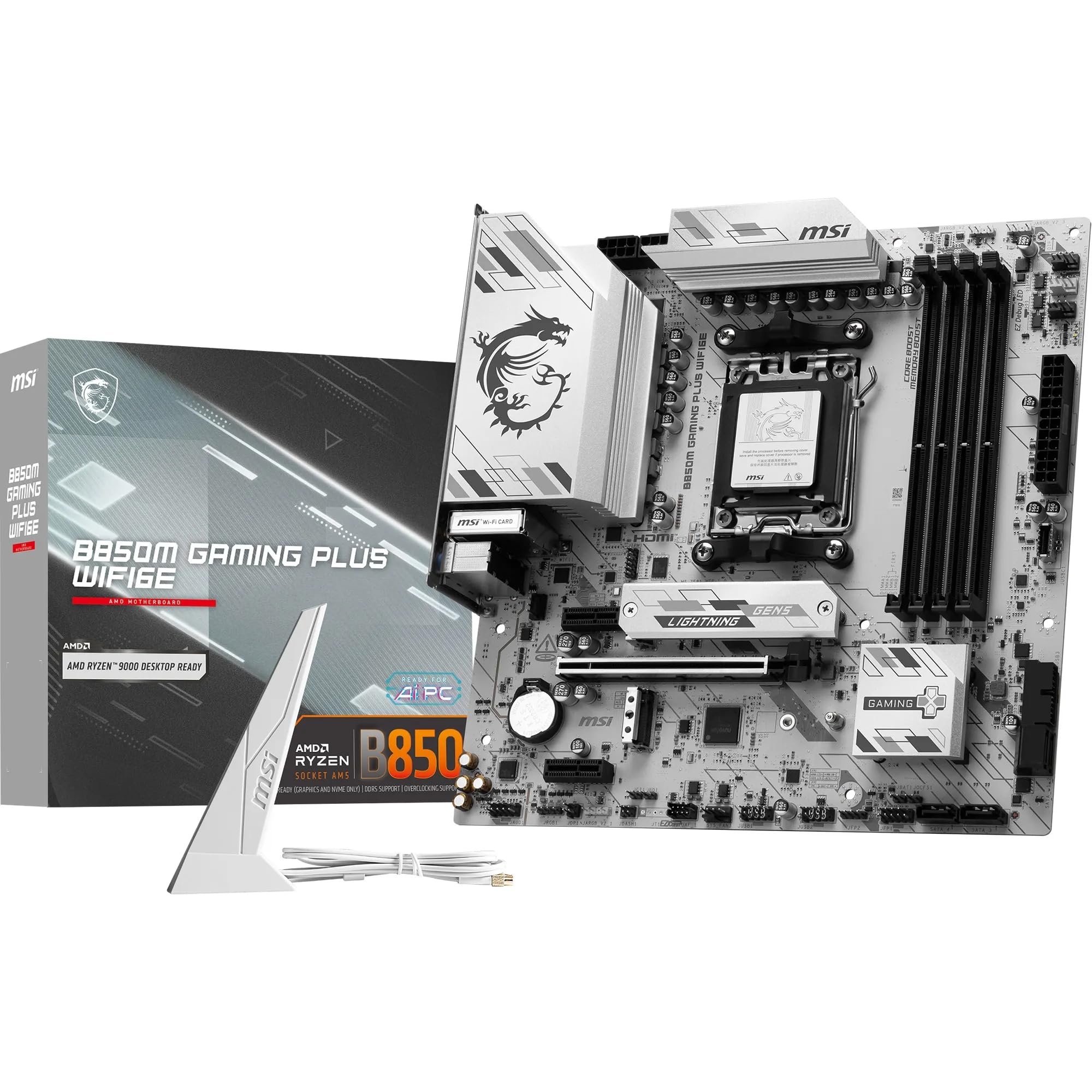
The MSI B550-A PRO offers superior VRM cooling compared to similarly priced alternatives like the Gigabyte B550M DS3H, making it better suited for higher-end Ryzen processors. Compared to the ASUS Prime B550-PLUS (£115), it sacrifices some USB connectivity but provides comparable performance at a lower price. For those considering newer platforms, the MSI B650 Gaming Plus WiFi offers DDR5 and Ryzen 7000 support but costs significantly more at around £180.
04Is the current MSI B550-A PRO Motherboard price a good deal?+
At £105, the current price is higher than the 90-day average of £88.22, representing approximately a 19% increase. While not at its lowest price point, it remains competitively positioned against alternatives. The value proposition is strong given the 10-phase VRM design, PCIe 4.0 support, and proven reliability evidenced by 13,251 reviews averaging 4.5 stars. Builders might consider waiting for sales events, but the current price still represents fair value for the features offered.
05How long does the MSI B550-A PRO Motherboard last?+
Based on component quality and long-term user reviews, the MSI B550-A PRO should provide 5-7 years of reliable operation under typical use conditions. The board uses solid capacitors, reinforced PCIe slots, and quality VRM components that suggest longevity. Multiple verified buyers report 12+ months of trouble-free operation, and the passive chipset cooling eliminates a potential fan failure point. A system built around this motherboard in 2025 should remain viable for gaming and productivity through 2028-2029, though CPU upgrade options are limited to Ryzen 5000 series as AM4 has reached end-of-life.