Samsung has long been one of the most trusted names in display technology, and its monitor range for 2025 covers everything from budget-friendly 1080p panels to 4K smart screens with built-in streaming apps. This roundup is aimed at UK buyers who want a reliable Samsung monitor without spending more than £500, whether that means a sharp gaming display with a high refresh rate, a productivity workhorse for the home office, or a versatile smart monitor that doubles as a TV replacement. Compared with last year, Samsung has pushed prices down on several key models, particularly in the 4K and high-refresh-rate categories, making it easier than ever to get genuine quality for under £300. We've researched six models across different use cases, covering resolution, panel type, refresh rate, and connectivity, so you can find the right screen for your setup without overspending.
Quick Verdict
Best Overall: Samsung Odyssey G5 LS27CG552EUXXU. At under £135, this 27-inch QHD VA panel with a 165Hz refresh rate delivers outstanding value and image quality that punches well above its price point.
Best Value for Smart Features: Samsung LS32FM703UUXXU 32" 4K Smart Monitor. A 32-inch 4K screen with HDR10 support, built-in speakers, and smart TV functionality is genuinely hard to beat for living room or bedroom use.
Best for Competitive Gaming: Samsung Odyssey G3 LS27DG302EUXXU. A 180Hz IPS panel at 1080p gives buttery-smooth motion for fast-paced titles, and the price keeps it accessible for console and PC gamers alike.
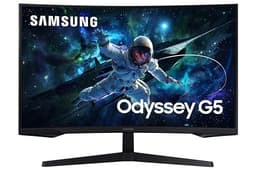
The Samsung Odyssey G5 LS27CG552EUXXU is the standout pick in this roundup for anyone who wants a genuinely capable gaming and productivity monitor without spending a fortune. Priced at just £167.00, it delivers a QHD (2560x1440) resolution on a 27-inch VA panel with a 1000R curve, which is a specification combination that would have cost significantly more just two years ago.
The 2560x1440 resolution is the sweet spot for 27-inch screens. At this pixel density, text is noticeably sharper than on a 1080p panel of the same size, and games look considerably more detailed without demanding the GPU horsepower that 4K requires. Whether you are playing an open-world RPG, working in spreadsheets, or editing photos, the extra resolution pays dividends. The VA panel technology delivers deeper blacks and higher contrast ratios than IPS, which makes dark scenes in games and films look genuinely cinematic rather than washed out.
The 165Hz refresh rate is more than sufficient for most gaming scenarios. While competitive esports players might chase 240Hz or higher, 165Hz is smooth enough to feel genuinely responsive in fast-paced shooters, racing games, and action titles. The 1000R curve wraps slightly around your field of view, which some users find immersive and others find unnecessary, but it does not cause distortion at normal viewing distances. Connectivity is sensible: one DisplayPort 1.4 and one HDMI 2.0, plus a headphone output. There is no USB hub, which is a minor inconvenience, but at this price it is hard to complain.
This monitor suits PC gamers who want a step up from 1080p without moving to 4K, home office workers who value sharp text and good contrast, and anyone who wants a curved screen for an immersive single-monitor setup. It is not the best choice for colour-critical creative work, as VA panels can exhibit some colour shift at extreme viewing angles, but for the vast majority of everyday tasks and gaming sessions it performs admirably.
Verdict: The best-value monitor in this entire roundup. QHD resolution, 165Hz, and a curved VA panel for under £135 is genuinely exceptional and makes this the easy recommendation for most buyers.
Pros
- QHD 2560x1440 resolution at a budget price point
- 165Hz refresh rate handles fast-paced gaming smoothly
- VA panel delivers deep blacks and high contrast for gaming and films
Cons
- VA panel shows some colour shift at wide viewing angles
- No USB hub or built-in speakers
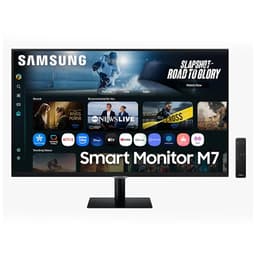
The Samsung LS32FM703UUXXU is a 32-inch 4K smart monitor finished in white, priced at Check price. It sits in a growing category of monitors that blur the line between a traditional computer display and a smart television, and it does so at a price that is genuinely competitive for a 32-inch 4K screen.
The headline appeal here is the combination of 4K resolution, HDR10 support, and built-in smart TV functionality. You can connect it to a PC via its display inputs and use it as a standard monitor, or you can use the smart platform independently to stream Netflix, Disney+, YouTube, and other services without any external device plugged in. This makes it an excellent choice for a bedroom, a small living room, or a home office where you want one screen to serve multiple roles throughout the day.
The 32-inch VA panel delivers the kind of colour depth and contrast that VA technology is known for, and at 4K resolution the image is sharp and detailed. HDR10 support means compatible content will show improved highlight detail and a wider tonal range, though as with most monitors in this price bracket the peak brightness is not quite high enough to match a dedicated HDR television. The built-in speakers are a practical addition that reduces cable clutter, particularly if you are using this as a TV replacement rather than a dedicated gaming or work monitor.
This monitor is ideal for users who want a large, versatile screen that can handle PC work, streaming, and casual gaming without requiring a separate media player or soundbar. It is not aimed at competitive gamers who need high refresh rates, and the VA panel means viewing angles are not as wide as IPS, so it works best when viewed from directly in front. The white finish gives it a clean, modern look that suits living room and bedroom environments well.
Verdict: A superb all-rounder for users who want smart TV functionality and 4K resolution in a single affordable package. The white design and built-in speakers make it particularly well suited to non-desk environments.
Pros
- 4K resolution on a large 32-inch panel for under £200
- Built-in smart TV platform removes the need for a separate streaming device
- HDR10 support improves contrast in compatible content
Cons
- VA panel has narrower viewing angles than IPS alternatives
- Not suited to high-refresh-rate gaming use cases
The Samsung Odyssey G3 LS27DG302EUXXU is aimed squarely at gamers who prioritise smooth, responsive motion above all else. Priced at £144.99, it delivers a 180Hz refresh rate on an IPS panel, which is a combination that suits competitive gaming particularly well. The 1ms response time (MPRT) ensures that fast-moving objects remain sharp without trailing or ghosting, which is critical in shooters, fighting games, and other fast-paced genres.
The IPS panel technology is a meaningful advantage over VA alternatives in this context. IPS panels maintain consistent colour and brightness across a wider range of viewing angles, which matters when you are leaning to the side during an intense gaming session or sharing the screen with someone sitting next to you. The trade-off is that IPS panels typically cannot match VA panels for contrast depth, so blacks will not appear as rich, but for brightly lit gaming environments and daytime desktop use the IPS advantage in colour consistency is noticeable.
At 1920x1080 on a 27-inch screen, the pixel density is lower than on QHD or 4K alternatives. Text and fine detail are not as crisp as on the Odyssey G5, for example, and if you sit close to the screen you may notice individual pixels in fine text. However, the lower resolution has a practical benefit for gaming: it is much easier to push 180 frames per second at 1080p than at higher resolutions, meaning mid-range GPUs can fully exploit the high refresh rate. For console gamers, the HDMI and DisplayPort inputs cover both current-generation and previous-generation connections.
This monitor suits PC and console gamers who want the smoothest possible motion at an accessible price, particularly those running mid-range graphics cards that would struggle to maintain high frame rates at QHD or 4K. It is less suited to productivity tasks where pixel density matters, such as photo editing or detailed document work.
Verdict: The best choice for gamers who prioritise refresh rate and response time. The 180Hz IPS panel delivers genuinely smooth, responsive gameplay, and the price makes it one of the most competitive gaming monitors available from Samsung.
Pros
- 180Hz refresh rate with 1ms MPRT for exceptionally smooth gaming
- IPS panel provides consistent colours at wider viewing angles than VA
- Accessible price for a high-refresh-rate gaming monitor
Cons
- 1080p on a 27-inch screen results in lower pixel density than QHD alternatives
- IPS panel cannot match VA for deep blacks and contrast
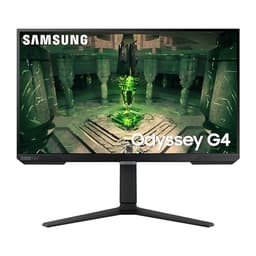
The Samsung Odyssey G4B LS25BG400EU is the most compact monitor in this roundup, measuring 25 inches and priced at £168.60. It is designed for gamers who prefer a smaller screen size for faster eye movement tracking in competitive titles, or for users with limited desk space who still want a dedicated gaming display.
The 25-inch IPS panel at 1920x1080 delivers a higher pixel density than a 27-inch 1080p screen, which means images and text appear slightly sharper at normal viewing distances. The IPS technology ensures consistent colours and wide viewing angles, which is useful both for gaming and for everyday desktop tasks. The Odyssey G4B branding signals gaming credentials, and the monitor includes features appropriate for that use case.
Connectivity is genuinely strong for a monitor at this price: two HDMI 2.0 ports, one DisplayPort 1.2, a USB port, and a headphone output. The inclusion of a USB port is a welcome addition that the more expensive Odyssey G3 lacks, allowing you to connect a USB device directly to the monitor. The headphone output means you can plug in a headset without reaching around to the back of your PC. This combination of ports makes the G4B one of the most practically equipped monitors in this roundup relative to its price.
The smaller 25-inch screen size is a deliberate choice rather than a compromise for some buyers. Competitive gamers, particularly those who play first-person shooters or real-time strategy games, often prefer smaller screens because they can take in the entire display without moving their eyes as far, which can improve reaction times. For users who sit close to their monitor, 25 inches can also feel less overwhelming than 27 or 32 inches.
Verdict: An excellent compact gaming monitor with a strong connectivity package. The 25-inch IPS panel suits competitive gamers and users with limited desk space, and the inclusion of USB and headphone outputs adds genuine practical value.
Pros
- 25-inch size delivers higher pixel density than 27-inch 1080p alternatives
- Comprehensive port selection including USB and headphone output
- IPS panel maintains consistent colour at wide viewing angles
Cons
- 25-inch screen may feel small for users accustomed to 27-inch or larger displays
- DisplayPort 1.2 rather than 1.4 limits future bandwidth headroom
Buying Guide
Resolution: What Do You Actually Need?
Resolution is one of the most important decisions when choosing a monitor, and it has a direct impact on both image quality and the hardware required to drive it. At 27 inches, 1080p (1920x1080) is acceptable but noticeably less sharp than QHD (2560x1440), which is why the Odyssey G5 represents such strong value. QHD at 27 inches hits a sweet spot where text is crisp, images look detailed, and the GPU demand remains manageable for mid-range graphics cards. For 32-inch screens, 4K (3840x2160) is worth considering if your budget allows, as the larger panel size makes the lower pixel density of 1080p more apparent. If you are primarily gaming and want to maximise frame rates, 1080p remains the most GPU-friendly option.
Panel Type: VA vs IPS
The monitors in this roundup use either VA or IPS panels, and the choice between them involves real trade-offs. VA panels offer higher contrast ratios, typically 3000:1 or more, which means darker blacks and more cinematic images in games and films. They are well suited to single-user setups where you sit directly in front of the screen. IPS panels offer wider viewing angles and more consistent colour reproduction, making them better for shared workspaces, colour-sensitive work, and situations where you might view the screen from an angle. Neither technology is universally superior; the right choice depends on how you use your monitor.
Refresh Rate: Gaming vs Everyday Use
For non-gaming use, the standard 60Hz refresh rate is perfectly adequate. For gaming, higher refresh rates deliver smoother motion and a more responsive feel. At 144Hz and above, the difference is immediately noticeable in fast-paced games. The Odyssey G3 at 180Hz is the highest refresh rate option in this roundup and is aimed specifically at gamers who want the smoothest possible experience. The Odyssey G5 at 165Hz is only marginally lower and is unlikely to feel different in practice. If you do not play fast-paced games, a high refresh rate is not worth prioritising over resolution or panel quality.
Smart Monitor Features
Samsung's smart monitors can run streaming apps independently of a PC, which makes them genuinely versatile for bedroom or living room use. If you want a screen that can serve as both a monitor and a TV replacement, the smart monitor options in this roundup are worth considering. If you only ever use your monitor connected to a PC, the smart features add cost without adding value to your workflow.
Is Samsung a Good Brand for Monitors?
Samsung is widely regarded as one of the top three monitor brands globally, alongside LG and Dell. The company manufactures its own panels, which gives it a degree of quality control that pure assemblers cannot match. Samsung monitors are known for reliable build quality, strong colour performance, and good longevity. Most Samsung monitors will last well beyond five years with normal use, and the brand's warranty and UK support infrastructure is well established. Compared with Dell, Samsung tends to offer more competitive pricing at the budget end of the market, while Dell has a stronger reputation for colour-accurate professional displays. Compared with HP, Samsung generally offers more variety and better gaming-oriented options. Both Dell and HP produce reliable monitors, but Samsung's range breadth and panel manufacturing expertise give it a strong overall standing.
Connectivity: Ports Matter More Than You Think
Before buying, count how many devices you need to connect. If you use a PC and a games console, you need at least two video inputs. If you use headphones plugged into the monitor, a headphone output is essential. A USB port on the monitor can save you reaching around to your PC for peripheral connections. The monitors in this roundup vary significantly in their port selection, so matching connectivity to your actual needs can save you from buying an external hub later.
The Samsung Odyssey G5 LS27CG552EUXXU is the overall winner of this roundup. For under £135, it delivers QHD resolution, a 165Hz refresh rate, and a curved VA panel on a 27-inch screen, which is a specification that would have commanded a significantly higher price in previous years. It suits the widest range of buyers, from gamers who want smooth, detailed visuals to home office workers who want sharper text and better contrast than a 1080p screen provides. For those who want smart TV functionality and a large 4K screen at an outstanding price, the Samsung LS32FM703UUXXU is the best value runner-up. Competitive gamers who need the highest possible refresh rate should look at the Odyssey G3 at 180Hz, while users who need versatile connectivity in a compact form factor will find the Odyssey G4B hard to fault. Across all six models, Samsung demonstrates why it remains one of the most trusted monitor brands in the UK market.