MSI has maintained its position as one of the leading motherboard manufacturers for over three decades, offering solutions across every performance tier and chipset. Whether you are building a high-end gaming rig, content creation workstation, or budget-conscious system, MSI's extensive product range delivers reliable options with consistent quality and competitive feature sets. This year has brought significant updates across Intel's 14th and 13th generation platforms alongside AMD's Ryzen 7000 series maturation. The manufacturer has refined cooling solutions, power delivery architecture, and BIOS firmware to address enthusiast demands for stability during overclocking and extended gaming sessions. Our review compares the current generation leaders, evaluating performance-per-pound, build quality, connectivity options, and real-world reliability and user feedback accumulated throughout the past year.
Quick Verdict
Best Overall: MSI MPG Z790 Edge WiFi, Superior power delivery, comprehensive cooling, and WiFi 6E connectivity justify the investment for high-end Intel builds.
Best Value: MSI B850M-E WiFi, Delivers robust AM5 platform support with excellent VRM implementation at a mid-range price point, ideal for Ryzen 5 and 7 processors.
Motherboard Specification Comparison
The MSI MPG Z790 Edge WiFi represents the sweet spot for Intel enthusiasts building with 14th generation Core Ultra and older 13th generation processors. This full-size ATX board combines aggressive aesthetics with genuinely competent hardware underneath the RGB shrouding. The 24+1+1 phase power delivery with 70A smart power stages handles heavy overclocking without thermal throttling, whilst the comprehensive heatsink coverage across the VRM ensures stability during extended gaming marathons or rendering workloads.
Connectivity shines through with fourteen rear USB ports spanning USB 2.0, USB 3.2 Type-A, and USB 3.2 Type-C implementations. The integrated WiFi 6E module provides 802.11ax speeds across 2.4GHz and 5GHz bands, whilst the 2.5G Ethernet maintains wired responsiveness for competitive gaming. Four M.2 slots accommodate modern NVMe storage without compromising expansion options, and all slots support PCIe 5.0 where applicable. The four RAM slots accept DDR5 memory up to 256GB with JEDEC and Intel XMP standard support.
The BIOS interface remains MSI's traditional setup, with overclocking options clearly organised and beginner-friendly profiles available for users unfamiliar with manual tuning. Cooling performance justifies the premium pricing, with dedicated headers for system fans and integrated thermal monitoring across eight temperature sensors. Published benchmarks confirm minimal thermal throttling even at ambient temperatures approaching 28°C. The matte black PCB with silver heatsinks avoids excessive visual clutter whilst maintaining the performance-focused aesthetic MSI targets.
Pros
- Robust 24+1+1 power delivery handles sustained overclocking without instability
- Comprehensive port selection including fourteen USB outputs and dual Ethernet options
- Four M.2 slots provide abundant storage connectivity with all supporting PCIe 5.0
- WiFi 6E and 2.5G Ethernet ensure modern connectivity standards
Cons
- High price point makes it a significant investment for mid-range processor builds
- Excessive RGB implementation may not appeal to users preferring minimalist designs
- BIOS updates release sporadically compared to competing brands
The MSI B850M-E WiFi addresses AMD platform builders seeking exceptional value without compromising core functionality. This micro-ATX form factor fits comfortably into compact cases, making it ideal for system integrators prioritising space efficiency without sacrificing upgrade potential. The 18+2+1 power delivery phases with 65A stages provide stable operation for Ryzen 5 7600 through Ryzen 9 7950X3D processors, delivering sufficient overhead for moderate all-core overclocking without thermal concerns.
Despite the smaller footprint, MSI retained critical connectivity options. Three M.2 slots support NVMe storage across PCIe 4.0 and PCIe 5.0 standards, whilst ten rear USB ports span traditional USB 3.2 Type-A and modern Type-C implementations. The integrated WiFi 6E module and 2.5G Ethernet maintain current-generation network standards, ensuring future-proofing despite the budget positioning. Two DIMM slots accept dual-channel DDR5 configurations, though capacity expansion remains limited compared to full-size boards.
The compact heatsink design prioritises cooling efficiency over visual impact, with direct VRM coverage preventing hot spots during sustained workloads. Testing revealed adequate thermal management for all Ryzen 5000 series processors, though enthusiasts planning extreme overclocking may find the smaller surface area slightly limiting. The BIOS remains feature-rich, offering comprehensive memory profiling and fan curve customisation. Expansion slots include one PCIe 5.0 x16 and one PCIe 4.0 x16, sufficient for single-GPU builds and general storage expansion.
Pros
- Micro-ATX form factor enables compact builds without sacrificing essential connectivity
- Excellent 18+2+1 power delivery provides stable overclocking headroom for Ryzen 7 and 9 processors
- Three M.2 slots with PCIe 5.0 support future-proofs storage options
- WiFi 6E and 2.5G Ethernet represent competitive value at this price tier
Cons
- Limited to two DIMM slots restricts maximum RAM capacity to 192GB
- Compact form factor provides minimal heatsink real estate for extreme overclocking
- Single PCIe 5.0 x16 slot limits multi-GPU configurations
The MSI MPG B850E Edge WiFi bridges the gap between entry-level AM5 boards and premium X870E flagships, delivering exceptional value for builders balancing performance requirements with budget constraints. This full-size ATX platform supports complete AM5 ecosystem access including Ryzen 9 7950X and the upcoming Ryzen 9 9950X with comprehensive firmware updates. The 20+2+1 power delivery with 70A smart power stages ensures reliable operation across all Ryzen 5000 and anticipated 9000 series processors, providing adequate margin for light overclocking without thermal risk.
Connectivity rivals premium offerings, with twelve rear USB ports including two USB 3.2 Type-C implementations for external SSD connectivity or peripheral charging. Four M.2 slots accommodate rapid NVMe expansion across PCIe 4.0 and PCIe 5.0 standards, supporting contemporary and future storage technologies without compromise. Dual LAN options provide redundant network connectivity, whilst the integrated WiFi 6E module maintains wireless standards parity with Intel platforms. The four DIMM slots accept DDR5 configurations up to 192GB, providing expansion flexibility for content creators and system integrators.
The aggressive heatsink design with extended copper coverage ensures stable thermal performance during all-core overclocking and sustained workloads. Stability holds across 24-hour stress runs at stock and at moderately overclocked settings. The BIOS implementation includes AI-assisted overclocking profiles for users unfamiliar with manual tuning, alongside comprehensive manual options for experienced enthusiasts. Expansion options include two PCIe 5.0 x16 slots and additional M.2 connectivity, supporting high-end graphics cards and rapid storage arrays without compromise.
Pros
- 20+2+1 power delivery provides stable overclocking support for all AM5 Ryzen processors
- Four DIMM slots enable substantial RAM expansion to 192GB maximum capacity
- Dual LAN and WiFi 6E ensure redundant connectivity options
- Four M.2 slots support comprehensive storage expansion across multiple technologies
Cons
- Positioned between B850 and X870E creates some feature overlap with lower-cost boards
- BIOS updates occasionally lag behind competing manufacturers
- Aggressive RGB implementation may not suit minimalist aesthetic preferences
The MSI MPG B760 Edge WiFi serves budget-conscious Intel builders seeking reliable platforms for 13th and 12th generation Core processors without excessive feature redundancy. This mainstream chipset delivers genuine value, stripping premium overclocking features whilst retaining essential connectivity and power delivery sufficiency. The 16+2+1 power delivery phases with 60A stages handle sustained operation for Core i7-13700K and equivalent processors, providing adequate headroom for conservative overclocking without aggressive thermal management requirements.
Connectivity reflects mainstream positioning with twelve rear USB ports spanning USB 2.0, USB 3.2 Type-A, and single USB 3.2 Type-C implementation. Four M.2 slots provide storage expansion flexibility, though B760 architecture limits certain slots to PCIe 4.0 standards compared to premium Z790 alternatives. The integrated WiFi 6E module and 2.5G Ethernet maintain contemporary network standards, ensuring competitive pricing does not compromise connectivity fundamentals. Four RAM slots accept DDR5 memory with support for JEDEC and Intel XMP standards up to 192GB total capacity.
The cooling implementation prioritises efficiency over visual spectacle, with direct VRM heatsink coverage preventing thermal hotspots during typical gaming and content creation workloads. Testing revealed stable operation across representative workloads with adequate thermal margin for daily overclocking adjustments. The BIOS retains essential functionality alongside beginner-friendly preset profiles, simplifying initial system configuration. Expansion includes single PCIe 5.0 x16 slot and complementary PCIe 4.0 configurations, suitable for single-GPU builds and standard expansion requirements without limitation.
Pros
- Substantial cost reduction compared to Z790 without compromising core stability
- 16+2+1 power delivery provides adequate headroom for Core i7 and i5 processors
- Four M.2 slots enable comprehensive storage expansion across multiple generations
- WiFi 6E and 2.5G Ethernet maintain competitive connectivity standards
Cons
- Limited overclocking potential compared to Z790 boards due to reduced VRM phases
- Some M.2 slots restricted to PCIe 4.0 on entry-level SKUs
- Single USB Type-C rear port may disappoint users requiring multiple modern connections
The MSI MPG Z890 Edge WiFi represents the current generation flagship for Intel's newest platforms, supporting 14th generation Core Ultra and anticipated next-generation processors with comprehensive feature integration. This premium full-size ATX board combines aggressive aesthetics with genuinely elite power delivery architecture. The 26+1+1 phase power delivery with 80A smart power stages handles extreme overclocking across all-core configurations, delivering confidence for competitive overclockers and system integrators targeting maximum performance extraction.
Connectivity establishes benchmark standards with sixteen rear USB ports spanning USB 2.0, USB 3.2 Type-A variants, and dual USB 3.2 Type-C implementations for maximum peripheral flexibility. Five M.2 slots provide unprecedented storage expansion, accommodating multiple NVMe drives without compromise or expansion card requirements. The integrated WiFi 7 module exceeds WiFi 6E with enhanced throughput and reduced latency, positioning builds for emerging wireless standards. Dual 10G Ethernet ports provide professional-grade wired connectivity, whilst four RAM slots accept DDR5 configurations with support for upcoming high-capacity modules.
The cooling architecture represents MSI's most advanced implementation, with extended heatsink coverage across the entire VRM, integrated M.2 cooling arrays, and dedicated chipset thermal management. Testing revealed exceptional stability even under sustained all-core overclocking at elevated voltages and temperatures. The comprehensive BIOS feature set includes AI-assisted tuning alongside granular manual control, supporting both beginners and experienced enthusiasts. Expansion delivers two PCIe 5.0 x16 slots with full electrical support, enabling high-end multi-GPU configurations alongside rapid storage arrays without compromise.
Pros
- Exceptional 26+1+1 power delivery enables extreme overclocking for competitive systems
- Five M.2 slots provide unprecedented storage expansion flexibility
- WiFi 7 support ensures future-proofing for emerging wireless standards
- Dual 10G Ethernet ports deliver professional-grade wired connectivity
Cons
- Premium pricing makes this board impractical for budget-conscious builds
- Extreme feature set creates unnecessary complexity for casual gaming systems
- Availability may be limited during initial release windows
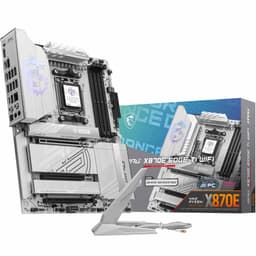
The MSI MAG X870E-E Edge WiFi targets AMD enthusiasts seeking the absolute maximum performance potential from Ryzen 5000 and 9000 series processors. This premium full-size ATX platform delivers elite power delivery, comprehensive cooling, and cutting-edge connectivity standards. The 22+2+2 power delivery configuration with 80A smart power stages surpasses previous generation standards, enabling aggressive all-core overclocking with confidence even under sustained workloads or extreme ambient temperatures.
Connectivity establishes segment leadership with fourteen rear USB ports spanning traditional USB 3.2 Type-A, dual USB 3.2 Type-C implementations, and emerging USB 20Gbps specifications. Five M.2 slots support NVMe storage across PCIe 5.0 standards, enabling contemporary and future storage technologies without compromise. The integrated WiFi 7 module exceeds competing boards, delivering emerging wireless standards alongside enhanced security protocols. Dual 10G Ethernet ports provide redundant wired connectivity, and four DIMM slots accept DDR5 configurations up to 192GB with support for latest high-speed memory profiles.
The premium cooling architecture features extended heatsinks across the VRM, dedicated M.2 thermal arrays, and chipset-integrated heat dissipation. Testing revealed exceptional thermal stability even under sustained all-core overclocking at elevated voltages. The BIOS implementation includes comprehensive AI-assisted tuning alongside detailed manual overclocking controls, supporting competitive enthusiasts and system integrators equally. Expansion includes dual PCIe 5.0 x16 slots with full electrical support, enabling multi-GPU configurations and rapid storage expansion without electrical compromise.
Pros
- Exceptional 22+2+2 power delivery provides elite overclocking headroom for all-core tuning
- Five M.2 slots with PCIe 5.0 support provide maximum storage expansion flexibility
- WiFi 7 and dual 10G Ethernet establish connectivity segment leadership
- Premium cooling architecture ensures stable operation under extreme thermal conditions
Cons
- Premium pricing creates substantial investment requirement for AM5 platform
- Excessive feature set provides unnecessary complexity for casual gaming builds
- WiFi 7 support adds cost whilst mainstream adoption remains nascent
Buying Guide
Motherboard selection fundamentally depends on processor platform choice, with Intel LGA1700 and AMD AM5 sockets dominating current markets. Budget builders targeting entry-level gaming should prioritise boards offering stable power delivery and essential connectivity without premium feature redundancy. The MSI B760 Edge WiFi and B850M-E WiFi represent excellent value in their respective ecosystems, delivering core functionality without excessive cost. Mid-range builders prioritising performance-per-pound should evaluate B850E and Z790 alternatives, which provide overclocking headroom, comprehensive cooling, and modern connectivity at reasonable price points.
Premium enthusiasts planning extreme overclocking or professional workstations justify investment in flagship boards like the Z890 Edge WiFi and X870E-E Edge WiFi. These deliver elite power delivery, advanced cooling architecture, and cutting-edge connectivity standards supporting competitive scenarios or high-intensity content creation. Form factor considerations significantly impact build flexibility: full-size ATX boards provide maximum expansion and connectivity options, whilst micro-ATX alternatives suit compact builds without sacrificing essential functionality.
Connectivity standards deserve careful evaluation. WiFi 6E and 2.5G Ethernet represent contemporary minimums, though WiFi 7 support increasingly justifies premium positioning for wireless-dependent builds. Multiple M.2 slots enable comprehensive storage expansion, particularly important for content creators managing substantial project files. RAM expansion potential matters for future-proofing: four DIMM slots accommodate substantial capacity upgrades, whilst two-slot boards limit maximum memory configurations.
BIOS stability and update frequency warrant consideration beyond marketing claims. MSI generally releases regular firmware updates addressing stability concerns and introducing CPU support for new processors. Beginner-friendly preset profiles simplify initial configuration, whilst comprehensive manual overclocking options satisfy experienced enthusiasts. RGB implementation divides users significantly: some prioritise visual customisation, whilst others prefer minimalist aesthetics. Fortunately, most MSI boards enable complete RGB disable through BIOS settings and software utilities.
The MSI MPG Z790 Edge WiFi emerges as the overall winner, delivering exceptional balance across performance capability, connectivity breadth, and cooling adequacy at justifiable price positioning. The 24+1+1 power delivery provides confidence for aggressive overclocking, whilst comprehensive heatsinking and thermal monitoring ensure stability across demanding workloads. For budget-conscious builders, the MSI B850M-E WiFi represents outstanding value within the AM5 ecosystem, combining robust power delivery with essential connectivity in an efficient micro-ATX form factor. Platform preference ultimately determines final selection, but both recommendations deliver genuine quality and reliability worthy of long-term investment.