CAD work places demands on a monitor that gaming benchmarks rarely capture: consistent colour rendering across large drawings, enough pixels per inch to read fine dimension text without squinting, and a panel that stays accurate after hours of continuous use. The under-£300 bracket has improved markedly since 2025, with ultrawide WQHD panels dropping well below £250 and fast IPS displays now offering far better colour fidelity than the VA-dominated market of a year ago. This guide is aimed at draughtspeople, mechanical engineers, architects and students who need a capable daily-driver for AutoCAD, SolidWorks, Fusion 360 or similar tools, and who cannot justify a professional-grade display costing four figures. Whether you are equipping a home office or a small studio, these four picks cover the key trade-offs between screen real estate, pixel density, refresh rate and build quality, all within a realistic budget.
Quick Verdict
Best Overall: AOC Gaming CU34G2XPD. A 34-inch WQHD ultrawide at 3440x1440 gives CAD users the horizontal canvas that makes multi-view layouts genuinely comfortable, and at under £200 it is remarkable value for the resolution on offer.
Best Value: MSI MAG 275CQRF. A 27-inch QHD VA panel at well under £120 delivers 2560x1440 resolution, which is the sweet spot for pixel density on a 27-inch screen, making dimension text crisp without needing display scaling.
| Product | Price | Resolution | Panel / Refresh | Screen Size | Key Ports |
|---|---|---|---|---|---|
| AOC CU34G2XPD | £259.99 · Details | 3440x1440 WQHD | VA / 180 Hz | 34 inch | 2x HDMI 2.0, 2x DP 1.4, 4x USB-A |
| Alienware AW2725DM | 2560x1440 QHD | IPS / 180 Hz | 27 inch | 2x HDMI, 1x DP, 3x USB | |
| Philips Evnia 27M2N3800A | 4K UHD | IPS / 160 Hz | 27 inch | Not specified in verified data | |
| LXZ 34 Inch Curved | Check price | 3440x1440 WQHD | VA / 165 Hz | 34 inch | 2x HDMI, 1x DP |
1. AOC Gaming CU34G2XPD 34-Inch WQHD Ultrawide
The AOC CU34G2XPD is the standout pick for CAD professionals who want screen real estate without spending serious money. At 34 inches and 3440x1440 resolution, it delivers a pixel density of roughly 110 PPI, which is comfortable for reading dimension annotations and part labels without needing to zoom in constantly. The ultrawide 21:9 aspect ratio is arguably the single biggest productivity upgrade available in this price bracket: you can run a full-width SolidWorks model view on one side and your drawing tree or part properties panel on the other, without resorting to a dual-monitor setup.
The VA panel brings good contrast ratios, which helps when working with dark-on-light technical drawings for long periods, reducing the washed-out appearance that cheaper IPS panels can exhibit in bright office environments. The 1500R curve is gentle enough that straight lines in AutoCAD do not appear noticeably bowed when you are sitting at a normal working distance of 60 to 80 centimetres. The 180 Hz refresh rate and 1ms response time are gaming-oriented specs that are largely irrelevant for CAD, but they do mean the display will also serve dual duty for gaming in the evenings without compromise.
Connectivity is excellent for a sub-£200 panel: two HDMI 2.0 ports, two DisplayPort 1.4 outputs, a USB-B upstream port and four USB-A downstream ports mean you can connect a laptop and a desktop simultaneously and use the monitor as a USB hub for peripherals. This is a genuine convenience in a shared or hybrid working setup. The stand offers height, tilt and swivel adjustment, which matters for ergonomics during long drawing sessions.
The main caveat is that VA panels can exhibit some colour shift when viewed at steep off-axis angles, which is less of a concern for a single user but worth noting if colleagues regularly look over your shoulder. Black uniformity on VA can also vary between units. At this price, however, the AOC CU34G2XPD represents genuinely exceptional value for any CAD user who wants more horizontal workspace.
Verdict: The best all-round CAD monitor under £300, combining ultrawide WQHD resolution, generous connectivity and a usable curve at a price that undercuts most 27-inch QHD rivals.
Pros
- 3440x1440 ultrawide gives substantial horizontal workspace for multi-view CAD layouts
- Four USB-A ports make it a practical hub for peripherals in a desk setup
- Two HDMI 2.0 and two DP 1.4 ports allow simultaneous connection of laptop and desktop
Cons
- VA panel shows colour shift at steep off-axis viewing angles
- Black uniformity can vary between production units on VA panels
2. Alienware AW2725DM 27-Inch QHD Fast IPS
The Alienware AW2725DM is the premium pick for CAD users who prioritise colour accuracy and panel quality over raw screen size. At this price, it is priced at the upper end of the value bracket, but the Fast IPS panel technology justifies the premium for professional work where colour consistency matters. IPS panels maintain accurate colour rendering across a much wider viewing angle than VA alternatives, which is important when presenting work to clients or colleagues who may be viewing the screen from the side.
The 2560x1440 QHD resolution on a 27-inch screen delivers the same approximately 109 PPI as the MSI above, but the IPS panel renders colours with greater fidelity and less of the colour shift that VA panels exhibit off-axis. For CAD users who also work in Photoshop, Illustrator or any colour-sensitive application alongside their technical drawings, the IPS panel is a meaningful advantage. The 180 Hz refresh rate is again gaming-oriented, but the low input lag of 1ms means the display feels extremely responsive even when panning around large assemblies.
The Alienware branding brings with it a build quality step up from the budget options: the stand is sturdy, the OSD controls are well laid out, and the overall fit and finish is noticeably better than monitors at half the price. Connectivity includes two HDMI ports, one DisplayPort and three USB ports, which covers most workstation needs. The USB ports are particularly useful for connecting a drawing tablet, USB dongle for CAD software licensing, or a wired keyboard and mouse without cluttering the desk with a separate hub.
The main consideration is whether the IPS premium over the MSI MAG 275CQRF is worth roughly £90. For pure CAD work in a single-user environment where you are always sitting directly in front of the screen, the VA panel on the MSI is entirely adequate. For users who also do colour-sensitive work, present to others, or simply want the best panel quality available in the budget, the Alienware earns its price.
Verdict: The best IPS option under £200, combining QHD resolution with genuinely accurate colour rendering and solid build quality. The right choice for CAD users who also handle colour-sensitive design work.
Pros
- Fast IPS panel delivers accurate colour rendering across wide viewing angles, useful for client presentations
- Three USB ports integrated into the monitor reduce desk clutter
- Build quality and stand rigidity are noticeably above budget-tier alternatives
Cons
- Costs roughly £90 more than the MSI MAG 275CQRF for the same QHD resolution
- 180 Hz and gaming-oriented specs add cost that most CAD users will never use
3. Philips Evnia 27M2N3800A 27-Inch 4K IPS
The Philips Evnia 27M2N3800A is the only 4K option in this roundup and,, it is also one of the more surprising value propositions available. A 27-inch 4K IPS panel delivers approximately 163 PPI, which is a substantial step up from QHD and transforms the experience of reading fine text, small dimension annotations and detailed part geometry in CAD software. At native 4K resolution with no display scaling applied, a 27-inch screen can feel small for some users, but for those with good eyesight or who prefer a very dense, sharp image, it is exceptional.
The IPS panel technology ensures wide viewing angles and accurate colour reproduction, making this a strong choice for engineers who also work with rendered visualisations, technical illustrations or any colour-managed workflow. The 160 Hz refresh rate is higher than most users will need for CAD, but it does mean the display is future-proofed for any GPU upgrade and will handle smooth scrolling through large drawing sets without any perceptible stutter.
For CAD specifically, 4K resolution on a 27-inch screen means you can display a full A0-equivalent drawing at a meaningful scale without losing detail, which is a genuine workflow advantage when checking complex assemblies or reviewing drawings before sending to a client. The trade-off is that your GPU needs to be capable of driving 4K output: integrated graphics on older workstations may struggle, and a discrete GPU with a DisplayPort 1.4 or HDMI 2.1 output is advisable.
The Philips Evnia sits in an interesting position: it is cheaper than the Alienware despite offering higher resolution and a 4K panel. The Alienware's advantage lies in its USB hub, its Alienware build quality and its slightly more gaming-oriented feature set. For a CAD-first user who wants the sharpest possible image on a 27-inch screen, the Philips Evnia 27M2N3800A is a compelling choice that punches well above its price point.
Verdict: The best pixel density in this roundup, with 4K IPS on a 27-inch screen delivering 163 PPI that makes fine CAD annotations genuinely sharp. Requires a capable GPU to drive at native resolution.
Pros
- 4K resolution at 27 inches gives 163 PPI, the sharpest image in this roundup for reading fine dimension text
- IPS panel provides accurate colour and wide viewing angles for colour-managed workflows
- Priced below the Alienware QHD option despite offering higher resolution
Cons
- Requires a capable discrete GPU to drive 4K at 160 Hz without performance issues
- At native 4K with no scaling, interface elements may appear small for users with average eyesight
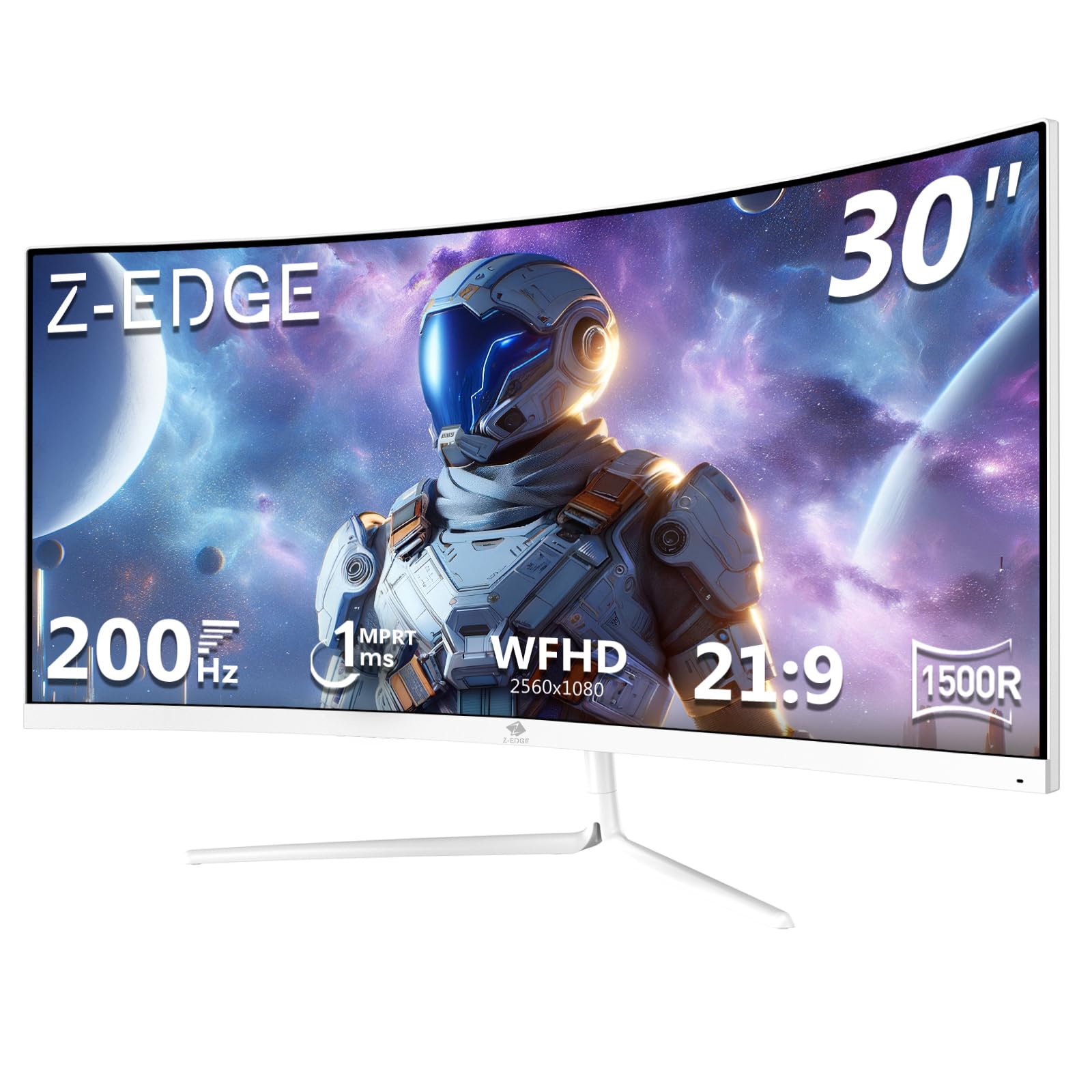
4. LXZ 34-Inch Curved WQHD Monitor
The LXZ 34-Inch Curved Monitor is the alternative ultrawide option in this roundup, sitting and offering 3440x1440 resolution on a 34-inch VA panel with a 1500R curve and 165 Hz refresh rate. It occupies a slightly different position to the AOC CU34G2XPD: it costs around £30 more but the feature set is broadly comparable, making it a secondary recommendation for users who find the AOC out of stock or who prefer the LXZ's specific aesthetic.
The 3440x1440 ultrawide resolution delivers the same horizontal workspace advantage as the AOC: a full-width model view in one portion of the screen, with drawing trees, properties panels and toolbars occupying the remainder, without the need for a second monitor. For CAD users who regularly switch between 3D model views and 2D drawing sheets, this workflow benefit is difficult to overstate. The 1500R curve is the same radius as the AOC, providing a gentle arc that helps equalise viewing distance across the screen width without distorting straight lines in technical drawings.
The VA panel delivers good contrast performance, which is useful for distinguishing between layers and line weights in complex drawings. The 165 Hz refresh rate is slightly lower than the AOC's 180 Hz, but this is irrelevant for CAD work. Connectivity is more limited than the AOC: two HDMI ports and one DisplayPort cover basic needs, but there are no USB hub ports, which means peripheral management requires a separate hub or relies on the workstation's own USB ports.
A common question among those considering ultrawide monitors for CAD is whether the 1500R curve causes problems with straight lines in technical drawings. In practice, at a normal working distance of 60 to 80 centimetres, the curve is subtle enough that straight horizontal and vertical lines appear straight. The distortion becomes more apparent at very close viewing distances, but at a normal desk setup it is not a practical concern.
Verdict: A solid ultrawide WQHD alternative to the AOC CU34G2XPD, offering the same resolution and curve radius at a slightly higher price and with fewer USB ports. A good choice if the AOC is unavailable.
Pros
- 3440x1440 ultrawide resolution provides the same horizontal workspace benefit as the AOC pick
- 1500R curve is gentle enough that straight lines in CAD drawings appear undistorted at normal working distance
Cons
- No USB hub ports, unlike the AOC CU34G2XPD which includes four USB-A downstream ports
- Costs around £30 more than the AOC for a broadly comparable feature set
How We Picked
Every monitor in this roundup was evaluated against a specific set of criteria relevant to CAD and technical drawing work, rather than gaming or general media consumption. Resolution and pixel density were weighted heavily, as the ability to read fine dimension text and part annotations without zooming is the most direct measure of a monitor's suitability for CAD. Panel type was assessed for colour accuracy and viewing angle consistency, with IPS panels scoring higher for colour-managed workflows and VA panels noted for their contrast advantage. Screen size was considered in relation to working distance and desk depth. Connectivity was evaluated for real-world workstation use, including USB hub functionality and the number of video inputs. Price was assessed relative to the specifications offered, with particular attention to value at the QHD and ultrawide resolution tiers. All specifications used in this article are drawn from verified manufacturer data.
Buying Guide
Resolution: The Most Important Specification for CAD
Resolution is the single most important specification when choosing a monitor for CAD work. At 27 inches, 1080p delivers approximately 82 PPI, which produces noticeably soft text and fine lines. QHD at 2560x1440 on the same screen gives around 109 PPI, which is the practical minimum for comfortable reading of dimension annotations and part labels over a full working day. 4K on a 27-inch screen gives 163 PPI, which is exceptional but requires a capable GPU and may require display scaling for users who find the interface elements too small at native resolution. On a 34-inch ultrawide, 3440x1440 gives approximately 110 PPI, comparable to QHD on 27 inches, while adding substantial horizontal workspace.
Panel Type: IPS vs VA for Technical Work
IPS panels are generally preferred for colour-sensitive work because they maintain accurate colour rendering across wide viewing angles. If you present work to clients or colleagues who view the screen from the side, or if you work in colour-managed workflows alongside your CAD work, an IPS panel is the better choice. VA panels offer higher contrast ratios, which can make it easier to distinguish between line weights and layers in complex drawings, and they are typically cheaper at equivalent resolutions. For a single user working directly in front of the screen on purely technical drawings, a good VA panel is entirely adequate.
Screen Size and Working Distance
A 27-inch monitor is not too big for office work at a normal desk depth of 60 centimetres or more. Many experienced CAD users prefer 27 inches as the sweet spot between screen real estate and comfortable viewing without head movement. Some professionals prefer 24 inches because it keeps all content within comfortable eye movement range, reducing fatigue in long sessions. Ultrawide 34-inch monitors are excellent for multi-view CAD layouts but require a desk depth of at least 70 centimetres for comfortable viewing. A 27-inch monitor is generally considered the mainstream choice for professional CAD work.
Curved vs Flat for CAD
Curved monitors with a 1500R radius are gentle enough that straight lines in technical drawings appear undistorted at normal working distances. The 1500R curve is less aggressive than the 1800R curve found on some gaming monitors: 1500R means the radius of curvature is 1,500 millimetres, so a tighter number indicates a more aggressive curve. For document work and CAD, a 1500R curve can reduce eye fatigue by equalising the viewing distance across the screen width. Flat monitors remain the default for professional CAD environments, particularly where multiple users share a workstation, but a 1500R curved monitor is a practical choice for a single-user setup.
Connectivity and Ergonomics
For a CAD workstation, look for at least one DisplayPort 1.4 output to support QHD or 4K resolution at full refresh rates. HDMI 2.0 supports QHD at up to 144 Hz and is adequate for most CAD use. USB hub functionality is a genuine convenience, allowing you to connect a drawing tablet, USB dongle and peripherals through the monitor rather than the workstation. Height-adjustable stands are important for ergonomic positioning during long working sessions; if the stand is tilt-only, budget for a monitor arm with VESA 100x100 compatibility.
Final Verdict
The AOC Gaming CU34G2XPD is the overall winner for CAD work under £300. Its 34-inch WQHD ultrawide panel at 3440x1440 resolution provides the horizontal workspace that transforms the CAD workflow: running a full model view alongside a drawing tree, properties panel and toolbars without switching windows or using a second monitor is a genuine productivity gain that no amount of refresh rate or gaming features can replicate. The four USB-A ports and dual DisplayPort inputs make it a practical hub for a full workstation setup. At under £200, it is exceptional value for the resolution and connectivity on offer. For users who need a more compact footprint or who prioritise IPS colour accuracy, the Alienware AW2725DM is the best single-screen QHD IPS alternative, while the MSI MAG 275CQRF remains the best-value QHD option for budget-conscious engineers.
Frequently Asked Questions
For most CAD users, a 27-inch QHD monitor or a 34-inch ultrawide WQHD monitor is the best choice. QHD at 2560x1440 on a 27-inch screen gives around 109 PPI, which is sharp enough to read fine dimension annotations without zooming. An ultrawide 3440x1440 panel adds substantial horizontal workspace, allowing you to display a full model view alongside drawing trees and properties panels simultaneously without switching windows.
Some experienced CAD users prefer 24-inch screens because all the content falls within comfortable eye movement range without requiring head movement, which reduces fatigue over long working sessions. A 24-inch screen also suits tighter desk setups and is easier to position at the correct ergonomic distance. That said, many professionals consider 27 inches the mainstream sweet spot, and at a normal desk depth of 60 centimetres or more, a 27-inch monitor is not uncomfortably large.
1500R is more curved than 1800R. The number refers to the radius of curvature in millimetres: a smaller radius means a tighter, more pronounced curve. A 1500R monitor curves more aggressively than an 1800R monitor. For CAD work, 1500R is generally considered the maximum curve that keeps straight lines in technical drawings appearing undistorted at a normal working distance of 60 to 80 centimetres.
No, a 27-inch monitor is not too big for office work at a normal desk depth of 60 centimetres or more. It is the most popular screen size for professional workstations and is widely used in engineering, architecture and design offices. The key consideration is viewing distance: at 60 centimetres, 27 inches is comfortable and does not require significant head movement to scan the full screen. Desks shallower than 50 centimetres may make a 27-inch screen feel uncomfortably close.
Curved monitors with a 1500R radius are generally suitable for CAD and document work. The gentle curve helps equalise the viewing distance from your eyes to different parts of the screen, which can reduce the need to refocus when moving from the centre to the edges of a large drawing. The main concern, that straight lines appear bowed, is minimal at a 1500R radius when sitting at a normal working distance. Flat monitors remain the default in shared professional environments, but a 1500R curved monitor is a practical choice for a dedicated single-user workstation.