If you play competitively, whether that is CS2, Valorant, Apex Legends or any other title where a fraction of a second separates a win from a loss, your monitor's refresh rate matters as much as your GPU. A 240Hz panel refreshes the image 240 times per second, cutting perceived input lag and making fast targets easier to track compared with a 144Hz screen. This year the market has shifted significantly: 1440p panels are now available at 240Hz and above for under £300, which was unthinkable 18 months ago. Meanwhile, Fast IPS technology has closed the gap on VA response times, giving buyers genuine choice between panel types. This guide is aimed at PC gamers who want the smoothest possible competitive experience without spending on a flagship display. It covers six monitors priced under £300, ranging from a sub-£130 24-inch IPS to a 1440p 300Hz panel that redefines what budget esports hardware looks like in 2025.
Quick Verdict
Best Overall: ASUS 27-inch 1440p 300Hz Gaming Monitor (B0F8W5SM6N)the highest refresh rate in this group, a sharp 1440p IPS panel, and priced at £238.99. It is the clearest recommendation for any competitive player who can run it. Best Value: AOC 24G4ZR (B0F8NTYR6Y) at £122.96 delivers 260Hz on a Fast IPS panel with 0.3ms MPRT for under £130, making it the strongest budget pick for esports on a tight budget.
Spec Comparison
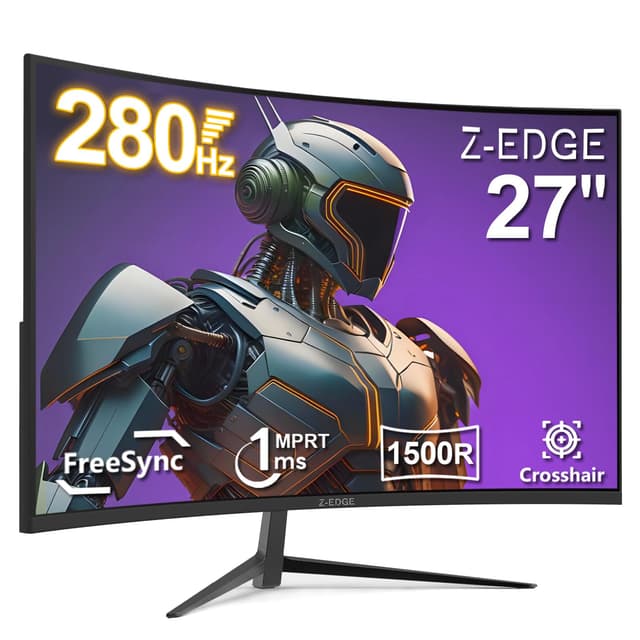
The Z-Edge 27-inch QHD is a strong second choice for buyers who want 1440p at 240Hz but would prefer to spend a little less than the ASUS flagship. At £179.99, it undercuts the ASUS by a meaningful margin while still delivering a 2560x1440 IPS panel with a 240Hz refresh rate and 1ms response time. For most competitive gamers, 240Hz is more than sufficient, and the saving could go towards a better headset, chair, or mouse.
The IPS panel at 1440p is the core appeal here. At 27 inches, the pixel density is the same as the ASUS at around 109 PPI, so text, UI elements, and distant targets in games are equally sharp. The Fast IPS technology used in modern 240Hz panels means pixel transitions are fast enough to keep up with the high refresh rate without introducing the inverse ghosting that plagued earlier IPS panels at high speeds.
One area where the Z-Edge actually outperforms the ASUS is connectivity. The Z-Edge ships with two DisplayPort inputs and two HDMI inputs, making it easier to connect multiple devices simultaneously, whether that is a PC and a console, or a desktop and a laptop. The audio out jack is also included, which is a small but useful addition for headset users who prefer to route audio through the monitor rather than their PC's rear panel. The ASUS has a more established brand reputation and likely better factory calibration, but the Z-Edge's port selection is genuinely superior for multi-device households.
The Z-Edge is a newer brand in the UK monitor market, and that does bring some uncertainty around long-term support and warranty service compared with ASUS or Samsung. However, for a budget-focused buyer who is primarily interested in specifications per pound, the Z-Edge represents excellent value. The 240Hz, 1440p, IPS combination at this price is genuinely impressive, and the dual DisplayPort inputs are a practical advantage that more expensive monitors sometimes omit.
The monitor supports Adaptive Sync, so AMD FreeSync and compatible NVIDIA G-Sync setups will benefit from variable refresh rate technology. The stand is functional rather than exceptional, offering tilt adjustment but potentially limited height adjustment, so buyers who want precise ergonomic positioning may want to budget for a VESA arm.
Verdict: An excellent 1440p 240Hz IPS monitor at a competitive price, with a port selection that beats most rivals. The Z-Edge is the pick for buyers who want near-flagship specs without the flagship price tag.
Pros
- 2560x1440 IPS panel at 240Hz delivers sharp, smooth visuals for competitive and single-player gaming alike
- Dual DisplayPort and dual HDMI inputs make multi-device setups straightforward
- Priced below comparable 1440p 240Hz panels from established brands
Cons
- Z-Edge is a lesser-known brand with less established UK warranty and customer support infrastructure
- Stand ergonomics may be limited compared with ASUS or Samsung equivalents
The Samsung Odyssey G4B in its 25-inch configuration is one of the most well-regarded budget esports monitors on the market, and it continues to hold its own in 2025. At £184.34, it offers Samsung's IPS panel technology at 240Hz with a 1ms GtG response time, backed by the reliability and warranty support of one of the world's largest display manufacturers. For buyers who want a proven, tested option from a brand with strong UK customer service, the G4B is a safe and sensible choice.
The 25-inch screen size is slightly smaller than the 27-inch panels that dominate this category, and that is actually an advantage for some competitive players. A smaller screen means your eyes travel less distance to cover the full display, which can improve reaction times in games where peripheral awareness matters. Professional esports players have historically favoured 24 to 25-inch panels for exactly this reason, and the G4B's dimensions align with that preference.
Samsung's IPS panel in the G4B is well-calibrated out of the box, with accurate colours and good brightness uniformity. The 240Hz refresh rate is delivered reliably, and Samsung's implementation of Adaptive Sync is compatible with both AMD FreeSync Premium and NVIDIA G-Sync Compatible setups. The 1ms GtG response time is genuine rather than the MPRT figure that some manufacturers use to make panels appear faster than they are, which is worth noting when comparing specifications across brands.
The connectivity suite is notably generous for this price: two HDMI 2.0 ports, one DisplayPort 1.2, a USB port, and a headphone output. The USB port is particularly useful for connecting a headset or other peripheral directly to the monitor, reducing cable clutter on the desk. The stand offers tilt adjustment, and the monitor is VESA compatible for wall or arm mounting.
The main limitation of the G4B compared with the top two picks in this group is the 1080p resolution. At 25 inches, 1080p gives approximately 88 PPI, which is sharper than a 27-inch 1080p panel but still softer than the 1440p options. For pure competitive gaming in fast-paced titles, this is rarely a meaningful disadvantage, but players who also use their monitor for content consumption or productivity work may notice the difference.
Verdict: A proven, reliable 240Hz IPS monitor from a trusted brand, with a generous port selection and a screen size that suits competitive play. The 1080p resolution is the only meaningful compromise at this price.
Pros
- Samsung IPS panel delivers accurate, well-calibrated colour with 1ms GtG response time at a genuine 240Hz
- 25-inch screen size aligns with professional esports preferences for reduced eye travel
- USB port and headphone output included, making desk cable management cleaner
Cons
- 1080p resolution at 25 inches is softer than the 1440p panels available at similar prices in 2025
- DisplayPort 1.2 rather than 1.4 limits future bandwidth headroom
Buying Guide
Is a 240Hz monitor worth it?
For competitive gaming, yes, a 240Hz monitor is worth the investment over a 144Hz panel. The jump from 60Hz to 144Hz is the most dramatic improvement most gamers will ever experience, but the step from 144Hz to 240Hz is still meaningful, particularly in fast-paced shooters. At 240Hz, each frame is displayed for 4.17 milliseconds compared with 6.94ms at 144Hz. This reduces the window of time in which a moving target can shift position between frames, making tracking easier and improving the perceived responsiveness of your mouse input. Studies and player feedback consistently support the idea that 240Hz provides a measurable advantage in competitive play, even if the difference is smaller than the 60Hz-to-144Hz jump.
Is 144Hz vs 240Hz noticeable?
Yes, the difference between 144Hz and 240Hz is noticeable, though it requires some acclimatisation. Side-by-side comparisons reveal smoother motion, reduced perceived input lag, and sharper tracking of fast-moving objects at 240Hz. The effect is most apparent in games with high frame rates where your GPU is actually delivering 200fps or more. If your system can only sustain 100 to 120fps in your primary game, the practical benefit of 240Hz over 144Hz is reduced, since the monitor will be displaying repeated frames to fill the gap. To get the most from a 240Hz monitor, you need a GPU capable of sustaining high frame rates in your chosen titles.
What panel type should I choose?
For competitive gaming, Fast IPS is the recommended panel type. It combines fast pixel transitions, typically 0.3 to 1ms MPRT, with wide viewing angles and accurate colour reproduction. VA panels offer superior contrast ratios, making them better for dark environments and immersive single-player gaming, but their pixel response can lag behind Fast IPS at very high refresh rates. TN panels are largely absent from this price bracket now, having been superseded by Fast IPS technology that matches or exceeds their response times while offering much better colour quality.
1080p vs 1440p at 240Hz: which is better?
The right answer depends on your GPU and your priorities. At 1080p, it is easier to sustain the high frame rates needed to take full advantage of a 240Hz or 300Hz panel. At 1440p, you get a noticeably sharper image, which can help with target visibility at range in games like CS2 or Valorant. If your GPU can sustain 200fps or more at 1440p in your primary game, the 1440p option is worth choosing. If your GPU struggles at 1440p, a 1080p 240Hz panel will deliver a smoother overall experience. The ASUS 300Hz 1440p panel is the aspirational choice; the AOC 24G4ZR 1080p 260Hz is the practical budget option.
What are the disadvantages of a 240Hz monitor?
The main disadvantages are cost and GPU demand. A 240Hz monitor costs more than a 144Hz equivalent, and to use it effectively you need a GPU capable of sustaining high frame rates. Running a 240Hz monitor at 100fps is not harmful, but it does not deliver the full benefit of the high refresh rate. Some 240Hz panels also sacrifice colour accuracy or contrast ratio compared with slower, higher-quality display panels, though Fast IPS technology has largely addressed this at the budget end of the market. Additionally, at very high refresh rates, the difference between 240Hz and 300Hz is subtle enough that most players will not notice it without a direct comparison.
Is 240Hz better for your eyes?
Higher refresh rates can reduce eye strain during long gaming sessions because the image appears smoother and flickers less than at lower refresh rates. The perceived flicker of a 60Hz display, even though it is above the threshold of conscious perception, can contribute to fatigue over time. At 240Hz, this effect is essentially eliminated. However, the most important factor for eye comfort is brightness and blue light management, not refresh rate alone. Using the monitor at a comfortable brightness level and taking regular breaks matters more than the specific refresh rate for long-term eye health.
The ASUS 27-inch 1440p 300Hz Gaming Monitor is the clear winner of this roundup. It combines the highest refresh rate in the group with a sharp 1440p IPS panel at a price that sits comfortably under £300. For competitive esports players who want the fastest, sharpest experience available at this budget, there is no better option currently on the market. The 300Hz refresh rate and 1440p resolution together represent a specification that was genuinely out of reach at this price just 18 months ago, and the ASUS delivers it with the build quality and brand reliability that justify the investment.
For buyers on a tighter budget, the AOC 24G4ZR is the Best Value recommendation. At under £130, it delivers 260Hz on a Fast IPS panel with 0.3ms MPRT, which is a competitive specification by any standard. The 23.8-inch screen size suits tournament-style play, and the price leaves significant budget for other parts of your gaming setup. Between these five picks, every competitive gaming budget under £300 is well served.