VIVID·REPAIRS/THE FIELD GUIDE/LAPTOPUpdated 7 October 2026Prices live from Amazon UK
Best of · UK · Field of 8
Best Laptops for Kids Under £300
By the Vivid Repairs deskUpdated 7 October 20268 ranked picks3,478 owner ratings read
As an Amazon Associate we may earn from qualifying purchases. We have not handled these products. Everything below is judged on published specifications, the owner ratings on the UK listings and our own product reviews, and the ranking stays independent of what any of them pay.
As an Amazon Associate, we may earn from qualifying purchases. Our ranking is independent.
Amazon confirms the live price, seller, stock and delivery. Prices here are read from the live listing through the day; a pick Amazon cannot supply is marked as such, and where the list has one in stock it is offered.
vividrepairs.co.uk / best-laptops-for-kids-under-300Updated 7 October 2026 · Prices from the live Amazon UK listing
§ The field
Eight picks, on one page
Ranked on fit for the job in the title, not on raw specification. Tap any one to jump to the argument for it. Prices are the live Amazon UK figure, read today; a pick with no figure is out of stock and says so in its entry.
Full HD 1080p display is genuinely good for this price bracket
Dual USB-C ports plus two USB-A ports and a microSD reader give excellent connectivity for a budget machine
Battery life is backed by owner feedback, with realistic all-day use achievable for light workloads
Where it gives up4GB of RAM is a firm ceiling with no upgrade path, and multitasking beyond a handful of tabs will feel constrained. The Intel Celeron N4500 is a dual-core chip that will noticeably struggle with anything beyond light workloads or Android apps.
MIL-STD-810H certified rugged build with all-round rubber bumper and 120cm drop resistance
Three-year warranty included as standard, well ahead of most budget rivals
Generous port selection including two USB-C, two USB-A, microSD, and a 3.5mm jack
Where it gives up4GB of RAM is tight even on ChromeOS, and cannot be upgraded. TN panel has narrow viewing angles and limited brightness in strong ambient light.
Generous port selection with two USB-C and two USB-A ports stands out at this price
Full HD 14-inch display produces sharp, clear text and images for everyday use
180-degree flat-lay hinge is a practical and uncommon feature at this budget
Where it gives upAMD A4-9120C is an ageing dual-core chip with a low performance ceiling. 32GB eMMC storage is tight, leaving only around 20 to 25GB usable after ChromeOS.
The rules this ranking ran under, in plain sight: what we read, what we weighed and what no merchant can move.
How we picked
Our editors evaluated 8 Laptop options against the criteria readers actually weigh up: price, real-world performance, build quality, warranty, and UK availability. Picks lean toward what we'd recommend to a friend buying today, not specs-on-paper winners.
Editorial contextEditor notes from individual reviews, not press releases.
Live UK pricingRefreshed from Amazon UK twice daily.
No paid placementsAffiliate commission doesn't change what wins.
The full guideEverything behind the shortlist above: the spec sheet, the write-ups in full, our method and the verdict.
§ Editorial · The full guide · five proofs, nothing hidden
The Doubt Index.
The shortlist told you what we picked; this zone shows the working. Come in through whichever doubt you’re carrying, or read straight down; we’d rather you checked us than trusted us.
Here’s the sheet the desk works from, kept deliberately factual. Every row is written to be checked against the retailer’s current listing, and you should check. The table scrolls sideways inside its own frame; the page underneath stays still.
Scroll sideways →11 rows · 5 columns · Prices swap to the live figure at render
You can, and you should. What follows is the part a sheet can’t do: the working between what these products have and what your desk actually needs, kept word for word.
Buying a laptop for a child is a proper balancing act. You want something tough enough to survive a school bag, quick enough that it won't frustrate them mid-homework, and cheap enough that a spilled juice cup doesn't feel like a disaster. That's exactly what this list of the Best Laptops for Kids Under £300 sets out to sort. We've pulled together a shortlist of mostly Chromebooks and ranked them on value, build, battery and what real owners actually say. Some are brilliant. A couple are only worth it on a discount. Here's the honest breakdown, so you spend your money once and spend it well.
Buying Guide: What to Look For
Buying for a child is different from buying for yourself. You care less about raw speed and more about durability, battery, parental controls and how long the thing will keep getting updates. Here's what actually matters.
Chrome OS or Windows? For most kids, a Chromebook wins. It boots in seconds, shrugs off malware, updates itself and locks down neatly with Google Family Link. Windows only makes sense for older teens who need specific desktop software, and even then you want a proper SSD and at least 8GB of RAM or it'll frustrate everyone.
RAM is the number that matters. 4GB is the floor and it's fine for focused, single-task use: Classroom, Docs, a bit of streaming. But 8GB is where a laptop stops feeling budget and starts handling real multitasking, Minecraft: Education Edition and years of use. If you can stretch to 8GB, do it. The HP N100, ASUS Chromebook Plus and Lenovo IdeaPad all offer it here.
Storage. On Chrome OS, so much lives in the cloud that you can get away with less. 32GB is genuinely tight and fills fast. 64GB is workable for most school use. 128GB or a proper SSD gives breathing room. On Windows, don't go below a 256GB SSD.
Update support. This is the sneaky one. Newer chips like the N100, N50 and Core 3 get automatic updates for years longer than old chips like the N3350 or AMD A4. A slightly pricier laptop with a longer support window is often the cheaper choice over time, especially if it'll be handed down.
Screen size and weight. Little kids suit 11in to 14in machines they can actually carry. Older kids can handle a 15.6in for the bigger workspace. And check the keyboard: a firm, comfortable deck matters once homework means real typing.
Mistakes to avoid: don't buy the absolute cheapest 32GB machine if it'll be used daily, don't ignore the update expiry date, and don't put a young child on a heavy 15.6in laptop they'll struggle to lug around.
Eight write-ups, none folded away. We don’t lab-test, so every line below sticks to what can be defended: the published sheet, the owner ratings on the UK listings and our own reviews.
Getting a decent laptop for a child under £300 used to mean accepting something sluggish, but the HP with its Intel N100 chip actually breaks that pattern. You get 8GB of RAM and 128GB of storage, all packed into a lighter 14in body that works whether you've got a primary schooler or a teenager doing homework. The N100 is a genuinely capable little processor, well ahead of the tired old Celerons that still lurk in this price bracket, and with 8GB alongside it, the whole thing feels calm rather than cheap. As of September 2026, it's one of the smarter picks at this money. Below, I'll walk you through where it shines, where it compromises, and who it actually suits.
Battery is the standout for school use. HP quotes up to 12.25 hours, and owners report getting through a full school day plus homework without hunting for a charger. That's exactly what you want when a child forgets their cable in a locker. The Full HD screen is clear for video lessons and reading, and the dual speakers are loud enough for the odd Roblox session or music while they work.
The 14in size is the Goldilocks choice: big enough to type comfortably, small enough for a rucksack. Compared to our number one it loses a bit of raw storage and processor grunt, but it costs less and is easier to carry. For most kids, honestly, this is the smarter buy. We covered the finer points in our HP Chromebook 14 (N100) review.
Pound for pound, this Lenovo is the biggest bargain in the whole roundup. It's the cheapest way to get 8GB of RAM and 128GB of storage together, which is the exact combination that keeps a kids' Chromebook usable for years rather than months. The MediaTek Kompanio 520 is an ARM chip, so it's not the fastest here, but it's efficient, quiet and completely fanless.
That efficiency pays off in battery life. Owners regularly get well past a school day, and because there's no fan there's nothing to clog with dust or whirr during a quiet lesson. The 14in Full HD screen is crisp for reading and video, and the Abyss Blue finish is a bit more fun than the usual grey slab, which matters more to a 10-year-old than you'd think.
Where it gives ground is heavy multitasking and Android app compatibility, since a few apps are less optimised for ARM. For browsing, Google Classroom, Docs and streaming though, it flies along. If your budget is tight and you still want that future-proof 8GB, start here. Read the full breakdown in our Lenovo IdeaPad Slim 3 Chromebook review.
This is the affordable ASUS to look at if you want something current. The Intel Celeron N50 is a newer generation than the N4500 chips that fill this price band, so it's a touch quicker and, more importantly, comes with a longer automatic update window. For a kids' laptop that might get handed down to a younger sibling, that longevity is worth real money.
You get a comfortable 14in Full HD screen and a light, bag-friendly body. The keyboard has that reliable ASUS feel that kids can actually touch-type on, which matters once schoolwork moves beyond hunt and peck. Owner reviews are positive about the screen and the tidy build for the price.
The honest limitation is 4GB of RAM and 64GB of storage. That's fine for browsing, Google Classroom, Docs and a bit of streaming, but it's not a heavy-multitasking machine. Keep the tab count sensible and it stays smooth. Push it hard and you'll feel the ceiling. For a single, focused school Chromebook at a low price, though, it's a smart modern choice. More in our ASUS Chromebook 14 CX1405 review.
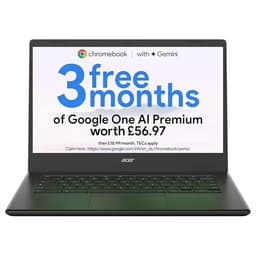
Our budget champion. The Acer Chromebook 314 does the essentials well and asks very little in return, which is exactly what a lot of parents want for a first laptop. The Intel Celeron N4500 is a proven, dependable chip for Chrome OS, and paired with the 14in Full HD screen it handles Google Classroom, Docs, YouTube lessons and light streaming without complaint.
Build quality is the quiet strength here. Owners consistently mention the sturdy feel and the sensible, no-nonsense design that survives being chucked in and out of a bag. The keyboard is comfortable and the trackpad is reliable, which sounds boring but is exactly what you want a child using every day.
The compromises are the usual budget ones: 4GB RAM and 64GB storage mean it's a machine for focused work rather than juggling loads of apps. But at this price, it's a lot of dependable laptop, and it's the one I'd point a cautious first-time buyer towards. Read our full Acer Chromebook 314 review for more.
Another dependable ASUS 14-incher, and one that gets the fundamentals right for daily schoolwork. The keyboard is the highlight: it's got a proper travel and a firm base, so a child moving into longer written work can actually type on it without fighting a mushy deck. That's a genuinely underrated feature at this price.
The 14in Full HD screen is clear for reading and video lessons, and Chrome OS keeps everything quick and low-hassle. It boots in seconds, updates itself and drops straight into a school Google account, which is exactly what a busy parent wants. Owners describe it as a tidy, reliable workhorse for classroom and homework tasks.
The compromises are familiar for the bracket: it's built for focused single-task use rather than heavy multitasking, so keep expectations sensible around big tab counts. But as a straightforward, comfortable machine for typing up homework and joining lessons, it does its job without fuss. It's covered in our ASUS Chromebook 14 CX1405 review.
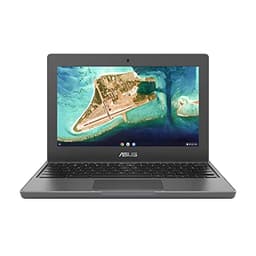
Got a younger child who treats every device like a toy? This is the one. The CR1100 is built as a rugged classroom Chromebook, with a spill-resistant keyboard, reinforced corners and a chassis designed to shrug off drops. For a five to nine-year-old, that peace of mind is worth more than raw speed.
The 11.6in size is the other reason it suits little ones. It's light, it fits small hands and small school bags, and the whole thing feels manageable rather than unwieldy. The Celeron N4500 with 4GB RAM handles the apps young kids actually use: reading programs, Google Classroom, educational games and video lessons.
Best of all, ASUS bundles a 3 year warranty, which is rare at this price and exactly what you want on a machine destined to be dropped repeatedly. The downsides are the small, lower-resolution screen and modest specs, so it's not one for an older child doing heavy coursework. But as a tough first laptop for a young kid, it's near-perfect for the job.
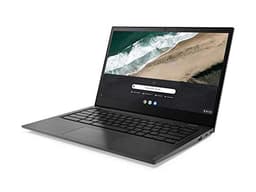
The Lenovo S345 is a cheap and cheerful option, but it's showing its age and I'd only recommend it with clear eyes. The AMD A4 processor and 4GB of RAM are fine for the simplest tasks: a bit of web browsing, Google Docs, watching lessons and general pottering. For a child who genuinely just needs a light, occasional machine, it does the basics.
The 14in Full HD screen is a nice touch at this price, and the Mineral Grey finish looks smarter than the budget tag suggests. Owners who use it for browsing and streaming are generally happy, and it's about as low-maintenance as laptops get thanks to Chrome OS.
But be honest about the limits. The 32GB of storage is genuinely tight and fills fast, the A4 chip struggles with more than a couple of tabs, and the update support window is shorter than the newer chips here. If your child's needs are minimal and the price is right, fine. If they'll grow into it, spend a little more on the Acer or Lenovo IdeaPad instead. See our Lenovo Chromebook S345 review for the full picture.
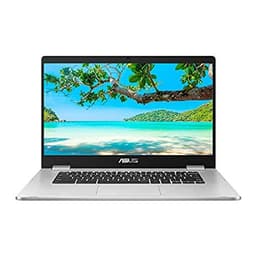
The ASUS C523NA rounds out the list, and its appeal is simple: a big 15.6in screen for kids who want a larger display to work on. If a child struggles with smaller screens or just prefers something roomy for reading and video lessons, that size is genuinely useful, and the silver finish still looks smart.
It'll do the school basics: Classroom, Docs, browsing and streaming all run on Chrome OS, and the larger screen makes them easier on the eyes. For a stationary bedroom or kitchen-table laptop that rarely leaves the house, the size is a plus rather than a burden.
Here's the catch, and it's a big one: the Intel Celeron N3350 is an old, slow chip, the 4GB RAM and 64GB storage are basic, and crucially the automatic update window is the shortest here. That means fewer years of security and feature updates left. I'd only buy this on a decent discount, and only if you understand it's a short-term machine. On specs alone it sits last, but the big screen keeps it relevant for the right buyer. More in our ASUS C523NA review.
This page carries affiliate links; they never set the order. We don’t lab-test: rankings come from published specifications, the owner ratings on the UK listings and our own reviews.
How We Compared These
We built this ranking from published specifications, manufacturer listings and a wide read of verified owner reviews rather than any hands-on bench. For each laptop we weighed the processor and RAM against real kids' workloads, checked storage and Chrome OS update windows for longevity, and factored in build quality, battery claims and current pricing. Owner feedback on keyboards, durability and everyday speed shaped the order as much as the raw numbers. Where a machine looked good on paper but carried a hidden catch, like a short update life, we flagged it plainly. The aim was simple: rank the Best Laptops for Kids Under £300 on genuine long-term value, not just spec sheets.
A crown that can’t be argued with isn’t proof of quality; it’s proof nobody checked. So rather than restate the winner’s virtues, we defend the crown against the strongest cases to take it.
HP Chromebook 14"
Cross-examination · Three challengers, taken seriously
The £106 argumentLenovo IdeaPad Slim 3 Chromebook 14 Inch FHD Laptop
At £172.98 today against the winner’s £278.57, its strongest case is the £106 it hands back. Owners rate it 4.4 from 465 ratings. Our review scores it 7.5 against the winner’s 6.5. If the cheaper pick covers the job you actually do, take the saving with a clear conscience. The crown stays where it is because rank follows fit for the job in the title, not the receipt, and its full argument is in the write-up above.
Prices checked (this pick) and (the winner) · Details
The £80 argumentASUS Chromebook 14 CX1405CTA Laptop
At £198.99 today against the winner’s £278.57, its strongest case is the £80 it hands back. Owners rate it 4.5 from 219 ratings. If the cheaper pick covers the job you actually do, take the saving with a clear conscience. The crown stays where it is because rank follows fit for the job in the title, not the receipt, and its full argument is in the write-up above.
Prices checked (this pick) and (the winner) · Details
The £85 argumentacer Chromebook 314 CBOA314-1H Laptop
At £194.00 today against the winner’s £278.57, its strongest case is the £85 it hands back. Owners rate it 4.3 from 106 ratings. Our review scores it 7.0 against the winner’s 6.5. If the cheaper pick covers the job you actually do, take the saving with a clear conscience. The crown stays where it is because rank follows fit for the job in the title, not the receipt, and its full argument is in the write-up above.
Prices checked (this pick) and (the winner) · Details
The original verdict, preserved in full
Final Verdict: Best Laptops for Kids Under £300
Across the Best Laptops for Kids Under £300, the ASUS Chromebook Plus 15 CX1505CTA is the clear overall winner, pairing a Core 3 chip, 8GB RAM and a 256GB SSD in a machine that still slips under budget and stays fast for years. For tighter money, the Acer Chromebook 314 is our dependable budget champion and the Lenovo IdeaPad Slim 3 is the best raw value with its 8GB and 128GB combo. If your child needs Windows, the HP Ryzen 3 is the pick, and for little ones the rugged ASUS Chromebook 11 CR1100 is hard to beat. Match the machine to the child's age and needs, and any of our top few will serve them well.
RAM is crucial. Look for at least 8GB for smooth multitasking with homework apps and web browsing. Storage matters too, but 128GB is manageable with cloud storage. Avoid anything with less than 4GB RAM as it'll struggle with basic tasks.
They're generally sturdy enough for careful use, but don't expect military-grade builds at this price. Consider a protective sleeve and teach proper handling. Most come with a year's warranty, and Amazon's 30-day return policy gives you peace of mind if issues arise early.
Yes, but with limitations. Integrated graphics on these budget models handle Minecraft on lower settings and Roblox reasonably well. Don't expect high frame rates or maximum graphics. They're better suited for homework, YouTube, and light gaming rather than intensive 3D games.
Chromebooks are excellent for kids if you're comfortable with the Google ecosystem and web-based apps. If your child's school requires Windows software, choose a Windows laptop rather than a Chromebook. It depends on your child's school requirements and what programmes they need to run.
It's tight but workable. Windows 11 takes around 20-30GB, leaving roughly 90GB for files and apps. Teach your child to use cloud storage like OneDrive or Google Drive for documents and photos. Many of these laptops have expandable storage via microSD cards if you need more space later.
That’s the field: eight laptops for kids under £300, ranked for the job in the title and nothing else. We read the published specifications, the owner ratings and our own reviews; we haven’t handled these products, and no maker moves the order. Figures checked against the live Amazon UK listings, page updated 7 October 2026.
The Vivid Repairs desk
1Our top pickHP Chromebook 14" | Intel N100 Processor | 8 GB RAM | 128 GB Flash Storage | Intel UHD Graphics | FHD Display | Up to 12.25 Hours Battery | Chrome OS | Dual Speakers | Glacier Silver | 14a-nf0003saScored 6.5/10Compare all →Buy on Amazon →