Best Overall Value
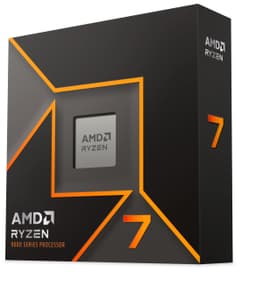
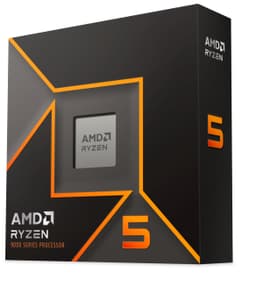
Start with the cache, because that's the whole story here. 104MB of it, most of that a stacked V-Cache layer sitting under the cores, and it's the reason this chip leaves everything else on this page behind in games. Our review lists the 9800X3D as the fastest gaming processor available, with 15 to 25 percent frame rate improvements over non-X3D chips and measurable leads in both average frame rates and 1% lows over every competitor. That last part matters more than headline averages. 1% lows are the stutter you actually feel.
It's an eight-core, 16-thread Zen 5 part on AM5, boosting to 5.2GHz with a 4.7GHz base. The 120W TDP is modest for the performance on offer, and our review notes it performs well above competing chips that draw considerably more power for similar or lesser gaming output. Compared to the Ryzen 7 9700X further down this list, the 9800X3D is the meaningfully faster gaming chip in cache-sensitive titles. That's the trade: the 9700X is cooler and cheaper, the X3D wins the frames.
Two honest limits. There's no integrated graphics, so a discrete GPU is mandatory even to get a picture on screen while troubleshooting. And the eight-core layout caps heavy productivity: our review points out the Ryzen 9 9950X and Core Ultra 9 285K are substantially faster for rendering and compilation. This is a gaming chip that does everything else competently, not a workstation part.
The AM5 platform is the long game. PCIe Gen 5 for GPU and NVMe, DDR5, and AMD's stated socket support through at least 2027. Our review notes owners on an existing AM5 Zen 4 board can drop this straight in with a BIOS update, which validates the earlier platform spend. One physical detail from the listing: no cooler in the box, and our review flags that sustained loads under poor cooling can run it hot. Buy a decent cooler with it, not as an afterthought. On the numbers it earns its place: 4.8 stars from 6,141 Amazon UK ratings, and a 9.2 in our review.
Pros
- Largest cache on this list at 104MB, the source of its frame-rate lead
- AM5 socket with stated support through at least 2027 gives a real upgrade path
- Zen 5 IPC lifts single-thread response in desktop work, not just games
- 4.8 stars from 6,141 UK ratings
Cons
- No integrated graphics, so a GPU is required even for basic display output
- No cooler supplied, and V-Cache makes good cooling non-negotiable
- Eight cores limit heavy rendering versus 12 and 16-core rivals
Buy on Amazon£374.99Read full review
Best AM5 Starter
This is an affordable way onto AM5, and the reason is the box contents. Six Zen 4 cores, 65W, a 5.1GHz boost, and a Wraith Stealth cooler included. That last bit saves £30 to £50 you'd otherwise spend on the 9600X or 9700X, both of which arrive bare. For a first-time builder watching every pound, that's the difference between one order and two.
It carries Radeon graphics from the Ryzen 7000 line, so you get display output and a troubleshooting fallback without a discrete card. Not a gaming iGPU, mind. If you want to actually play games without a GPU, the Ryzen 5 8600G lower down is the chip for that. The 7600 assumes you'll pair it with a graphics card and just wants to keep costs down elsewhere.
Against the newer Ryzen 5 9600X, the gap is architecture: the 9600X is Zen 5 with more single-thread grunt and a higher 5.4GHz boost, but it's dearer and coolerless. The 7600 trades a bit of raw speed for the bundled cooler and a lower entry price, which for a budget 1080p build is often the smarter call. Same AM5 socket, same upgrade path through 2027, same DDR5 requirement that adds to the total build cost. Owner sentiment is strong: 4.7 stars from 3,251 UK ratings. It's the pragmatic entry point, not the fastest chip, and it knows it.
Pros
- Wraith Stealth cooler included, saving £30 to £50 over coolerless rivals
- 65W TDP keeps heat and running costs low for a 1080p build
- AM5 socket means a later drop-in upgrade without a new board
- 4.7 stars from 3,251 UK ratings
Cons
- DDR5 is mandatory, adding cost versus older DDR4 platforms
- Radeon iGPU is for output only, not real gaming
- Zen 4 six-core trails the newer Zen 5 chips in single-thread work
Buy on Amazon£158.59Read full review
Best for Content Creators
Twenty cores. That's eight performance cores and twelve efficiency cores, 28 threads total, and it's why this Intel chip is the one to look at if you game and also edit or stream on the same box. Our review calls it a solid mid-range choice for gamers who also stream or edit content, with strong multi-threaded throughput and a genuinely useful Quick Sync video encoder. The 5.6GHz P-core boost matches the Ryzen 9 9900X at the top of this list.
The flexibility is real too. The listing states DDR4 and DDR5 support plus PCIe 5.0 and 4.0, so you can reuse older memory or build fresh. That's an option the AM5 chips here don't give you, since they're all DDR5 only. If you're migrating from an older DDR4 system on a budget, that matters.
But the socket is the sting. Our review notes LGA1700 is end-of-life with no CPU upgrade path, so this board takes no faster chip later. Set against the Ryzen 7 9700X, which sits on a socket supported to 2027, you're buying a dead end for more cores now. There's no stock cooler either, and our review points out power efficiency lags behind AMD's Ryzen alternatives and thermal management wants quality cooling. Our review scores it 8 out of 10; owners give it 4.6 stars from 1,362 UK ratings. For a creator who values cores and DDR4 reuse today, it stacks up. For pure gaming or long-term upgrades, look at AMD.
Pros
- 20 cores and 28 threads, the highest core count on this page for content work
- Listing states DDR4 or DDR5 support, letting you reuse old memory
- 5.6GHz boost, level with the 9900X at the top of this list
- Wide choice of Z790 and 600 Series boards at varied prices
Cons
- LGA1700 is end-of-life with no future CPU to upgrade to
- No cooler included and it needs a good one
- Our review notes it's less power-efficient than Ryzen 7000 rivals
Buy on Amazon£345.97Read full review
Best Budget
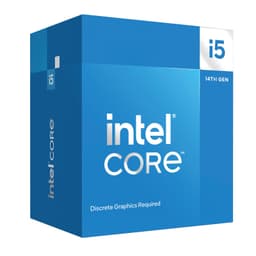
Who shouldn't buy this? Anyone chasing all-core productivity, and anyone who wants a chip that outlives the board. Our review is blunt: the 245KF is a narrow fit, best for budget gamers with discrete GPUs who skip heavy workloads. Get that, and it makes sense at the low end of this price range.
It's a 14-core Arrow Lake part, six P-cores and eight E-cores, boosting to 5.2GHz. Our review lists respectable 1080p gaming and improved power efficiency as the wins, with PCIe 5.0 and DDR5 on the Z890 platform. The KF suffix means no integrated graphics, so a GPU is mandatory, and there's no cooler in the box. Our review also flags that dropping Hyper-Threading on the P-cores limits heavily-threaded work, which is where the weak multi-core score comes from.
Against the Ryzen 5 9600X, which our review says runs cooler at 65W, the 245KF's 125W base power runs warmer for broadly similar gaming. The Intel gives you more cores and the newer LGA1851 platform; the AMD gives efficiency and a longer socket life. For a first gaming build on a strict budget with a graphics card already sorted, the 245KF earns its badge. Owners rate it 4.4 stars from 147 UK ratings, and our review gives it 8 out of 10.
Pros
- 14 cores and PCIe 5.0 at the bottom of this price range
- Unlocked multiplier for overclocking on Z890 boards
- LGA1851 is a newer socket than the 14th Gen Intel chips here
Cons
- No integrated graphics, so a discrete GPU is required
- No cooler supplied, adding to build cost
- Our review notes 125W base power runs warmer than the 65W 9600X
- No Hyper-Threading on P-cores caps heavily-threaded performance
Buy on Amazon£139.99Read full review
Best Efficient Eight-Core
65W for eight Zen 5 cores boosting to 5.5GHz. That number is the pitch. Our review calls the 9700X the mid-range gaming processor that genuinely deserves its positioning, with real IPC gains over Zen 4 and cool, quiet running that keeps electricity costs down. If you want strong gaming without the heat and noise of the Intel K chips, this is it.
The homogeneous eight-core layout, with no efficiency cores, helps game scheduling and 1% low frame times, per our review. It's the same core count as the 9800X3D at the top of this list, but without the stacked V-Cache, so our review is clear that the 9800X3D is meaningfully faster in cache-sensitive titles. The 9700X is the pick if gaming isn't your sole priority and you'd rather bank the saving and the lower power draw.
No cooler in the box, which first-time builders sometimes miss, though our review notes AM4 coolers fit via the existing bracket, so upgraders may not need to buy one. DDR5 only, PCIe 5.0 for GPU and primary NVMe, and the AM5 socket's long life. Eight cores may feel tight in four to six years for heavy threaded pro work, per our review. Owners give it 4.8 stars from 2,666 UK ratings, and our review scores it 9 out of 10.
Pros
- 65W TDP for eight cores means cool, quiet, cheap-to-run operation
- AM4 coolers fit via bracket, saving upgraders a purchase
- Homogeneous eight-core design aids consistent 1% lows
- 4.8 stars from 2,666 UK ratings
Cons
- No cooler in the box, an unexpected cost for new builders
- DDR5 only, so AM4 upgraders must buy new RAM
- The 9800X3D is clearly faster in cache-heavy games
Buy on Amazon£269.99Read full review
Best for Multitasking
Twelve cores and 24 threads is the reason to pick this over the eight-core 9700X above. Our review calls the 9900X excellent for anyone who needs fast gaming and serious productivity in one package, with the Zen 5 IPC gains and a 5.6GHz boost carrying the speed. If you render, compile or stream while gaming, those four extra cores over the 9700X do real work.
It's 120W, which our review notes is significantly more efficient than the 7900X it replaces, so you get the extra cores without a huge power penalty. Integrated Radeon graphics handle setup and act as a fallback display, though it's not for gaming. The AM5 socket brings the same 2027-plus upgrade path as the rest of the AMD chips here.
The catch is aimed at pure gamers: our review says they can get similar gaming performance cheaper from the Ryzen 7 9700X, so the 9900X only makes sense if you'll use the productivity cores. No cooler included, and our review stresses you genuinely need a decent one at 120W. AM5 entry cost sits higher than older sockets. Owners rate it 4.8 stars from 1,697 UK ratings; our review gives 8.5 out of 10.
Pros
- 12 cores and 24 threads for simultaneous gaming and productivity
- 120W is more efficient than the previous-gen 12-core it replaces
- Integrated Radeon graphics for setup and fallback output
- 4.8 stars from 1,697 UK ratings
Cons
- No cooler included and 120W demands a good one
- Pure gamers get similar frames cheaper from the 9700X
- AM5 entry cost is higher than older sockets
Buy on Amazon£329.99Read full review
Best AM4 Upgrade
Nearly 30,000 people can't all be wrong. This AM4 six-core has 4.8 stars from 29,715 UK ratings, and our review still calls it a brilliant gaming CPU, rivalling far dearer chips when paired with a mid-range graphics card. It's Zen 3, 65W, with a Wraith Stealth cooler in the box.
The pitch is upgrades. If you're on an older AM4 board with a Ryzen 2000 or 3000 chip, this drops in without a new motherboard, no DDR5, no platform reshuffle. That's a cheaper leap than any AM5 chip here, all of which force new RAM and a new board. Our review notes the 32MB L3 cache helps gaming latency, and the bundled cooler means no extra purchase to get running.
The honest limits: AM4 is a finished platform, so this is the end of that upgrade road, and our review says six cores can feel tight under heavy sustained multi-threaded work like video rendering. There's no integrated graphics, so a GPU is required. Against the newer Ryzen 5 8600G on AM5, the 5600X is the better pure upgrade for existing AM4 owners; the 8600G is the better fresh build. Our review scores it 9 out of 10.
Pros
- 4.8 stars from 29,715 UK ratings
- Drops into existing AM4 boards with no new RAM or board
- Wraith Stealth cooler included in the box
- 32MB L3 cache benefits gaming latency
Cons
- AM4 is finished, so this is the last upgrade for that board
- No integrated graphics, GPU required for any display
- Six cores strain under heavy sustained rendering
Buy on Amazon£147.98Read full review
Best for Beginners
This is the one chip here you can build a whole gaming PC around with no graphics card. The Radeon 760M iGPU is genuinely capable for 1080p gaming, per our review, which is a different league from the display-only graphics on the 7600 or 5600X. Six Zen 4 cores, 65W, a Wraith Stealth cooler included, and the AM5 socket for a later upgrade. Our review does note the iGPU drops off without fast dual-channel DDR5, so pair it with quick memory. Owners rate it 4.7 stars from 1,266 UK ratings.
Pros
- Radeon 760M iGPU handles real 1080p gaming with no GPU
- Wraith Stealth cooler included
- AM5 socket for a future CPU or add-in GPU upgrade
Cons
- iGPU performance needs fast dual-channel DDR5 to hold up
- Six cores trail Intel's 10-core i5-14400F in threaded work
Buy on Amazon£159.00Read full review
Best for Compact Builds
Ten cores, 65W, and a Laminar RM1 cooler in the box. Our review says it handles 1080p and 1440p gaming without bottlenecks and suits small form factor and ITX builds thanks to those manageable thermals. The listing states DDR4 or DDR5 support, so you can reuse old memory to keep a compact build cheap. There's no iGPU on the F chip, so a GPU is required, and the multiplier is locked, so 4.7GHz is the ceiling. Against the six-core 8600G above, the 14400F wins on core count for threaded work but loses the integrated graphics. Owners give it 4.7 stars from 581 UK ratings.
Pros
- 10 cores at 65W suit compact and ITX builds
- Laminar RM1 cooler included in the box
- Listing states DDR4 or DDR5 for memory reuse
Cons
- No integrated graphics, GPU required at all times
- Locked multiplier caps it at 4.7GHz
- LGA1700 is end-of-life with no in-socket upgrade
Buy on Amazon£148.97Read full review
Best Value Gaming
The newest six-core here, and our review calls it a solid Zen 5 gaming and productivity chip with strong single-thread performance and excellent 65W efficiency, boosting to 5.4GHz. It justifies a fresh AM5 build with an upgrade path through 2027. No cooler is included, unlike the 7600 it sits near in price, and it's DDR5 only. Six cores limit heavy multi-thread work like 4K video, and the RDNA 2 graphics are output-only, not for gaming. Owners rate it 4.8 stars from 4,020 UK ratings, and our review scores 9 out of 10.
Pros
- Zen 5 single-thread performance keeps frame times low
- 65W runs cool and quiet under sustained gaming
- AM4 coolers fit, saving upgraders a purchase
- 4.8 stars from 4,020 UK ratings
Cons
- No cooler in the box, unlike the nearby 7600
- DDR5 only, no DDR4 support
- Six cores limit 4K video and 3D rendering
Buy on Amazon£160.97Read full review