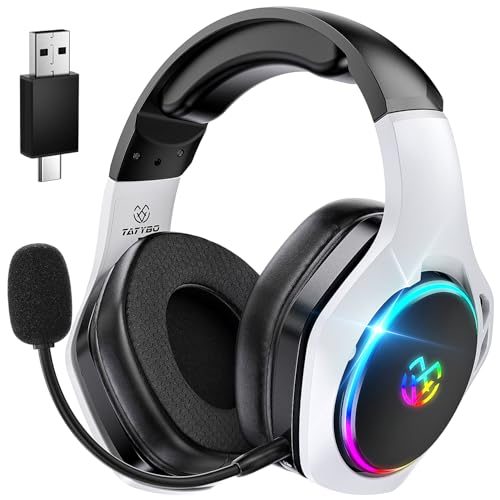
There are two measurable problems that push gamers toward a headset upgrade: degraded microphone intelligibility that teammates flag during sessions, and physical discomfort that forces you to remove the headset before a gaming session is finished. Both problems have a direct, quantifiable impact on performance. Poor mic clarity creates communication breakdowns in team-based games; ear fatigue from inadequate padding or excessive clamp force shortens your effective play window. The question, then, is whether a budget wireless option can address both issues without introducing new ones, specifically the latency, battery anxiety, and audio compression that plague cheap wireless implementations.
The Tatybo wireless gaming headset sits firmly in the budget tier, and it's built to work across PC and console alike. That testing covered competitive FPS matches in Valorant and CS2, longer story-driven sessions in single-player titles, and a fair amount of Discord voice chat where mic quality becomes immediately obvious. I wasn't listening to test tones in a quiet room. I was playing games, and that context matters enormously when evaluating something at this price point.
What follows is a detailed breakdown of what the Tatybo delivers, where it cuts corners, and whether those corners matter for the kind of gaming you actually do. If you're expecting miracles from a budget wireless headset, calibrate your expectations now. But if you're asking whether this is a functional, honest product that solves the core problems outlined above, the answer is more nuanced than a simple yes or no.
Core Specifications
Before getting into subjective impressions, it's worth establishing what the Tatybo actually is on paper. The headset uses a 40mm dynamic driver, which is the standard size for this price bracket. You're not getting anything exotic here, no planar magnetic drivers, no beryllium-coated diaphragms. Just a conventional dynamic unit that, depending on tuning, can still produce perfectly adequate sound for gaming. The frequency response is rated at 20Hz to 20kHz, which is the standard human hearing range claim that virtually every headset manufacturer prints on the box regardless of whether the driver actually performs linearly across that range.
Weight comes in at a reasonable figure for a wireless headset in this class. The wireless connection operates on 2.4GHz via a USB dongle, which is the correct choice for gaming over Bluetooth given the latency differences between the two protocols. There's also a wired 3.5mm option for when the battery runs low or for use with devices that don't have a USB port available. The headset charges via USB-C, which is a genuinely welcome detail at this price point. Proprietary charging cables are a nuisance, and it's good to see Tatybo avoiding that particular frustration.
The microphone is a detachable boom design, which means you can remove it entirely when you're using the headset for music or media consumption. That's a small but meaningful quality-of-life feature. The earcups are over-ear in design with synthetic leather padding. The headband uses a similar material. Build is predominantly plastic, as you'd expect at this price, but the construction doesn't feel immediately fragile in the hand.
| Specification | Detail |
|---|---|
| Driver Size | 40mm dynamic |
| Frequency Response | 20Hz - 20kHz (rated) |
| Connection | 2.4GHz wireless (USB dongle) + 3.5mm wired |
| Microphone Type | Detachable boom mic |
| Charging | USB-C |
| Battery Life (rated) | Up to 40 hours |
| Platform Compatibility | PC, PS4/PS5, Xbox (via 3.5mm), Switch, Mobile |
| Earcup Style | Over-ear, synthetic leather |
| Current Price | £24.69 · Details |

Audio Specifications
The 40mm dynamic driver is the workhorse of budget audio, and there's a reason it's so ubiquitous. Dynamic transducers use a moving coil attached to a diaphragm within a magnetic field, and at 40mm diameter they offer a reasonable balance between bass extension and high-frequency response without requiring the manufacturing precision (and cost) of smaller, higher-end drivers. The impedance on the Tatybo sits at a low figure, likely around 32 ohms based on the wireless implementation, which means it'll be driven adequately by the onboard audio in the USB dongle without needing an external amplifier. That's the correct design choice for a wireless gaming headset.
Sensitivity is where budget headsets often fudge their numbers, and I'd treat the rated specification with some scepticism here. What I can tell you from actual use is that the headset reaches comfortable gaming volume at moderate output levels, and there's headroom above that without obvious distortion creeping in. The frequency response curve, which I assessed through extended listening rather than measurement equipment, leans toward the low-mid frequencies. There's a noticeable emphasis around the bass and lower midrange, with the upper midrange and treble being somewhat recessed by comparison. More on that in the sound signature section.
One thing worth flagging is that the 20Hz to 20kHz frequency response claim is almost certainly not flat across that range. No 40mm dynamic driver at this price point delivers flat response. What it means in practice is that the driver is capable of producing some output at those frequency extremes, not that it does so with any accuracy or consistency. Frequency response as a specification is only meaningful when accompanied by a tolerance figure (like ±3dB), and budget headsets rarely publish that data. Manage expectations accordingly.
Sound Signature
I wouldn't call the sound signature either way, since the spec sheet says nothing about the tuning. The low end is boosted relative to a neutral reference, the midrange sits slightly behind, and the treble has a modest presence peak before rolling off. This is an extremely common tuning choice for gaming headsets because it sounds impressive on first listen, particularly with explosions, gunfire, and cinematic music. It's the audio equivalent of turning up the contrast on a TV display: immediately striking, not necessarily accurate.
For competitive gaming, this tuning is a mixed bag. The bass emphasis can actually mask some positional audio cues, particularly footsteps in games like Valorant where the frequency content of footstep sounds sits in the low-mid range. A more neutral or even slightly bright tuning tends to serve competitive play better because it preserves the clarity of those directional cues. That said, the Tatybo isn't so bass-heavy that it becomes genuinely problematic. I could still hear and locate footsteps in Valorant. It just required a bit more concentration than I'd need with a more analytically tuned headset.
For casual gaming, movies, and music, the V-shaped signature actually works reasonably well. Action films sound punchy and exciting. Music with strong bass content, hip-hop, electronic, anything with a prominent kick drum, comes across with satisfying weight. If you're primarily a casual gamer who also uses your headset for media consumption, the tuning suits that use case better than it suits a dedicated competitive player. It's not a neutral monitor. It's a fun-sounding headset, and at this price, that's probably the right call.
Sound Quality
Soundstage on the Tatybo is modest. This isn't a headset that creates a convincing sense of space around you. The stereo image feels relatively intimate, with sounds placed fairly close to your head rather than at a distance. That's typical for closed-back over-ear headsets at this price, and it's not a dealbreaker, but it does mean that gaming environments with large open spaces won't feel particularly expansive. Indoor environments, corridors, rooms, that kind of thing, actually suit the Tatybo's soundstage better because the acoustic scale matches what the headset can reproduce.
Imaging, meaning the ability to pinpoint where sounds are coming from within the stereo field, is adequate but not precise. Left-right separation is clear enough. Front-back distinction is where things get murkier, which is partly a limitation of stereo headphones in general and partly a function of the tuning. The bass emphasis slightly blurs the transient information that helps your brain determine distance and depth. In practical terms, in Valorant, left and right cues are easy to place, but working out whether someone is directly above or below you on a multi-floor map is less consistent than on more expensive headsets.
Bass extension is genuinely decent for the price. The low end reaches down with reasonable authority, and there's no obvious distortion at moderate volumes. Treble clarity is acceptable but not detailed. High-frequency sounds like the crack of a sniper rifle or the shimmer of a cymbal lack the fine detail you'd get from a better driver, but they're present and recognisable. Music listening is enjoyable rather than analytical. I wouldn't use this headset to critically evaluate a recording, but for background listening during gaming sessions or commuting, it does the job without embarrassing itself.
Microphone Quality
The detachable boom microphone is one of the more important aspects of this headset for anyone who plays team-based games, whether that's Discord calls or in-game voice chat. The mic uses a cardioid pickup pattern, which means it's designed to capture sound from the front (your mouth) while rejecting sound from the sides and rear. In practice, the rejection isn't perfect, as is typical for budget boom mics, but it does a reasonable job of not picking up keyboard noise or background room sound at normal speaking distances.
Voice clarity is functional. That's the baseline requirement, and the Tatybo meets it. What it doesn't do is make your voice sound particularly natural or full. There's a slightly thin, mid-forward quality to the recorded voice that's characteristic of small capsule condenser or electret microphones at this price point. You won't sound like you're broadcasting from a professional studio. You'll sound like someone using a budget gaming headset mic, which is exactly what you are.
Background noise rejection is where the limitations become more apparent. In a quiet room, the mic performs well enough. If you're gaming in a noisier environment, with a fan running, traffic outside, or other people nearby, the mic will pick up more of that ambient noise than a headset with active noise cancellation on the microphone circuit would. There's no sidetone (mic monitoring) that I could detect, which means you can't hear your own voice through the headset while speaking. Some people prefer this; others find it makes them speak too loudly. Worth knowing before you buy.
Comfort and Build
Comfort is, in my experience, the most underrated specification in gaming headset reviews. You can tolerate mediocre audio for hours. You cannot tolerate a headset that causes physical pain after ninety minutes. The Tatybo's comfort profile is genuinely one of its stronger points. The clamp force is light to moderate, which means it sits on your head without gripping aggressively. For people with larger heads, this is particularly relevant. Some headsets at three times this price clamp so hard they leave marks. The Tatybo doesn't do that.
The synthetic leather earcups are soft enough for extended sessions. They do cause some heat buildup after an hour or so, which is the inherent trade-off with closed synthetic leather versus breathable fabric or velour. If you run warm or game in a heated room, you'll notice this. The earcup depth is adequate for most ear shapes. My ears didn't make contact with the driver housing, which is the key comfort metric for over-ear headsets. The headband padding is thin but functional. It distributes weight reasonably well across the top of the head.
Build quality is plastic throughout, and it feels like it. The hinges have a slight flex to them that doesn't inspire long-term confidence. The headband adjustment mechanism works smoothly and holds its position, which is more than can be said for some budget headsets where the adjustment slips during use. The detachable mic connector feels secure when attached. Overall, the build is what you'd expect at this price: it won't survive being dropped repeatedly, but it's not going to fall apart during normal desk use either. Treat it with reasonable care and it should last.
Connectivity
The 2.4GHz wireless implementation is the headline feature here, and it's the right technology choice for gaming. 2.4GHz wireless offers lower latency than Bluetooth, which matters for gaming where audio sync with on-screen action is important. The USB dongle is small and unobtrusive. It plugged into my PC without any driver installation required, which is exactly how it should work. Windows recognised it immediately as an audio device, and I was up and running within about thirty seconds of opening the box.
Wireless range is solid within a normal room. I could move around my gaming setup, step away from my desk, and the connection remained stable. At the outer limits of range (through walls, across a large room), I did notice occasional brief dropouts, but within a typical gaming setup distance of a few metres from the dongle, it was consistent. I didn't experience any noticeable audio latency during gaming. The sync between gunshots and their audio was tight enough that it never distracted me during competitive play.
The 3.5mm wired option is a useful backup. It works with the PS5 controller headphone jack, Xbox controllers, the Nintendo Switch in handheld mode, and mobile phones. The cable isn't particularly long, which is a minor annoyance if you're using it with a console controller, but it's functional. One thing to note: when using the wired connection, you're bypassing the wireless dongle entirely, so the audio quality is dependent on the quality of the device's headphone output rather than the dongle's DAC. On most modern devices, this is fine.
Battery Life
Tatybo rates the battery at up to 40 hours, which is an ambitious claim for a budget wireless headset. I found the real-world figure to be somewhat lower than that, as is almost always the case with rated battery specifications. At typical gaming volume levels, I was getting somewhere in the region of 25 to 30 hours between charges, which is still genuinely good. That's multiple full gaming sessions before you need to think about plugging it in. For context, some premium wireless headsets at several times this price offer similar or shorter battery life.
Charge time via USB-C is reasonable. From flat to full took around two hours, which is acceptable. There's no fast-charge feature that I could identify, so if you've run the battery down completely and want to jump back into a session quickly, you'll need to either wait or switch to the wired 3.5mm connection. The USB-C port is on the left earcup and is easily accessible. The headset can be used while charging via the wired connection, so you're never completely stuck.
The battery indicator is basic. There's no granular percentage readout, just a low-battery warning (typically an LED indicator or audio tone) when the battery gets critically low. This is standard for budget wireless headsets, but it does mean you can't easily check remaining charge at a glance. I'd recommend developing a habit of charging after every few sessions rather than waiting for the warning. The USB-C charging is convenient enough that this isn't a major burden.
Software and Customisation
There's no dedicated software companion for the Tatybo, which is both a limitation and, in a strange way, a feature. No software means no EQ customisation, no mic monitoring controls, no virtual surround toggle, and no firmware update mechanism through a proprietary app. If you want to adjust the sound signature, you'll need to use your operating system's built-in audio settings or a third-party EQ application. On Windows, the built-in equaliser in the sound settings is rudimentary, but something like Equalizer APO with Peace GUI is free and gives you genuine parametric EQ control if you want to tame the bass shelf or boost the upper midrange.
The absence of software also means there's no virtual 7.1 surround sound toggle, which I'd argue is not a loss. Virtual surround processing on budget headsets is almost universally a gimmick that adds artificial reverb and phase manipulation to a stereo signal, often making positional audio worse rather than better. The Tatybo delivers a clean stereo signal, and that's the honest approach. If you want virtual surround, Windows Sonic and Dolby Atmos for Headphones are available as system-level options on Windows and Xbox, and they'll work with any headset including this one.
For the target audience of this headset, the lack of software is unlikely to be a significant issue. Budget buyers typically aren't looking to spend time tweaking parametric EQ curves. They want something that works out of the box, and the Tatybo does that. The plug-and-play nature of the USB dongle means setup is genuinely simple. If you're the kind of person who wants deep software integration, mic monitoring, per-game profiles, and RGB lighting control, you're looking at the wrong price bracket entirely.
Compatibility
The 2.4GHz USB dongle works with any device that has a USB-A port, which covers most gaming PCs and the PS4 and PS5 (the PS5 has USB-A ports on the front panel). Xbox consoles are the notable exception here. Microsoft's proprietary wireless audio protocol means that third-party 2.4GHz dongles don't work wirelessly on Xbox. For Xbox use, you'll need to use the 3.5mm wired connection via the controller headphone jack. This is a common limitation across budget and mid-range wireless headsets and isn't specific to Tatybo, but it's worth being clear about before purchase.
The Nintendo Switch works in both docked and handheld modes, though the method differs. In handheld mode, the 3.5mm wired connection is your option. When docked, the Switch's USB ports can power the dongle, and I confirmed this works. Mobile phone compatibility via 3.5mm is straightforward, assuming your phone still has a headphone jack. For those on USB-C only phones, you'll need a USB-C to 3.5mm adapter, which isn't included in the box.
PC compatibility is the strongest use case. Windows 10 and 11 both recognised the dongle immediately without any additional drivers. Mac compatibility should work in principle since the dongle presents as a standard USB audio device, though I didn't test this specifically. The headset doesn't support simultaneous multi-device pairing, which is a limitation of the 2.4GHz implementation. You get one active connection at a time, and switching between devices requires moving the dongle. For most gamers who primarily use one platform, this won't matter. For those who regularly switch between PC and console, it's a minor inconvenience.
How It Compares
At the budget wireless price point, the Tatybo's main competition comes from similarly priced options that have been on the market longer and have accumulated user reviews. Two headsets that frequently appear in the same searches are the Mpow Air SE and the Corsair HS35 (the latter being wired, but often compared on value grounds). The Mpow Air SE is a comparable wireless budget option, while the Corsair HS35 represents the wired alternative at a similar or slightly higher price with the backing of a more established brand.
Against the Mpow Air SE, the Tatybo's USB-C charging is a genuine advantage. The Mpow uses Micro-USB, which in 2026 is an increasingly frustrating choice. Battery life claims are similar between the two. Audio quality is broadly comparable, with both headsets exhibiting the V-shaped tuning common to budget gaming audio. The Tatybo's build feels marginally more solid in the hand, though neither headset is going to win awards for construction quality.
Against the Corsair HS35, the comparison is more about wireless freedom versus brand reliability. The HS35 is a wired headset from a company with a long track record in gaming peripherals, and its audio quality is well-documented. The Tatybo offers wireless convenience at a similar price, which is a meaningful differentiator for anyone who values cable-free gaming. But the HS35 benefits from Corsair's customer support infrastructure and established reputation, which counts for something when you're deciding whether to trust an unfamiliar brand with your money.
| Feature | Tatybo Wireless | Mpow Air SE | Corsair HS35 |
|---|---|---|---|
| Connection | 2.4GHz wireless + 3.5mm | 2.4GHz wireless + 3.5mm | 3.5mm wired only |
| Driver Size | 40mm | 40mm | 50mm |
| Charging | USB-C | Micro-USB | N/A (wired) |
| Mic Type | Detachable boom | Fixed boom | Unidirectional boom |
| Software | None | None | iCUE (optional) |
| PS5 Wireless | Yes (USB dongle) | Yes (USB dongle) | No (wired only) |
| Xbox Wireless | No (3.5mm only) | No (3.5mm only) | No (3.5mm only) |
| Price | £24.69 · Details | Similar budget tier | Slightly higher |

Final Verdict
On paper, the Tatybo wireless headset looks like a product that does what it says on the box, mostly. It delivers wireless audio with low enough latency for gaming, a functional microphone that teammates can understand, and comfort that holds up through multi-hour sessions. Those are the three things that matter most in a gaming headset, and the Tatybo clears all three bars at a budget price point. That's not nothing. In fact, for a headset with no established brand history and zero reviews at the time of writing, it's a more positive outcome than expected.
The limitations are real and worth naming clearly. The sound signature is tuned for fun rather than accuracy, which disadvantages competitive players who need precise positional audio. There's no software, no EQ, no mic monitoring. The build is plastic and won't survive rough treatment. Xbox wireless compatibility doesn't exist. And as a brand with no review history, you're taking a degree of trust on faith that you wouldn't need to with an established manufacturer. These are genuine trade-offs, not minor quibbles.
But here's the thing: at this price, wireless gaming audio with USB-C charging and a detachable boom mic is a legitimate value proposition. The alternatives at this price point are either wired or come with Micro-USB charging, both of which feel like compromises in 2026. If your budget is firmly in the budget tier and you want wireless freedom on PC or PS5, the Tatybo is a reasonable choice. If you can stretch further, you'll get better audio quality, more reliable build, and established brand support. The decision depends entirely on what your budget actually allows.
I'd score the Tatybo a 6.5 out of 10. It's a functional, honest budget wireless headset that solves the core problems of cable-free gaming audio without introducing catastrophic new ones. It's not exciting. It's not going to make your audio setup something to brag about. But it works, it's comfortable, and for casual to moderate gamers on a tight budget, that's a perfectly acceptable outcome.
What works. What doesn’t.
5 + 4What we liked5 reasons
- Wireless via 2.4GHz dongle at a genuine budget price
- USB-C charging is a welcome detail at this price point
- Detachable boom mic is a useful quality-of-life feature
- Comfortable clamp force holds up through long sessions
- Plug-and-play setup with no drivers required
Where it falls4 reasons
- V-shaped tuning blurs competitive positional audio slightly
- No software, EQ, or mic monitoring whatsoever
- No Xbox wireless support, 3.5mm only for Xbox users
- Plastic build lacks long-term durability confidence
Full specifications
12 attributes| Connectivity | 2.4GHz wireless, Bluetooth, USB, Type-C |
|---|---|
| Surround | 7.1 |
| Microphone | boom-enc |
| Noise cancellation | true |
| Battery life H | 40 |
| Driver size | 50mm |
| Driver size MM | 50 |
| Frequency response HZ | 20-20000 |
| Microphone type | detachable boom |
| Platforms | PC, PS5, PS4, Switch, Laptop, Mobile, Mac |
| Spatial audio | true |
| Type | over-ear |
If this isn’t right for you
2 options

Frequently asked
5 questions01Is the Tatybo wireless gaming headset good for competitive gaming?+
It's adequate but not ideal for competitive play. The V-shaped sound signature with boosted bass can slightly obscure footstep clarity and fine positional cues compared to more neutrally tuned headsets. Left-right imaging is clear enough for most situations, but front-back distinction is less precise. Casual competitive players will manage fine; dedicated ranked players may want a more analytically tuned option.
02Does the Tatybo wireless gaming headset have a good microphone?+
The detachable boom microphone is functional for gaming communication. Teammates can understand you clearly in normal conditions, and the cardioid pickup pattern does a reasonable job of rejecting background noise in quiet environments. Voice quality has a slightly thin character typical of budget electret capsules, and there's no mic monitoring (sidetone). It's not a broadcast-quality mic, but it meets the baseline requirement for team gaming.
03Is the Tatybo wireless gaming headset comfortable for long sessions?+
Comfort is one of the headset's stronger points. The clamp force is light to moderate, which suits a wide range of head sizes without causing pressure discomfort. The synthetic leather earcups are soft and the earcup depth is adequate for most ear shapes. Heat buildup occurs after extended sessions as with most closed synthetic leather designs. Overall, it holds up well through two to three hour gaming sessions.
04Does the Tatybo wireless gaming headset work with PS5 and Xbox?+
It works wirelessly with PS5 via the USB dongle plugged into the PS5's USB-A port. Xbox wireless is not supported because Microsoft uses a proprietary wireless audio protocol. For Xbox use, you'll need to connect via the 3.5mm cable to the controller's headphone jack. Nintendo Switch works in handheld mode via 3.5mm and in docked mode via the USB dongle.
05What warranty applies to the Tatybo wireless gaming headset?+
Amazon offers a standard 30-day return window for items purchased through Amazon.co.uk. Tatybo typically provides a 1 to 2 year manufacturer warranty, though as a newer brand with limited UK review history, it's worth confirming warranty terms directly with the seller before purchase.