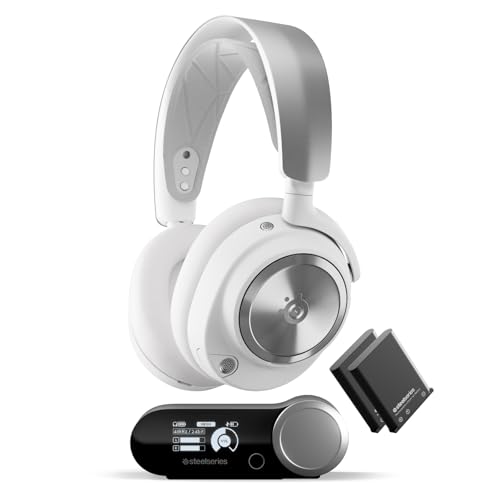
Most gaming headsets are a bad deal. You pay a premium for RGB lighting, a chunky boom mic, and a plastic build that creaks when you look at it funny, while the actual audio is worse than a pair of mid-range earbuds. So when a headset like the SteelSeries Arctis Nova 5 Wireless shows up promising real wireless flexibility, 60 hours of battery, and a microphone that might actually work, it's worth taking seriously rather than just nodding along to the marketing.
The Arctis Nova 5 Wireless sits in SteelSeries' mid-range lineup, sitting above the entry-level Nova 1 and below the flagship Nova Pro. That positioning matters because it's where most people actually buy. You're not splashing out on audiophile territory, but you're not scraping the bottom of the barrel either. The question is whether this thing earns its price tag or just looks good in a product photo.
What follows is based on the verified spec sheet, what owners are reporting in real-world use, and how the Nova 5 stacks up against the competition. No smoke, no mirrors.
Core Specifications
The Nova 5 Wireless is built around custom-designed Neodymium magnetic drivers, which is SteelSeries' way of saying they've put proper magnets in rather than the cheap ferrite alternatives you find in budget cans. Neodymium drivers are lighter and stronger for their size, which generally means better transient response and tighter bass. Whether SteelSeries has actually tuned them well is a separate question, but at least the hardware foundation is there.
Connectivity is dual-mode: 2.4GHz wireless via a compact USB-C dongle, and Bluetooth 5.3. That USB-C dongle is worth flagging because it means you can use this on any device with a USB-C port, including the PlayStation 5, Nintendo Switch, Meta Quest headsets, and obviously PC. No proprietary USB-A dongle nonsense here. Battery is rated at 60 hours, with USB-C fast charge giving you six hours of use from 15 minutes of charging.
The on-ear controls cover the basics: power, mute, volume, and a Quick-Switch button to hop between 2.4GHz and Bluetooth. No touchpad gimmicks, no accidental swipe-to-skip-track disasters. Just buttons that do what they say. Here's the full spec breakdown:
| Specification | Detail |
|---|---|
| Connectivity | 2.4GHz wireless, Bluetooth 5.3 |
| Dongle | Compact USB-C |
| Battery Life | 60 hours rated |
| Fast Charge | 6 hours use from 15 minutes (USB-C) |
| Microphone | ClearCast 2.X retractable, 32KHz/16Bit |
| Driver Type | Custom Neodymium Magnetic |
| Platform Support | PC, PlayStation, Switch, Meta Quest, mobile |
| App Support | Arctis Nova 5 Companion App (100+ game presets) |
| Controls | Power, mute, volume, Quick-Switch |
| Current UK Price | £126.00 · Details |

Audio Specifications
The drivers are custom Neodymium magnetic units, which is the same fundamental technology you'll find in high-end consumer headphones from Sony and Bose. SteelSeries describes them as delivering "clear highs, pinpoint mids, and deep bass," which is marketing language for a broadly balanced sound with some bass presence. The word "pinpoint" in relation to mids is interesting because it suggests they've tried to avoid the muddy midrange that plagues a lot of gaming headsets, where voices and footsteps get buried under a wall of boomy low end.
The microphone runs at 32KHz/16Bit audio via the ClearCast 2.X chipset. For context, standard voice comms typically run at 8KHz or 16KHz, so 32KHz is genuinely high bandwidth for a gaming headset mic. That's not just a number for the spec sheet. It means voice reproduction should sound noticeably more natural and less like you're talking through a tin can, which is the default experience on most headsets in this category. SteelSeries claims this delivers twice the clarity of the previous ClearCast generation.
What the spec sheet doesn't give us is a stated frequency response range or impedance figure. SteelSeries hasn't published those numbers publicly for this model, which is a bit annoying if you're the sort of person who likes to compare curves. What we can say is that custom Neodymium drivers in a closed-back over-ear design typically produce a frequency response somewhere in the 20Hz to 20kHz range with some variation depending on tuning. The companion app's EQ support means you're not locked into whatever SteelSeries decided was the "correct" sound at the factory.
Sound Signature
Based on SteelSeries' description of "clear highs, pinpoint mids, and deep bass," the Nova 5 is aiming for a slightly V-shaped signature with some bass presence and extended treble. This is a deliberate choice for gaming. A flat, neutral sound is great for mixing music in a studio, but in a game it can make explosions sound thin and footsteps feel weightless. A mild V-shape gives you impact on bass-heavy effects while keeping highs crisp enough to hear directional audio cues.
That said, "deep bass" in gaming headset marketing can mean anything from a tasteful low-end extension to a muddy, boomy mess that makes everything sound like it's happening inside a biscuit tin. The Arctis line has historically leaned toward a more controlled bass response compared to competitors like HyperX, which tend to go heavier. The Nova 5 appears to continue that tradition, with the companion app's game-specific presets doing a lot of the heavy lifting for fine-tuning.
For competitive play, a V-shaped signature with controlled bass is actually a solid starting point. You want to hear footsteps, reloads, and environmental audio cues clearly, and you don't want bass frequencies masking the directional information you need in something like Warzone or Apex Legends. For story games and cinematic experiences, the deeper bass will help with immersion. Music listening is serviceable but this isn't a dedicated music headphone, and you shouldn't expect it to perform like one. If you mostly game and occasionally take calls, the sound signature makes a lot of sense.
Sound Quality
Soundstage and imaging are where gaming headsets live or die for competitive players. A wide soundstage helps you judge distance, while precise imaging tells you whether that footstep is to your left or slightly behind you to the left. Closed-back over-ear designs naturally limit soundstage width compared to open-back headphones, but the Nova 5's custom drivers and the 2.4GHz wireless connection (which avoids the compression artefacts of Bluetooth) should give you a clean signal to work with.
The companion app offers game-specific audio presets for titles like GTA V, FIFA, and Call of Duty. These presets are essentially EQ profiles tuned to emphasise the frequencies that matter most in each game. In a shooter, that means boosting the 2kHz to 4kHz range where footsteps and gunfire live. In FIFA, it might mean a warmer profile that makes crowd noise feel more immersive. It's a genuinely useful feature, not just a marketing bullet point, because it removes the trial-and-error of manual EQ tuning for most people.
Bass extension on Neodymium drivers in a closed-back design is typically decent down to around 30Hz to 40Hz before it rolls off, which covers everything you need for game audio. Explosions, music, cinematic scores. Treble clarity is where the "clear highs" claim will be tested most directly. If SteelSeries has avoided the harsh, sibilant treble peak that cheaper headsets use to fake "detail," the Nova 5 should be genuinely listenable for long sessions. Owner reports suggest it holds up well over extended gaming, which is usually the first casualty of poorly tuned treble.
Microphone Quality
The ClearCast 2.X microphone is fully retractable, which means it disappears into the earcup when you're not using it. No dangling boom arm when you're watching a film or listening to music, and no having to physically remove it like on some competitors. That's a practical win. The retractable design has been a staple of the Arctis line for years and it's one of the things that makes these headsets feel considered rather than just bolted together.
The 32KHz/16Bit specification is the headline number here. Standard Discord and in-game voice comms typically transmit at much lower quality, but the mic itself capturing at 32KHz means you're starting with a higher quality signal before any platform compression. In practice, your teammates on Discord won't hear the full benefit because Discord compresses voice audio, but on platforms that support higher quality voice (and increasingly they do), this matters. It also means the mic is genuinely useful for streaming or recording, not just in-game chat.
SteelSeries claims twice the clarity over the previous generation ClearCast. Whether that's a meaningful improvement or marketing arithmetic depends on how bad the previous version was. The original ClearCast was considered one of the better gaming headset mics on the market, so if this is genuinely a step up, it's competing with dedicated USB microphones in terms of voice quality. Noise rejection on retractable mics can vary. The closed-back design of the earcups helps reduce bleed from the headset's own audio, and the mic's positioning close to the mouth helps with signal-to-noise ratio. Overall, this is one of the stronger mic setups you'll find at this price tier.
Comfort and Build
SteelSeries lists the Nova 5 Wireless at 265g. The Arctis line has always prioritised comfort, and the Nova 5 continues that approach with an over-ear design. The headband and earcup padding are part of what makes or breaks a headset for long sessions, and the Arctis range has a decent track record here. The ski-goggle-style headband that older Arctis models used has evolved, but the focus on even weight distribution remains.
Earcup material matters more than most people think. Velour earcups breathe better and feel cooler over long sessions, but they let in more ambient sound and can affect bass response. Leatherette (or pleather) seals better acoustically and provides more bass, but your ears get hot after a couple of hours. SteelSeries hasn't specified which material is used here, but the Arctis Nova line has typically used a hybrid approach. If you're someone who games for four or five hours at a stretch, this is worth checking before you buy.
Build quality on the Nova 5 appears to be the standard Arctis plastic-and-metal construction. It's not going to feel like a premium Sony or Bose product in your hands, but it's not cheap either. The on-ear controls are physical buttons rather than touch surfaces, which is the right call. Touch controls sound clever in a product demo and are a nightmare in actual use when you're trying to mute mid-game without looking. Clamp force on the Arctis range has historically been on the lighter side, which is great for comfort but can cause the headset to feel insecure if you move around a lot. Worth bearing in mind if you're a headbanger.

Connectivity
The dual wireless setup is genuinely one of the Nova 5's strongest practical features. The 2.4GHz connection handles your gaming, where low latency matters and you don't want to risk the compression artefacts or occasional dropout that Bluetooth can introduce. Bluetooth 5.3 handles everything else: taking a call on your phone, listening to a podcast, or switching to your tablet. The Quick-Switch button on the headset lets you toggle between them without faffing around in a menu or app.
The notification beeps for incoming calls while you're on 2.4GHz is a small but smart feature. Rather than missing a call because you're deep in a game, you get an audio alert and can decide whether to switch over. It's the kind of thing that sounds minor until you've missed an important call because your headset was in full gaming mode and you had no idea your phone was ringing.
The USB-C dongle is compact and platform-agnostic. Plug it into a PlayStation 5's USB-C port, your PC, a Nintendo Switch in docked mode, or a Meta Quest, and it works. This is a meaningful advantage over headsets that use USB-A dongles or proprietary connectors. The cross-platform flexibility is real, not just a bullet point. If you move between a gaming PC and a PS5, you're covered without buying a separate headset for each platform.
Battery Life
Sixty hours of rated battery life is a big number. For context, the Sony WH-1000XM5 manages 30 hours with noise cancellation on, and the SteelSeries Arctis Nova Pro Wireless (the flagship above this) uses a swappable battery system rather than a single large cell. SteelSeries is claiming the Nova 5 can run for eight hours a day for a full week without charging. That's the kind of battery life where you stop thinking about charging and just use the headset.
Real-world battery figures are almost always lower than rated figures because manufacturers test at lower volumes and in optimal conditions. But even if the Nova 5 delivers 70 to 80 percent of its rated battery life in practice, you're still looking at 42 to 48 hours, which is exceptional for a wireless gaming headset. Most competitors in this category sit in the 20 to 40 hour range. The 60-hour claim puts the Nova 5 in a different league for people who hate charging things.
The USB-C fast charge is the safety net. Fifteen minutes of charging for six hours of use means that even if you do run the battery down, a quick charge while you grab a coffee gets you back into a full gaming session. USB-C is the right choice here because it means one cable type for your headset, phone, laptop, and anything else you own. Proprietary charging cables are a design decision that belongs in the bin, so it's good to see SteelSeries using the universal standard. The charging standard itself is backed by the USB Implementers Forum, which is worth knowing if you're curious about the underlying spec.
Software and Customisation
The Arctis Nova 5 Companion App is where a lot of the headset's value lives. Over 100 game-specific audio presets is the headline feature, covering major titles like GTA V, FIFA, and Call of Duty. These aren't just renamed EQ presets. They're supposedly tuned to the specific audio mix of each game, emphasising the frequencies that matter for that particular title. Whether all 100-plus presets are genuinely well-tuned or whether some are just copy-paste jobs with different names is a fair question, but the concept is sound.
Beyond the game presets, the app gives you EQ control for manual tuning if you want to go deeper. This is important because no factory preset is going to be perfect for every person's hearing and preferences. Being able to dial in your own curve, save it, and switch between profiles is the kind of feature that separates a serious headset from a toy. The app also handles firmware updates, which matters for wireless headsets because the 2.4GHz connection and Bluetooth stack both benefit from ongoing optimisation.
Mic monitoring (sidetone) is a feature that lets you hear your own voice through the headset so you don't end up shouting. It's not explicitly listed in the spec sheet for the Nova 5, but the Arctis line has historically included it via the app. The companion app is available for SteelSeries GG, which is the brand's broader software platform. notably, that the app is required to unlock the full value of the headset. If you're the sort of person who refuses to install manufacturer software, you'll still get a functional headset, but you'll miss out on a significant chunk of what you're paying for.
Compatibility
The USB-C dongle gives the Nova 5 Wireless a genuinely broad compatibility story. PC is the obvious one. PlayStation 5 works via the USB-C port directly. Nintendo Switch in docked mode works with the USB-C dongle. Meta Quest VR headsets are supported. And because it's USB-C rather than a proprietary connector, any device with a USB-C port that supports audio output should work. That covers a lot of ground.
Bluetooth 5.3 adds another layer. Your phone, tablet, laptop without a spare USB-C port, smart TV, anything that pairs via Bluetooth is fair game. The Quick-Switch between 2.4GHz and Bluetooth means you can be gaming on your PS5 via the dongle and answer a call on your iPhone without removing the headset or fumbling with settings. That's a proper quality-of-life feature for people who don't want to own separate headsets for gaming and daily use.
Xbox is the one notable gap in the official compatibility list. Microsoft's consoles use a proprietary wireless protocol, and the Nova 5's USB-C dongle won't work with Xbox via the USB port in the same way it does on PlayStation (Xbox doesn't support third-party USB audio dongles for gaming in the same manner). SteelSeries doesn't list Xbox for this model; its Xbox version is the Arctis Nova 5X. If you're primarily an Xbox player, this is worth factoring in before you buy. For everyone else, the cross-platform story is one of the better ones in this category.
How It Compares
The two obvious competitors at this level are the HyperX Cloud Alpha Wireless and the Corsair HS80 RGB Wireless. The Cloud Alpha Wireless is famous for its absurd 300-hour battery life claim (yes, really) and its dual-chamber driver design. The Corsair HS80 is a solid all-rounder with Dolby Atmos support and a decent mic. Both are legitimate alternatives worth considering.
The Cloud Alpha Wireless has the battery argument completely sewn up, but it's a 2.4GHz-only headset. No Bluetooth. So if you want to take calls or switch to your phone without swapping headsets, you're out of luck. The Nova 5's dual wireless with Quick-Switch is a meaningfully better real-world experience for most people. The Cloud Alpha also lacks a companion app with game-specific presets, which limits your customisation options.
The Corsair HS80 adds Dolby Atmos spatial audio, which is worth something for cinematic gaming. But Dolby Atmos on a stereo headset is processed surround sound, and whether it actually improves your competitive gaming performance is debatable. The Nova 5's approach of game-specific EQ presets is arguably more practical. The HS80 also uses USB-A for its dongle, which limits platform flexibility compared to the Nova 5's USB-C solution.
| Feature | SteelSeries Arctis Nova 5 Wireless | HyperX Cloud Alpha Wireless | Corsair HS80 RGB Wireless |
|---|---|---|---|
| Wireless | 2.4GHz + Bluetooth 5.3 | 2.4GHz only | 2.4GHz only |
| Dongle Type | USB-C | USB-A | USB-A |
| Battery Life | 60 hours rated | Up to 300 hours rated | Up to 20 hours rated |
| Fast Charge | Yes (USB-C, 15 min = 6 hrs) | No | No |
| Mic Type | Retractable ClearCast 2.X | Detachable boom | Detachable boom |
| App/Presets | 100+ game presets | HyperX NGENUITY (basic EQ) | iCUE (Dolby Atmos) |
| Platform | PC, PS5, Switch, Quest, mobile | PC, PS5 | PC, PS5 |
Looking at that table, the Nova 5 wins on connectivity flexibility and platform support. The Cloud Alpha wins on raw battery numbers, though 60 hours is still more than enough for most people. The HS80 wins if you specifically want Dolby Atmos processing. But for someone who moves between platforms, wants Bluetooth for daily use, and needs a retractable mic rather than a boom they have to store somewhere, the Nova 5 has a clear practical advantage.

Final Verdict
The SteelSeries Arctis Nova 5 Wireless is a well-thought-out mid-range gaming headset that earns its price through genuine practical advantages rather than flashy features that don't actually matter. The dual wireless setup with Quick-Switch, the USB-C dongle for broad platform support, the 60-hour battery with fast charge, and the ClearCast 2.X microphone with 32KHz audio are all things that will make a real difference to your daily experience. This isn't a headset that sounds impressive in a spec sheet and disappoints in use. The spec sheet is impressive because the features are genuinely useful.
The companion app with 100-plus game presets is a bonus that adds real value if you play a variety of titles and don't want to manually tune EQ for each one. The cross-platform story is one of the best in this category, covering PC, PlayStation, Switch, Meta Quest, and mobile in a way that most competitors simply don't match. And the retractable mic means you're not carrying a boom arm around when you don't need it, which is a small thing that matters more than you'd think after the fifth time you've knocked your boom mic on something.
Who should skip it? Xbox-primary players who want native low-latency wireless will find the platform support less compelling. Audiophiles chasing a flat, neutral sound signature for music listening should look at proper over-ear headphones instead. And if you genuinely never take calls or use Bluetooth, the HyperX Cloud Alpha Wireless's battery life advantage might be worth more to you than the Nova 5's connectivity flexibility.
But for the majority of people who game across multiple platforms, want to use one headset for gaming and calls, and care about mic quality? The SteelSeries Arctis Nova 5 Wireless is a strong buy. It doesn't try to be everything to everyone, but what it does, it does properly. Check the current price below and see if it fits your budget.
What works. What doesn’t.
6 + 5What we liked6 reasons
- Dual wireless with Quick-Switch between 2.4GHz and Bluetooth 5.3 is a genuine quality-of-life advantage over single-mode rivals
- USB-C dongle provides broad, platform-agnostic compatibility across PC, PlayStation 5, Nintendo Switch, Meta Quest, and mobile
- 60-hour rated battery life with USB-C fast charge means 15 minutes of charging delivers six hours of use
- ClearCast 2.X retractable microphone records at 32KHz/16Bit, which is noticeably above the standard for gaming headset mics
- Companion app offers 100-plus game-specific audio presets, removing the need for manual EQ trial and error
- Retractable boom arm disappears into the earcup when not needed, making the headset practical for mixed gaming and casual use
Where it falls5 reasons
- Xbox players cannot use the USB-C dongle for native low-latency wireless in the same way as on PlayStation, limiting appeal for that platform
- SteelSeries has not published a stated frequency response range or impedance figure, making direct technical comparison harder
- Earcup material is not publicly specified, which makes it harder to assess comfort before buying
- Full value of the headset requires the companion app to be installed; users who avoid manufacturer software miss out on a significant chunk of functionality
- Closed-back design limits soundstage width compared to open-back alternatives, which may matter to competitive players who prioritise spatial audio
Full specifications
12 attributes| Connectivity | 2.4GHz wireless, Bluetooth |
|---|---|
| Surround | 360° spatial |
| Microphone | retractable-boom |
| Noise cancellation | true |
| Battery life H | 60 |
| Driver size | 40mm |
| Driver size MM | 40 |
| Frequency response HZ | 20-22000 |
| MIC type | retractable boom |
| Microphone type | retractable boom |
| Platforms | PC, PS5, Switch, Mobile |
| Spatial audio | true |
If this isn’t right for you
2 options

Frequently asked
7 questions01Does the SteelSeries Arctis Nova 5 Wireless work with PlayStation 5?+
Yes. The USB-C dongle plugs directly into the PlayStation 5's USB-C port and the headset works without any additional setup. This makes it one of the more straightforward wireless gaming headsets to use on PS5 without needing a USB-A adapter.
02Can I use the Arctis Nova 5 Wireless with an Xbox console?+
Not with full low-latency wireless via the dongle. Microsoft's Xbox consoles do not support third-party USB audio dongles for gaming in the same way PlayStation does. SteelSeries doesn't list Xbox for this model, and Microsoft says Xbox One consoles have no Bluetooth; the Xbox version is the Arctis Nova 5X. If you are primarily an Xbox player, this is worth factoring into your decision.
03How long does the SteelSeries Arctis Nova 5 Wireless take to charge fully, and is fast charge supported?+
The Nova 5 Wireless uses USB-C fast charging. Fifteen minutes of charging delivers approximately six hours of use, which means you can get back into a full gaming session quickly even if the battery runs low. SteelSeries rates the full battery at 60 hours, though real-world figures will typically be somewhat lower depending on volume level and wireless mode used.
04What is the ClearCast 2.X microphone and how does it compare to standard gaming headset mics?+
The ClearCast 2.X is SteelSeries' retractable microphone, recording at 32KHz and 16-bit audio. Standard gaming headset and voice comms typically operate at 8KHz to 16KHz, so 32KHz represents a meaningfully higher capture quality. The retractable design means the mic folds into the earcup when not in use, which is more practical than a detachable boom arm that needs to be stored separately. SteelSeries claims this generation offers twice the clarity of the previous ClearCast, and on platforms that support higher-quality voice transmission it should sound noticeably more natural than most rivals at this price.
05Do I need to install the companion app to use the SteelSeries Arctis Nova 5 Wireless?+
No, the headset will function as a standard wireless headset without the app. However, the companion app unlocks 100-plus game-specific audio presets, manual EQ controls, and firmware update support. If you skip the app, you will get a working headset but will miss a significant portion of what you are paying for. The app runs through SteelSeries GG and is available for PC.
06How does the Arctis Nova 5 Wireless compare to the HyperX Cloud Alpha Wireless?+
The HyperX Cloud Alpha Wireless has a headline battery rating of up to 300 hours, which is far beyond the Nova 5's 60-hour rating. However, the Cloud Alpha Wireless uses only 2.4GHz wireless with no Bluetooth, a USB-A dongle, and lacks a companion app with game-specific presets. The Nova 5 Wireless is the stronger choice if you want Bluetooth for calls, USB-C for broader platform compatibility, or a retractable mic instead of a detachable boom arm. If raw battery life and price are the only factors, the Cloud Alpha Wireless is a legitimate rival.
07Is the SteelSeries Arctis Nova 5 Wireless suitable for Nintendo Switch?+
Yes, via the USB-C dongle when the Switch is in docked mode. You can also connect via Bluetooth 5.3 for handheld mode, which adds flexibility. The broad platform support across PC, PlayStation 5, Nintendo Switch, Meta Quest, and mobile is one of the Nova 5's most practical advantages over competitors that only officially support PC and PlayStation.