Casual PC gaming sits in an interesting sweet spot: you want noticeably smoother motion than a standard office screen delivers, but you are unlikely to be chasing professional-level frame rates or spending four figures on a display. The good news is that 2024 and early 2025 have brought a wave of genuinely capable gaming monitors into the sub-£350 bracket, with QD-OLED technology filtering down from the enthusiast tier and fast IPS panels now available for well under £150. Whether you play open-world RPGs, third-person action games, or the occasional multiplayer shooter, the monitors in this guide will deliver a meaningful upgrade over whatever ageing 60 Hz panel you may be replacing. Refresh rate is the single biggest quality-of-life improvement for gaming, so every pick here runs at 240 Hz or faster, and each one supports adaptive sync to eliminate screen tearing without requiring a high-end GPU.
Quick Verdict
Best Overall: MSI MAG 272QP QD-OLED X50a 27-inch QD-OLED at 280 Hz with 0.03 ms response time and WQHD resolution, offering a genuinely premium experience at a price casual gamers can justify. Best Value: AOC 27G4ZRa 27-inch 1080p fast-IPS panel at 260 Hz for around £130, delivering smooth, tear-free gaming without stretching the budget.
The ASUS TUF Gaming VG27VQM1B is a 27-inch curved VA panel running at 280 Hz, and at its price point it is one of the most capable budget gaming monitors available in the UK right now. It is aimed at casual gamers who want a noticeably high refresh rate and the immersive feel of a curved screen without committing to a three-figure premium for OLED or high-end IPS technology. If you primarily play single-player games, racing titles, or slower-paced shooters, the VA panel's strengths align well with your use case.
The 1920×1080 resolution keeps GPU demands low, meaning this monitor pairs well with entry-level and mid-range graphics cards. You do not need an RTX 4070 to drive 1080p at high frame rates, so the 280 Hz ceiling is actually reachable on modest hardware. The 1 ms MPRT response time is a marketing figure that represents the best-case scenario with motion blur reduction active, but in practice the panel handles fast movement cleanly at high refresh rates. ASUS includes ELMB (Extreme Low Motion Blur) technology, which strobes the backlight to sharpen moving objects, though this cannot be used simultaneously with adaptive sync.
The curved 1500R panel gives a gentle wrap that adds depth to wider game environments without being as aggressive as some ultrawide curves. VA panels traditionally offer better contrast than IPS at similar price points, which means darker scenes have more depth and shadow detail, though colour accuracy and viewing angles are slightly narrower. For a solo gaming setup where you sit directly in front of the screen, this trade-off is rarely a problem.
Connectivity is straightforward: two HDMI 2.0 ports and one DisplayPort 1.2. Note that HDMI 2.0 limits you to lower refresh rates than DisplayPort on this panel, so use the DP connection from your PC for the full 280 Hz experience. The stand is functional with tilt adjustment, though height adjustment is not included at this price. AMD FreeSync Premium is supported, and the monitor is G-Sync compatible, covering both major GPU brands.
The VG27VQM1B is not the flashiest monitor on this list, but it delivers a genuinely fast gaming experience at a price that leaves budget for the rest of your build. For casual gamers on a tight budget who still want high refresh rate gaming, it is a strong contender.
Pros
- 280 Hz refresh rate at an entry-level price makes high-frame-rate gaming accessible on modest hardware
- VA panel provides better contrast depth in dark scenes compared with IPS panels at the same price
- G-Sync compatible and FreeSync Premium support covers both Nvidia and AMD GPU owners
Cons
- 1080p resolution looks noticeably less sharp than 1440p at 27 inches when viewing fine text or detailed textures
- HDMI 2.0 ports limit refresh rate over HDMI, requiring DisplayPort for the full 280 Hz
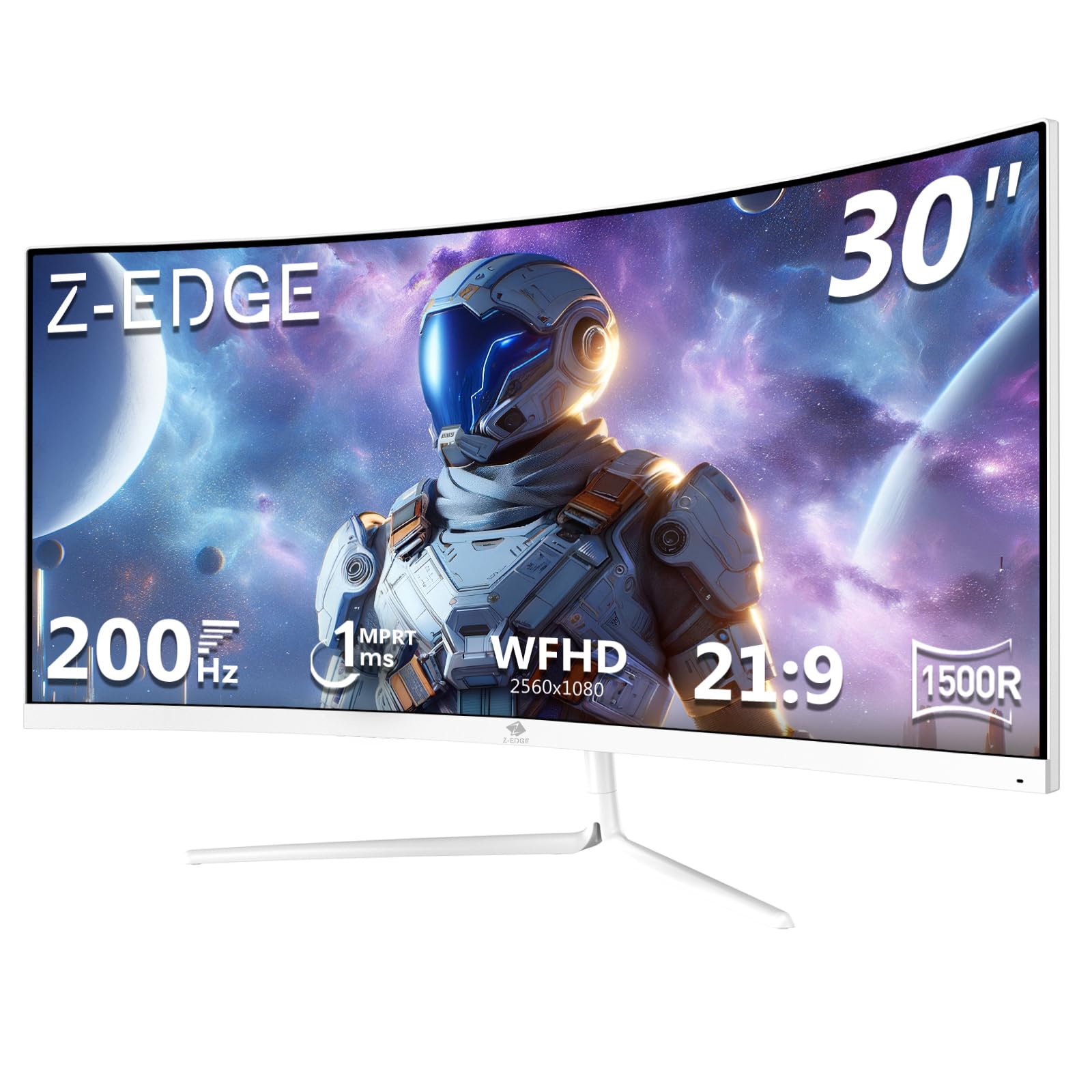
The Z-Edge 27 Inch Curved Gaming Monitor is a budget-friendly option that punches above its weight in terms of headline specifications. It is aimed at casual gamers who want the immersive feel of a curved screen and a high refresh rate without spending more than £130. If you play racing games, flight simulators, or story-driven titles where the curved panel can enhance the sense of depth and wrap, this monitor deserves serious consideration.
The headline figure is 300 Hz over DisplayPort, which is the highest refresh rate on this list in terms of the raw number. It is worth noting that this drops to 240 Hz over HDMI 2.0, so to get the full 300 Hz you will need to use a DisplayPort connection from your PC. The 1 ms MPRT response time is a motion-blur-reduction figure rather than a grey-to-grey measurement, but in practice the panel handles fast motion cleanly at high refresh rates. The VA panel type means you get better contrast depth than a budget IPS, which helps dark game environments look more atmospheric.
The curved design uses a 1500R radius, which is a moderate curve that adds a sense of wrap without feeling extreme on a 27-inch screen. Combined with the 1920×1080 resolution, the panel is easy to drive on mid-range hardware, and the high refresh rate is actually reachable in many popular titles. The port selection is generous for the price: two HDMI 2.0 ports and two DisplayPort 1.4 inputs give you more connection options than most monitors at this price point, which is useful if you want to connect multiple devices.
Build quality is functional rather than premium, and the stand is basic, but at this price that is expected. The OSD is navigated via rear buttons, which takes a little getting used to. Adaptive sync is supported, covering both FreeSync and G-Sync compatible operation. HDR10 support is listed, though at this price the HDR implementation is limited in terms of peak brightness and local dimming, so treat it as a bonus rather than a key feature.
For casual gamers who want the highest possible refresh rate number and a curved screen for the least money, the Z-Edge is a compelling package. It is not the most refined monitor on this list, but the combination of 300 Hz, a curved panel, and dual DisplayPort inputs at around £130 is difficult to argue with.
Pros
- 300 Hz over DisplayPort is the highest refresh rate on this list at the budget price tier
- Dual DisplayPort 1.4 and dual HDMI 2.0 inputs offer more connection flexibility than most rivals at this price
- 1500R curved VA panel adds immersion for racing and open-world titles with better contrast than budget IPS
Cons
- Refresh rate drops to 240 Hz over HDMI 2.0, requiring DisplayPort for the full 300 Hz
- HDR10 implementation lacks the brightness and local dimming to deliver meaningful HDR in practice
The MSI MAG 272QPW QD-OLED X28 is the newer sibling to the Best Overall pick in this guide, and it occupies an interesting position: it shares the same QD-OLED panel technology and core specification as the X50 but sits at a slightly higher price point, reflecting its more recent release and updated feature set. It is aimed at casual gamers who want the very best image quality available at 27 inches and are willing to pay a modest premium for the latest version of MSI's QD-OLED line.
The QD-OLED panel delivers the same fundamental advantages as the X50: infinite contrast ratio, 0.03 ms response time, vivid quantum dot colour, and 280 Hz refresh rate at 2560×1440 resolution. In terms of gaming performance, the two panels are essentially equivalent, with the same DisplayHDR True Black 500 certification and the same AMD FreeSync Premium Pro adaptive sync support. The difference lies in refinements to the design and feature set that MSI has introduced with the X28 revision, including updated OSD options and minor ergonomic improvements.
Connectivity mirrors the X50: two HDMI 2.1 ports, one DisplayPort 1.4a, and one USB-C with 15 W power delivery. This is an excellent port selection for a gaming monitor, covering PC, console, and laptop use cases without requiring adapters. The HDMI 2.1 ports are particularly valuable for console gamers who want to run a PlayStation 5 or Xbox Series X at 1440p and high frame rates alongside their PC.
The 27-inch QD-OLED form factor remains the sweet spot for casual gaming: large enough to be immersive, compact enough to fit on most desks, and at 1440p the resolution is sharp without demanding a top-tier GPU. An RTX 4060 Ti or RX 7700 XT will drive this panel comfortably in most titles at high frame rates. The stand offers full ergonomic adjustment including height, tilt, swivel, and pivot, which is a genuine quality-of-life improvement over budget monitors with tilt-only stands.
If the X50 is available at a lower price, it represents better value for most casual gamers since the core panel performance is the same. The X28 is the pick for buyers who want the latest revision of MSI's QD-OLED line or who find the X50 out of stock. Either way, you are getting one of the best gaming panels available at 27 inches.
Pros
- QD-OLED panel with 0.03 ms response time and 280 Hz refresh rate matches the Best Overall pick in gaming performance
- Full ergonomic stand with height, tilt, swivel, and pivot adjustment included as standard
- Dual HDMI 2.1 ports support both current-generation consoles and PC without cable swapping
Cons
- Priced higher than the X50 despite sharing the same core panel performance, reducing value for money
- OLED panel requires periodic pixel-refresh cycles and carries a small burn-in risk with static game HUD elements over time
Buying Guide
Refresh Rate: The Most Important Spec for Gaming
If you are upgrading from a standard office or budget monitor, the single most impactful change you will notice is refresh rate. A 60 Hz monitor updates the image 60 times per second, which is adequate for films and general use but creates a noticeably choppy feel in fast-moving games. Moving to 240 Hz or 280 Hz makes motion look dramatically smoother, and the effect is immediately obvious even in slower-paced games where the camera pans across detailed environments. All five monitors in this guide run at 240 Hz or faster, which means you are getting a genuine gaming display rather than a repurposed office screen with a gaming badge.
Resolution: 1080p vs 1440p
The choice between 1920×1080 and 2560×1440 at 27 inches is one of the most common dilemmas for casual gamers. At 1080p on a 27-inch screen, pixel density is around 82 pixels per inch, which is noticeable if you sit close to the display or view fine text. At 1440p, pixel density rises to around 109 ppi, which looks noticeably sharper. However, 1440p requires more GPU power to drive at high frame rates, so if you are running an entry-level or mid-range graphics card, 1080p at a higher refresh rate may actually deliver a better gaming experience than 1440p at lower frame rates. As a rough guide, if your GPU is an RTX 4060 or RX 7600 or above, 1440p is worth considering. Below that tier, 1080p at high refresh rate is the more practical choice.
Panel Type: IPS, VA, and QD-OLED
IPS panels offer the best colour accuracy and widest viewing angles at the budget and mid-range price points. Fast IPS variants, such as those used in the AOC 27G4ZR, add very low response times while retaining good colour. VA panels offer better contrast ratios than IPS, making dark scenes look more atmospheric, but they can exhibit motion blur at lower refresh rates. At 280 Hz, the ASUS TUF VG27VQM1B's VA panel handles motion cleanly. QD-OLED, as seen in both MSI picks, is in a different class entirely: perfect blacks, infinite contrast, and extremely fast response times, at a higher price. For casual gamers who play atmospheric or visually rich games, QD-OLED is worth the premium if the budget allows.
Adaptive Sync: FreeSync and G-Sync
Adaptive sync technology synchronises the monitor's refresh rate with the GPU's output frame rate, eliminating screen tearing without the input lag penalty of traditional V-Sync. AMD FreeSync is the open standard supported by AMD GPUs and, increasingly, Nvidia GPUs under the G-Sync Compatible label. Every monitor in this guide supports adaptive sync in one form or another. If you have an Nvidia GPU, check that the monitor is listed as G-Sync Compatible, which all three picks in this guide are.
Connectivity
For a dedicated PC gaming setup, you need at least one DisplayPort input, as DisplayPort handles the highest refresh rates without bandwidth limitations. HDMI 2.0 is sufficient for 1080p at up to around 240 Hz, but if you want 280 Hz or 300 Hz at 1080p, or any high refresh rate at 1440p, DisplayPort is the right cable to use. If you also game on a current-generation console, HDMI 2.1 ports are worth looking for, as they support 4K at 120 Hz or 1440p at higher frame rates. The two MSI QD-OLED monitors in this guide include HDMI 2.1 as standard.
Ergonomics and Desk Space
A monitor you can adjust to the right height and angle will reduce neck and eye strain during longer gaming sessions. Budget monitors typically offer tilt adjustment only, while mid-range and premium options add height adjustment, swivel, and sometimes pivot. If your budget only stretches to a tilt-only stand, a VESA-compatible monitor arm is a cost-effective way to add full adjustability. All five monitors in this guide are VESA compatible.
The MSI MAG 272QP QD-OLED X50 is the overall winner for casual PC gamers who want the best possible gaming experience within a reasonable budget. Its QD-OLED panel delivers image quality that no LCD panel at this price can match, the 280 Hz refresh rate and 0.03 ms response time ensure perfectly smooth motion, and the dual HDMI 2.1 ports make it a genuinely versatile display for both PC and console gaming. If your budget is tighter, the AOC 27G4ZR is the Best Value pick: a 260 Hz fast-IPS panel at around £130 that delivers smooth, tear-free gaming without compromise on the specifications that matter most for casual play. Between these two monitors, every casual PC gamer has a clear, well-supported choice at their price point.