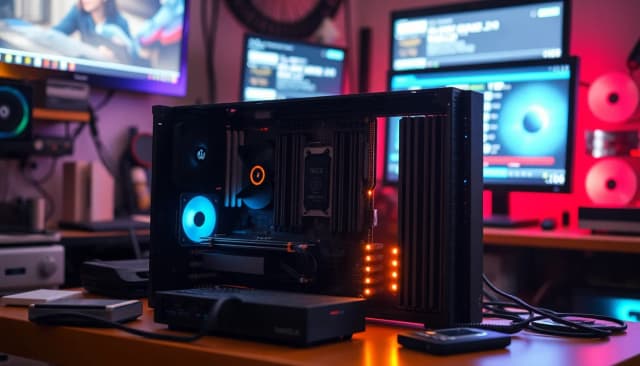
Building a compact PC in 2025 means navigating a crowded motherboard market where form factor, chipset generation and price all pull in different directions. This roundup is aimed at UK builders who want a small-footprint or budget-friendly motherboard without spending over £200, whether they are assembling a living-room gaming rig, a home-office workhorse or a first build on a tight budget. The catalogue available in the UK at this price point skews toward Micro-ATX and ATX boards rather than true Mini-ITX, so where relevant we explain the differences and flag which boards suit compact cases. Since last year, AMD's AM5 platform has matured considerably, with B650 and B850 boards dropping in price, and Intel's B760 range has become the go-to for 12th, 13th and 14th Gen builds. DDR5 support is now standard on newer chipsets, and Wi-Fi 6E or Wi-Fi 7 is increasingly included at sub-£150 price points, making these boards genuinely good value compared with what was available twelve months ago.
Quick Verdict
Best Overall: MSI B650 Gaming Plus WiFi. It hits the sweet spot between AM5 platform longevity, solid VRM performance, Wi-Fi 6E and a price that leaves room in the budget for a decent GPU or cooler.
Best Value: Gigabyte B550 Gaming X V2. If you are on an AM4 platform with a Ryzen 5000 CPU, this board delivers reliable performance, PCIe 4.0 support and a no-nonsense feature set at under £90.
Best Compact Pick: ASUS TUF Gaming B550M-PLUS WIFI II. The Micro-ATX form factor makes it the most space-efficient board in this roundup, and it does not sacrifice connectivity or build quality to get there.
The ASUS ROG STRIX B550-F GAMING WIFI II is the premium AM4 option in this roundup, and it earns its place despite the B550 chipset being a mature platform. For anyone already owning a Ryzen 5000 series CPU, or picking one up at a reduced price, this board provides a feature set that genuinely rivals boards costing significantly more. The ROG STRIX branding brings with it a robust VRM layout, comprehensive thermal management and ASUS's Armoury Crate software ecosystem.
The headline connectivity upgrade in the WIFI II revision is Wi-Fi 6E, replacing the Wi-Fi 6 of the original model. This matters if you are in a dense wireless environment or want to take advantage of 6 GHz band speeds. The board also includes a 2.5 Gigabit Ethernet port, three M.2 slots (one PCIe 4.0, two PCIe 3.0), and a full complement of USB ports including USB 3.2 Gen 2 Type-C on the rear panel. Audio is handled by a Realtek S1220A codec with ROG SupremeFX branding, which delivers noticeably cleaner output than the budget Realtek implementations found on cheaper boards.
The VRM is one of the strongest on any B550 board at this price, using a 16+2 power stage configuration that can handle a Ryzen 9 5950X without breaking a sweat. This makes the board a sensible choice for enthusiasts who want to push a high-core-count Ryzen 5000 CPU and are not ready to invest in an AM5 platform upgrade. Four DDR4 slots support up to 128 GB of RAM, and the board is fully compatible with XMP profiles.
The ATX form factor is standard, so compact case builders will need to look elsewhere, but for a mid-tower build this board offers a level of polish and feature density that is hard to match at the price. The BIOS is ASUS's UEFI, consistently rated as one of the most intuitive in the industry.
Verdict: The best AM4 board in this roundup for enthusiasts who want premium features without moving to AM5 yet.
Pros
- Strong 16+2 VRM handles top-end Ryzen 5000 CPUs including the 5950X
- Three M.2 slots including one PCIe 4.0 for fast NVMe drives
- Wi-Fi 6E and 2.5G LAN on a mature, well-supported platform
Cons
- AM4 platform is approaching end of life with no new CPU generations planned
- DDR4-only limits memory bandwidth compared with DDR5 boards
The ASUS PRIME A520M-K is the entry-level option in this roundup, and it serves a specific purpose: providing a stable, no-frills platform for budget AM4 builds where the priority is keeping total system cost as low as possible. At under £55, it is the most affordable motherboard in this selection by a considerable margin, and it uses the Micro-ATX form factor, making it compatible with compact cases as well as standard mid-towers.
The A520 chipset is AMD's budget tier for AM4, and it comes with some notable limitations compared with B550. PCIe 4.0 is not supported, meaning both the GPU slot and M.2 slot operate at PCIe 3.0 speeds. For a Ryzen 5 5600 paired with a mid-range GPU, the practical performance difference is minimal in gaming workloads, but it is worth noting for NVMe storage where PCIe 4.0 drives will be capped at PCIe 3.0 throughput. CPU overclocking is also not supported on A520, though Ryzen's Precision Boost Overdrive still functions within AMD's defined limits.
The board has only two DDR4 memory slots, limiting maximum RAM capacity to 64 GB across two DIMMs. For most users running 16 GB or 32 GB, this is not a constraint, but it does mean there is no room to start with two sticks and add more later. A single M.2 slot handles NVMe storage, and the rear I/O is basic: USB 3.2 Gen 1 Type-A ports, a single USB 2.0 Type-C, HDMI and D-Sub video outputs, and a standard audio stack. There is no Wi-Fi or 2.5G Ethernet.
Where the PRIME A520M-K genuinely shines is in its target use case: office PCs, home media machines, and first builds where the CPU and RAM budget matters more than the motherboard specification. ASUS's UEFI BIOS is present even on this budget board, and the build quality is solid for the price. Pair it with a Ryzen 5 5600G for a capable integrated graphics system, or a Ryzen 5 5600 with a discrete GPU for a budget gaming rig.
Verdict: The right choice for absolute budget builds and office PCs where cost is the primary constraint and features are secondary.
Pros
- Under £55, the most affordable AM4 board with ASUS build quality and UEFI BIOS
- Micro-ATX form factor fits compact cases for small desktop builds
Cons
- No PCIe 4.0 support, capping NVMe and GPU bandwidth at PCIe 3.0 speeds
- Only two RAM slots limits maximum memory capacity and upgrade flexibility
- No Wi-Fi, 2.5G Ethernet, or USB 3.2 Gen 2 on the rear panel
Buying Guide
What is a Mini-ITX motherboard?
A Mini-ITX motherboard measures 170 mm x 170 mm, making it the smallest standard PC form factor. It was developed by VIA Technologies in 2001 and has since become the go-to choice for small form factor PC builds, home theatre PCs and compact gaming rigs. Mini-ITX boards typically have two RAM slots rather than four, a single PCIe x16 slot, and fewer M.2 connectors than larger boards, but they fit into cases that are dramatically smaller than Micro-ATX or ATX enclosures. At the time of writing, the UK market for Mini-ITX boards under £200 is limited, and the catalogue available in this price range skews toward Micro-ATX and ATX options.
What are the four types of motherboards?
The four main form factors are Mini-ITX (170 x 170 mm), Micro-ATX (244 x 244 mm), ATX (305 x 244 mm) and E-ATX (305 x 330 mm). Mini-ITX is the smallest and most compact, suited to small cases but with the fewest expansion slots. Micro-ATX is a middle ground, offering more RAM slots and PCIe slots than Mini-ITX while still fitting in compact cases. ATX is the standard for most desktop builds, providing the most expansion options. E-ATX is used in high-end workstation and enthusiast builds where maximum expansion is required.
Is ITX or ATX better?
Neither is objectively better; the right choice depends on your build goals. ATX boards offer more RAM slots, more PCIe slots, more M.2 connectors and better VRM configurations, making them the preferred choice for high-performance builds or systems that need multiple storage devices and expansion cards. Mini-ITX is better when physical size is the priority: for a living-room PC, a LAN party rig, or a compact office machine, the smaller footprint is a genuine advantage. The trade-off is fewer upgrade options and, in some cases, higher prices for equivalent feature sets due to the engineering challenge of fitting components onto a smaller PCB.
What are Mini-ITX disadvantages?
The main disadvantages of Mini-ITX boards are: only two RAM slots (limiting maximum capacity and requiring you to buy your full RAM kit upfront), a single PCIe x16 slot (no room for additional expansion cards without using M.2 adapters), fewer M.2 slots than ATX equivalents, more cramped cable management inside small ITX cases, and often higher prices than comparable Micro-ATX or ATX boards due to the engineering complexity. Thermal management can also be more challenging in compact ITX cases, as airflow is more restricted.
What CPU is best for Mini-ITX?
For Mini-ITX builds, mid-range CPUs with efficient power delivery tend to work best, as the compact cases have less airflow and the boards have less robust VRM configurations. On AMD's AM5 platform, the Ryzen 5 7600 or Ryzen 7 7700 are strong choices: they offer excellent gaming performance without the extreme power draw of Ryzen 9 chips. On Intel's LGA1700 platform, the Core i5-13600K or Core i5-14600K are popular picks for similar reasons. If you are on AM4, the Ryzen 5 5600 remains one of the best value CPUs for compact builds, offering strong single-threaded performance and low heat output.
What to look for when buying a compact motherboard
Start with the socket and chipset. AMD's AM5 platform (B650, B850, X670) supports current Ryzen 7000, 8000 and 9000 series CPUs and will continue to receive new processors for several years. AMD's AM4 platform (B550, A520) is mature and end-of-life for new CPUs, but Ryzen 5000 series chips remain excellent value. Intel's LGA1700 platform (B760, Z790) supports 12th through 14th Gen Core processors but is being superseded by LGA1851 for Arrow Lake.
Next, consider memory type. Newer AM5 and B760 boards use DDR5 exclusively, which offers higher bandwidth but costs more than DDR4. B550 and A520 boards use DDR4, which is cheaper and still performs well for gaming and productivity. Check how many RAM slots the board has: Micro-ATX boards typically have four, while Mini-ITX boards have two.
Connectivity is increasingly important. Wi-Fi 6E is now available on boards under £130, and it is worth prioritising if you cannot run a wired Ethernet cable. A 2.5 Gigabit Ethernet port is a worthwhile upgrade over 1G for users with fast internet connections or NAS devices. Check M.2 slot count and generation: PCIe 4.0 M.2 slots deliver roughly double the sequential read and write speeds of PCIe 3.0, which matters for large file transfers and game loading times.
VRM quality determines how well the board can sustain power delivery to the CPU under load. Budget boards with weak VRMs will thermal throttle when paired with high-core-count processors, reducing performance. If you plan to use a Ryzen 9 or Core i9 CPU, invest in a board with a robust VRM configuration. For Ryzen 5 or Core i5 builds, a mid-range VRM is more than adequate. Finally, consider the BIOS: ASUS's UEFI and MSI's Click BIOS 5 are consistently rated as the most user-friendly, which matters when setting up XMP memory profiles or troubleshooting boot issues.
The MSI B650 Gaming Plus WiFi is the overall winner of this roundup. It combines AM5 platform longevity, DDR5 support, Wi-Fi 6E, a PCIe 5.0 M.2 slot and a 2.5 Gigabit Ethernet port at a price that undercuts many of its rivals. For builders starting fresh or upgrading from an older AMD platform, it offers the best combination of current performance and future-proofing available under £130. If budget is the overriding concern and you already own an AM4 CPU, the Gigabyte B550 Gaming X V2 delivers reliable performance at under £90 and is the clear value pick. For compact builds where physical size matters, the ASUS TUF Gaming B550M-PLUS WIFI II in Micro-ATX is the most space-efficient option in this roundup, and it does not compromise on the features that matter most.