Finding the right CPU under £200 requires balancing performance, core count, and future-proofing. This category has shifted significantly since 2023, with newer generation processors like the Ryzen 5 9600X and 8400F offering substantially better power efficiency and gaming performance than their predecessors. Budget-conscious builders now face a genuine choice: go for older, proven chips like the 5600X and 7600, or invest in newer architecture that consumes less power and delivers faster single-thread speeds. Each contender is covered here to help you identify which processor matches your workload, whether you're gaming, streaming, or handling productivity tasks on a tight budget.
Quick Verdict
Best Overall: AMD Ryzen 5 9600X. Latest architecture, excellent gaming performance, integrated graphics, excellent value.
Best Value: AMD Ryzen 5 4500. Under £60, six cores solid for light gaming and office work, though older generation shows in demanding titles.
The Ryzen 5 9600X represents AMD's latest budget-friendly mainstream chip, bringing Zen 5 architecture to the sub-£150 bracket. This six-core, twelve-thread processor includes integrated Radeon graphics, eliminating the need for a dedicated GPU if you're gaming at 1080p or handling office work. At 65W TDP, it runs cool and quiet, making it ideal for silent builds or compact cases where thermal headroom matters. The 32 MB cache and newer IPC improvements deliver frame rates that rival chips costing £50 more, particularly in CPU-bound titles like Civilization VI and Star Wars Outlaws.
This chip suits builders who want modern efficiency without paying enthusiast prices. The Zen 5 architecture handles streaming, video editing, and coding tasks noticeably better than previous-generation Ryzen 5 chips, thanks to improved branch prediction and cache efficiency. If you're planning to keep this build for four to five years, the 9600X's manufacturing node and instruction set support make it less likely to become a bottleneck. The integrated graphics are a bonus if your GPU budget is limited, though you'll see superior gaming performance pairing it with a dedicated card. Motherboards are widely available, prices are stable, and the AM5 socket gives you upgrade paths to more powerful chips down the line.
Verdict: The best choice for most sub-£200 builders. Performance, efficiency, and integrated graphics in one tidy package.
Pros
- Latest Zen 5 architecture with improved single-thread performance for gaming
- Integrated Radeon graphics eliminate discrete GPU for office and light gaming
- 32 MB cache and lower power draw suit silent, efficient builds
- AM5 socket provides future upgrade potential
Cons
- No unlocked multiplier (though overclocking margin is limited at base clocks)
- Radeon graphics cannot handle demanding AAA titles at high settings
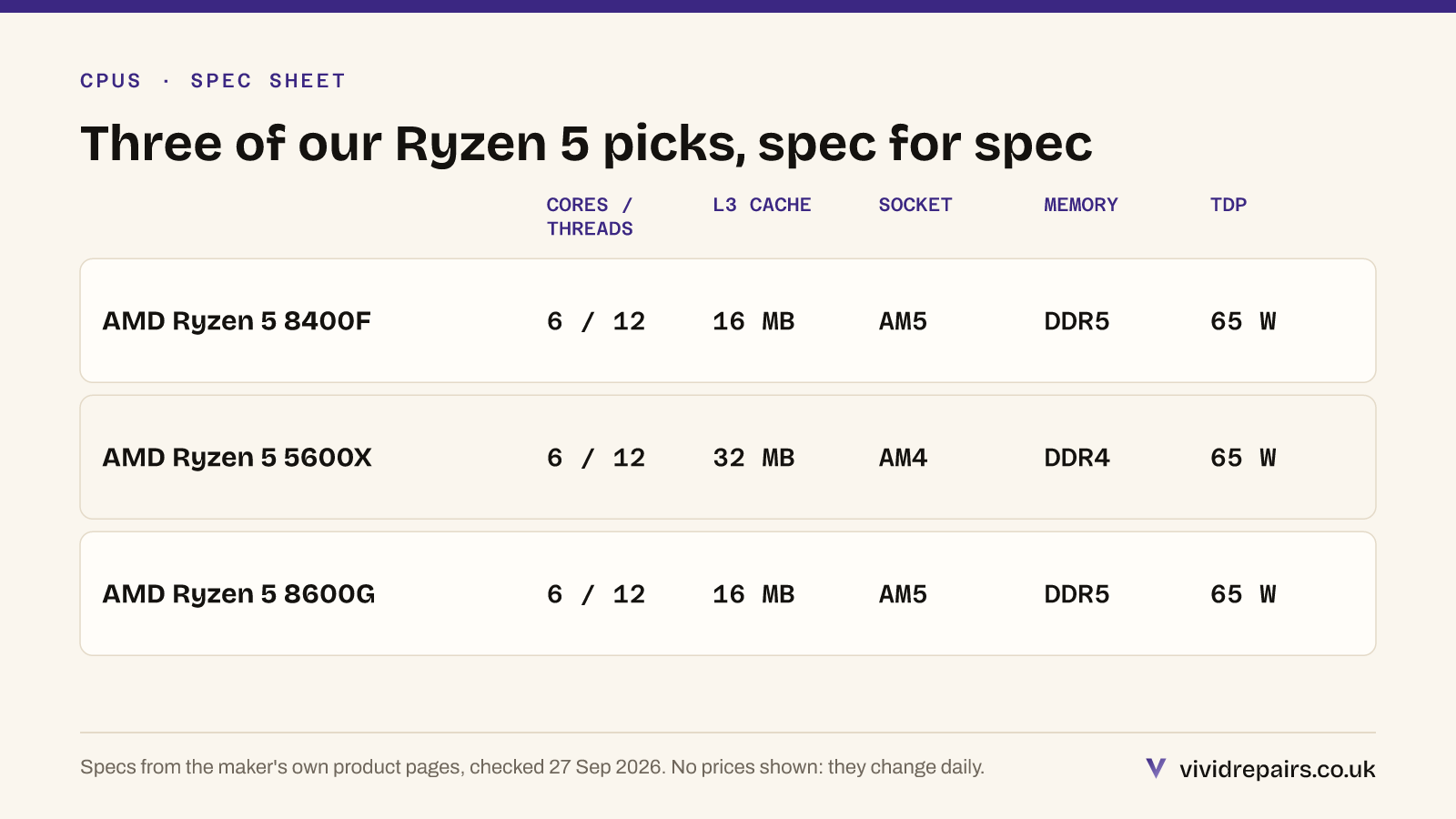
The Ryzen 5 8400F sits at the sweet spot between price and raw performance in the sub-£130 category. This Zen 5 architecture chip drops integrated graphics, which saves cost but requires a dedicated GPU. If you're building a gaming system with a graphics card anyway, this omission is irrelevant and you gain direct savings. The six cores and twelve threads run at reasonable boost clocks, delivering solid frame rates in 1440p gaming when paired with a mid-range GPU like an RTX 4060 Ti. The 22 MB cache and 65W TDP keep temperatures manageable even in budget coolers, leaving room for overclocking if your motherboard allows.
This processor appeals to gamers with tight budgets who already own or plan to buy a discrete graphics card. Zen 5's improved instructions-per-clock efficiency mean the 8400F often matches or exceeds the performance of older 5600X and 7600 chips in gaming benchmarks, despite similar core counts. The AM5 socket connects you to modern motherboard features, faster RAM support, and potential future CPU upgrades. If you're encoding video or running productivity software, the 8400F handles these tasks respectably, though it's not targeted at content creators demanding high thread counts. The lack of iGPU makes troubleshooting and BIOS updates simpler, as you don't have to wrestle with graphics driver settings.
Verdict: Outstanding value for gamers with a GPU budget. Zen 5 architecture at a bargain price.
Pros
- Zen 5 architecture outperforms older Zen 3 chips like the 5600X in gaming per pound
- No iGPU allows lower power draw and simpler troubleshooting
- AM5 socket and 65W TDP suit budget builds with modest cooling
- 22 MB cache sufficient for gaming and light productivity
Cons
- No integrated graphics, mandatory discrete GPU purchase
- Smaller cache than the 9600X limits performance in some CPU-heavy titles
The Ryzen 5 5600X established itself as the benchmark for sub-£150 processors in 2020 and remains a capable option in 2024. This Zen 3 chip still delivers punchy gaming performance, particularly in titles that don't stress all six cores evenly. At this price, it's often the same price or cheaper than the newer 9600X, making direct comparison essential. The 35 MB cache is a standout feature at this price point, helping performance in games like Red Dead Redemption 2 and Unreal Engine 5 titles. However, the lack of integrated graphics means you must pair it with a dedicated GPU, and AM4 socket motherboards are becoming harder to source at competitive prices.
This CPU suits builders who have existing AM4 infrastructure, older X570 or B550 boards lying around, or who can find used deals. Zen 3 still handles everyday tasks, light streaming, and 1080p gaming without complaint. However, thermal efficiency lags behind Zen 5: the 5600X runs warmer under sustained load, particularly in summer environments or compact cases. The generational gap to newer chips is noticeable in CPU-bound scenarios, and software developers are increasingly optimising for Zen 5 instructions. If you're upgrading from an older Ryzen 5 2600 or Intel i5-8400, the jump is meaningful. If you're comparing it to the 9600X or 8400F, the newer chips win on efficiency and per-pound performance. Availability is solid, but expect to pay a premium for new stock compared to OEM channel pricing.
Verdict: Capable but ageing. Choose only if you already have an AM4 board or find a substantial discount.
Pros
- 35 MB cache provides consistent performance across gaming library
- Zen 3 proven maturity, excellent BIOS support after four years
- Abundant AM4 motherboard selection at competitive prices (though availability declining)
Cons
- No integrated graphics requiring GPU investment
- Zen 3 architecture less efficient than Zen 5, higher heat output
- AM4 socket has no meaningful upgrade path beyond Ryzen 7 5700X
The Ryzen 5 8600G brings integrated Radeon graphics to the budget segment without sacrificing newer architecture. At this price, it's marginally more than the 9600X but includes the same Zen 5 backbone with a different GPU configuration. The 8600G integrates seven Radeon cores, matching the 9600X's iGPU capability for office work, streaming, and light gaming at 1080p. The 16 MB cache is smaller than alternatives, which shows in CPU-heavy gaming scenarios, but remains sufficient for 1440p gaming with a dedicated GPU or general productivity.
This chip targets builders who want integrated graphics on AM5 but don't need the maximum L3 cache. The 65W TDP keeps thermals reasonable, and the Zen 5 instruction set ensures competitive performance against previous-generation chips. If you're comparing it to the 9600X, the decision hinges on your use case: the 8600G is marginally cheaper and suitable if you're not planning heavy CPU-heavy gaming, while the 9600X's larger cache justifies its cost for enthusiasts or streamers. The 8600G performs identically to the 9600X in general computing, so gaming-focused builders might save money here. Availability is good, and AM5 boards offer modern features like PCIe 5.0 on high-end models.
Verdict: Solid alternative to the 9600X if you want to save £3-5 and don't game in CPU-intensive titles.
Pros
- Zen 5 efficiency and integrated graphics for office and light gaming
- AM5 platform ensures modern motherboards and future upgrade options
- Slightly lower price than 9600X makes it the budget iGPU option
Cons
- 16 MB cache is noticeably smaller, limiting CPU-heavy gaming performance
- Radeon GPU performs identically to 9600X, so premium for iGPU is same
The Ryzen 5 4500 is the budget floor, for six cores and twelve threads. This Zen 3 chip targets builders with minimal budgets or those upgrading from much older systems. The 11 MB cache and AM4 socket connect it to the established ecosystem, though motherboards are becoming harder to find at retail. At this price, performance is respectable for office work, video playback, and light gaming at 1080p with reduced settings. The 65W TDP ensures thermal simplicity in any budget cooler.
The 4500 is honest budget silicon: capable enough for basic tasks but ageing. Gaming performance in demanding titles like Cyberpunk 2077 or Baldur's Gate 3 requires significant GPU investment to compensate, and the lack of integrated graphics mandates a discrete card. The small cache and older generation mean streaming performance is noticeably worse than newer chips, and video encoding takes considerably longer., you get what you pay for. If you're building an office machine, media server, or retro gaming rig, it's adequate. Modern gaming builds should stretch to the 8400F or 9600X instead. This chip occasionally appears in bundles with AM4 boards, which is the only scenario where buying new makes financial sense.
Verdict: Bottom-tier option. Only buy if absolute budget is your constraint or you're bundled with a motherboard.
Pros
- Lowest price point at under £60 for six-core processor
- Zen 3 architecture sufficient for office work and video playback
- AM4 socket connects to established ecosystem with budget board options
Cons
- No integrated graphics requires GPU purchase for any gaming
- 11 MB cache and older generation significantly slower than Zen 5 alternatives in games
- AM4 socket reaching end-of-life with fewer new boards available
Buying Guide
Budget CPU selection hinges on three core decisions: architecture generation, integrated graphics, and platform socket.
Architecture and Performance: Zen 5 processors (9600X, 8400F, 8600G) offer the strongest single-threaded gaming performance and best multi-threaded efficiency. Zen 4 (7600, 7500X3D) remains competitive but consumes slightly more power. Zen 3 (5600X, 5600GT, 4500) is ageing visibly against newer alternatives, showing performance gaps in CPU-bound titles. For gaming, gaming-focused workloads benefit most from newer architecture. Productivity users gain efficiency improvements but rarely see dramatic speedups. If your budget stretches to £150, always choose Zen 5 over older alternatives.
Integrated Graphics Consideration: Processors with integrated Radeon graphics (9600X, 8600G, 5600GT, 7600) eliminate the need for a discrete GPU, saving £150-400 if you're gaming at 1080p or handling office work. These suit builders with tight GPU budgets or those deferring GPU upgrades. However, integrated graphics cannot handle demanding AAA titles beyond 30-40 frames per second at medium settings. If serious gaming is your priority, discrete GPUs unlock the CPU's potential; integrated graphics are best viewed as a bonus for office work, not your primary gaming solution.
Socket and Platform Longevity: AM5 processors (9600X, 8400F, 8600G, 7600, 7500X3D) connect to modern platforms with PCIe 5.0 support and potential CPU upgrades to Ryzen 7 and 9 equivalents. AM4 processors (5600X, 5600GT, 4500) are reaching platform maturity, with motherboard availability declining and no meaningful upgrade path beyond Ryzen 7 5700X. New builders should prefer AM5, but upgraders with existing AM4 boards can justify older chips if pricing is compelling. Consider motherboard cost: AM5 boards start at £70-90 but offer modern features, whilst AM4 boards are increasingly second-hand or heavily discounted.
Cooling and Power Draw: All processors here operate at 65W TDP, meaning budget air coolers suffice. Zen 5 chips run cooler under load, producing less heat and noise. Zen 3 processors generate more heat, which matters in hot climates or compact cases. If silent operation is important, Zen 5 efficiency wins over Zen 3 despite identical TDP ratings. Workstation cooling matters: silence-focused builders should account for real thermal output, not just TDP specifications.
The AMD Ryzen 5 9600X emerges as the clear winner for most sub-£200 builders. Its combination of latest Zen 5 architecture, integrated graphics, excellent gaming performance, and AM5 longevity justifies its price. Buyers saving every penny should consider the 8400F, which matches gaming performance at a lower cost but requires a GPU. Gamers with £200 to spend on the CPU alone benefit from the 7500X3D's 3D V-Cache gaming advantage, though productivity users lose performance compared to standard Zen 4. Those with existing AM4 infrastructure have the 5600X as a capable option, but new builds should prioritise AM5 to avoid platform dead-ends. The budget floor (4500) suits only minimal-use machines; the performance-per-pound gap to the 8400F is substantial enough to warrant stretching your budget slightly. Across all categories, efficiency, gaming performance, and platform upgrade path converge on the Ryzen 5 9600X as the best overall choice.